%E5%A4%A7%E3%81%8D%E3%81%84.png)
Sourcing & Supply · 2026
Where can cafes buy Japanese matcha directly from farms? Almost no cafe buys from a single farmer directly. The realistic farm-direct route is a farmer-connected exporter who buys at the farm, works with named producers, and handles export paperwork and lab testing for you. A trading company, by contrast, buys from the wholesale market and resells. In the 2026 shortage, that difference now decides who can get matcha at all, not just who pays less.
What this page is for. This page is about the chain: how many hands your matcha passes through, what each one is actually paid to do, and how to check the chain rather than the claim written on the bag. It is not a supplier shortlist and not a price sheet. If you want to vet a specific supplier, compare named US wholesalers, look up this month's wholesale prices, work out volumes and minimum orders, or handle US customs and FDA paperwork, those pages carry the detail. Come back here when you need to decide which kind of seller to buy from at all.
Quick facts
In this guide
Farm-direct rarely means a cafe wiring money to a single tea farmer. It usually means buying from a supplier who has a real, named relationship with the farms that grow the leaf and the mill that turns it into powder, and who handles export, documentation and quality testing on your behalf. The honest test is not the word direct on a website. It is whether the seller can name the farm, the region, the cultivar and the harvest, and show you the paperwork behind it.
Most Japanese tea farms are small family operations. They grow tencha, the shade-grown leaf that is milled into matcha, but few are set up to export, issue an English certificate of analysis, or hold food-safety registration for the US market. So a cafe that wants provenance almost always works through a farmer-connected exporter rather than the farmer alone. That is the version of farm-direct worth caring about: short chain, named origin, verifiable.
We should be straight about our own position here. Japanomars is a farmer-connected exporter, which means we are one of the hands in the chain. We are not claiming to have removed the middle of the market. We are claiming that there is one hop instead of three or four, that we can tell you whose field the leaf came from, and that you can check it. Any supplier who tells you their chain has nobody in it is describing an arrangement that does not exist for a cafe buying 5 or 50 kg from overseas.
There are four realistic routes to buy Japanese matcha wholesale, and they differ in provenance, price and how much work lands on you. Ranked from shortest chain to longest: the farmer, a farmer-connected exporter, a trading company or distributor, and an online marketplace. Only the first two give you a real answer to where did this come from, and the second is the practical choice for most cafes.
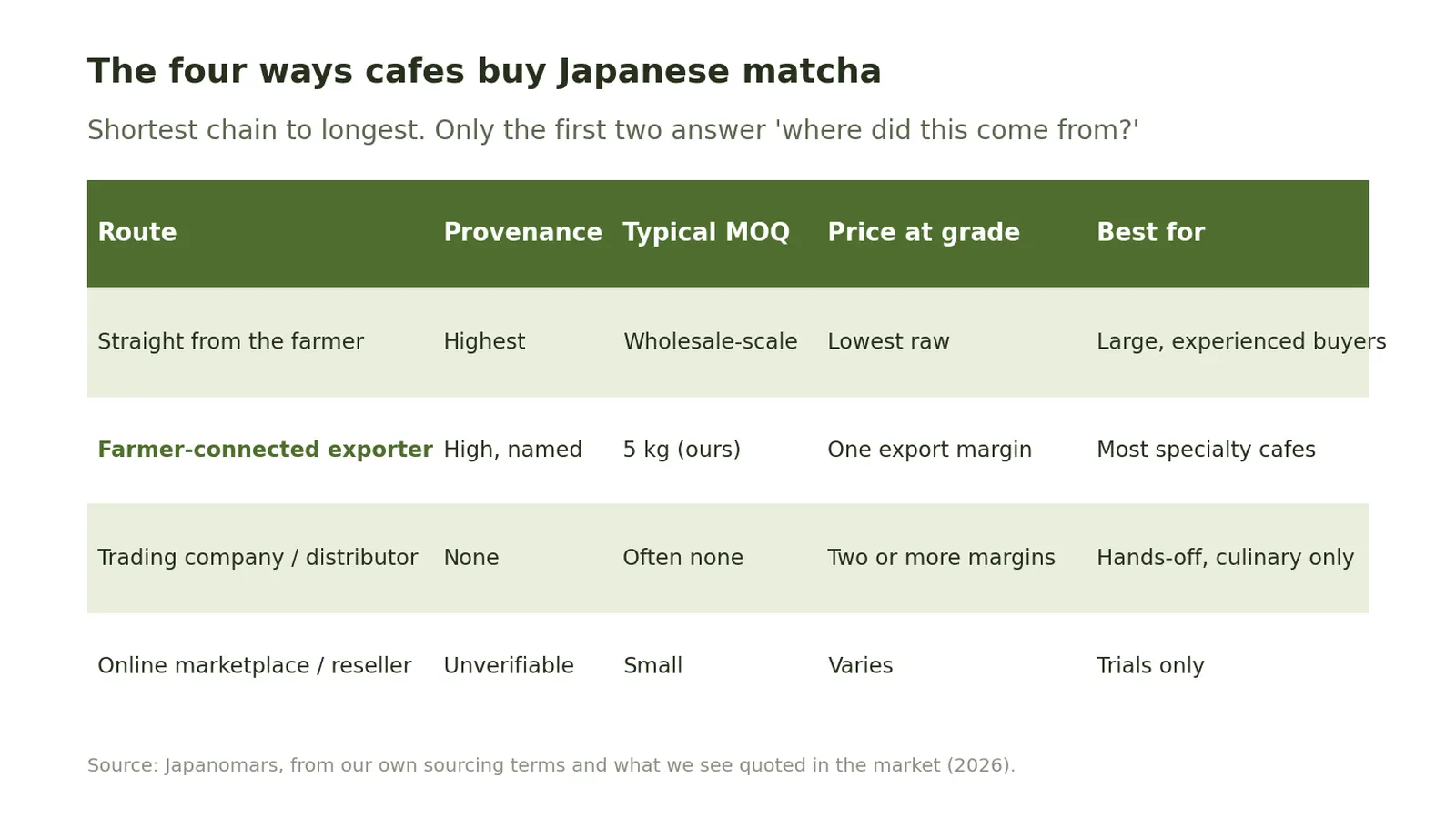
Figure 1: The four ways cafes buy Japanese matcha. Only the farmer and the farmer-connected exporter answer where the tea came from. Source: Japanomars, from our own sourcing terms and what we see quoted in the market, 2026.
The useful question is not "is this farm-direct?" It is "how many hands touched this, and what did each one actually do?" Some hops add something you are genuinely paying for. Others only add an invoice. Sorting them is the whole skill.
Hops that earn their margin do physical or regulatory work: shading and picking the leaf, steaming and drying it into tencha, milling tencha into powder at a specific mill, blending to a target profile, testing a batch to US and EU limits, and clearing export. Hops that do not earn it are the ones that take the bag from one warehouse to another and re-label it. A four-hop chain where every hop processes something can be perfectly good tea. A two-hop chain where the second hop only re-invoices is worse value than it looks.
This also explains why blends and single-origin lots behave differently. A single-origin lot can, in principle, be traced to one field and one mill. A blend passes through a blending step that is itself a hop, and that step is where a lot of the character of the finished powder is decided. Neither is dishonest. But if a supplier sells you a blend while implying single-farm provenance, the chain and the story have come apart.

Farm-direct wins on provenance, on margin count at a given grade, and on supply security. A trading company wins on convenience and hands-off consistency. The right answer depends on whether your cafe sells a story and a specific origin, or simply needs a reliable culinary-grade powder in the cup. Neither is better in the abstract. They serve different buyers.
Choose farm-direct, via a farmer-connected exporter, when provenance is part of your brand, you want single-origin or named-farm matcha, you want the shorter margin stack at a given grade, and you want priority allocation when supply is short. Choose a trading company when you value one invoice and one relationship over origin, you are buying only culinary grade for lattes, and you would rather pay more to avoid any sourcing work. Many cafes end up blending the two: farm-direct for a showcase drink, a distributor for high-volume culinary. Running both is also the cleanest version of keeping a second supplier. To pick origins by flavor and supply, our 2026 guide to Japanese matcha regions breaks down Uji, Kagoshima, Nishio and beyond.
Most pages on this subject sell farm-direct as a strict upgrade. It is not, and the limits are worth knowing before you move your account.
It does not scale the way a distributor does. A single region has a finite tencha crop, and in a tight year it runs out. When we were asked in 2026 to quote a tonne-scale annual volume out of one region, the honest answer was that the region could not fill it. Covering the gap meant pulling leaf from other regions, which pushed the quoted price to a level that ended the conversation. A distributor with a wide book would have said yes and blended it quietly. If your volume is large and your priority is simply having the powder, that difference matters.
It does not make one harvest taste like the last one. A named single-origin lot moves with its harvest. Consistency across years is something a blender manufactures on purpose, and buying closer to the field means buying closer to that variation. If your menu depends on an identical cup every quarter, say so before you sign, because that is a blending brief, not a provenance brief.
It does not shorten the calendar. Matcha is normally milled after the order is placed rather than held as finished powder, which is good for freshness and bad for anyone expecting same-week shipment. Allocation for the year is arranged around the harvest, so the useful conversation about next spring's leaf happens in summer, not in the week you run out.
And it cannot offset the price of the leaf itself. Shortening the chain saves you a margin. It does not save you a harvest.
Two numbers decide which route fits your cafe: the minimum order, and how many margins sit on top of the leaf. The minimum order is the one that usually rules a route out first. A farmer sells at wholesale scale, which is far more matcha than most cafes use in a year. Our own farm-direct entry order is 5 kg, and that is deliberately set at the point where a cafe can test a named lot on its real menu rather than from a 20 g sample.
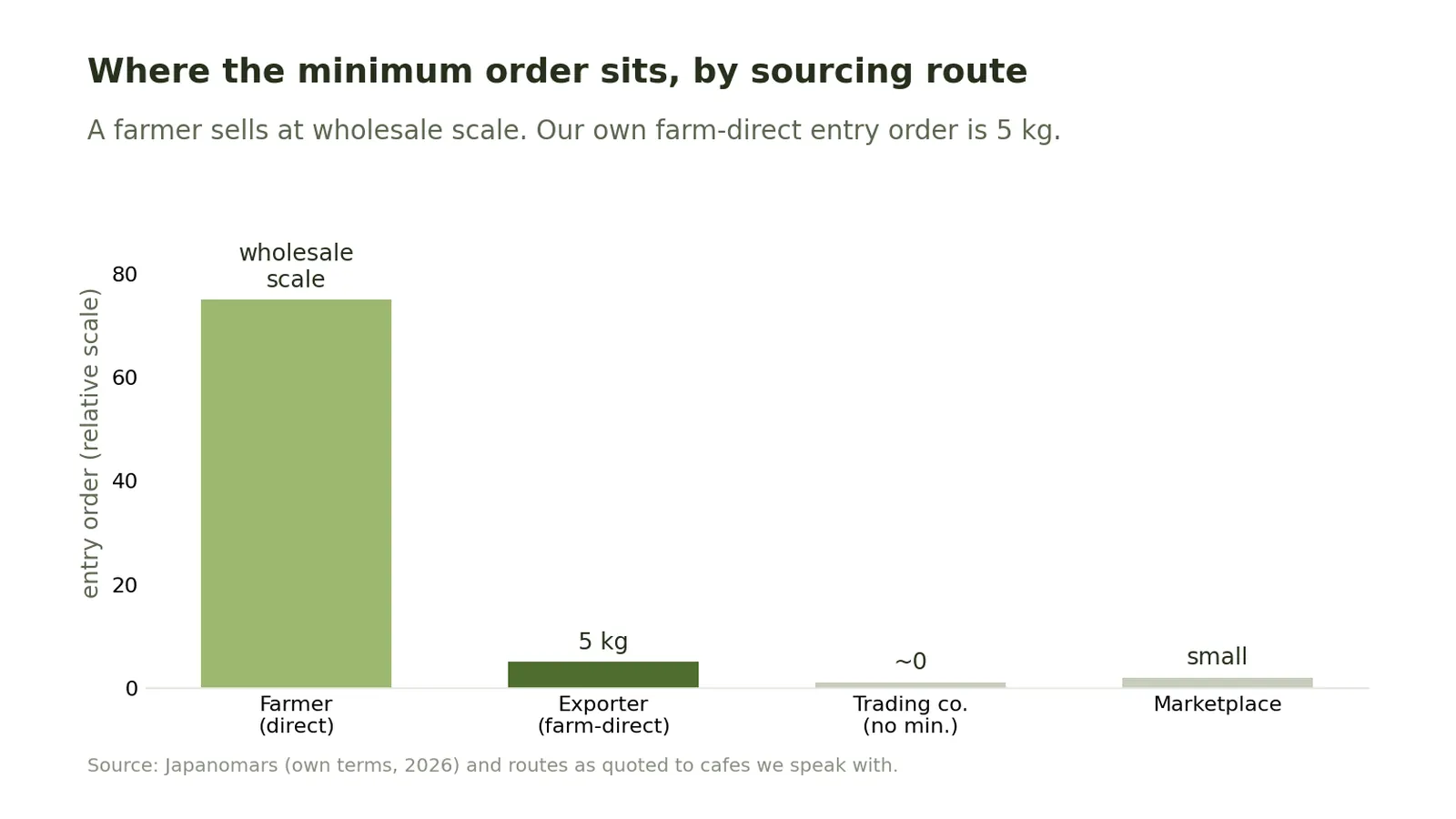
Figure 2: Where the minimum order sits, by route. The farmer bar is an indicative scale, not a quoted figure. Source: Japanomars, own terms, 2026.
On price, be skeptical of any specific percentage a supplier quotes for how much you save by going direct, including one quoted at you by us. The saving is real in direction and unverifiable in size, because the comparison is never like for like: distributor stock at "the same grade" is not a defined thing, and grade names are not standardised. What you can verify is the number of margins in the chain, and that is why this page counts hops rather than percentages. For what matcha actually costs at wholesale this month, use our wholesale price index; for how volume and commitment move a quote, see bulk and wholesale matcha for US cafes.
Whatever route you pick, 2026 is an expensive year to buy at all, and the increase is concentrated in exactly the leaf matcha is made from. At Kagoshima's May 14 prefectural tencha auction the average was ¥19,095/kg, about 1.8 times the prior year, with organic lots topping out at ¥47,100/kg. Uji's tencha auction on May 13 averaged ¥14,127/kg, about 1.7 times. Over the same season Shizuoka's first flush averaged ¥9,019/kg, down about 14%. Volume leaf got cheaper while tencha nearly doubled. Chasing the cheapest powder in this market usually means quietly changing what you are buying. For the full picture on why tencha specifically is climbing, see the 2026 matcha market outlook.
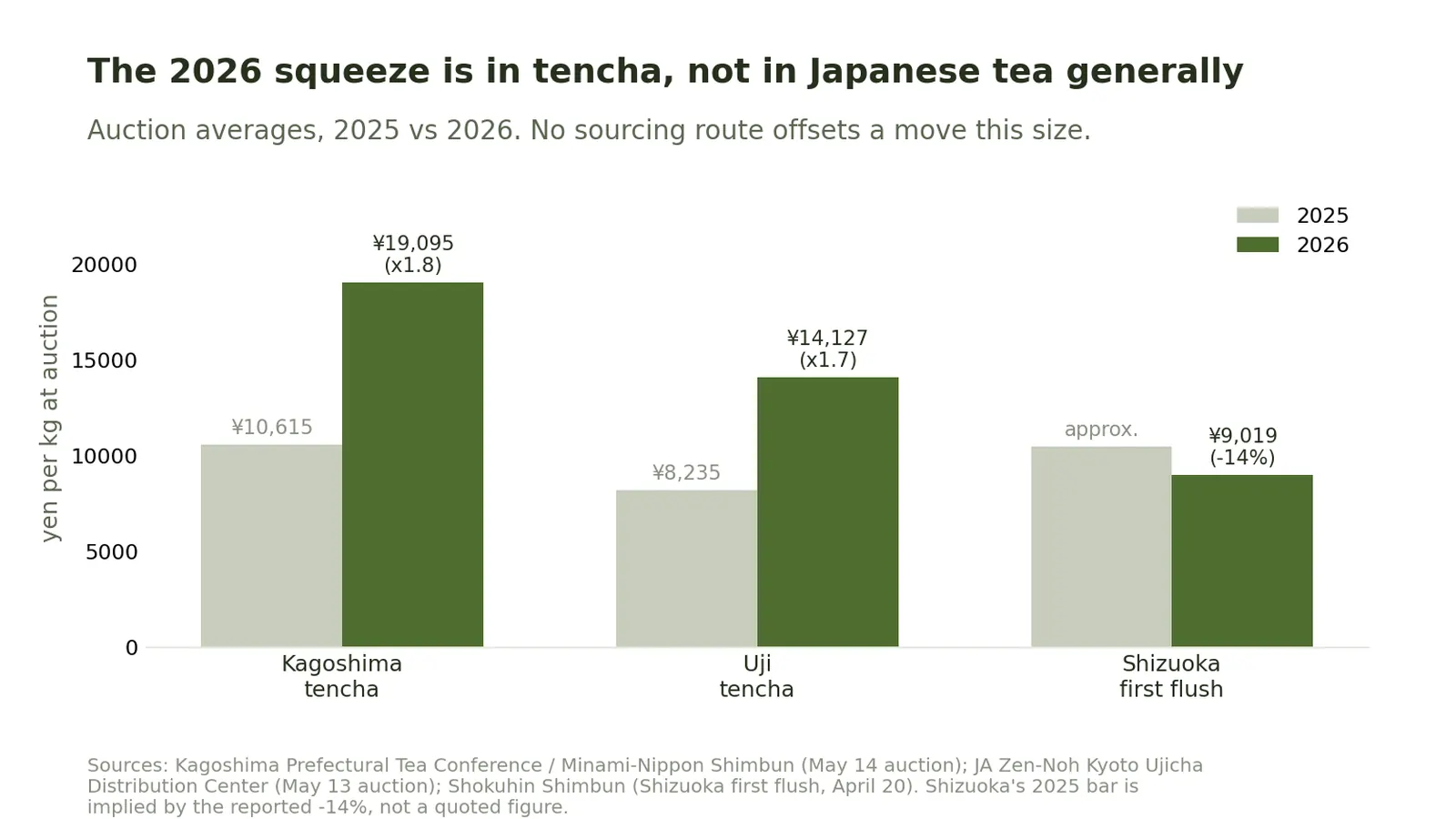
Figure 3: The 2026 squeeze is in tencha, not in Japanese tea generally. Sources: Kagoshima Prefectural Tea Conference and Minami-Nippon Shimbun (May 14 auction); JA Zen-Noh Kyoto Ujicha Distribution Center (May 13 auction); Shokuhin Shimbun (Shizuoka first flush, April 20).

In 2026 the matcha market shifted from you can buy it if you pay to you can buy it only if you have a connection, and that is the strongest argument for a farm-direct relationship. The Norinchukin Research Institute and the Japanese trade press describe a supply squeeze driven by surging overseas demand, an aging grower base and the slow conversion of fields to tencha. When raw leaf is scarce, wholesalers protect their existing customers first, and new or small spot buyers get pushed to the back of the line.
Suppliers who hold direct relationships with farms and mills are the ones who can still secure leaf during a squeeze, because their allocation is arranged around the harvest rather than fought over afterwards. For a cafe, that means a farmer-connected exporter is not just a provenance story. It is supply insurance: a better chance of getting your grade, at a workable price, in a year when the leaf is being rationed. It is also why the sourcing map is moving, with Kagoshima now setting the top of the tencha market rather than Uji. Sourcing on relationships rather than spot availability is the core lesson of sourcing Japanese matcha during the shortage.
Treat farm-direct as a claim to be checked, not a fact. A genuine farm relationship survives specific questions; a marketing label does not. Origin rules help a little: Japan's 2026 Japanese Tea geographical indication covers tea grown in Japan from Japanese leaf and processed in Japan, so a supplier should at least be able to show that their chain is domestic end to end. But the GI is a Japanese registration, it is not automatic for any Japanese tea, and it says nothing about which farm your particular lot came from. The questions below do more work than the label.
From the sourcing floor. Uji matcha is the clearest example of this, and it is worth knowing before you read any region name as a growing location. Under the definition set by the Kyoto Prefectural Tea Association, Uji tea is tea grown in one of four prefectures (Kyoto, Nara, Shiga or Mie) and finished by a Kyoto processor inside Kyoto, with Kyoto-grown leaf given priority. Leaf from the surrounding prefectures travels into Kyoto, is finished there, and is sold as Uji. So a tin marked Uji tells you where the tea was finished, not that it grew in Uji. That is a documented regional standard rather than a trick, and we sell Uji matcha under it ourselves. It does mean "where was this grown?" and "why does this say Uji?" are two different questions with two different answers, and a supplier who cannot separate them does not know their own chain.
If the answers are specific and documented, you are dealing with a real short chain. If they are evasive, you are likely buying repackaged wholesale-market tea with a direct sticker on it.
Sourcing matcha for your cafe this year?
Japanomars works with named Japanese farms across Uji, Sayama, Ibi, Ureshino, Yame, Kirishima and Chiran. Single-origin and blended lots, freshly milled to order, batch certificates of analysis, export handled, 5 kg entry order. Tell us your grade and monthly volume.
Request samples & pricingRarely from a single farmer directly. Most farms are small and cannot export, issue English certificates, or hold US food-safety registration, and they sell at wholesale scale rather than cafe scale. The practical farm-direct route is a farmer-connected exporter who buys at the farm, names the producer, and handles export and testing for you.
Usually it carries fewer margins at the same grade, which is the honest way to put it. Be skeptical of any exact percentage, including ours: grade names are not standardised, so a like-for-like comparison against distributor stock is not really available. Count the hops in the chain instead, and check what each hop did.
With us, 5 kg. That is set where a cafe can test a named lot on its real menu rather than from a 20 g sample, and it scales down per kg as you commit to a regular volume. Buying straight from a farmer means wholesale-scale lots, which is why most cafes go through an exporter instead.
No, and any supplier who says so is overselling. A farmer-connected exporter is itself a hop in the chain, ours included. The difference is that it is one hop with a named farm behind it rather than three or four with a wholesale market behind them. Ask how many hands touched the lot and what each one did.
Because supply is now allocated by relationship, not just price. Japanese trade sources describe a shift from buy it if you pay to buy it only if you have a connection. Suppliers with direct farm relationships arrange allocation around the harvest and protect their accounts, so a farm-direct relationship functions as supply insurance.
Ask them to name the farm, region, cultivar and harvest year, ask who milled the powder and where, and ask for a recent batch certificate of analysis. Genuine farmer-connected exporters answer with specifics and documents. Resellers give vague premium answers and cannot show the chain.
Not necessarily. A region name can describe where the tea was finished or blended rather than where the leaf grew, and shipping documents show where the lot was consolidated, which is a third thing again. Ask specifically: where was it grown, where was it milled, and where was it shipped from.
Not usually out of one region. A single region's tencha crop is finite, and covering a large order means pulling leaf from other regions, which moves the price. A distributor with a wide book will simply say yes and blend it. If volume matters more to you than provenance, that is a real argument for the distributor route.
Not on its own. A named single-origin lot moves with its harvest, and consistency across years is something a blender creates deliberately. If your menu needs an identical cup every quarter, say so up front, because that is a blending brief rather than a provenance brief.
Most cafes past a certain volume end up with two: a farm-direct lot for the drink the menu is built around, and a distributor for high-volume culinary. It also removes the single point of failure in a tight year. We cover the mechanics in our guide to keeping a second matcha supplier.
Written by Hiroshi, founder of Japanomars. We are a Japanese matcha exporter that works directly with tea farms and mills across Japan, including Uji (Kyoto), Sayama, Ibi, Ureshino, Yame, Kirishima and Chiran. We are one hop in the chain, not zero, and everything above about how a chain looks from the inside is written from that position.
Sources
%E7%99%BD_%E5%A4%A7%E3%81%8D%E3%81%84.png)