%E5%A4%A7%E3%81%8D%E3%81%84.png)
Wholesale Sourcing · 2026
Budget wholesale matcha in three line items, not one: the per-kilogram price for your grade and order size, the landed cost on top of it (duty, fees, freight), and the cash you tie up waiting on lead time. At cafe volume in 2026, expect premium latte grade around $55 to $85 per kilogram, a 10 to 50kg minimum order once you're past the sample stage, and two to four weeks standard lead time (eight to ten for first harvest). This guide walks through the full budget, how to negotiate the MOQ down, what payment terms are normal, and a simple quarterly template you can copy.
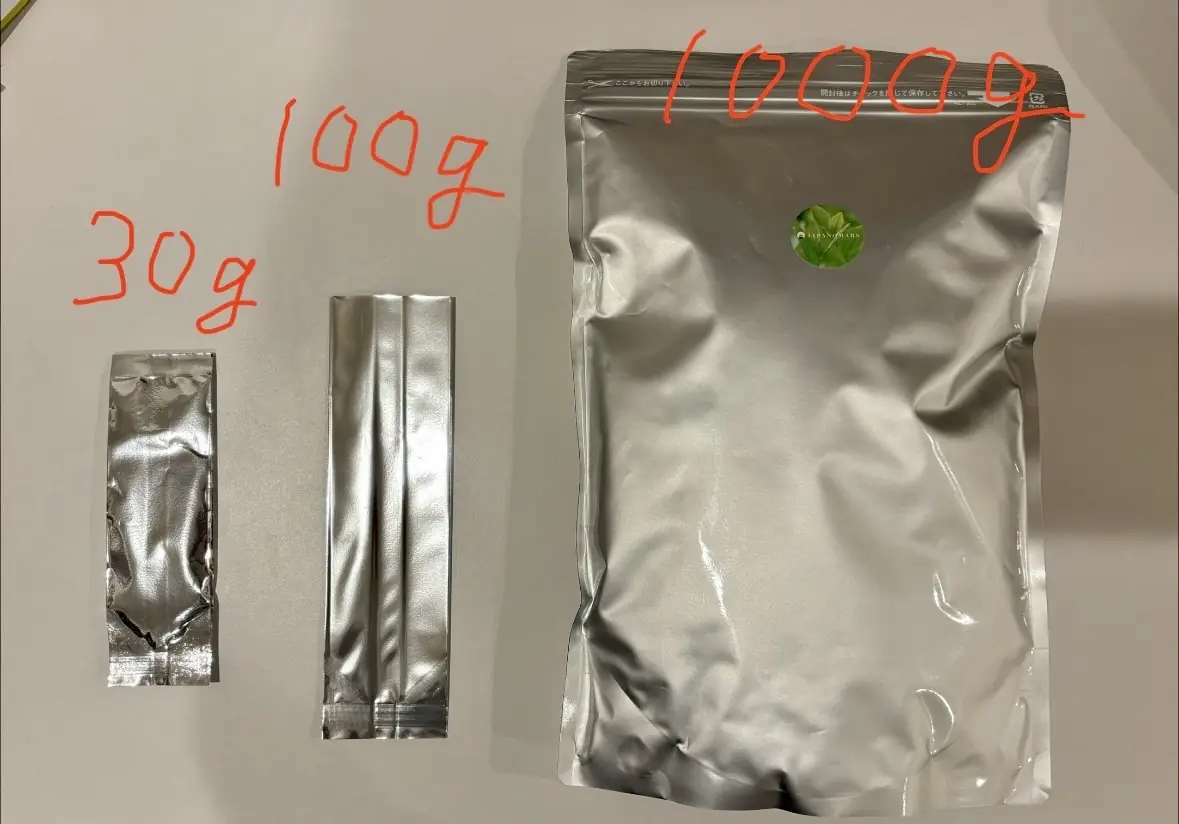
Key takeaways
In this guide
Your matcha line item is really two numbers multiplied together: price per kilogram (set by grade and order size) and kilograms per quarter (set by your drink volume). At a 10 to 50kg working-cafe tier, budget roughly $35 to $50/kg for culinary, $55 to $85/kg for premium latte, and $100 to $200/kg for ceremonial; at 1kg sample size every grade runs meaningfully higher. Get the grade-to-use match right before you touch the price, since that decision moves your budget more than any negotiation will.
| Grade | 1kg sample | 10-50kg (cafe) | 100kg+ (chain) | Cafe use |
|---|---|---|---|---|
| Culinary | $55-80/kg | $35-50/kg | lower by contract | Baking, blended drinks |
| Premium latte | $85-140/kg | $55-85/kg | lower by contract | Latte workhorse |
| Ceremonial | $180-320/kg | $100-200/kg | lower by contract | Small straight-whisked tier |
A 20-drink-a-day cafe running mostly latte grade turns roughly 1kg a month, so a quarterly order lands in the 3 to 5kg range before you scale toward the 10 to 50kg discount tier. For the fuller grade-by-grade cost breakdown and why prices sit where they do, see our wholesale and bulk matcha buyer's guide and matcha grades explained.
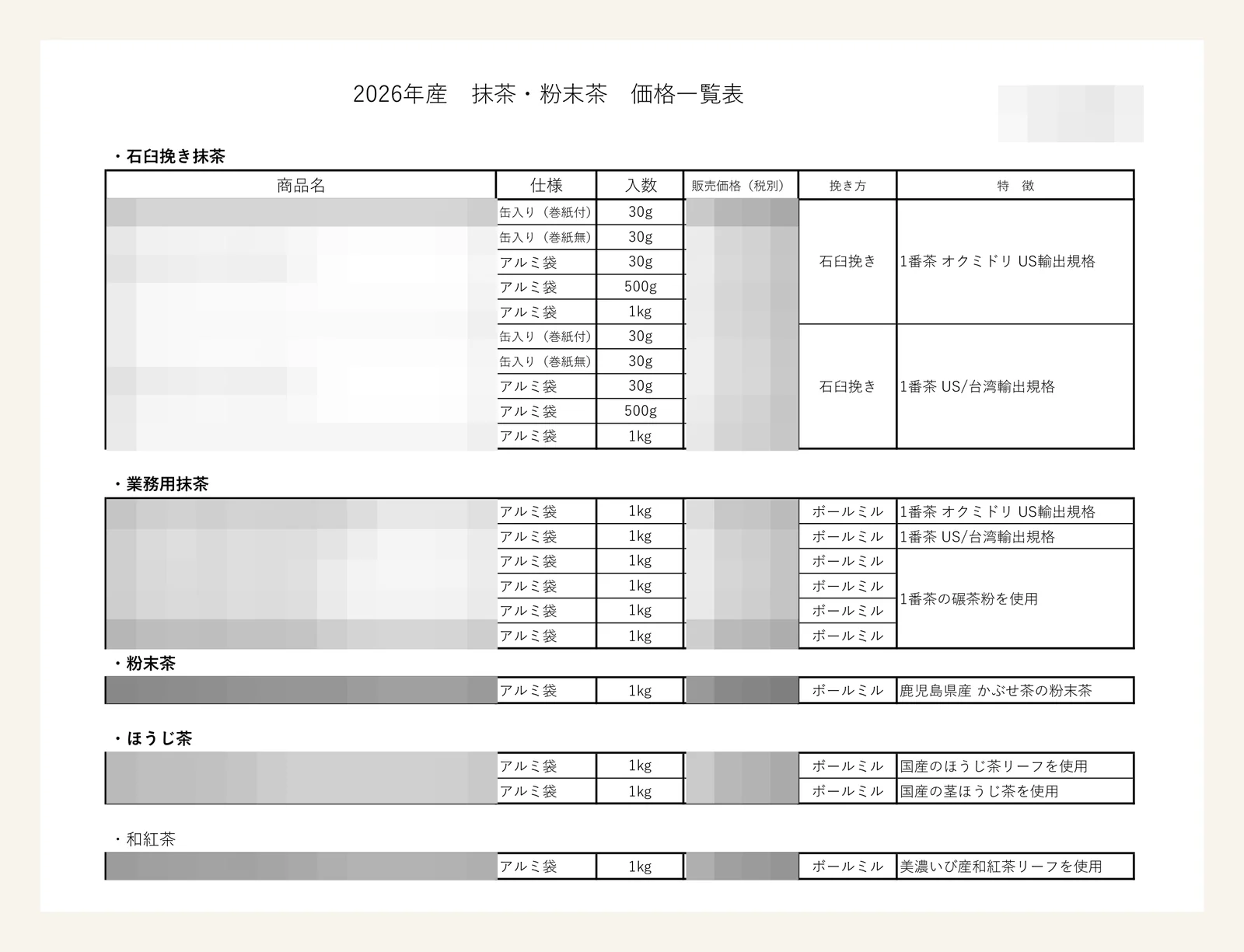
The per-kilogram quote is not what lands on your dock; duty, a customs processing fee, freight, and broker charges sit on top, and on a small first order those extras can matter more than the matcha price itself. Plain, unflavored matcha (HTS heading 0902) has long entered the US duty-free under normal rates. A temporary Section 122 balance-of-payments surcharge added 10% to most imports from February 24 to July 24, 2026, then expired on its own 150-day sunset. The Section 301 forced-labor tariff of 10 to 12.5% that replaced it on July 24, 2026 covers 60 trading partners including Japan, but Customs excluded the green-tea lines by name under heading 9903.05.86, so plain matcha still budgets at zero duty. Blended, sweetened or flavored products can classify outside 0902 and lose that exclusion, so confirm the exact line with your broker.
Beyond any duty, every commercial shipment carries a Merchandise Processing Fee (0.3464% of value, with a $33.58 minimum and $651.50 maximum through September 30, 2026, rising to $34.58 and $670.86 from October 1, 2026), a customs entry filing, and, for ocean freight, additional harbor and security fees. Add courier or freight cost and, if you're not buying Delivered Duty Paid, a broker fee. On a 1 to 5kg first order the fixed fees (broker, minimum MPF, courier) often outweigh the duty question entirely, so ask any supplier for one landed number per kilogram, not a bare price. Our importing matcha into the US guide covers the full customs and FDA mechanics if you're importing directly rather than buying DDP.
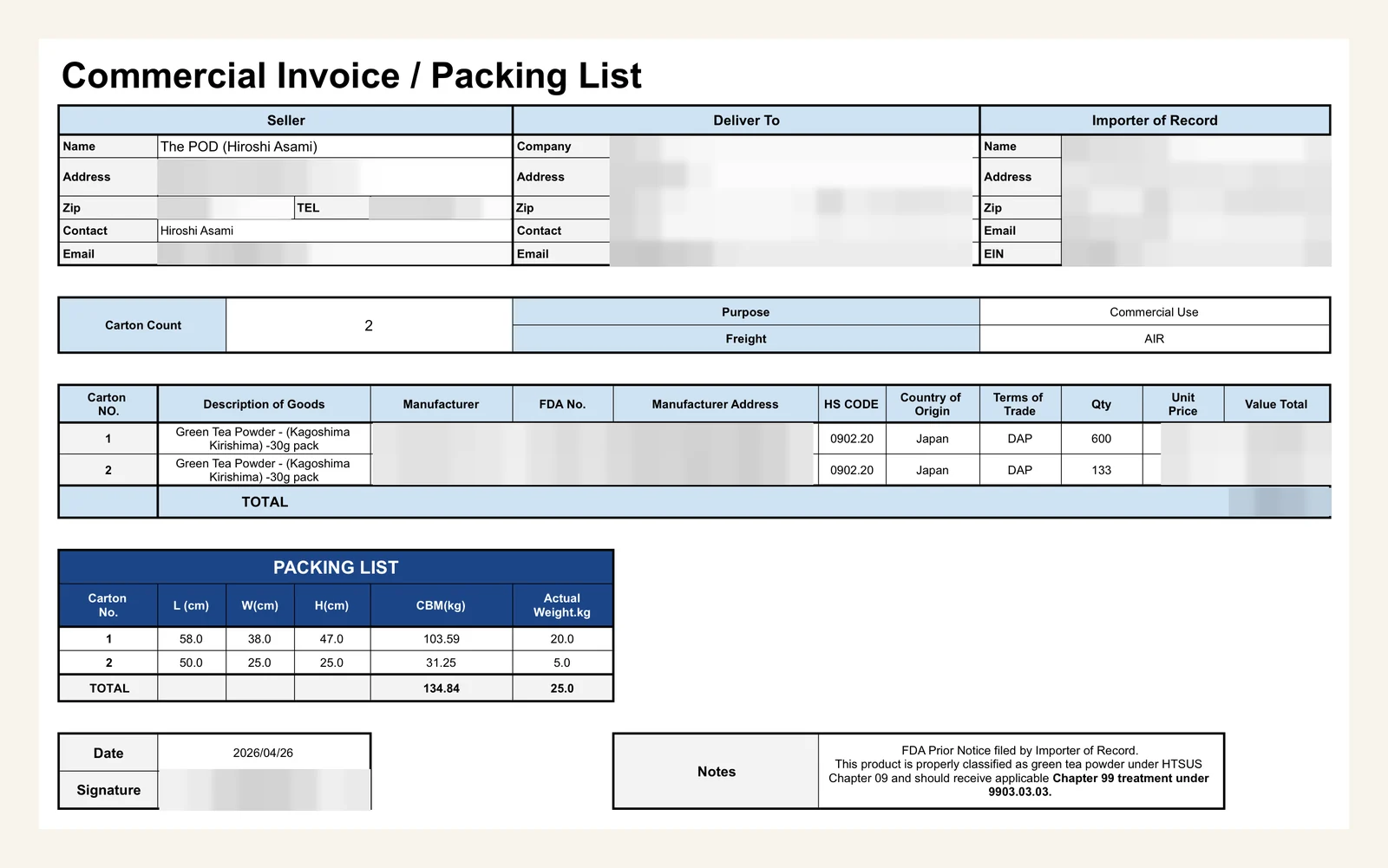
The lever that actually moves a minimum order quantity is commitment structure, not price pressure. A single-location cafe can rarely out-negotiate a supplier's stated MOQ on a one-off order, but signing an annual allocation with staggered quarterly (or monthly) delivery routinely gets the per-shipment minimum reduced, even though the yearly total is unchanged, because it converts you from a spot buyer into a planned allocation the supplier can mill and pack around. Japanese suppliers under 2026's tight allocation consistently prioritize this kind of standing relationship over a larger single order from someone they've never shipped to before.
A few practical options if 10 to 50kg is still more than you can use or store:
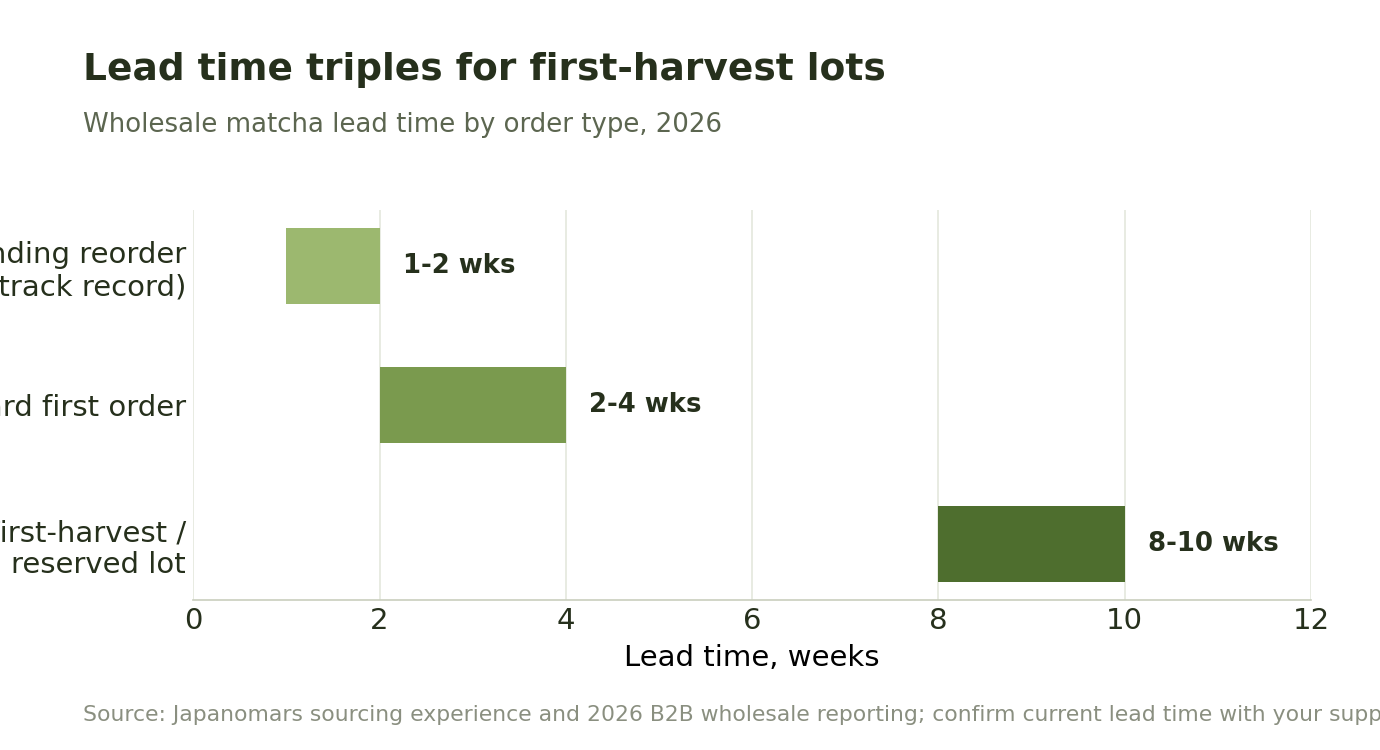
Standard wholesale lead time runs two to four weeks, but first-harvest and reserved lots run eight to ten weeks, and that gap is a real cash and stockout cost, not a scheduling footnote. The longer the lead time, the more buffer stock you're forced to carry against a perishable powder, and 2026 sharpens the tradeoff: Japanese tea retailers including Uogashi Meicha have posted 2026-crop price revisions of roughly 1.3x current levels as tencha supply stays tight, so a buyer who reserves late is both later and paying more.
Budget lead time in two tiers. For your standing latte-grade volume, a reliable supplier should turn a reorder in seven to fourteen business days once you have a track record — treat anything close to the four-week edge as a sign to build more buffer. For any first-harvest or named-lot allocation, reserve months ahead (ideally by spring, before the season's supply is claimed) and price in the 8 to 10 week wait as a cost of getting the best material, not a delay to fight.
Expect to prepay your first wholesale matcha order by wire transfer; net terms are something you earn after a track record, not something you request on order one. This isn't unique to matcha, but it matters more here because prepayment is also the strongest lever for securing an allocation during a shortage — a supplier holding limited stock will protect a paid reservation before an unpaid one, and reserved volume without a deposit can get reallocated to a later, higher bidder mid-season.
Practically: budget full or partial prepayment on your first one to two orders, ask explicitly whether a deposit locks a specific lot versus a general allocation, and raise net-15 or net-30 terms once you've placed two or three consistent orders. Consistent, modest reorders build the same trust as one large order, and they're what most suppliers actually prioritize when allocation gets tight.
Build the budget quarterly, not annually, because grade price, your own volume, and crop-year pricing all move faster than a once-a-year number can track. Start from your actual drink count, translate it to kilograms, price it at your real order-size tier, then add a landed-cost buffer and a reorder trigger date.
| Step | What to fill in | Example (20 lattes/day cafe) |
|---|---|---|
| 1. Monthly kg use | Drinks/day × dose (g) × 30 ÷ 1000 | ~1.2kg/month |
| 2. Quarterly order size | Monthly kg × 3, rounded to your tier | ~4kg (sample-to-cafe tier) |
| 3. Price tier | From the grade table above | Latte, ~$85-140/kg at this size |
| 4. Landed buffer | Add 5-15% for duty/MPF/freight/broker | +10% planning buffer |
| 5. Reorder trigger | Order date = need date minus lead time minus buffer | Order 5-6 weeks before you'd run out |
Re-run this each quarter: as your order size crosses into the 10 to 50kg tier the per-kilogram price drops meaningfully, and as 2026-crop pricing settles you'll want to re-check the grade table rather than assume last quarter's number still holds. For the full grade-selection and cost logic behind step 3, see our matcha for cafes guide.

At a 10 to 50kg working-cafe order size, budget roughly $35 to $50/kg for culinary, $55 to $85/kg for premium latte grade, and $100 to $200/kg for ceremonial. Add 5 to 15% for landed costs (duty, fees, freight) and get a live quote for your exact grade and lot.
A Merchandise Processing Fee of 0.3464% of value ($33.58 to $651.50 through September 30, 2026, and $34.58 to $670.86 from October 1, 2026), any applicable duty, freight or courier cost, and a broker fee if you're not buying Delivered Duty Paid. On a small first order these fixed fees often matter more than the duty question itself.
Yes, mainly through commitment structure rather than price haggling. An annual allocation with staggered quarterly or monthly delivery routinely gets a supplier to reduce the per-shipment minimum, even though the yearly total stays the same, because it turns a one-off buyer into a planned account.
Usually, yes. Expect wire transfer prepayment on your first one to two orders since you have no track record yet, with net-15 or net-30 terms available after a few consistent reorders. Prepayment also protects your allocation during a shortage, since unpaid reservations can be reassigned.
Months ahead, ideally by spring. First-harvest and reserved lots run eight to ten weeks of lead time versus two to four weeks for standard stock, and the best material is claimed early during a shortage. Reserving late means both a longer wait and, in 2026, a higher price as new-crop rates reset upward.
If you're building next quarter's matcha budget, the fastest way to get a real number is a landed quote on your exact grade, order size, and delivery cadence, not a market range. We work with cafes on standing quarterly allocations, not one-off orders, and can walk you through current pricing, MOQ, and lead time before you commit.
Request samples & pricingHiroshi Asami is the founder of Japanomars, which sources premium matcha directly from farms across Japan (Sayama, Ibi, Ureshino, Yame, Kirishima, and Chiran) and supplies specialty cafes abroad. This guide draws on first-hand wholesale order handling plus current market data.
Sources: 2026 B2B wholesale pricing and MOQ tiers as quoted in the market by Japanese matcha suppliers, alongside our own terms; Uogashi Meicha (魚河岸銘茶) and other Japanese tea retailers' 2026-crop price revision notices; US Customs and Border Protection Merchandise Processing Fee schedule; CBP CSMS #67844987 on the Section 122 surcharge (Feb 24-Jul 24, 2026) and CSMS #69326983 on the Section 301 forced-labor tariff that replaced it from July 24, 2026; USTR fact sheet, July 2026. Grade prices and fee thresholds are indicative; get a live landed quote before ordering.
%E7%99%BD_%E5%A4%A7%E3%81%8D%E3%81%84.png)