%E5%A4%A7%E3%81%8D%E3%81%84.png)
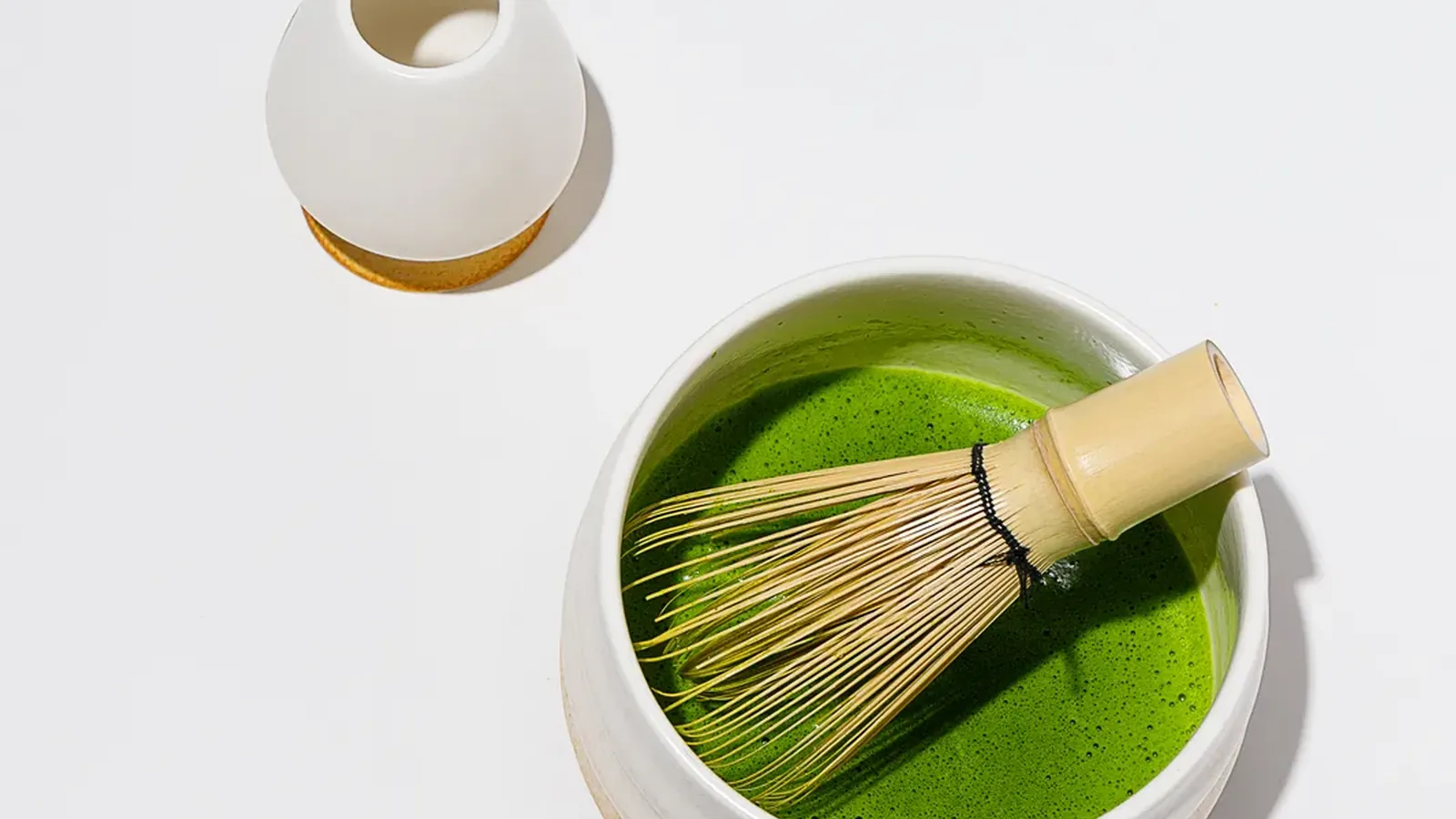
There is no legal definition of "ceremonial" or "culinary" matcha, so the grade on a bag tells you less than three things that are not usually printed on it: what leaf it is made from (tencha), which harvest it came from (first flush commands a large premium), and how far down the supply chain you bought it. Get those three right and you can judge quality and price for yourself instead of trusting a marketing word.
I'm Hiroshi Asami, and I source and export matcha directly from farmers across Japan through Japanomars. This is a buyer's guide to what actually drives matcha quality and cost, written from the supply side.
Key takeaways
Almost nothing official. Japan has no legal or industry-wide standard defining "ceremonial grade" or "culinary grade" matcha, so two suppliers can use the same words for very different products. The terms are useful shorthand for intended use (matcha you whisk and drink neat versus matcha built for lattes and baking), but they are not a guarantee of quality, and you should never source on the grade word alone.
What the word is trying to describe is real, though. Higher-quality matcha generally comes from younger, shade-grown leaf picked at the first harvest, processed carefully, and stone-milled slowly to a fine, bright-green powder; lower grades use coarser or later leaf and show it in color, texture, and a more astringent cup. The problem is that none of that is verified by the label. So the useful move is to ignore the adjective and ask about the three things that do determine quality and price: the leaf type, the harvest, and the route the tea took to reach you.
It starts as the same plant as every other Japanese tea, then two steps set it apart: weeks of shade before harvest, and stone-milling the finished leaf into powder. Matcha is an unfermented (green) tea, steamed right after picking to lock in its color, then, unlike sencha, dried without rolling to become tencha, which is finally stone-milled into matcha. Learning these steps is the fastest way to tell real matcha from cheaper powdered green tea.
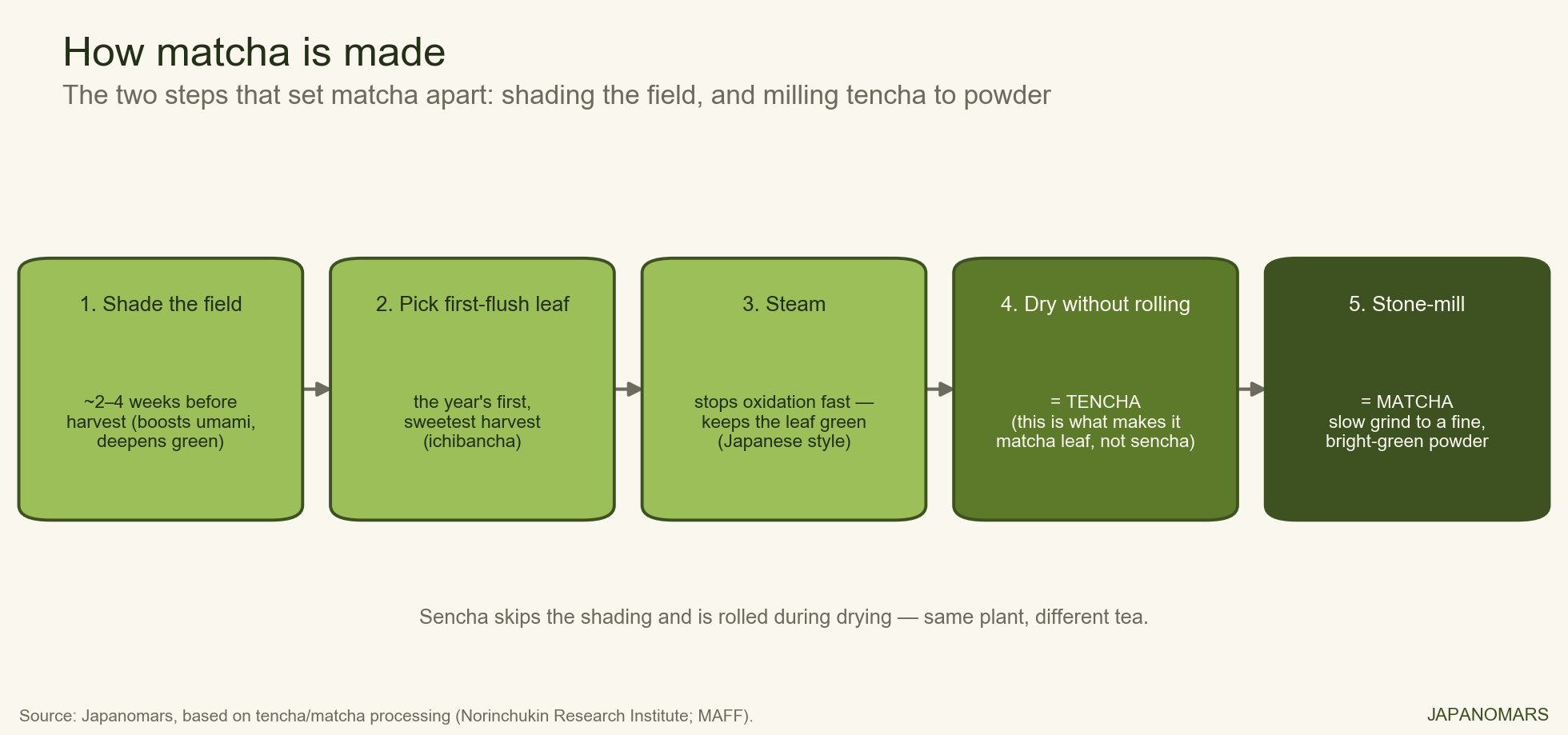
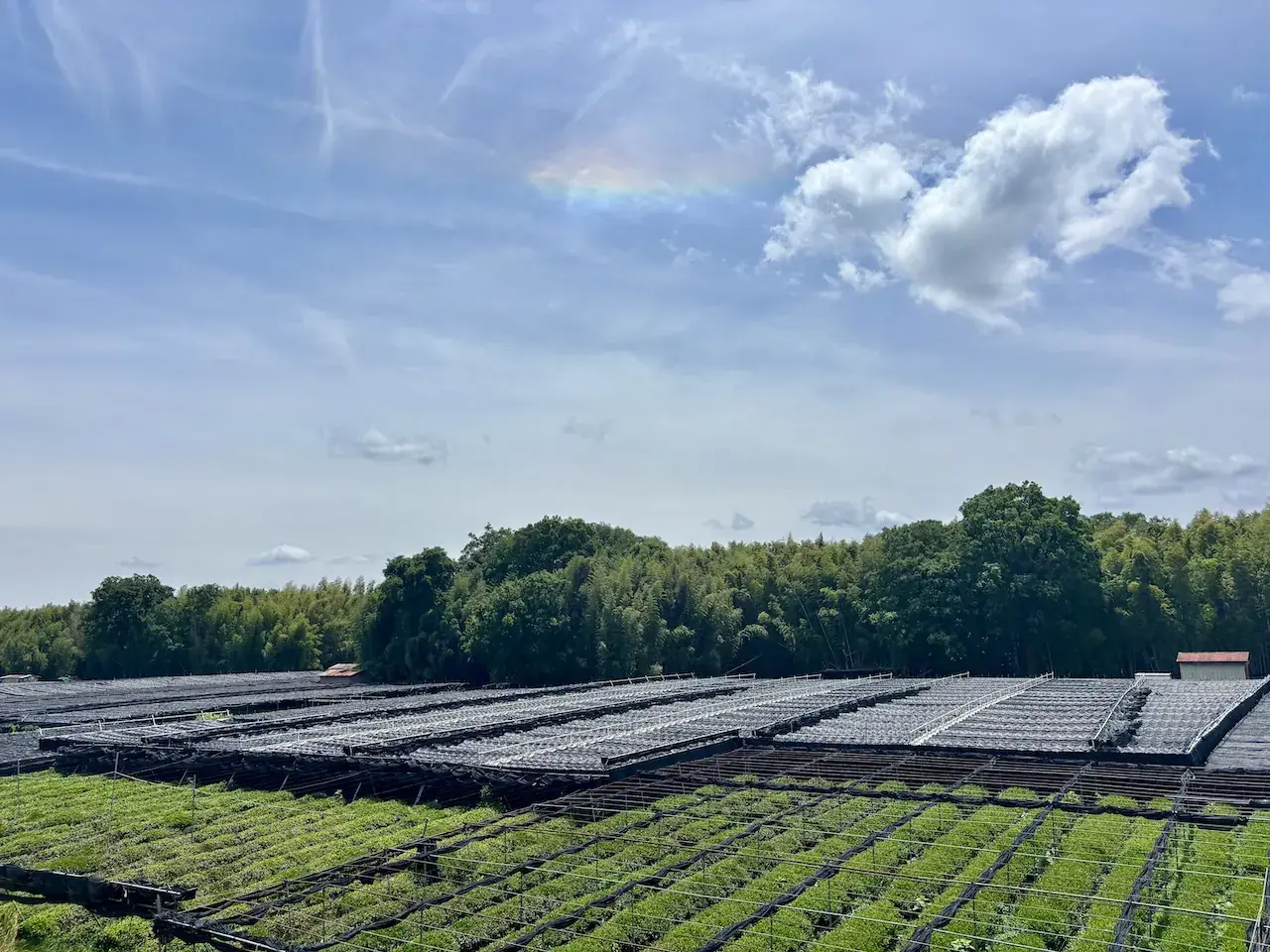
Two of those steps do the heavy lifting. Shading the field for roughly two to four weeks before harvest starves the leaf of sunlight, which raises its amino acids (sweetness and umami), holds back bitterness, and deepens the green; it also cuts yield and adds labor, which is why shaded teas cost more. Steaming immediately after picking is the Japanese kill-green step that stops oxidation and keeps the tea green (China pan-fires instead). The fork from sencha comes at drying: sencha is rolled, while tencha is dried flat and unrolled, then later stone-milled slowly into the fine, bright-green powder you whisk. Take away the shading and the milling and you do not have matcha; you have a different tea.
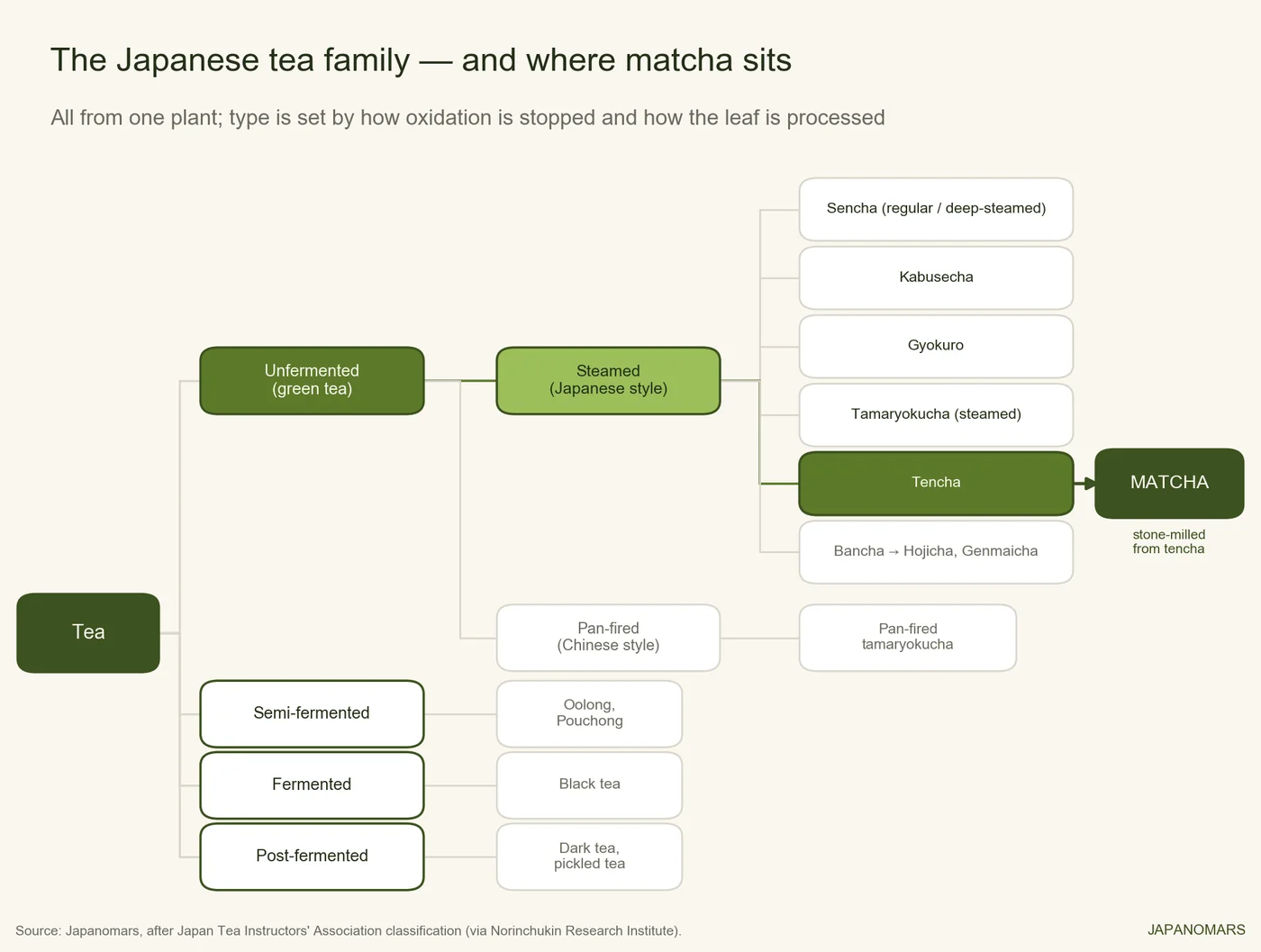
So the single most useful sourcing question is not "what grade is it?" It is "is it stone-milled tencha?" That one answer separates real matcha from green-tea powder before you ever discuss grade.
Because the way it is made is costly, and it is grown in only a handful of regions. Matcha's raw leaf, tencha, made up only about 7.3% of Japan's crude-tea production and averaged 3,278 yen/kg in 2024, against roughly 1,197 yen/kg for everyday sencha (Japan Tea Central Council). Shading cuts yield and adds labor, and tencha is finished on a dedicated line, so the price gap is the cost of production, not just a markup.
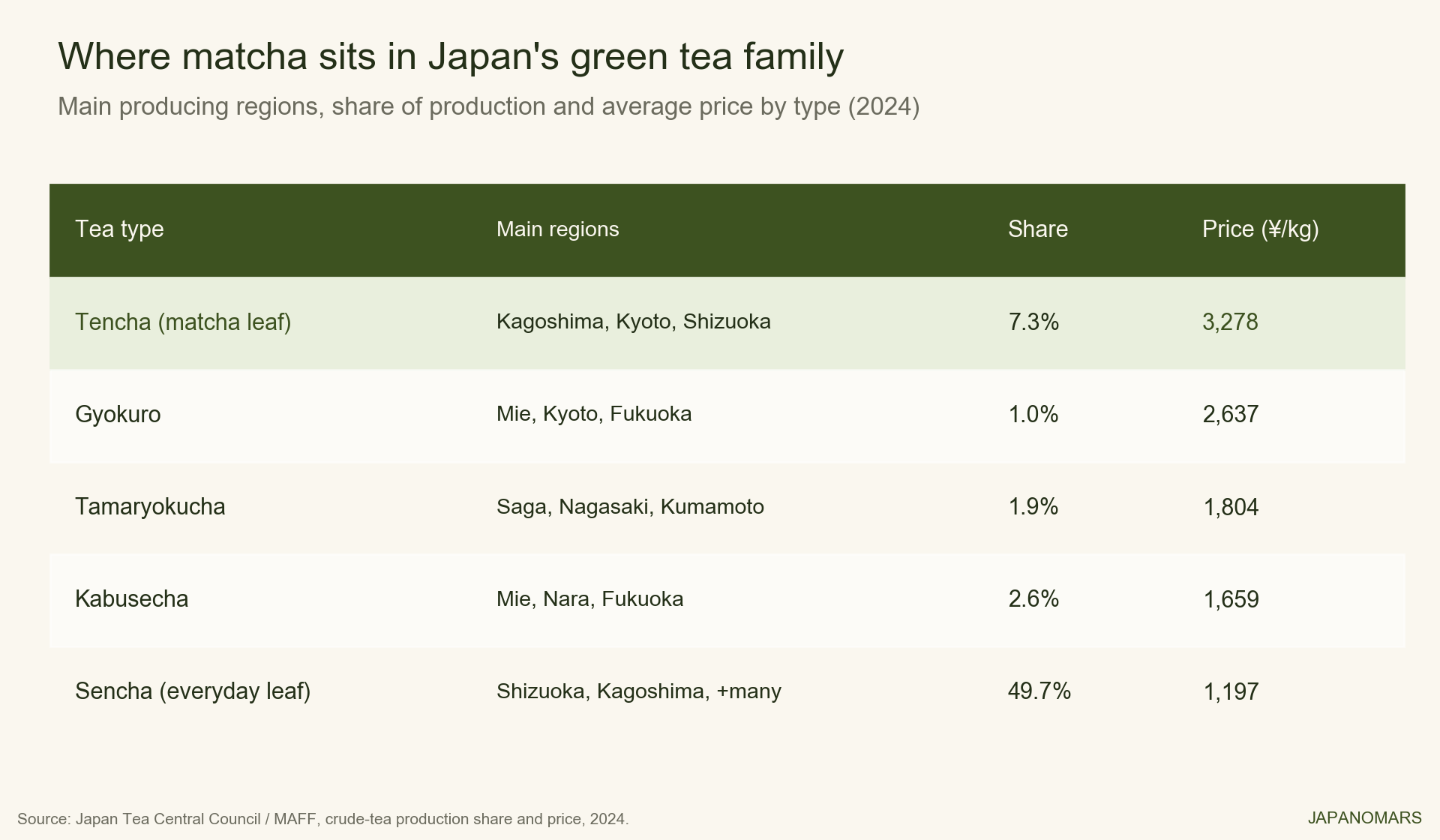
Origin matters as much as type. Tencha is concentrated in a few places, with Kagoshima, Kyoto (including Uji), and Shizuoka leading, while gyokuro, the other heavily shaded tea, leans on Mie, Kyoto, and Fukuoka (Yame). The shaded teas cluster at the top of the price ladder for the same reason: shading is expensive. For a cafe buyer, matcha is not "expensive green tea"; it is a structurally costlier category, from specific regions, before anyone adds a margin. For a region-by-region breakdown, see our matcha regions sourcing guide, and for why supply is shrinking, our 2026 market outlook.
Because the first leaves of the year are the best, and there is only one shot at them. Japanese tea is harvested in waves, and quality and price fall with each later round. Across 2020 to 2024, first-flush crude tea averaged about 1,808 yen/kg, the second flush about 734 yen/kg, the third about 422 yen/kg, and the autumn crop about 335 yen/kg (Japan Tea Central Council). The first picking is worth roughly 2.5x the second and over 5x the last.
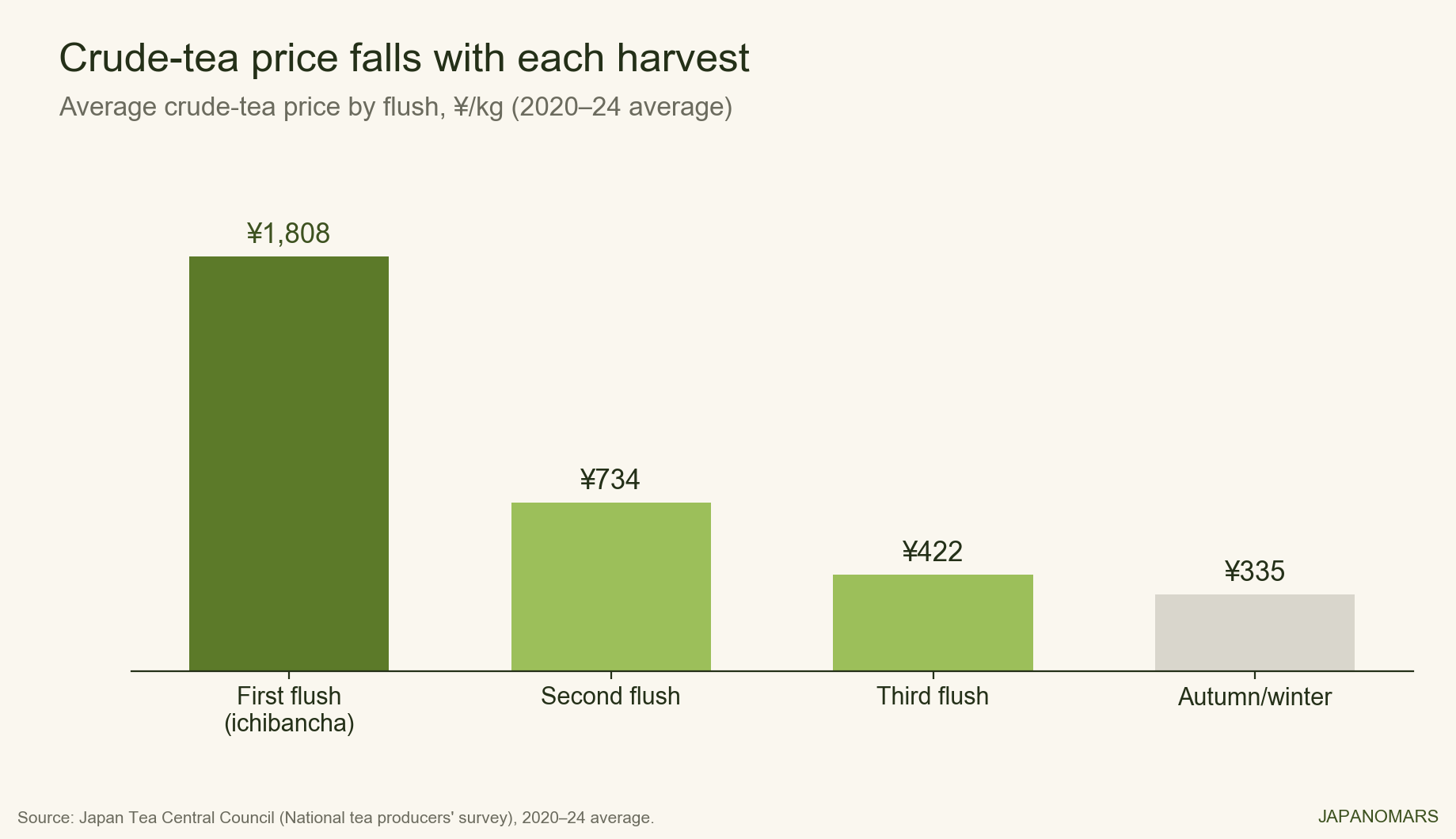
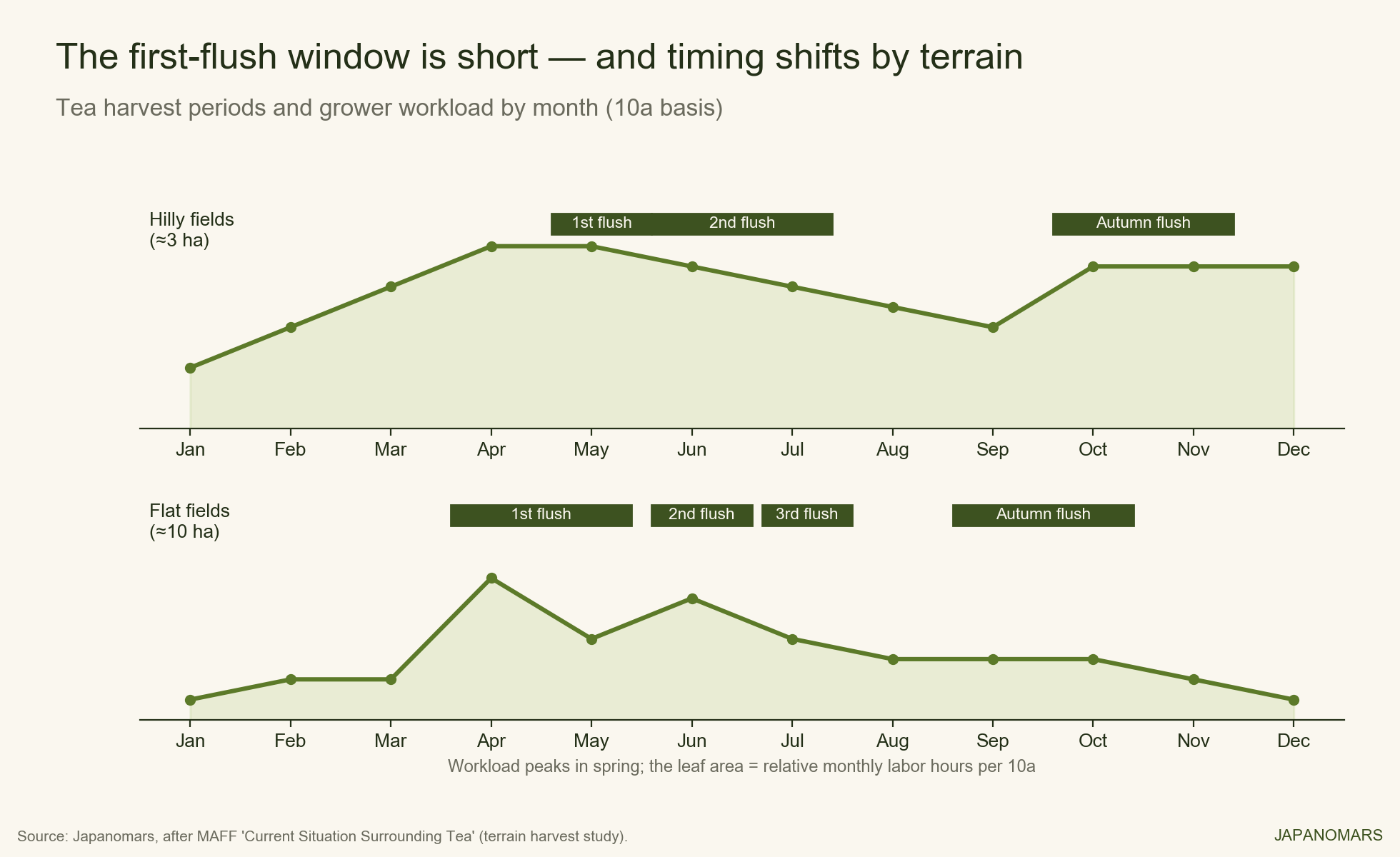
The reason is in the plant. Over winter the bush concentrates amino acids in the new buds; the first flush captures that, while later flushes, grown in summer heat, turn more bitter. First-flush leaf also demands the most labor, concentrated into a few intense weeks, especially on the steep, small fields that grow some of the best tea. Premium matcha is therefore almost always first-flush tencha, and "first harvest" or "ichibancha" on a spec sheet is a more meaningful quality signal than "ceremonial." Miss the first flush and you cannot make it up until the next spring.
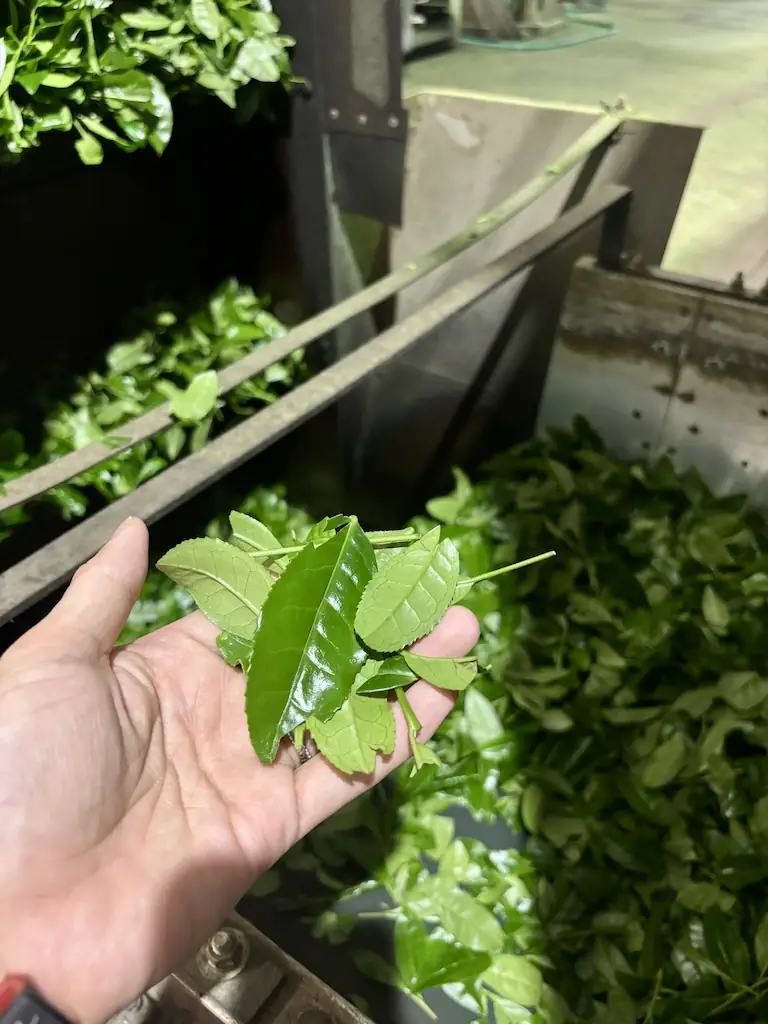
From the sourcing floor
This seasonality is why the market moves violently when a harvest is short. In 2026, the first-flush picture tightened dramatically: at the Kagoshima Prefectural Tea Market the first-flush average more than doubled year on year to its highest level since 1975, and first-flush tencha there averaged around 13,910 yen/kg (about $90/kg), roughly 2.3x the prior year. Because there is only one first flush a year, a hot spring or a demand spike cannot be made up later in the season.
It passes through several hands, and each one adds cost, time, and a chance for blending. In the standard Japanese chain, a farmer grows the fresh leaf, a crude-tea factory steams and dries it into aracha, that aracha is traded through a tea market or broker, a finishing processor refines and (for matcha) stone-mills it, and only then does it reach a wholesaler, exporter, and finally your cafe. Every hop is a margin and a handoff.
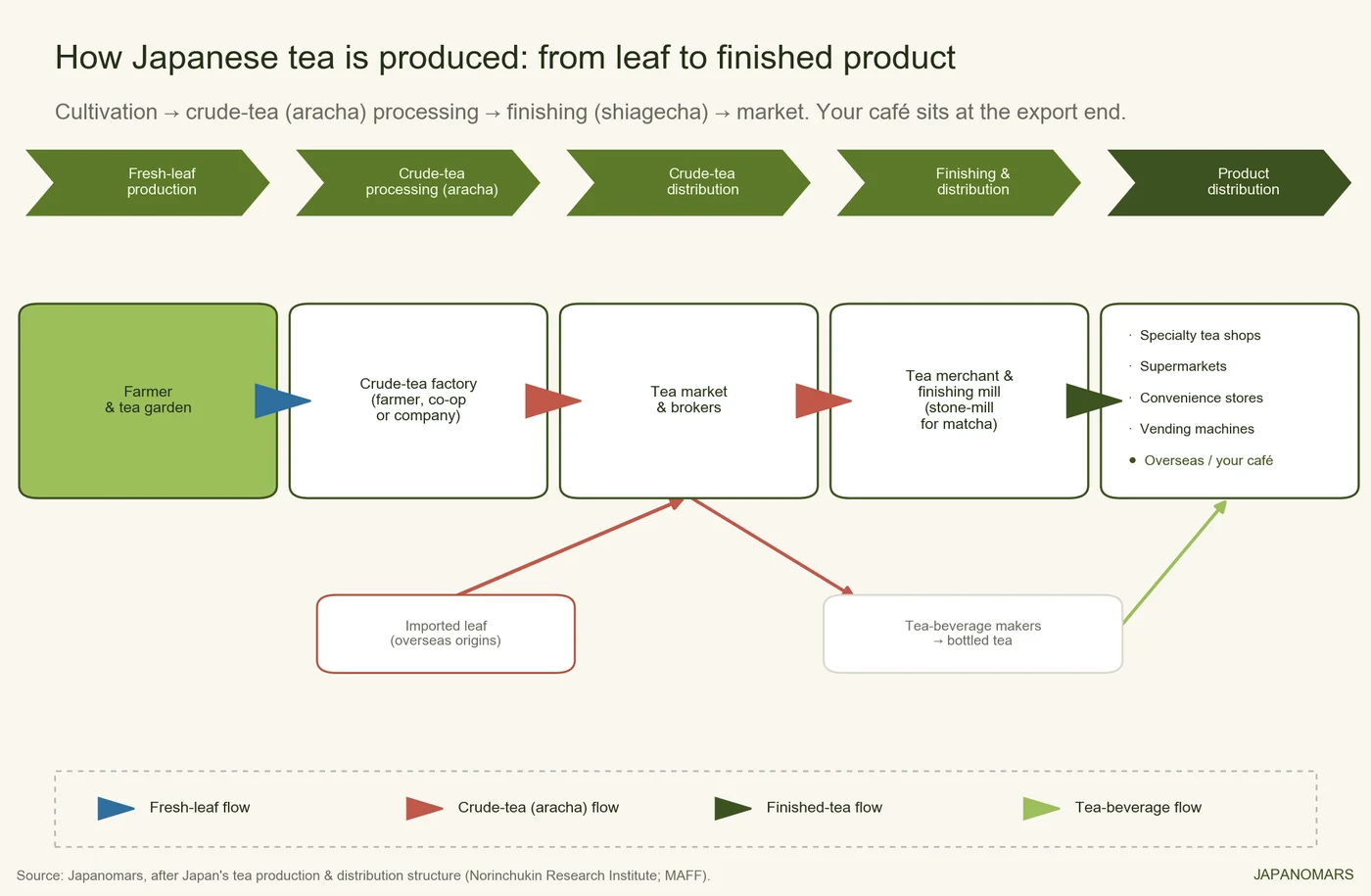
Two things matter for a buyer. First, the longer the chain, the more your price is made of intermediary margins rather than leaf quality, and the harder it is to know the actual region, harvest, and grower behind the powder. Second, the longer the chain, the more room for blending: aracha from different farms, regions, and even harvests is routinely combined at the finishing stage, which is fine for consistency but means "single-origin, first-flush" claims are easy to make and hard to verify once tea has passed through several anonymous hands. This is exactly why direct, origin-close sourcing matters more in a tight market, not less: you get the region, harvest, and grade in writing, and you are not paying three middlemen for the privilege.
Because demand is booming against a tiny, loosely-labeled supply, the perfect conditions for mislabeling. Japan accounts for only about 2.2% of world green-tea exports, while China makes up roughly 82% (UN Comtrade, 2024). Authentic Japanese matcha is a thin stream within a thin stream, and demand for it is rising far faster than the leaf can.
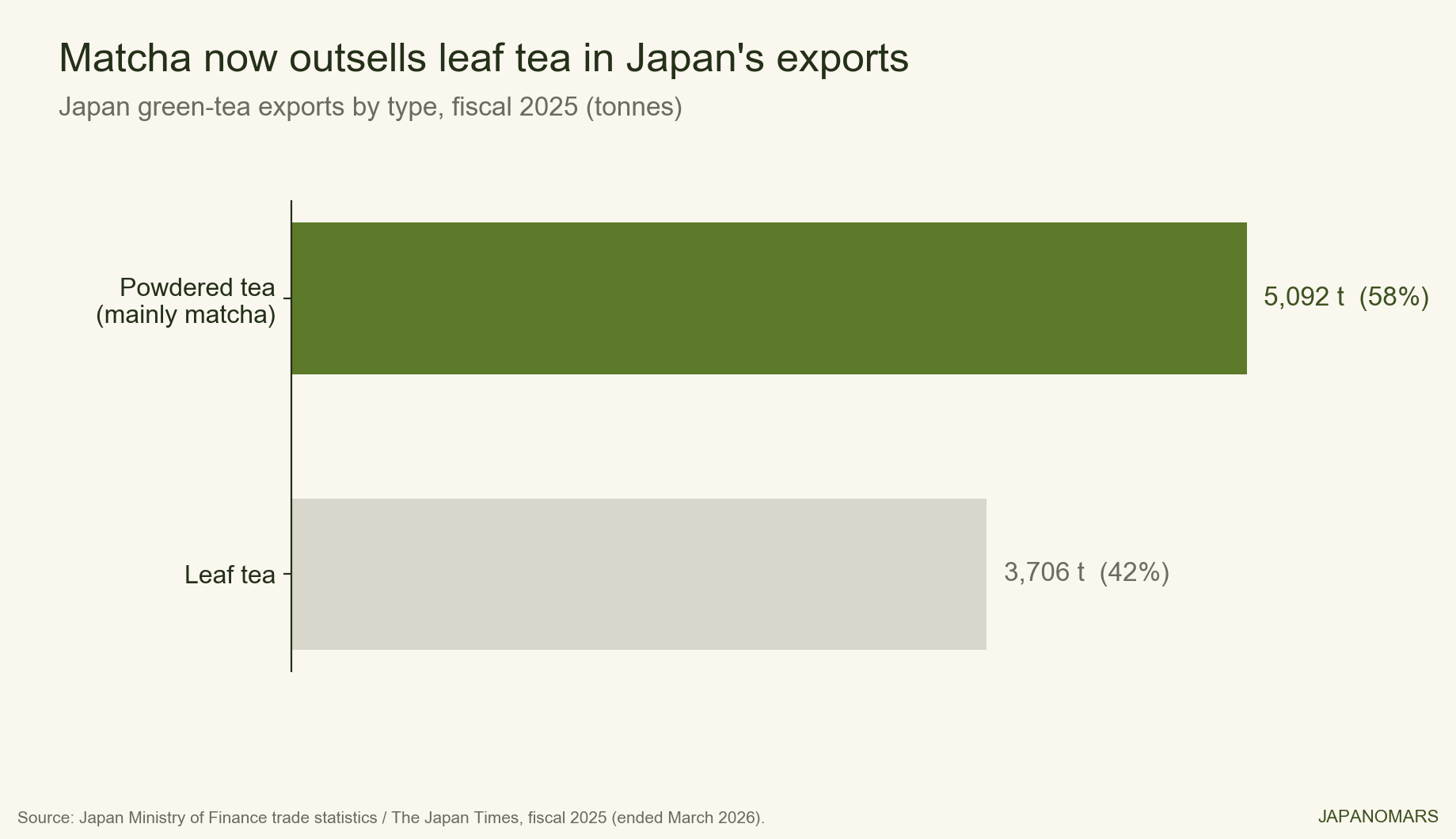
The export numbers are extraordinary. Japan's green-tea exports in fiscal 2025 (ended March 2026) jumped about 42% to 13,125 tonnes, and export value more than doubled to about 84.7 billion yen on soaring prices (Japan Times / Ministry of Finance). Powdered tea, overwhelmingly matcha, now makes up about 58% of those exports (roughly 5,092 tonnes), and the United States is the single largest market at about 30%. Put it together: surging global demand, a tiny authentic-matcha supply, vague grade labels, and a long chain where blending is normal. In that environment, the words "ceremonial" and "premium" do almost no work. What protects a cafe is insisting on verifiable specifics (leaf type, harvest, region) and a supplier close enough to the farm to stand behind them.
Treat the grade word as the least informative thing on the sheet. Before you commit to a wholesale matcha, get clear answers, ideally in writing, to the things that actually determine what is in the tin:
Then match the grade to the drink. Use true first-flush ceremonial tencha where the matcha is tasted on its own (a whisked usucha or a clean matcha latte ordered for the flavor) and a solid culinary grade in sweetened, blended drinks where milk and sugar carry the cup. A kilogram of matcha makes roughly 480 to 500 servings at 2 g each, so paying up for ceremonial grade only where it is tasted neat protects quality on the drinks that matter without inflating every cup. If you are also working out order timing, minimums, and storage, our sourcing guide for the shortage covers the logistics. For dosing by drink size, see how many grams of matcha per latte.
No. Neither Japan nor any major market legally defines "ceremonial" or "culinary" matcha, so the terms are not guarantees of quality; any supplier can use them. They loosely signal intended use (drinking neat vs lattes and baking). Judge matcha instead by leaf type (tencha), harvest (first flush), region, and milling.
Generally, "ceremonial" matcha is first-flush tencha, finely stone-milled for a smooth, sweet cup you whisk and drink straight; "culinary" matcha uses later or coarser leaf, with a stronger, more bitter flavor that holds up in milk and sugar. Because the terms are not regulated, the only reliable check is the underlying leaf, harvest, and origin, not the label. If you are choosing a grade for a new menu item, our guide to how to add matcha to a cafe menu walks through the rest of the decision.
Matcha's raw leaf, tencha, is shade-grown for weeks, dried without rolling, and stone-milled: all low-yield, labor-intensive steps. Even before recent price spikes, tencha averaged about 3,278 yen/kg versus 1,197 yen/kg for sencha (2024). You are paying for a structurally costlier category of tea, not just a higher margin.
First flush (ichibancha) is the year's first harvest, around April to May, when the leaf is sweetest and highest in amino acids. It is worth a clear premium: 2020 to 2024 first-flush crude tea averaged about 1,808 yen/kg versus 734 yen/kg for the second flush. For matcha you whisk and drink neat, first-flush tencha is the tier worth paying for.
Each step in the chain (farmer, crude-tea factory, broker, finishing miller, wholesaler, exporter) adds margin and a chance for blending across farms and harvests. A supplier close to the grower can put region, harvest, and grade in writing and trace it back, and you avoid paying several intermediaries. In a tight, loosely-labeled market, that traceability is your main protection.
Only if it is verifiable. Blending aracha from multiple farms and regions is normal at the finishing stage, so origin and harvest claims are easy to make and hard to check once tea has passed through several anonymous hands. Ask for the named region, crop year, and grower or cooperative, and prefer a supplier close enough to the farm to back the claim.
The grade word on a bag of matcha is the part least worth trusting. What you are really paying for is the leaf (tencha, a structurally premium category at roughly 3,278 yen/kg in 2024), the harvest (first flush, worth 2.5x the second and 5x the last), and how short and transparent the chain from farm to cafe is. Learn to ask about those three and you can buy on substance, in a market where the marketing words have never meant less.
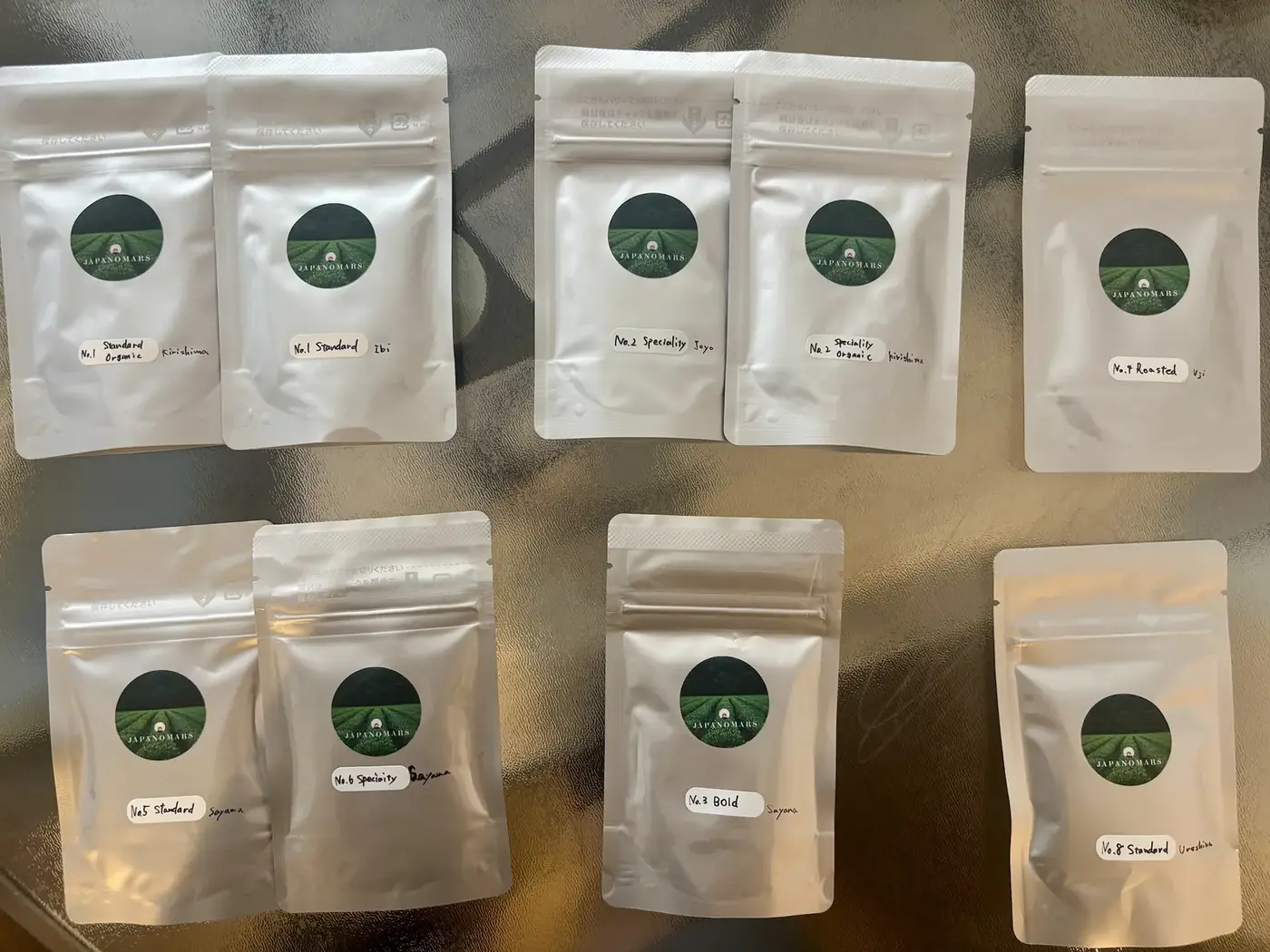
We export premium first-flush matcha directly from named Japanese regions and work with cafes on long-term supply, not one-off orders. Request a sample set with the leaf type, harvest, region, and current wholesale pricing spelled out, so you can taste and verify exactly what you are paying for.
Request samples & pricing%E7%99%BD_%E5%A4%A7%E3%81%8D%E3%81%84.png)