%E5%A4%A7%E3%81%8D%E3%81%84.png)
Menu & Operations · 2026
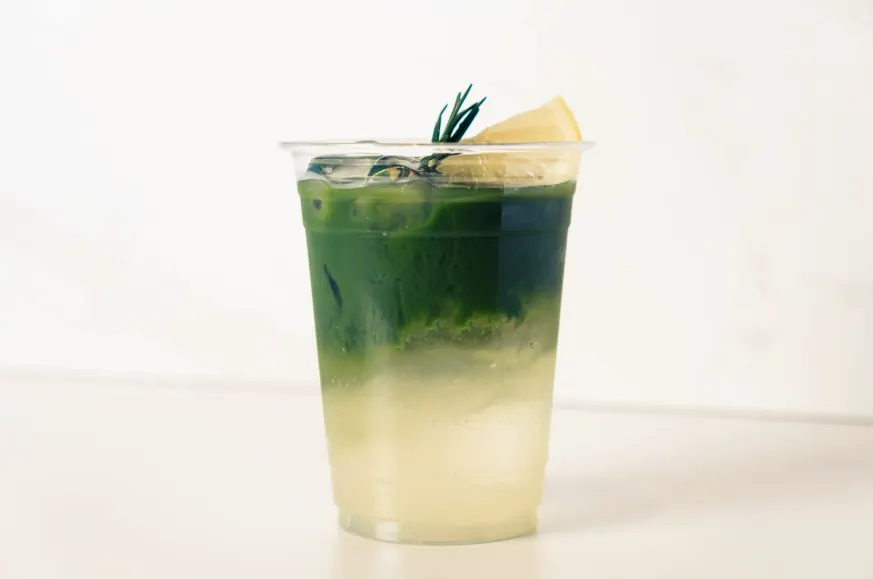
Adding matcha to a cafe menu takes four decisions: the right grade (latte-grade, not ceremonial, for milk drinks), about $200–500 in equipment, a prep workflow matched to your volume, and 2–4 hours of barista training. Done properly, matcha drinks return 82–85% gross margins (higher than espresso), and most of the customers they bring in are new, not converted coffee drinkers. This guide walks a US cafe owner through the whole setup, from the first tin to the first month of service, including the supply-side realities of buying Japanese matcha in 2026.
Key takeaways
In this guide
A matcha program needs five things: a reliable supplier of latte-grade matcha, roughly $200–500 in new equipment, a prep workflow suited to your daily volume, 2–4 hours of staff training, and a launch menu of three to five drinks. Most cafes can go from decision to first service in two to four weeks; supplier lead time, not setup, is usually the long pole. Grades, dosing, and margins are covered in our complete matcha for cafes guide.
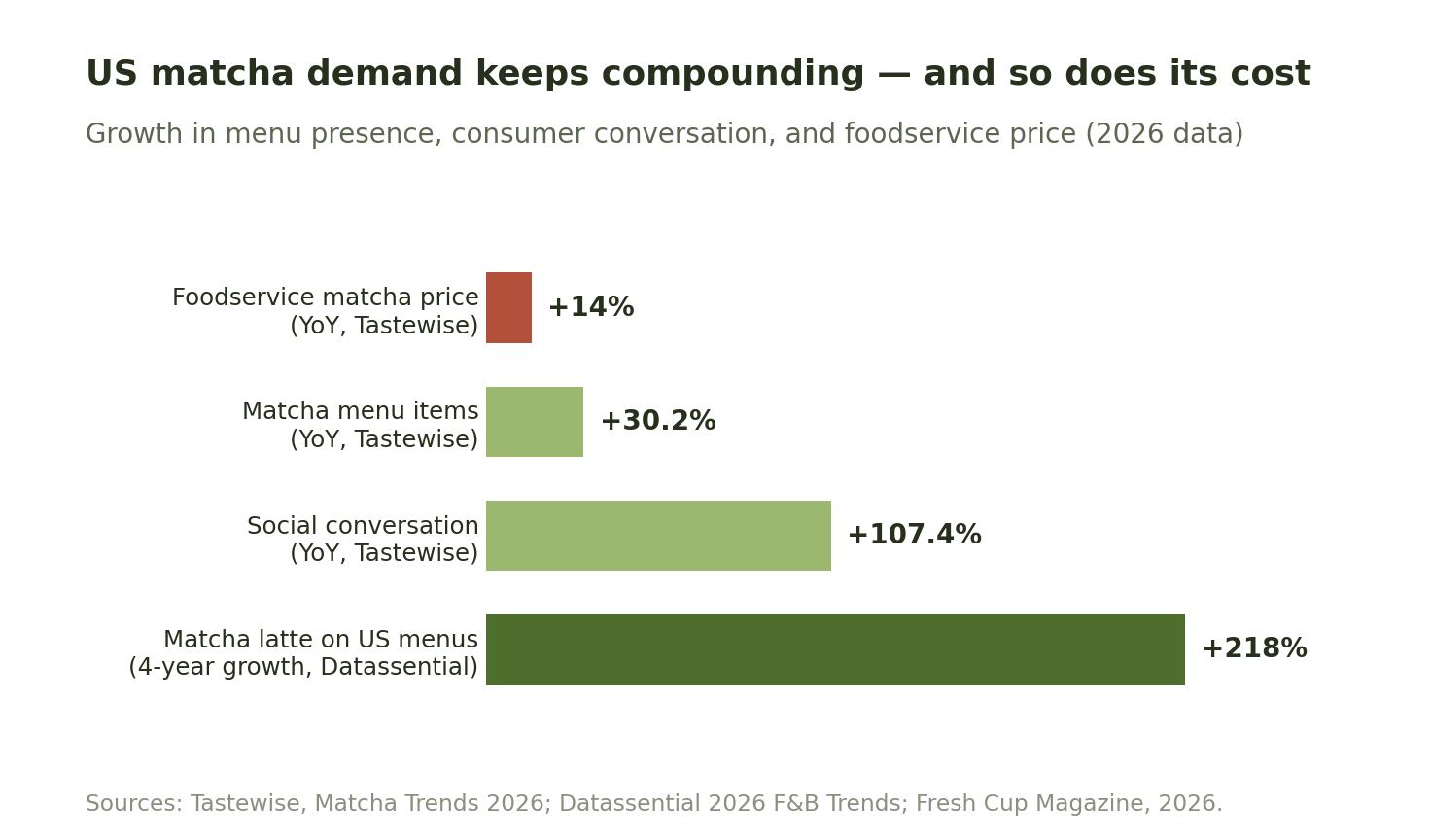
The demand case is no longer speculative. According to Tastewise's 2026 trend data, matcha menu items grew 30.2% year-over-year in the US, with social conversation up 107%, and Datassential reports matcha lattes have grown +218% on US menus over the past four years. This is a structural shift, not a TikTok spike: matcha now anchors the afternoon daypart and the "calm energy" segment that espresso can't serve. (For the science behind that positioning, see Matcha vs Coffee: Caffeine, L-Theanine, and the Calm-Energy Difference.)
The mistake we see most often from the supply side isn't underinvestment; it's sequencing. Cafes design the menu first, buy a beautiful tin of ceremonial matcha, then discover mid-launch that their supplier can't scale with them, or that hand-whisking every drink adds ten minutes to service at rush. Work through the sections below in order and you'll avoid both traps.
For milk-based drinks (which will be 80–90% of your matcha sales) buy latte-grade (high culinary) matcha, not ceremonial. Latte-grade is milled from slightly later-harvest tencha with the body and umami to cut through milk, at $55–75/kg on 2026 direct-Japan contract pricing. Reserve a small tin of ceremonial for straight usucha or a showcase pour. For the exact ratios and batching method, see our matcha latte guide for cafes.
"Ceremonial" and "culinary" are unregulated marketing terms in the US (no law defines them), so what matters is what's in the bag: harvest timing, cultivar, region, and how recently it was milled. We covered how to read those signals in Matcha Grades Explained and What Makes Matcha Good?; the short version for a menu launch:
One thing the price tags don't show: at identical grades, freshness of milling matters more than label. Matcha begins oxidizing the moment it's ground. A supplier who mills to order (as the farms we work with do) delivers a visibly greener, sweeter powder than one shipping year-old stock, at the same nominal grade.
Total new equipment for a single location runs $200–500, since matcha uses most of what an espresso bar already has. You need precise water temperature (matcha scorches above 75°C / 167°F), a way to blend without clumps, opaque storage for batched concentrate, and a fine sifter. No dedicated station, no ceremony bowls.
| Equipment | Typical cost | Why it matters |
|---|---|---|
| Temperature-controlled kettle | $80–150 | Hold water at 70°C; above ~75°C matcha turns bitter |
| Hand blender or counter blender | $40–120 | Batch-prepares clump-free concentrate in 30–45 seconds |
| Opaque squeeze bottles (set) | $8–15 | Store batched shots; block light, dose fast |
| Fine-mesh sifter (~30 mesh) | $12–25 | Kills electrostatic clumps before whisking |
| Precision scale (0.1 g) | already on bar | ±0.1 g dosing consistency |
Source: First Agri B2B operational guide (2026). A bamboo whisk (chasen) is worth having for showcase drinks and training palates, but it is not how you'll survive a Saturday rush.
There are three proven prep models, and the right one depends on daily matcha volume. Under 10 cups a day, whisk to order (90–120 seconds). At 10–30 cups, pre-batch matcha-and-water concentrate. Above 30 cups, run a full "matcha shot" system: 30 ml of concentrate poured like espresso, total drink time under 45 seconds.
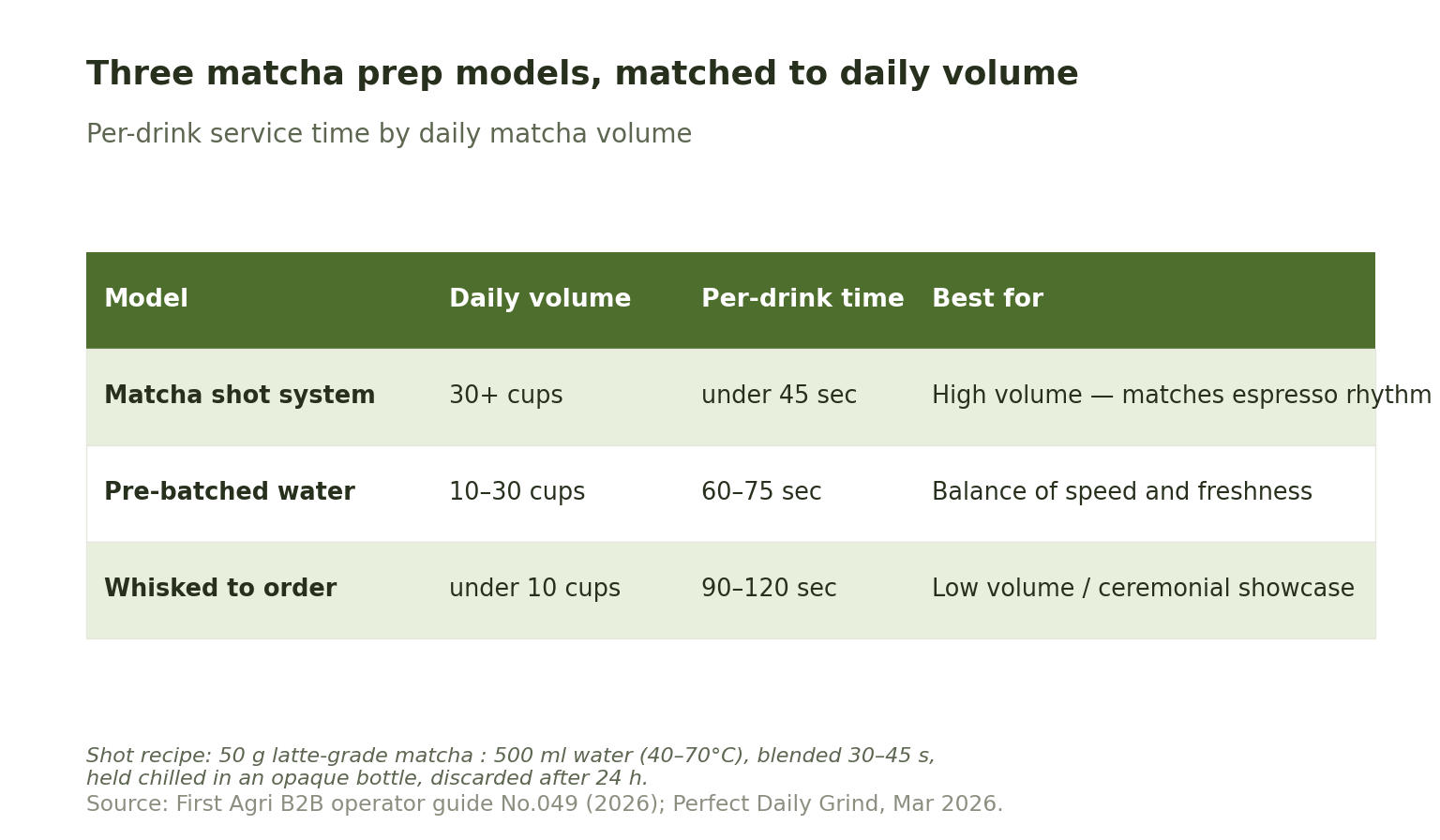
The shot system is what lets matcha coexist with espresso at rush hour. The standard recipe, per First Agri's 2026 operator guide: blend 50 g latte-grade matcha into 500 ml filtered water at 40–70°C for 30–45 seconds, store in an opaque squeeze bottle over an ice bath, dose 30 ml (3 g equivalent) per drink, and discard whatever remains after 24 hours. Every drink then builds exactly like a latte: shot, steamed or cold milk, done.
Perfect Daily Grind's March 2026 piece on batching quotes Flo-Smart's Keelan Hartnett with the line every new matcha operator should hear: "A café using mid-quality matcha, but excellent mixing technique, will often produce a better drink than one using premium matcha with inconsistent preparation." Technique and consistency beat label prestige. That's also the argument for standardized batching over heroic hand-whisking; PDG notes made-to-order prep can add ten minutes to service, while average customer patience tops out under six minutes.
Training is a smaller lift than most owners expect: 2–4 hours takes an espresso-competent barista through grades, temperature control, sifting, batching, and the drink builds. We'll publish a full barista-side recipe and ratio guide separately.
Matcha is the most perishable ingredient on your bar. Dry powder oxidizes on contact with air, light, heat, and moisture; batched concentrate degrades in hours. The rules: keep opened tins airtight, opaque, and refrigerated, use them within 4–8 weeks, hold batched concentrate chilled and discard within 24 hours, and size orders so stock turns monthly.
In practice, three habits keep waste under the 5% target First Agri recommends tracking in your first 90 days:
Storage deserves its own deep-dive, and we're writing one.
Launch with three to five drinks, not one and not ten: an iced matcha latte as the anchor, a dirty matcha (espresso + matcha) to convert coffee loyalists, one flavored signature (strawberry matcha is 2026's proven winner), and optionally a straight usucha as the quality statement. This lineup covers every customer segment with one base concentrate.
The anchor matters more than the range. At chains like Blank Street Coffee, matcha now drives roughly half of all orders, and the iced latte is the volume engine. The dirty matcha is your lowest-risk crossover SKU: it reads as "coffee plus" to espresso drinkers and typically runs 8–12% of matcha volume. Industry data suggests 60–70% of matcha customers are incremental (new visits, not cannibalized coffee sales), with cannibalization running under 15% in well-designed programs. Matcha genuinely grows the pie, especially after 2 pm when espresso demand fades.
We published a full menu playbook with recipes, roles, and 2026 flavor trend data (flavored matcha searches grew triple digits last year) as a companion piece.
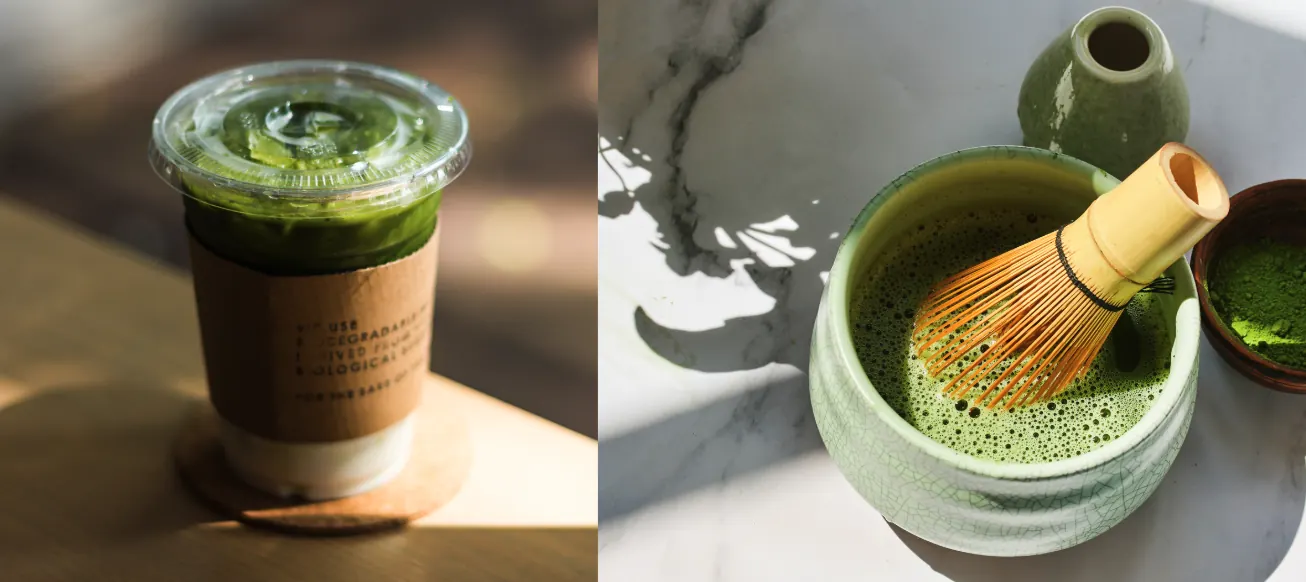
Expect under $700 all-in to launch (equipment plus your first kilogram), a cost per drink around $0.24 in matcha at contract pricing, and 82–85% gross margins at a $6.50 price point, several points better than espresso drinks. A cafe selling 50 matcha drinks a day adds roughly $98,500 in annual incremental gross profit (First Agri, 2026).
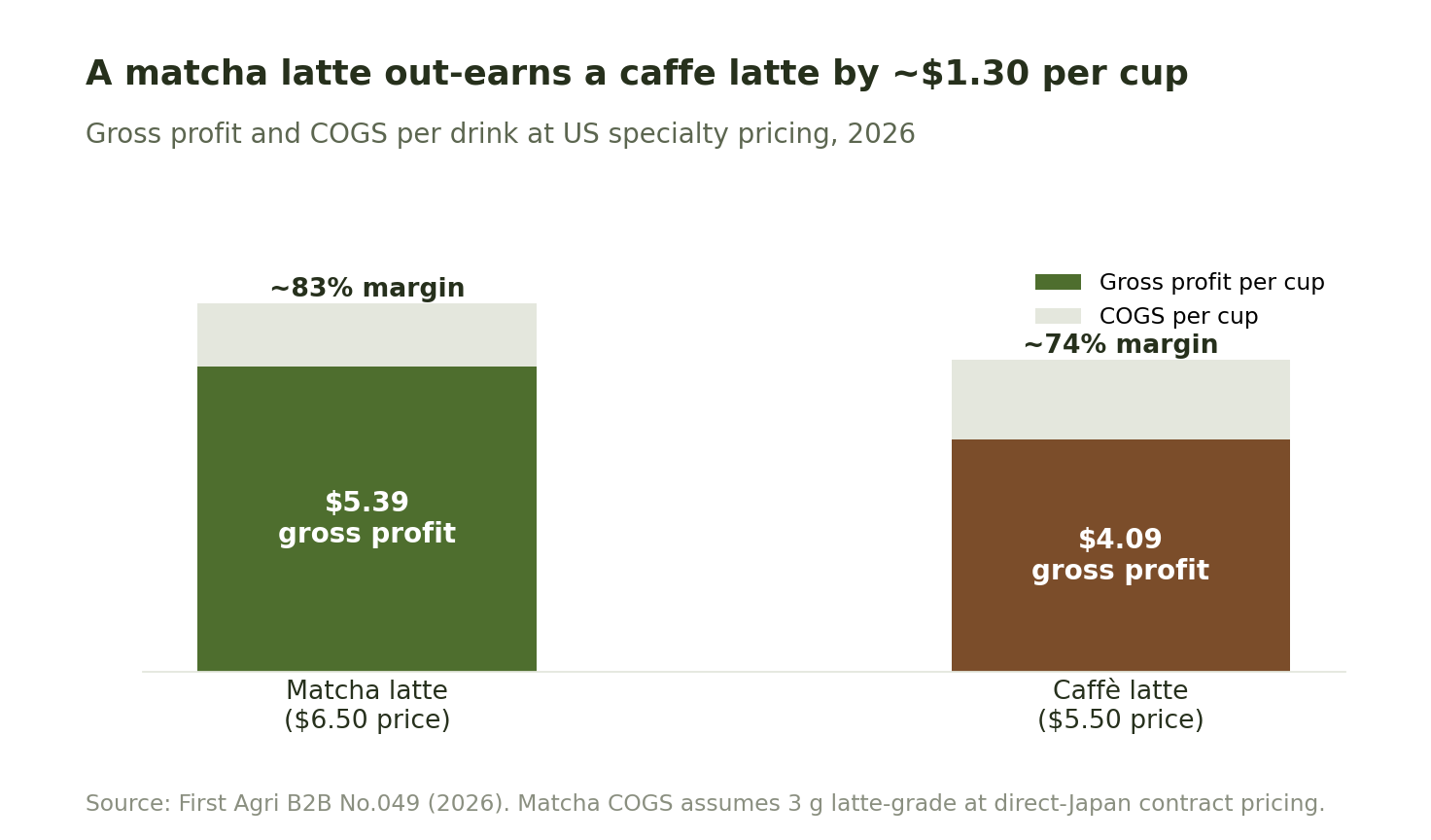
The US retail context supports the price point: the average matcha latte rose from $5.84 to $6.15 in the past year, and Starbucks charges $6.26 for a grande. A specialty cafe serving a visibly better product (real Japanese latte-grade, properly prepared) has no trouble at $6.50–7.50. Per First Agri's math, a $6.50 matcha latte returns about $5.39 gross profit per cup versus $4.09 for a $5.50 caffè latte.
One honest caveat from the supply side: your ingredient cost is the line most likely to move. Average US foodservice matcha prices rose 14% year-over-year (Tastewise, via Fresh Cup), and raw material costs in Japan roughly doubled this season; more on that below. Build your menu pricing with 15–20% ingredient-cost headroom rather than pricing to today's invoice. We'll cover pricing architecture in a dedicated piece.
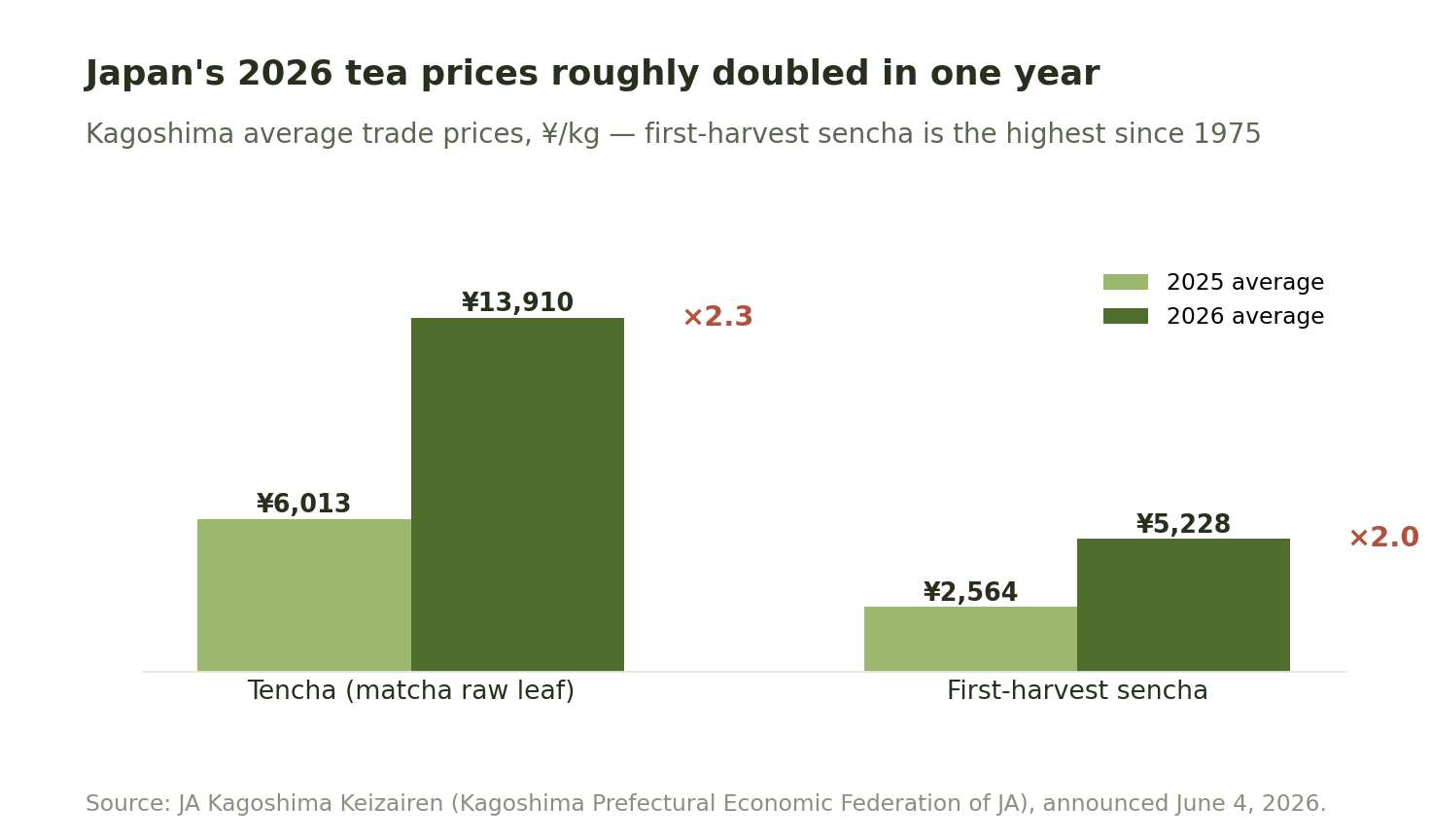
Secure your supplier before you print the menu; in 2026 this is the step most likely to sink a launch. Japanese raw-material prices have roughly doubled: JA Kagoshima Keizairen reported the 2026 average tencha price at ¥13,910/kg, 2.3 times last year's ¥6,013, while Kagoshima's first-harvest sencha hit ¥5,228/kg, the highest since records began in 1975. Demand is why: Japan's green tea exports doubled in a single year, from ¥36.4 billion (2024) to ¥72.1 billion (2025), per Ministry of Finance trade statistics. Our rundown of the best wholesale matcha suppliers for US cafes shows who is still taking new accounts this year.
What that means at the cafe level, from Fresh Cup's 2026 reporting: Denver's Panda Coffee House switched suppliers three times in a single year and sits on farm waitlists stretching into August 2026; one supplier raised prices 150% in a month. The operators who aren't scrambling are the ones with a committed supplier relationship: allocation, not spot-buying.
Practical sequence for a new program:
Roughly $700 or less to launch: $200–500 in equipment (temperature-controlled kettle, blender, squeeze bottles, sifter) plus your first kilogram of latte-grade matcha ($85–140 at single-kilo pricing; $55–75/kg on volume contracts). No dedicated station or build-out is required; matcha runs on an existing espresso bar.
About 2–4 hours for staff who already have solid espresso skills. The workflow (precise dosing, temperature control, batching, drink builds) maps directly onto espresso competencies. The critical technical points are water temperature (under 75°C) and sifting to prevent clumps.
Latte-grade (high culinary) matcha for anything with milk or flavoring, since it has the body and umami to cut through at a third of ceremonial's price. Ceremonial grade is for straight usucha or showcase drinks where its delicate aromatics can actually be tasted. Note that neither term is legally regulated in the US.
Same-day use is the quality standard. Refrigerated in an opaque, airtight bottle, batched concentrate is technically usable for 24 hours, but color and flavor degrade noticeably after 12–18 hours. Most cafes batch twice daily, morning and afternoon, and discard anything older than a day.
Mostly no. Industry data puts 60–70% of matcha customers as incremental (new visits or non-coffee drinkers), with cannibalization under 15% in well-designed programs. Matcha also sells disproportionately after 2 pm, extending revenue into the daypart where espresso demand drops off.
Well-run matcha programs deliver 82–85% gross margins at specialty pricing ($6.50+), compared with 72–75% for espresso drinks. At 3 g of latte-grade matcha per drink, ingredient cost is roughly $0.17–0.42 per cup depending on your purchasing tier.
Matcha is the rare menu addition that is simultaneously high-margin, low-capex, and demand-proven; the hard part in 2026 is not the bar setup but the supply chain behind it. Choose latte-grade, batch it properly, launch three to five drinks, and lock in a supplier who can grow with you before raw-material prices move again.
Request a sample set of our farm-direct latte-grade and ceremonial matcha with current wholesale pricing, and test it in your own recipes, with your own milk, before you commit. We work with US cafes on long-term supply relationships, not one-off orders.
Request samples & pricingHiroshi Asami is the founder of Japanomars, exporting single-origin Japanese matcha directly from farms in Sayama, Ibi, Ureshino, Yame, Kirishima, and Chiran to specialty cafes across the US and Canada. He has led four sourcing tours bringing overseas cafe owners to Japanese tea farms.
Sources: Tastewise, Matcha Trends and Statistics 2026 · Datassential 2026 Food & Beverage Trends · First Agri B2B operator guides Nos. 049/052 (2026) · Perfect Daily Grind, "Should coffee shops batch matcha?" (March 2026) · Fresh Cup Magazine, "The Matcha Boom Is Reshaping Cafes" (2026) · JA鹿児島県経済連 (JA Kagoshima Keizairen) 2026 first-harvest results, June 4, 2026 · 財務省貿易統計 (Japan Ministry of Finance trade statistics), 2025 green tea exports · Mission Chronicle, SF matcha price survey (2026)
%E7%99%BD_%E5%A4%A7%E3%81%8D%E3%81%84.png)