%E5%A4%A7%E3%81%8D%E3%81%84.png)

To find a Japanese matcha wholesale supplier, work backward from proof, not from price: shortlist exporters who name the prefecture and farm behind each lot, then vet them with batch-specific lab results, current-harvest documentation, and a real sample before you sign anything. In a market where tencha auction prices have roughly doubled in a year and "matcha" is increasingly diluted or relabeled, the supplier's ability to prove origin and safety is now the single most important thing you're buying.
This guide is for US specialty-cafe owners and operators who want a dependable wholesale matcha supply, not a one-off pallet, and who would rather ask the right questions now than discover a problem after it's in the hopper.
You'll find Japanese matcha suppliers through four main channels: direct outreach to producers and exporters in tea regions, Japanese trade-export bodies and B2B marketplaces, specialty trade shows, and referrals from other cafe operators. The channel matters less than the diligence that follows; the goal is a shortlist you can verify, not the longest list you can assemble. To start that shortlist, see our comparison of wholesale matcha suppliers for US cafes.
Practical starting points:
Your first week, concretely:
One caution: a polished storefront or a wholesale price list is not evidence of quality. Counterfeit and blended "matcha" has grown alongside the boom, and some of it routes through China and is relabeled, a risk we cover in Japanese vs Chinese matcha. Treat discovery as the easy part. Vetting is the work.
A trustworthy matcha supplier in 2026 is one that can prove three things on demand: where the leaf came from (named farm and prefecture), what's in it (batch-specific pesticide and heavy-metal testing against your market's limits), and that it can keep supplying you (real relationships with growers, not spot-market scrambling). Transparency under pressure is the differentiator now that demand has outrun supply.
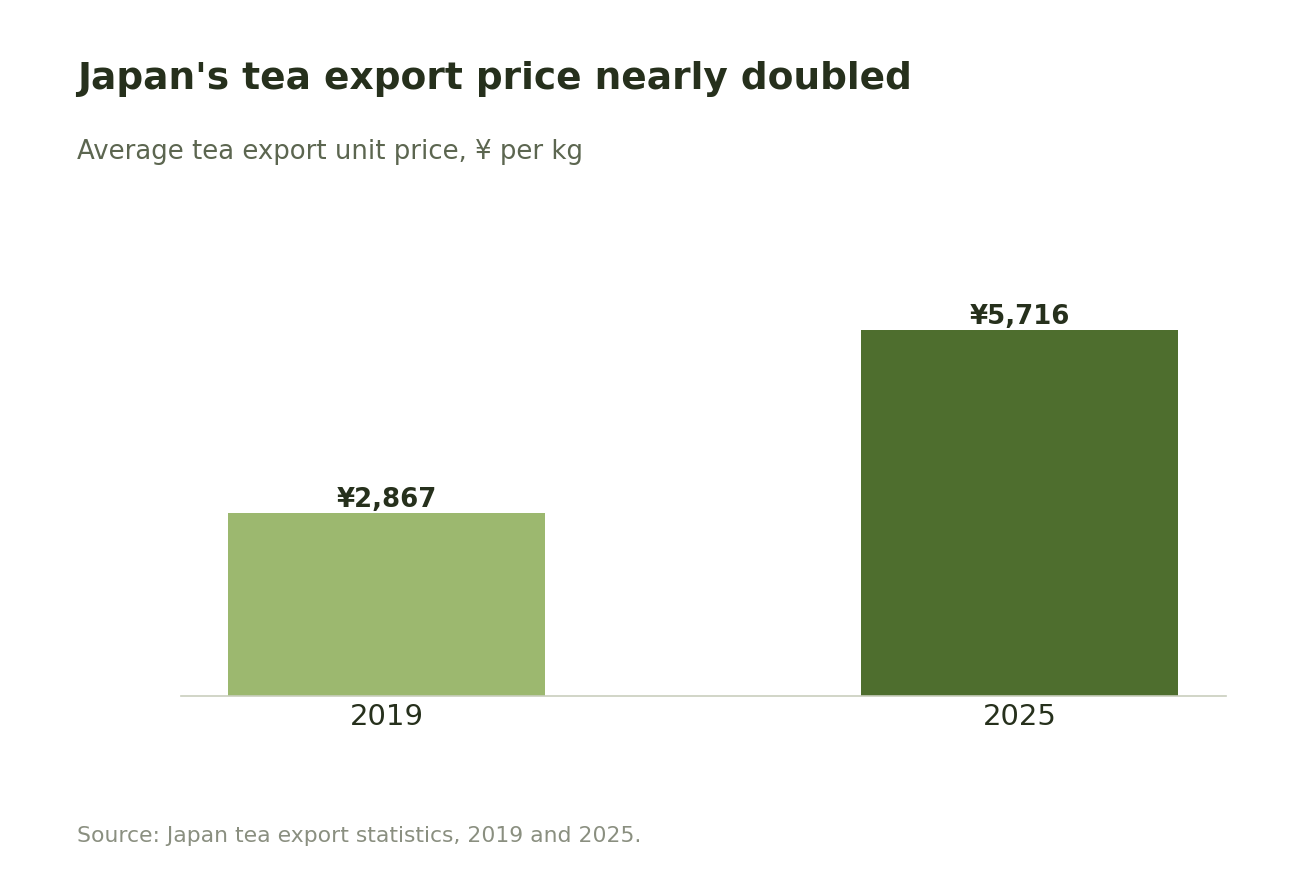
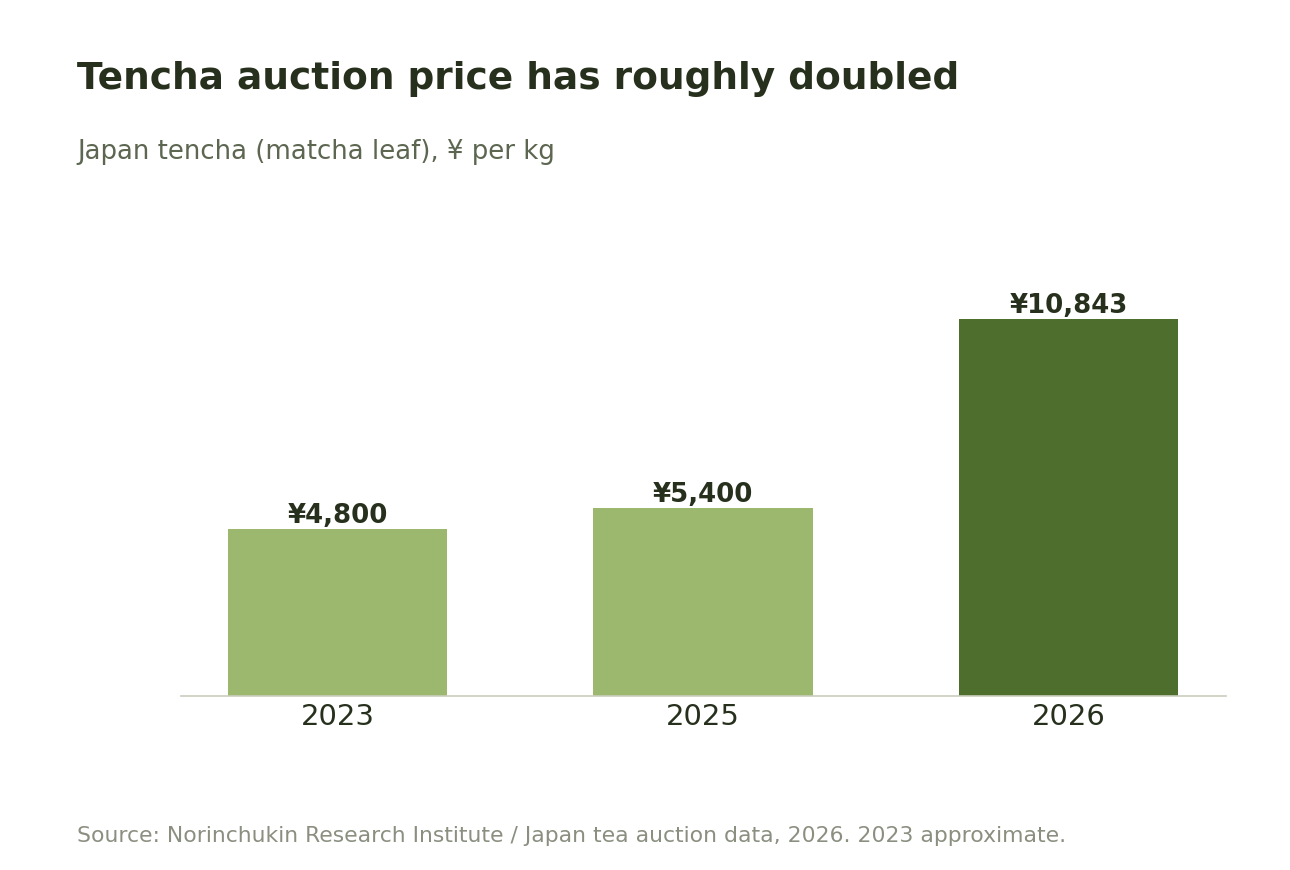
The pressure is real and documentable. Japan's tea exports roughly doubled in value year-on-year (the export unit price rose from ¥2,867/kg in 2019 to ¥5,716/kg in 2025), as the matcha boom pulled volume out of the country. At the same time, the raw material is scarce: producers are racing to convert sencha fields to tencha, and tencha auction prices hit about ¥10,843/kg in 2026, roughly twice the prior year. When everyone is short, weak suppliers cut corners: blending in lower grades, sourcing unnamed leaf, or relabeling. (Our 2026 matcha market outlook breaks down the supply-demand gap.)
Trust signals to weight heavily:
A genuine supplier is boringly transparent: they will name the farm, region, and harvest, and share a recent residue or lab report for the actual lot without being pushed. The timing tells you a lot too, because the reliable growers open first-harvest (ichibancha) reservations around April and May and ask for a deposit to hold your allocation; on a recent trip to Kyoto I saw large trading houses reserving a single farm's entire output ahead of everyone else, which is exactly why you want a committed, traceable relationship rather than a spot buyer. As a sanity check on any quote, I am currently seeing latte grade land around 100 to 160 dollars per kilogram and ceremonial around 160 to 210, so a price far below that is a red flag, not a bargain.
For most US cafes, a specialist exporter with direct farm relationships is the sweet spot: more provenance and flexibility than a large trading company, more reliability and compliance handling than buying raw from a single farm. The right choice depends on your volume, your appetite for logistics, and how much origin storytelling matters to your brand.
| Supplier type | Best for | Strengths | Watch-outs |
|---|---|---|---|
| Farm-direct | Cafes wanting single-origin story, smaller volumes | Maximum provenance, freshest lots, direct relationship | Farm may not handle export docs, FDA prior notice, or cold-chain; limited grade range |
| Specialist exporter (farm-connected) | Most specialty cafes | Named origin + handles compliance, samples, steady supply, can scale grades | Verify the farm links are real, not marketing |
| Large trading company | High-volume chains | Scale, price, logistics muscle | Provenance often blurred; harder to get farm-level proof |
| Generic B2B marketplace seller | , | Low entry price | Highest counterfeit/blending risk; provenance frequently unverifiable |
The structural reason this matters: Japan's supply base is shrinking. Teikoku Databank recorded 13 tea-processor closures and dissolutions in 2025 (the most on record, up from 8 in 2024), driven by soaring sencha raw-material costs and weak demand for everything except matcha. A supplier with genuine, long-term farm relationships is far better insulated from that attrition than one buying on the open auction each season. You are choosing supply security, not just a price.
Expect to pay, as a rough mid-2026 guide (confirm live, as these prices move fast), about $40–90/kg for culinary/latte-grade matcha and $150–400+/kg for ceremonial-grade, with top single-origin first-harvest lots higher. First orders typically run from 1–5 kg with a specialist exporter up to much larger commitments with a trading company. The bigger variable is rarely the per-kilo price; it's timing. To sanity-check any quote against the raw-material market, our US matcha wholesale price index shows the current auction prices and the cost bridge to US-landed.
| Culinary / latte grade | Ceremonial grade | |
|---|---|---|
| Rough wholesale price (mid-2026) | ~$40–90 / kg | ~$150–400+ / kg |
| Matcha cost per 12 oz latte (~2 g) | ~$0.08–0.18 | ~$0.30–0.80 |
| Best use | milk lattes, iced, blended | whisked / showcase drinks |
A few realities to plan around:
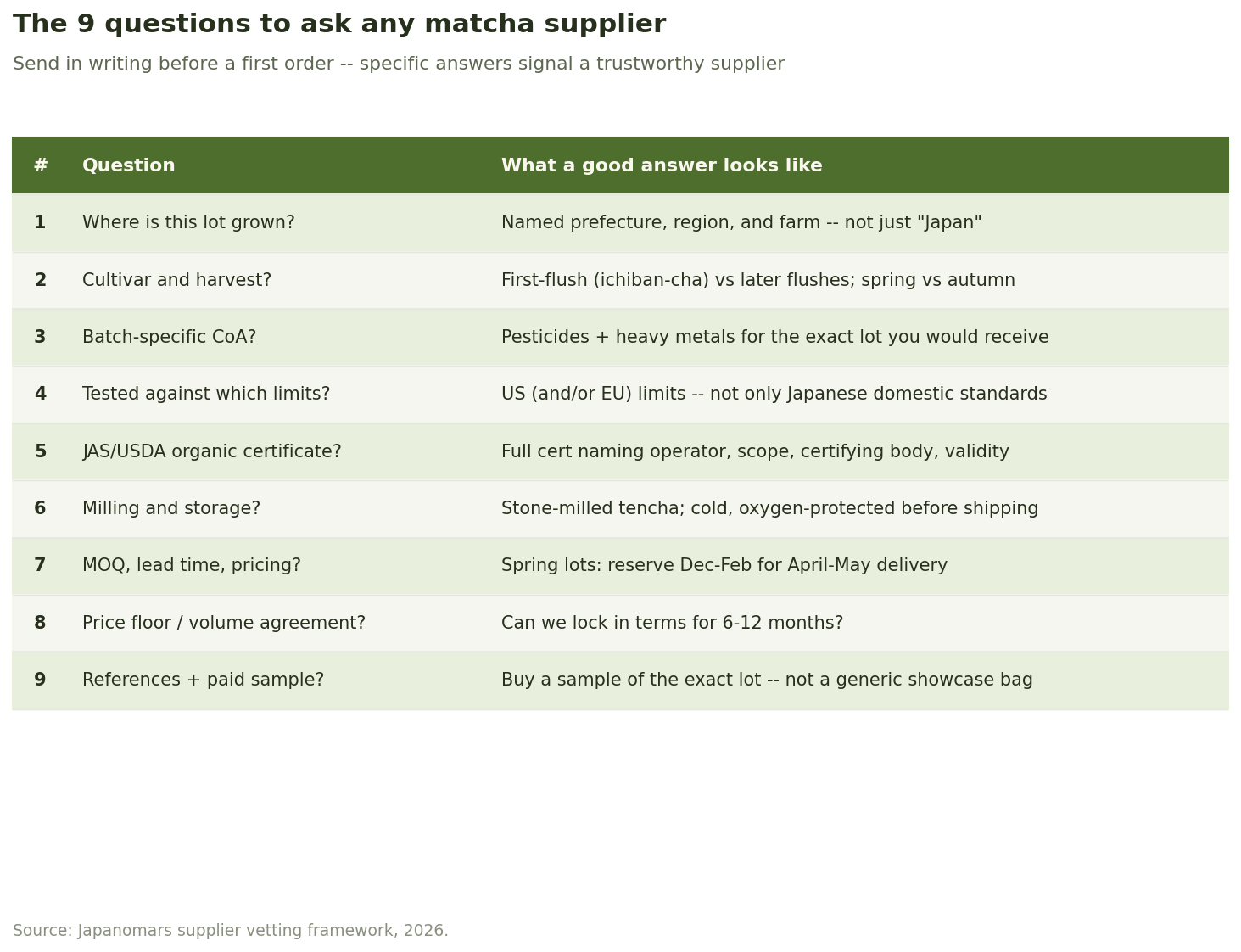
Ask these nine questions before you place a first wholesale order. A confident, specific supplier answers all nine without friction; vague or defensive answers are the warning you're paying for transparency you won't get. Send them in writing so the answers are on record.
Keep it short, specific, and identical across suppliers so you can compare replies. Something like:
A supplier who answers all five clearly is worth a sample. One who dodges them has already told you what you needed to know.
Provenance documents matter as much as lab results here. Japan's 2026 "Japanese Tea" Geographical Indication defines genuinely Japanese tea as grown, processed, and packed in Japan, so ask any supplier to show, on paper, that their tea meets that origin standard.
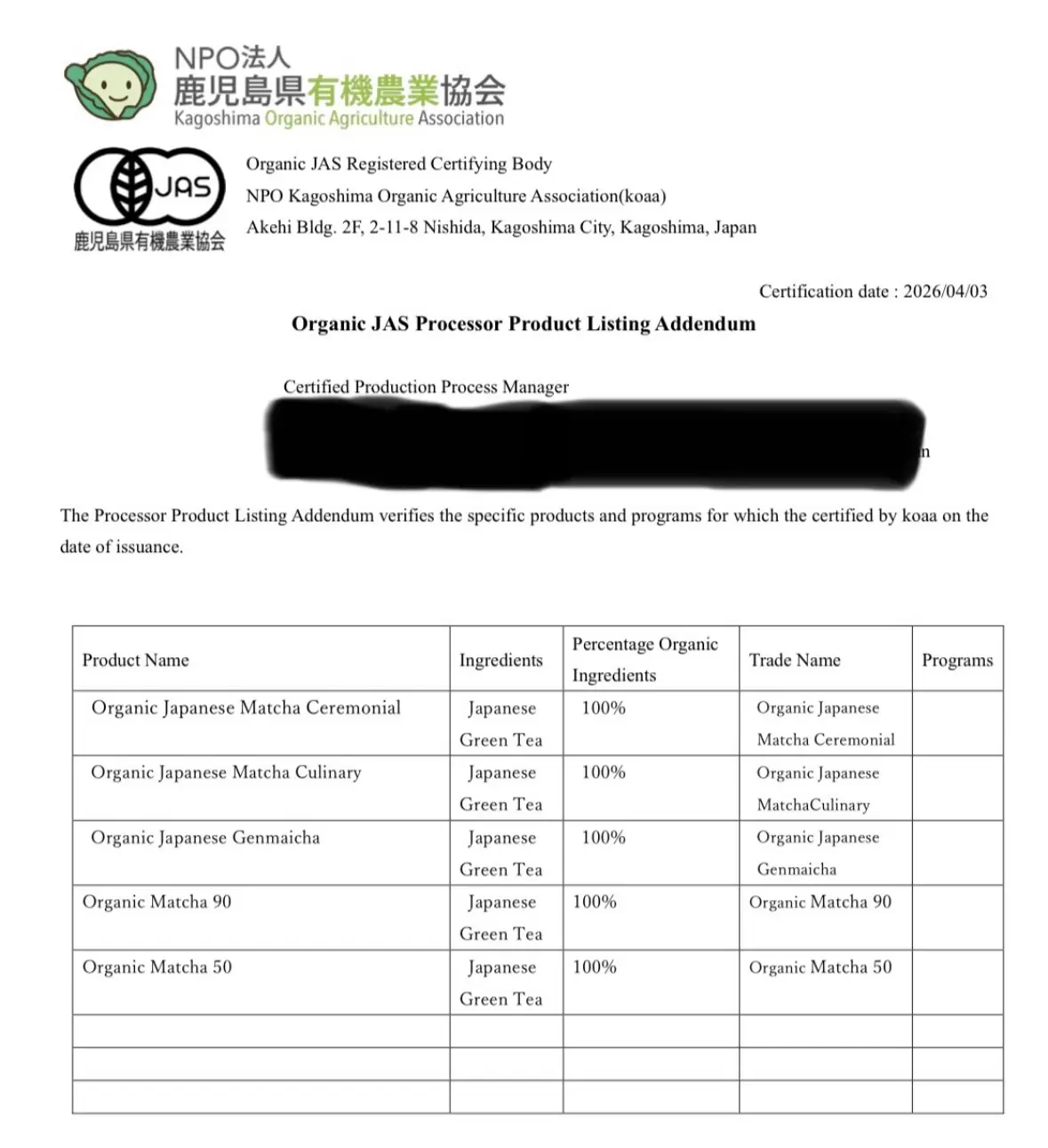
Require batch-specific lab testing and import paperwork, not blanket assurances. At minimum: a Certificate of Analysis covering a multi-residue pesticide screen and heavy metals, run by an ISO 17025-accredited independent lab against your destination market's limits, plus organic and (if you want it) radiation certificates tied to the specific batch. The phrase that matters is "batch-specific": a year-old generic report proves nothing about the bag you'll receive.
What to collect and why:
If a supplier can't produce a batch-specific CoA, treat the conversation as over. In 2026, it's the baseline.
Buy a paid sample of the exact lot you intend to order and evaluate it the way your customers will drink it (whisked in water and in your standard milk build) before you discuss volume. A free generic sample tells you what a supplier's best bag tastes like; a paid sample of your actual lot tells you what you'll be serving every day. Always evaluate the lot, never the marketing.
A simple bar-side protocol:
Only after a lot passes your bar should you negotiate MOQ, lead time, and, in this market especially, a price floor or volume agreement. Our shortage sourcing guide covers how to structure that commitment.
Prices have risen sharply. At the raw-material level, tencha auction prices reached about ¥10,843/kg (about $72) in 2026, roughly double 2025, and Japan's average tea export unit price hit ¥5,716/kg. Finished ceremonial-grade matcha that landed in the US around $11 per 30 g in 2023 is closer to $19 to $22 at supplier level in early 2026, before freight and margin. Budget for premiums on first-harvest spring lots.
It varies by supplier, from a few kilograms with a specialist exporter to much larger commitments with a trading company. More important than the MOQ is the lead time and how far ahead you must commit for spring (first-harvest) lots, which sell out earliest. Ask both questions together.
Require named provenance (prefecture and farm), a batch-specific Certificate of Analysis, and harvest documentation, then confirm with a paid sample. Vague "Japanese matcha" claims with no region, blended grades, or unusually low prices are common signs of repackaged or non-Japanese material.
Japanese matcha generally enters the US at a 0% tariff under its tea HTS classification, so duty itself shouldn't be a major cost. Your real compliance work is FDA prior notice and correct labeling, which a competent exporter or freight forwarder handles. Confirm who is responsible before shipping.
It's optional. Government mandates have largely been removed, but many US and EU buyers still request batch-specific radiation results (Iodine-131, Cesium-134, Cesium-137) as voluntary reassurance. It's inexpensive, so if it helps you or your customers feel confident, ask for it on each lot.
Not for most cafes. Farm-direct gives the strongest single-origin story but often leaves you handling export docs, FDA prior notice, and cold-chain logistics. A farm-connected specialist exporter usually offers the same provenance with the compliance and supply reliability a working cafe needs.
Finding a supplier is easy; finding one who can prove origin, pass your market's lab limits, and keep supplying you through a tight market is the real job. We work with US cafes on long-term, single-origin supply direct from the farms we know personally, with batch-level documentation. Request samples and current first-harvest pricing, and we'll help you vet the fit before you commit.
Request samples & pricing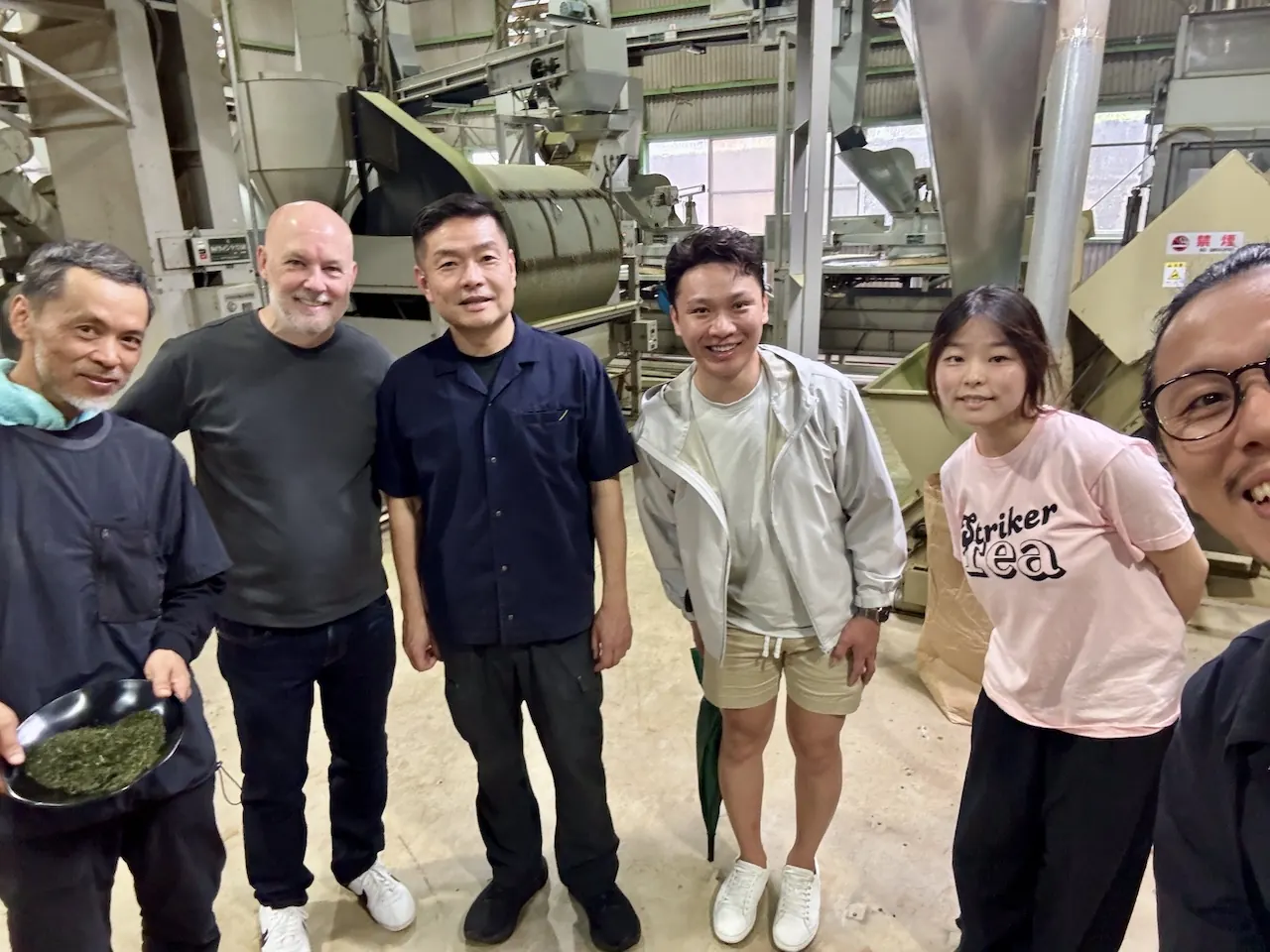
About the author: Hiroshi is the founder of Japanomars, which sources single-origin matcha directly from farms in Japan's tea regions for cafes abroad. He has guided overseas cafe owners on sourcing tours to Japanese farms and works with growers across Sayama, Ibi, Ureshino, Yame, Kirishima, and Chiran.
Sources
%E7%99%BD_%E5%A4%A7%E3%81%8D%E3%81%84.png)