%E5%A4%A7%E3%81%8D%E3%81%84.png)
Quality · Sourcing · 2026
Good matcha is five things you can measure: color, suspension, aroma, umami balance, and how much of all that survives milk and ice. None of them is the grade word on the bag, and none of them is guaranteed by the word matcha itself, which no government defines. This guide is the buying decision. Which traits should decide your order, what to demand in writing before a sample ships, and what each trait costs the producer who delivers it.
Key takeaways
In this guide
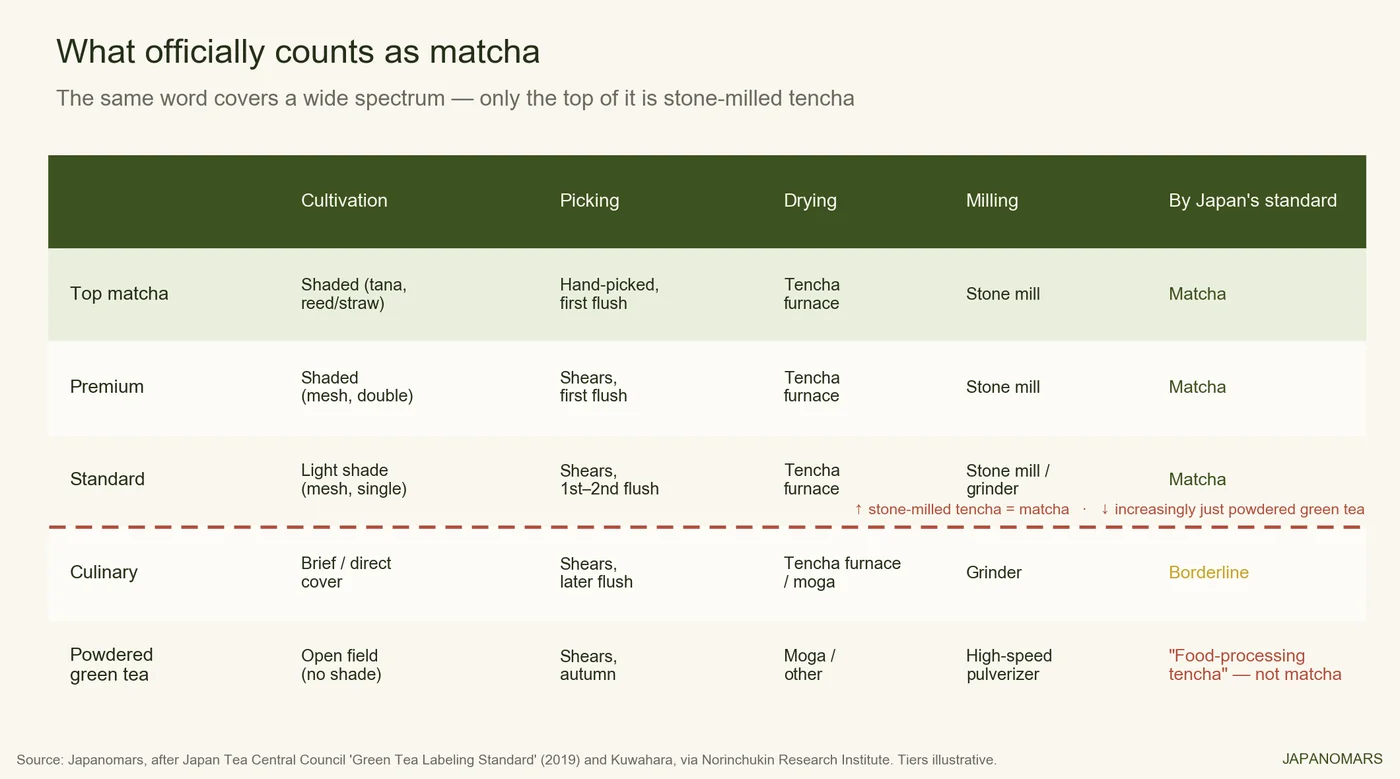
Not a binding one, and the two documents that come closest are both voluntary. Japan's Green Tea Labeling Standard, published by the Japan Tea Central Council, was established in April 1991 and last revised on July 10, 2026, though most English-language sources still cite the March 2019 revision it replaced. It defines matcha as tencha powdered by a tea mill, and tencha as leaf from a covered field shaded roughly two to three weeks, steamed, then dried without rolling in a tencha furnace. ISO/TR 21380:2022 says the same in international terms and adds that matcha contains no colorings, flavorings or other additives.
Here is the part almost nobody quotes: a stone mill is not the line. The same standard defines the tea mill as the stone mill used to powder tencha, then adds that "tea mill or equivalent" includes equipment with a comparable function, regardless of the grinding method. ISO/TR 21380 approaches it from the other side and notes that normal-grade matcha may be ground in a ceramic ball mill or a jet mill. So "if it is not stone-milled it is not matcha" is a claim both primary documents decline to make. Stone milling is a quality argument, and a good one for texture and aroma. It is not a definitional one, and the difference matters when a supplier uses the phrase to justify a price.
Two neighbouring names cause most of the confusion on spec sheets. Food-processing tencha is what Japan's standard calls autumn tencha and mogacha: leaf still dried unrolled in a tencha furnace, but understood to be supplied as a raw material for food manufacturing. Powdered tea is a separate entry in the same table, defined simply as tea put through a grinder, and it is not tencha at all. Those are three different products with three different names in Japan, and a spec sheet that says only "matcha" tells you which one you are buying: none of them. For the vocabulary in full, see our matcha glossary for cafe buyers and matcha versus green tea powder; for who is actually writing these rules, see who gets to call it matcha.

New in 2026: the industry starts building a common language. The International Matcha Association, a non-profit founded in Tokyo on April 22, 2026, published a statement of labeling and classification guidelines on June 8, 2026. It describes matcha as Camellia sinensis, shade-grown under cover, steamed to deactivate oxidative enzymes, dried without rolling, and ground to a fine powder, and it flags four product types buyers keep confusing. Note what it does not say. It does not specify a stone mill, and it presents itself as a starting point for dialogue rather than a binding standard, so there is no such thing as IMA-certified matcha yet. Logo shown for reference. Logo © IMA.
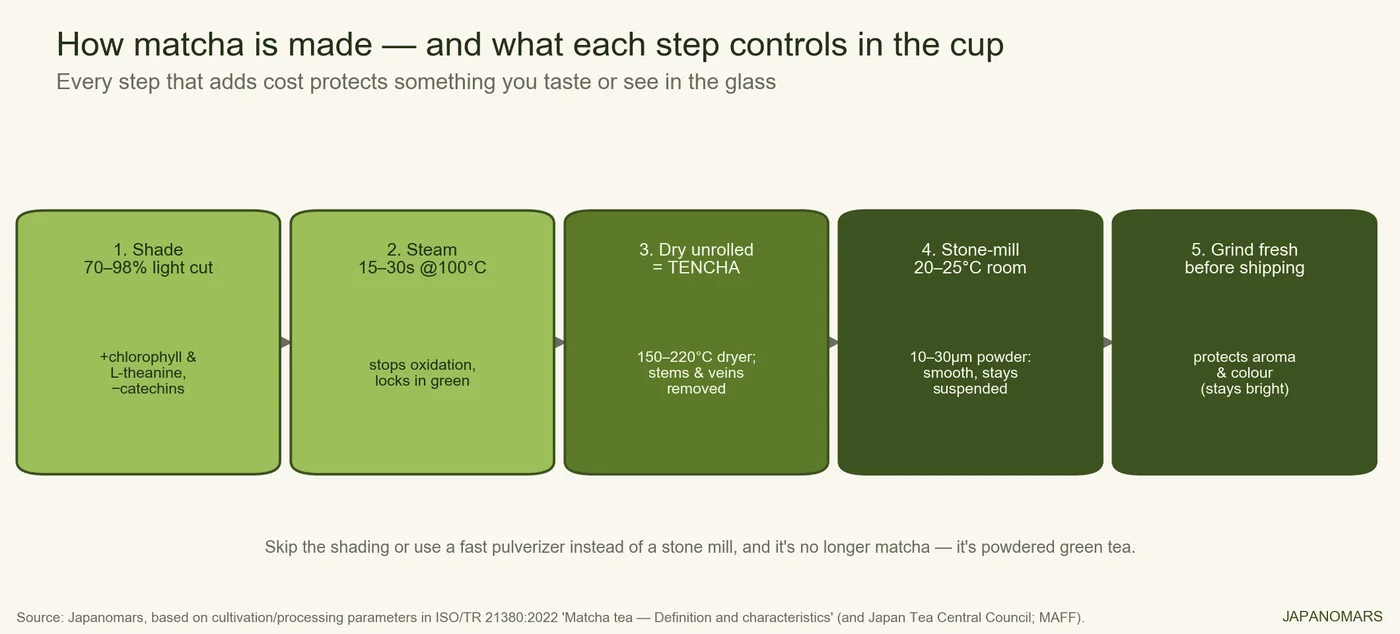
Four steps, and only two of them are unrecoverable once the tin reaches you. The reason to know the parameters is not curiosity. It is that each one becomes a question you can ask a supplier, and the answer is either specific or evasive.
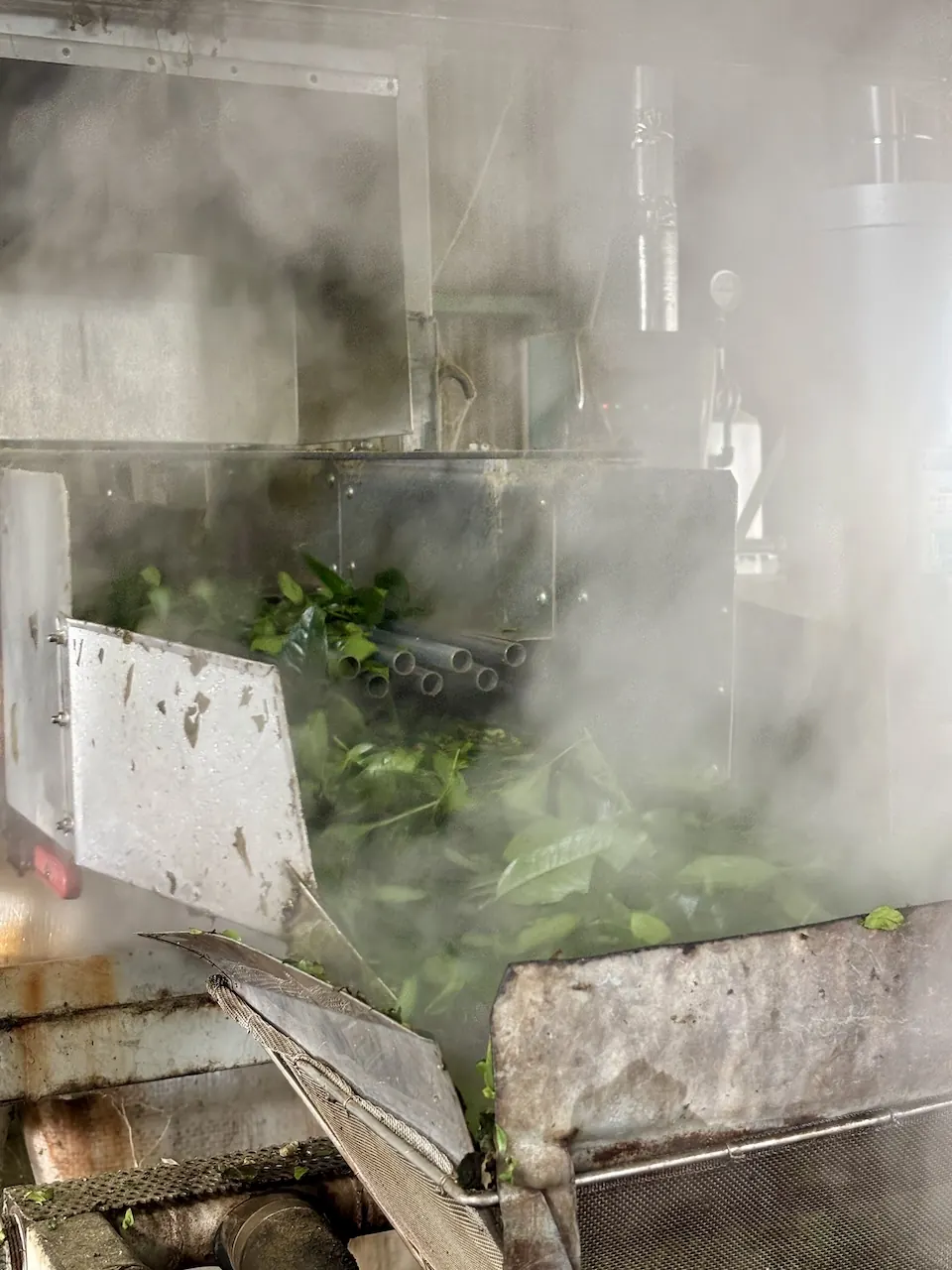
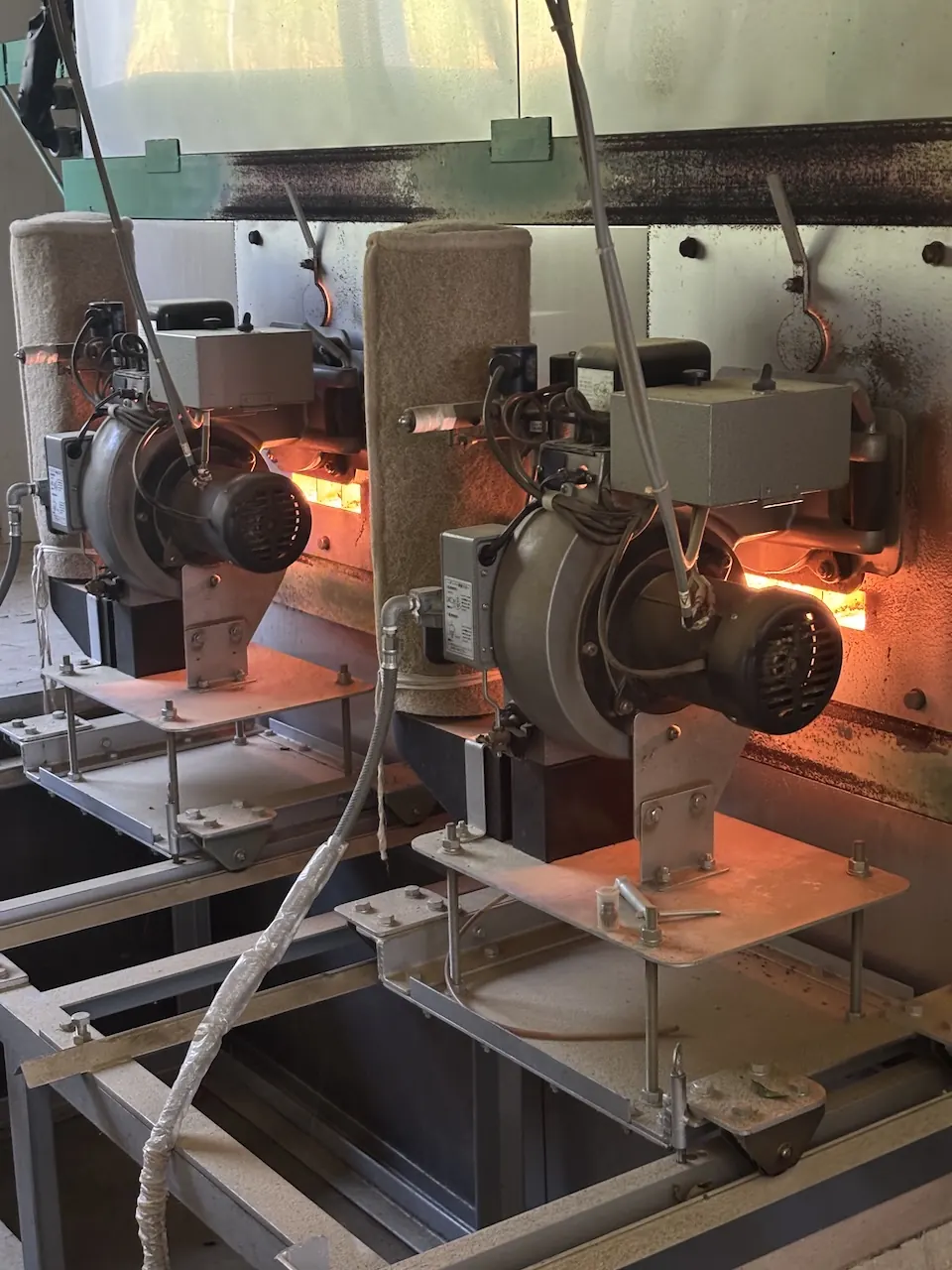
Shading builds the flavor and cannot be added later. ISO/TR 21380 describes overhead shading that blocks 70 to 80 per cent of light and rises to 95 to 98 per cent for the final days, with shoots plucked after 20 to 30 days, or direct cover at about 85 per cent for 20 days. Japan's standard puts it as two to three weeks under cover. Starving the leaf of light raises chlorophyll and L-theanine and lowers catechins, which you taste as deeper green, more umami and less bitterness. It is the step that costs yield, and the one nobody can fake downstream. Steaming and unrolled drying are what make it tencha: 15 to 30 seconds of steam at 100 degrees C within two to three hours of picking, then flat drying in a tencha furnace at 150 to 220 degrees C rather than the rolling that makes sencha. Drying flat is what lets the stems and veins, which will not mill fine, be removed in finishing.
Milling sets texture, and the grind date sets freshness. Quality matcha is milled to a mean particle size of 10 to 30 microns, median under 20, which is what keeps it suspended instead of sinking, and the mill room is held near 20 to 25 degrees C because grinding heat creates matcha's aroma but excess heat destroys color, aroma and taste. ISO also notes that quality deteriorates immediately after grinding. Of the four steps, shading and grind date are the two you cannot recover from. Mill type is a dial rather than a pass or fail. The full production walkthrough is here.
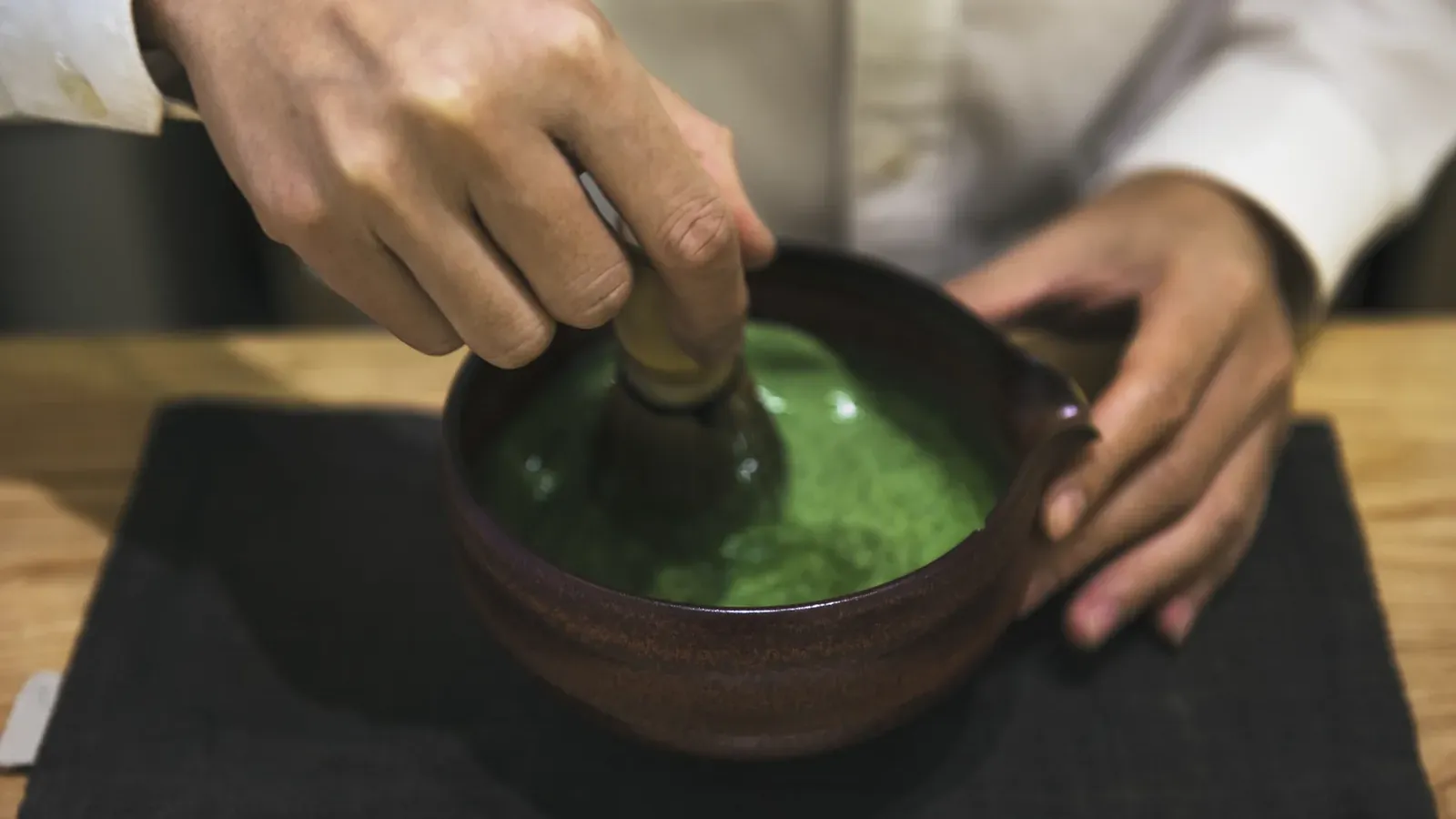
Five traits, plus a sixth that only shows up on your second order. Every quality claim a supplier makes eventually resolves into one of these, and each one has a production cost behind it, which is why they are also the traits worth paying for. The last column is the one to read across, because a trait you cannot verify on your own counter is a trait you are taking on trust.
| Trait | What good looks like | What it costs the producer | How you verify it |
|---|---|---|---|
| Color | Vivid, saturated, almost neon green, dry and in the bowl | 20 to 30 days of shading, first-flush leaf, cold sealed storage, a recent grind | Tip 2 g onto white paper in daylight, side by side against what you pour now |
| Suspension and texture | Stays suspended in water with no sediment, silky through a sieve | Slow, cool milling to 10 to 30 microns, on a mill that is the bottleneck of the whole operation | Whisk 2 g in 100 ml just-boiled water and leave it standing for one minute |
| Aroma | Sweet, green, faintly marine | Shading, a fresh grind, temperature control in the mill room | Smell the dry powder before anything else. It is the trait that fades first |
| Umami balance | Round sweetness carrying gentle rather than sharp bitterness | The final days of heavy shade, which cost yield | Taste it neat before you ever taste it in milk |
| Resistance in milk | Color and flavor still read through steamed or iced milk at your real dose | All of the above at once. This is the compound trait | Make your actual menu drink, at your actual dose, in your actual cup size |
| Batch consistency | The next 5 kg tastes like the last 5 kg | Single-source lots, mill capacity, and a supplier who holds leaf back | Order the same specification twice, three months apart, and taste them against each other |
Consistency is the trait cafes discover last and complain about most, because it is invisible in a single sample. It is also the one least connected to how the tea is made and most connected to how the supplier buys: whether they hold a named lot for you or re-source every quarter from whatever is available. In a market where tencha supply has not caught demand, that difference is what decides whether your matcha tastes the same in March and October.
Because the sample that wins on the tasting bench is not always the sample that should win the order. A matcha judged neat is judged on aroma and umami subtlety. A matcha poured into a 16 ounce iced latte with syrup is judged on almost nothing but color and resistance. If your volume driver is the second drink and you bought on the first test, you overpaid for qualities the cup destroys.
| What you sell | Traits that decide the buy | Traits you can trade away | Practical note |
|---|---|---|---|
| Straight matcha, usucha, matcha shot | Aroma, umami balance, color | Resistance in milk | Where first-flush leaf earns its premium, and usually your smallest volume |
| Hot latte, 12 oz | Resistance in milk, color, consistency | Fine aroma distinctions | Steam flattens top notes. Buy for what survives the steam wand |
| Iced and sweetened, 16 oz | Resistance in milk, color, suspension | Umami subtlety | Sugar and dilution punish thin powder hardest. Usually the volume driver |
| Baking and soft serve | Color, consistency, price per kilo | Aroma, umami | The oven removes aroma anyway. Do not pay for what you are about to destroy |
| Cold foam and dusted garnish | Color, suspension | Umami, aroma | Effectively a visual ingredient. A mid grade that stays green does the job |
Turn that into a number rather than an impression. Score each of the six traits from 1 to 5 on every sample, then weight them for your highest-volume drink: 3 for the traits in the deciding column, 2 for the rest of the six, 1 for the ones you listed as tradeable. Buy on the weighted total. Two lots that both taste excellent neat will routinely separate by eight to ten points once they are weighted for a 16 ounce iced latte, and that gap is the one your customers will taste. For what the price differences behind those scores are actually made of, see our guide to matcha grades and the real cost per drink.
Before a sample ships, send these eight lines and ask for the answers by email. Not because a supplier who answers is honest, but because the answers are checkable later and a verbal "yes, it is premium ceremonial" is not. Six of the eight are ordinary trade facts any real supplier has on hand.
| # | Ask for | A good answer | Red flag |
|---|---|---|---|
| 1 | Product name under Japan's standard | "Matcha, from tencha" or, honestly, "powdered tea" or "food-processing tencha" | "Matcha" with nothing behind it |
| 2 | Crude tea region | A named growing region | "Japan," or a region named with no distinction between growing and refining |
| 3 | Refining location | Named, or confirmed as the same as the growing region | Silence. Japan's own model wholesale shipping slip keeps these as two separate fields precisely because they often differ |
| 4 | Harvest period | First flush, with month and year | "Spring." There is no national date for first flush; Japan's standard defers to each municipality's customary classification, so a month is worth more than the word |
| 5 | Shading method and days under cover | Overhead or direct, plus the number of days | "Shade-grown," unqualified |
| 6 | Mill type and mill room temperature | Stone mill or ball mill, stated plainly, with a room temperature | Stone-mill imagery in the marketing and no specification in the offer |
| 7 | Particle size | A mean figure in microns | "Ultra fine" |
| 8 | Grind date and additives declaration | An actual grind date, plus a statement of no colorings or flavorings | A best-before date offered in place of a grind date |
The two that separate suppliers are lines 3 and 8. Line 3 because region branding in tea usually attaches to where leaf was refined and blended rather than where it grew, which is exactly why Japan's standard prints those as two separate fields on the wholesale shipping slip. Line 8 because ISO's own note that quality deteriorates immediately after grinding makes the grind date the most inconvenient number in the trade, and anyone milling to order can give it to you in a sentence. For what a named region does and does not promise, see what Uji matcha actually means.
Notice what is not on the list: the grade name. Japan's own implementing rules for this standard treat words like "complete," "highest," "extra fine," "special selection," "deluxe" and "special" as unfair labeling when there is no objective basis behind them, and treat "additive-free" as misleading because tea is normally made without additives in the first place. The vocabulary that dominates matcha marketing abroad is close to the vocabulary Japan's own rules view with the most suspicion. That is the whole argument for buying on eight checkable lines instead. Our guide to what ceremonial grade really means takes that apart in full.
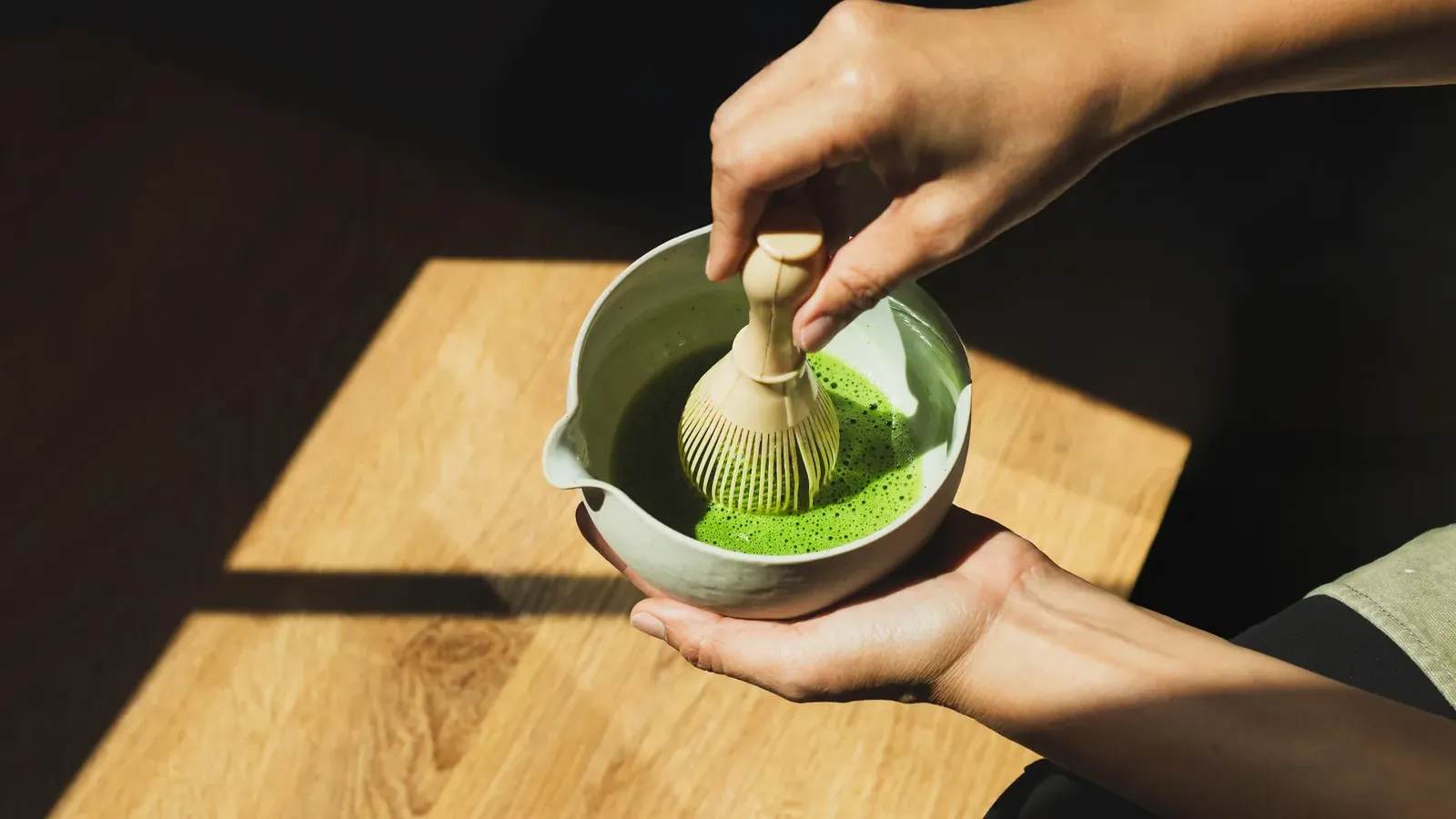
Five moves, a sieve, a whisk and a scale. Look at 2 g of dry powder on white paper in daylight. Smell it before you do anything else. Push it through a fine sieve and feel whether it is silky or gritty. Whisk 2 g into 100 ml of just-boiled water and watch it for a full minute, because quality matcha stays suspended without clumping or sedimenting. Then make your actual menu drink at your actual dose. The first four mirror the sensory method in ISO/TR 21380; the fifth is the one that protects your menu, and it is the one most buyers skip.
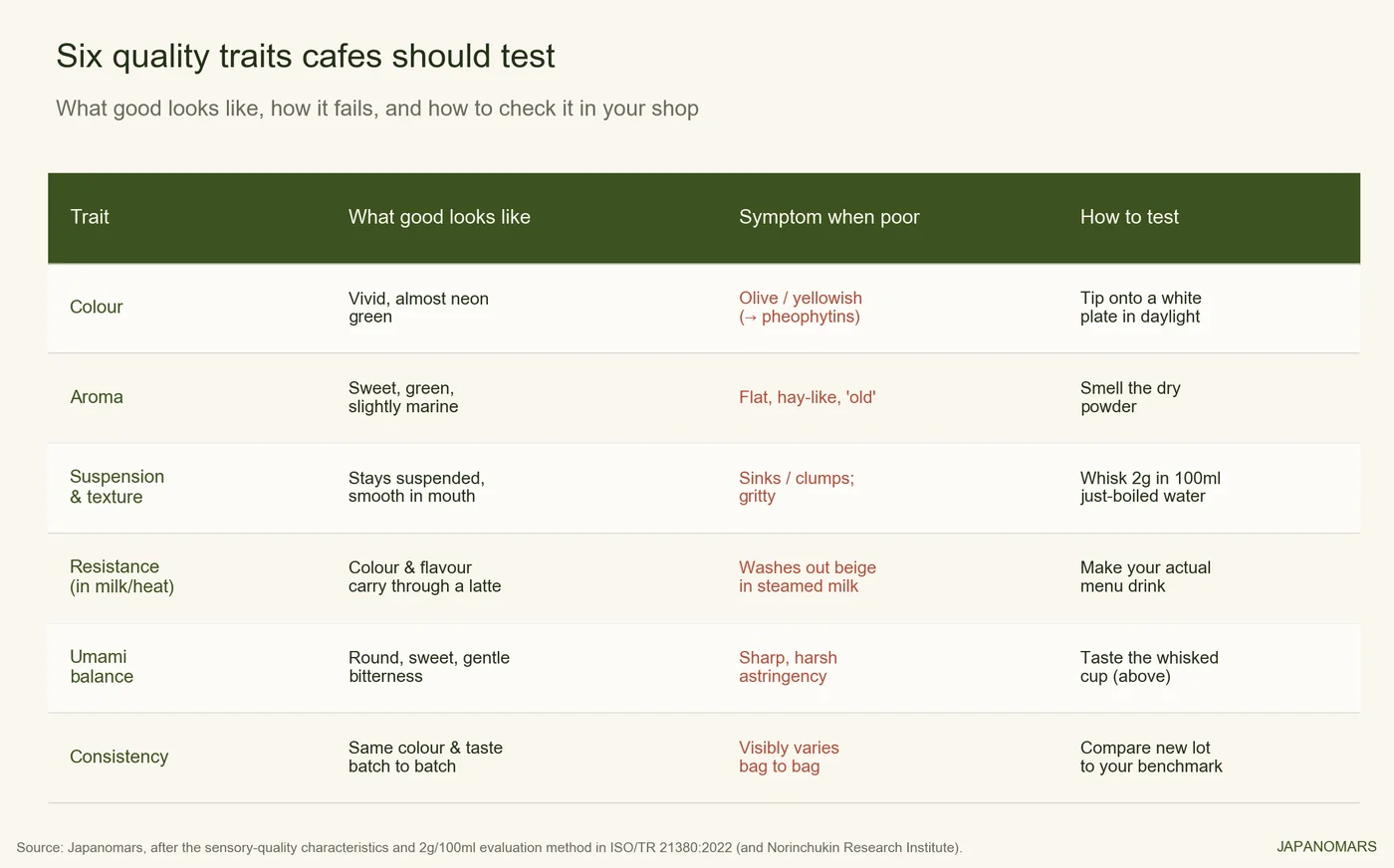
Run it against your current supply rather than in isolation, because the useful question is never "is this good" but "is this better than what I pour now, by enough to justify the change." The full 15-minute bench test has the protocol step by step, and how to evaluate a sample before you commit covers the paperwork side. For storing what you buy so the traits survive the first month, see matcha storage and shelf life.
We export first-flush matcha from named Japanese regions and work with cafes on standing supply rather than one-off orders, milling to order rather than shipping from stock. Tell us your highest-volume drink and its cup size, and we will send a sample set with all eight spec lines filled in, including region, refining location, shading, mill type and grind date, so you can run the weighted test yourself.
No. There is no binding legal definition of matcha in Japan or in major export markets. Japan's Green Tea Labeling Standard, last revised on July 10, 2026, is a voluntary industry labeling standard, and ISO/TR 21380:2022 is a technical report, which is informative rather than certifiable. In June 2026 the International Matcha Association published its first voluntary labeling and classification guidelines, also non-binding. Any green powder can still legally be sold as matcha, so verification is on the buyer.
No, and this is the most common overstatement in English-language matcha marketing. Japan's standard defines matcha as tencha powdered by a tea mill, then states that "tea mill or equivalent" includes equipment with a comparable function regardless of the grinding method. ISO/TR 21380 notes that normal-grade matcha may be ground in a ceramic ball mill or jet mill. Stone milling is a real quality argument for texture and aroma, because a slow, cool mill protects both. It is not what makes something matcha, and a supplier who tells you otherwise is selling a story rather than quoting a document.
They are three separate names in Japan's standard. Matcha is tencha, milled fine. Food-processing tencha is the standard's term for autumn tencha and mogacha, leaf still dried unrolled in a tencha furnace but understood to be supplied as a raw material for food manufacturing. Powdered tea is its own separate entry, defined as tea put through a grinder, and it is not tencha at all. All three can end up in a bag labeled matcha abroad, which is why the first line on the spec sheet asks which one you are actually buying.
Not in either primary document. Neither Japan's standard nor ISO/TR 21380 defines grade tiers for matcha, so ceremonial and culinary are trade and marketing vocabulary rather than specifications. Japan's implementing rules for the labeling standard go further and treat superlatives such as "highest," "extra fine" and "special selection" as unfair labeling where no objective basis exists. Grade words are still useful shorthand between a buyer and a supplier who agree on what they mean. They are not something you can verify or enforce.
Eight lines: product name under Japan's standard, growing region, refining location, harvest period with month and year, shading method and days, mill type with mill room temperature, mean particle size, and grind date with an additives declaration. Send them by email so the answers exist in writing. A supplier who can answer all eight in one reply is a different kind of counterparty from one who answers with adjectives.
A little clumping is normal and even a good sign. Genuinely fine matcha at 10 to 30 microns clumps because the particles attract each other statically, and a perfectly free-flowing powder is often either coarsely ground or carrying an anti-caking agent, which matcha by ISO's definition cannot contain. Sift before use and keep moisture out. The real test is what the powder does in water: it should stay suspended without clumping or sinking. Worry about matcha that stays gritty after sifting or sediments to the bottom of the bowl.
Storage degradation. Matcha's bright green comes from chlorophyll, which breaks down into pheophytins when exposed to light, heat, moisture and oxygen, turning the powder olive and the flavor flat. ISO advises sealed, nitrogen-flushed aluminium foil with minimal headspace, kept at 5 degrees C or below, and using it within a few weeks of opening for the best color and taste.
Sealed, opaque, cool and dry, and away from the steam wand. Buy in pack sizes you will finish within a few weeks of opening rather than one large tin that sits half-used behind the bar fading. If you are ordering in volume, split the order into smaller sealed units rather than taking it in one container, and keep the unopened units refrigerated.
Same dose, same water, same day, same person tasting, and both scored blind against your current supply as the control. Run all six traits from 1 to 5, weight them for your highest-volume drink, and then compare the weighted totals rather than your impression of the neat bowls. Ask both for the same eight spec lines, and treat a refusal to give a grind date as a scored result rather than a neutral non-answer.
Resistance in milk, then color, then suspension. Sugar, ice and dilution flatten aroma and umami subtleties that you would have paid a premium for, while a thin powder goes visibly beige and tastes vaguely grassy through the milk. Buy the lot that still reads green and still tastes of something at your real dose in your real cup, and do not pay for the last increment of neat-bowl sweetness that the build removes.
Matcha is not a regulated word, so good matcha has to be recognised rather than assumed, and the recognising is easier than the marketing suggests. Six traits carry every real quality claim, and each has a production cost behind it that a supplier can either explain or cannot. Weight those traits to the drink that actually moves on your bar, not to the bowl you taste in a sales meeting. Ask for the eight spec lines in writing before a sample ships, then run the fifteen-minute test against what you already pour and buy on the weighted total. That sequence costs one email and one afternoon, and it replaces every grade word on the market with something you can check.
Written by Hiroshi Asami, founder and CEO of Japanomars, which exports Japanese matcha to cafes in the United States, Canada and the Philippines. He sources through direct relationships with growers and processors including Kyoto (Uji and Joyo), Sayama, Ibi, Ureshino, Yame, Kirishima and Chiran, and has led four sourcing tours bringing overseas cafe owners to Japanese tea farms. The Japanese sources on this page were read in the original.
Sources
%E7%99%BD_%E5%A4%A7%E3%81%8D%E3%81%84.png)