%E5%A4%A7%E3%81%8D%E3%81%84.png)
Sourcing · Origin · 2026
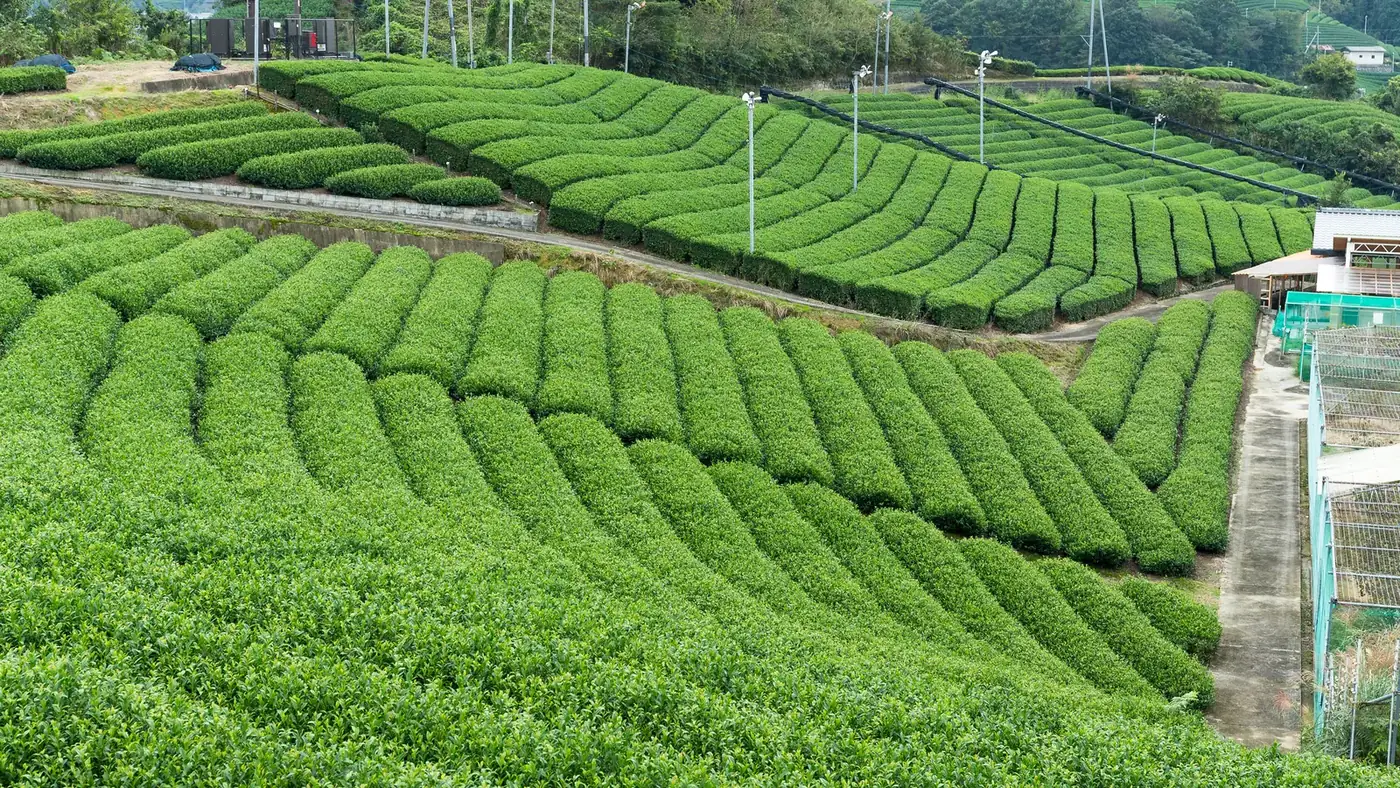
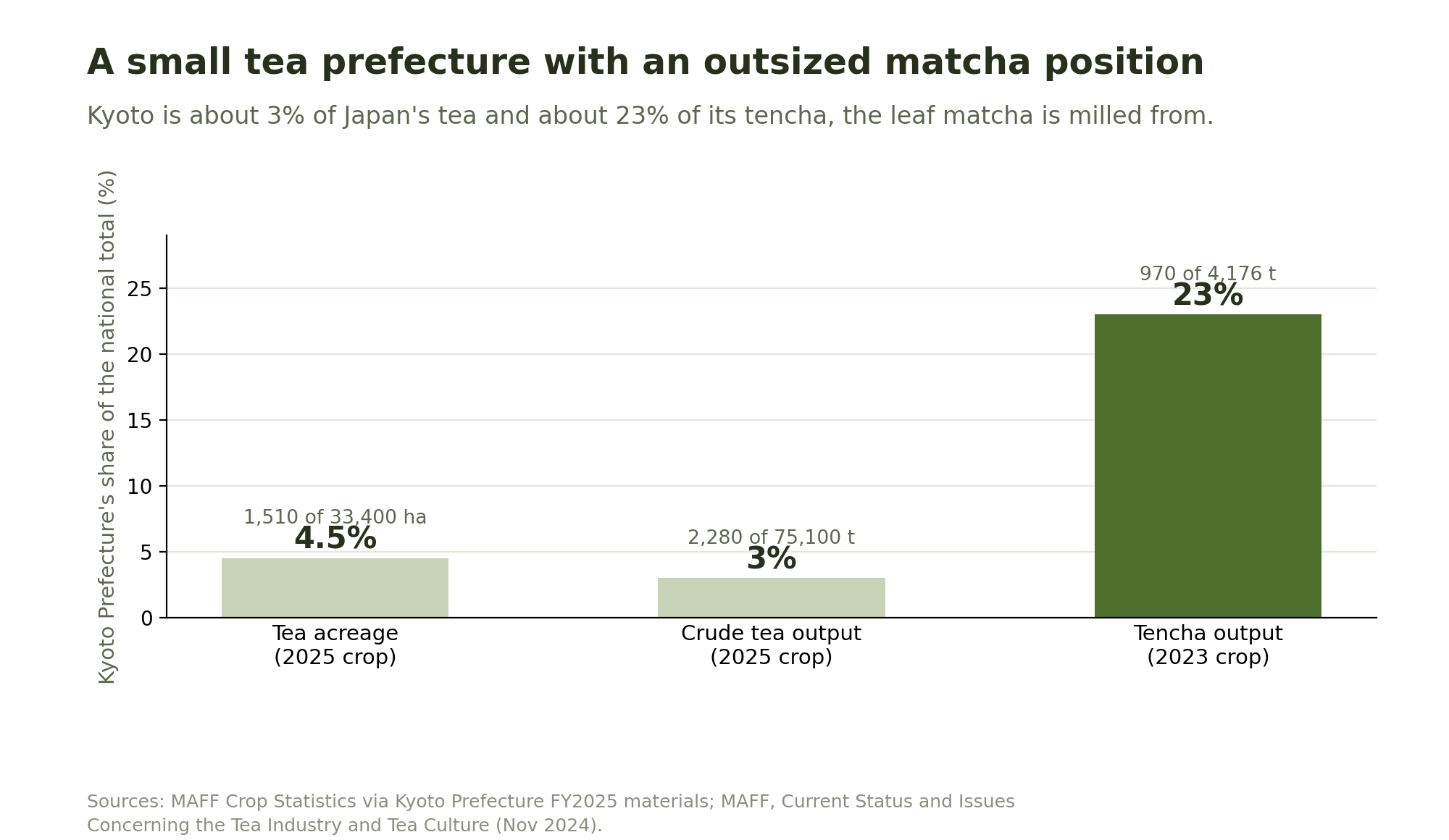
"Uji matcha" is a regional designation, not a farm address. Under the definition the Kyoto Prefectural Tea Industry Assembly adopted in 2004, Uji tea is tea grown in one of four prefectures, Kyoto, Nara, Shiga or Mie, and finished by a Kyoto business inside Kyoto. Kyoto Prefecture grows about 3 percent of Japan's crude tea, yet it accounts for roughly a quarter of the country's tencha, the shaded leaf that becomes matcha.
This guide is for cafe buyers deciding whether an Uji label is worth the premium, and what to ask a supplier who puts it on a tin.
Key takeaways
In this guide
Uji matcha is matcha that meets the Uji tea definition set by the Kyoto Prefectural Tea Industry Assembly in 2004: tea grown in Kyoto, Nara, Shiga or Mie, then finished by a Kyoto business within Kyoto Prefecture, with Kyoto-grown leaf given priority. It is a trade definition maintained by an industry body, not a government geographical indication, and it says nothing about grade.
That surprises most buyers, and it should change how you read a label. An Uji tin can legitimately contain leaf grown in Mie and blended and milled in Kyoto. It can also contain leaf from a single Kyoto farm you could visit. Both are correctly labeled. The word tells you where the tea was finished and which four prefectures it may have come from. It does not tell you the field, the harvest, or the cultivar.
The name still carries real weight, because Kyoto's tea sector is unusually concentrated in matcha's raw material. Nationally, tencha production reached a record 4,176 tonnes in the 2023 crop year, and Kyoto supplied 970 tonnes of that, about 23 percent, second only to Kagoshima's 1,585 tonnes, according to Japan's Ministry of Agriculture, Forestry and Fisheries. Meanwhile Kyoto accounted for only about 3 percent of national crude tea output in the 2025 crop year. Kyoto is a small tea prefecture that made itself a large matcha prefecture.
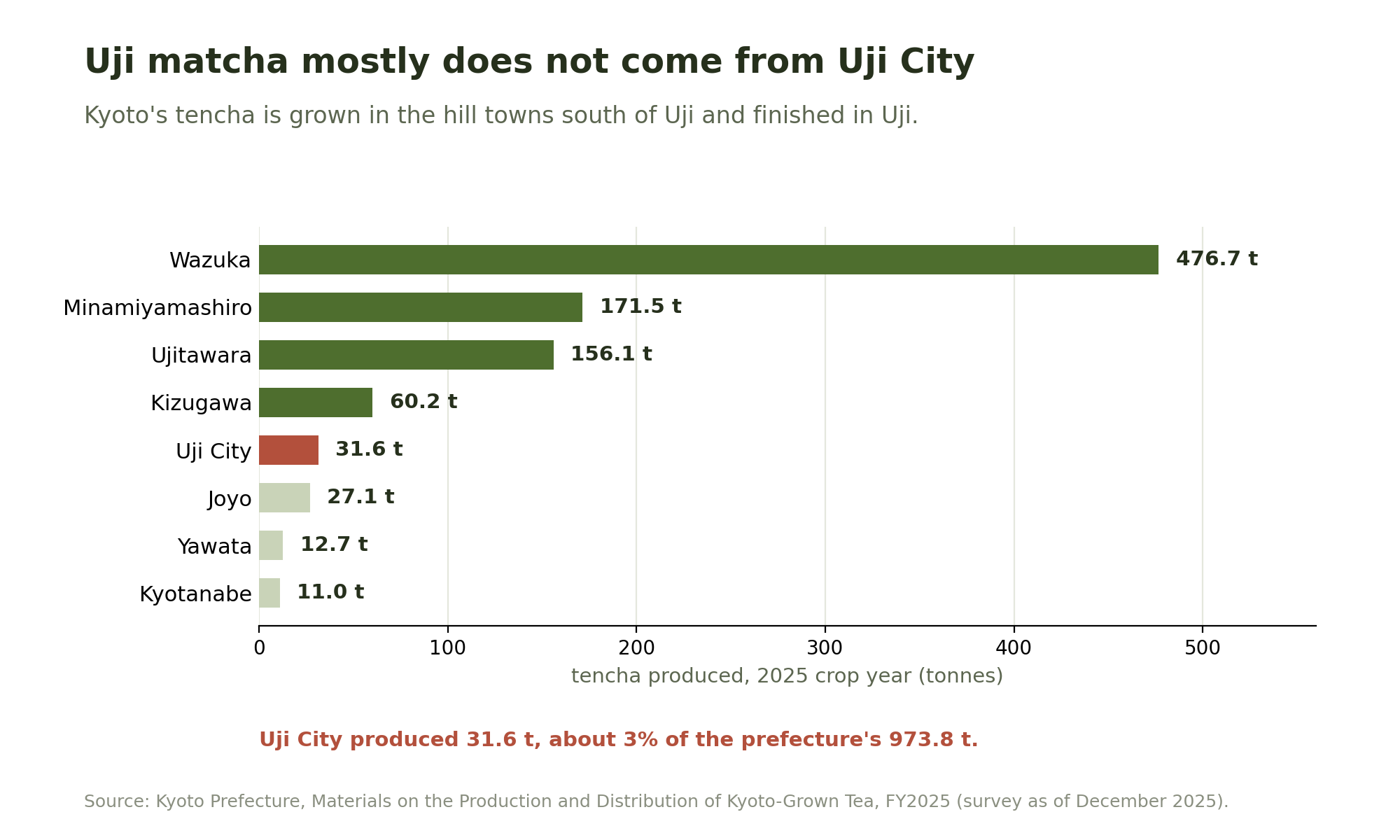
Mostly not from Uji City. In the 2025 crop year, Kyoto Prefecture produced 973.8 tonnes of tencha, and the town of Wazuka alone accounted for 476.7 tonnes of it, followed by Minamiyamashiro Village at 171.5 tonnes and Ujitawara at 156.1 tonnes. Uji City itself produced 31.6 tonnes, roughly 3 percent of the prefecture's tencha.
These figures come from Kyoto Prefecture's own annual survey, and they describe a landscape most buyers have never heard of. Wazuka is a steep valley of terraced tea about 40 minutes south of Uji. Minamiyamashiro is the prefecture's southernmost village. Ujitawara is where the sencha method was invented. Uji City is where much of the region's tea is finished, blended and milled, and where the merchants have their names on the door.
None of that makes Uji matcha inauthentic. It makes it regional rather than local, which is exactly what the 2004 definition says. But "from Uji" and "from an Uji farm" are different claims, and only one of them can be checked. If provenance is part of what you sell, ask for the town, not the region. We compare the growing regions in our guide to Japanese matcha regions.
Because Uji has had an eight-century head start, and because two of the inventions that define Japanese tea happened there. The story runs from the monk Eisai bringing tea cultivation back from China, through Myoe, who is credited with teaching Uji's villagers to grow it, to shaded cultivation in the 16th century and the sencha method in the 18th.
Shading matters most for matcha. In the 16th century, growers in Uji began covering tea fields with screens woven from reeds harvested at Ogura Pond, suppressing astringency and producing tencha, the leaf that is ground into matcha. Every shaded field in Japan today, including the ones in Kagoshima that now out-produce Kyoto, descends from that practice.
The second invention came in 1738, when Nagatani Soen, a tea farmer in Ujitawara, developed the hand-rolling method that produced a greener, more aromatic leaf tea than anything before it. It spread nationwide and became the basis of sencha. Toshikazu Yoshida, chairman of the Uji Tea Processing Technique Preservation Association, put Kyoto's position plainly at the association's July 2026 training session: the prefecture is a small share of the national tea area, and yet when people say tea, they say Uji.
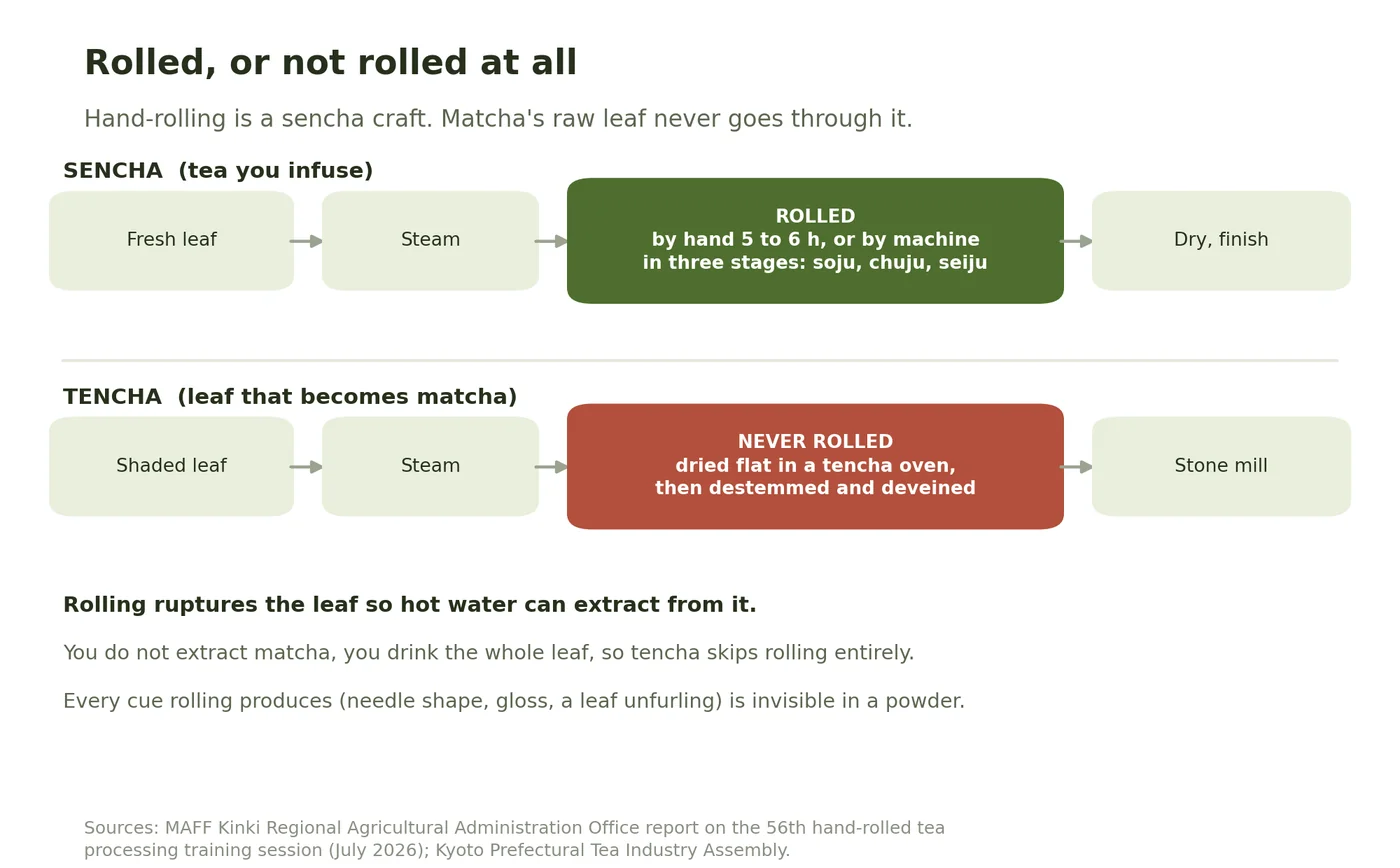
Rolling is what turns steamed leaf into tea you infuse, and matcha does not go through it at all. Sencha leaf is rolled, either by machine in three stages or by hand over a heated table for five to six hours. Tencha, the leaf destined for matcha, is steamed and then dried flat without any rolling, then destemmed and stone-milled. This is the single most useful process fact a matcha buyer can hold.
Hand-rolling, temomi, survives as a preserved craft rather than a production method. In July 2026 the Uji Tea Processing Technique Preservation Association held its 56th annual training session at the Kyoto Prefectural Tea Research Institute in Uji, according to a report by the Kinki Regional Agricultural Administration Office of Japan's Ministry of Agriculture, Forestry and Fisheries. Steamed leaf is worked over a charcoal-heated table through named stages including momikiri and yokomakuri, for five to six hours, until it dries down to roughly a fifth of its starting weight. Yoshida describes the goal as rolling the leaf round, thin and long, so that it opens out fully in hot water. That, he says, is the technique.
Almost all commercial sencha is now machine-rolled through three stages, soju, chuju and seiju, which do the same job faster, and very few producers still hold the hand skill. The association was formed in 1969 to keep it alive, and in 2009 the Kyoto Prefectural Board of Education designated Uji hand-rolled tea processing an intangible folk cultural property.
So why should a matcha buyer care about a craft their product does not use? Because knowing what rolling does tells you what it cannot do. Rolling ruptures the leaf so hot water can extract from it. You do not extract matcha, you drink the whole leaf, which is why tencha skips rolling and goes straight to the stone mill. Every quality cue rolling produces, the needle shape, the gloss, the way a leaf unfurls in the cup, is invisible in a powder. What is left is the part that came before the machine: the leaf itself. The full sequence is in how real matcha is made.
Yoshida gave the training session a line that belongs on every buyer's wall: roll a leaf of fifty strength with a technique of one hundred and you still will not get good tea. He was talking about hand-rolling, but the principle is the ceiling rule for the whole category. Processing can preserve quality and it can destroy it. It cannot create it.
For matcha the rule bites harder than for sencha, because less processing sits between the field and the cup and weak leaf has nowhere to hide. Shade, harvest timing and field management set the ceiling. Covering a field for weeks before picking raises the amino acids that read as umami and suppresses the catechins that read as bitterness, and first-flush leaf carries more of that character than later harvests. Cultivar matters too: plantings of Seimei, a cultivar developed for covered cultivation, rose roughly tenfold between the 2019 and 2023 crop years according to the agriculture ministry.
The practical consequence is that milling quality and grade names are the last things to interrogate, not the first. A perfectly stone-milled powder from tired second-flush leaf is still tired second-flush leaf. When a sample comes up flat, the problem is usually upstream of anything the supplier can adjust. We cover how grade vocabulary maps to what you are buying in matcha grades explained.
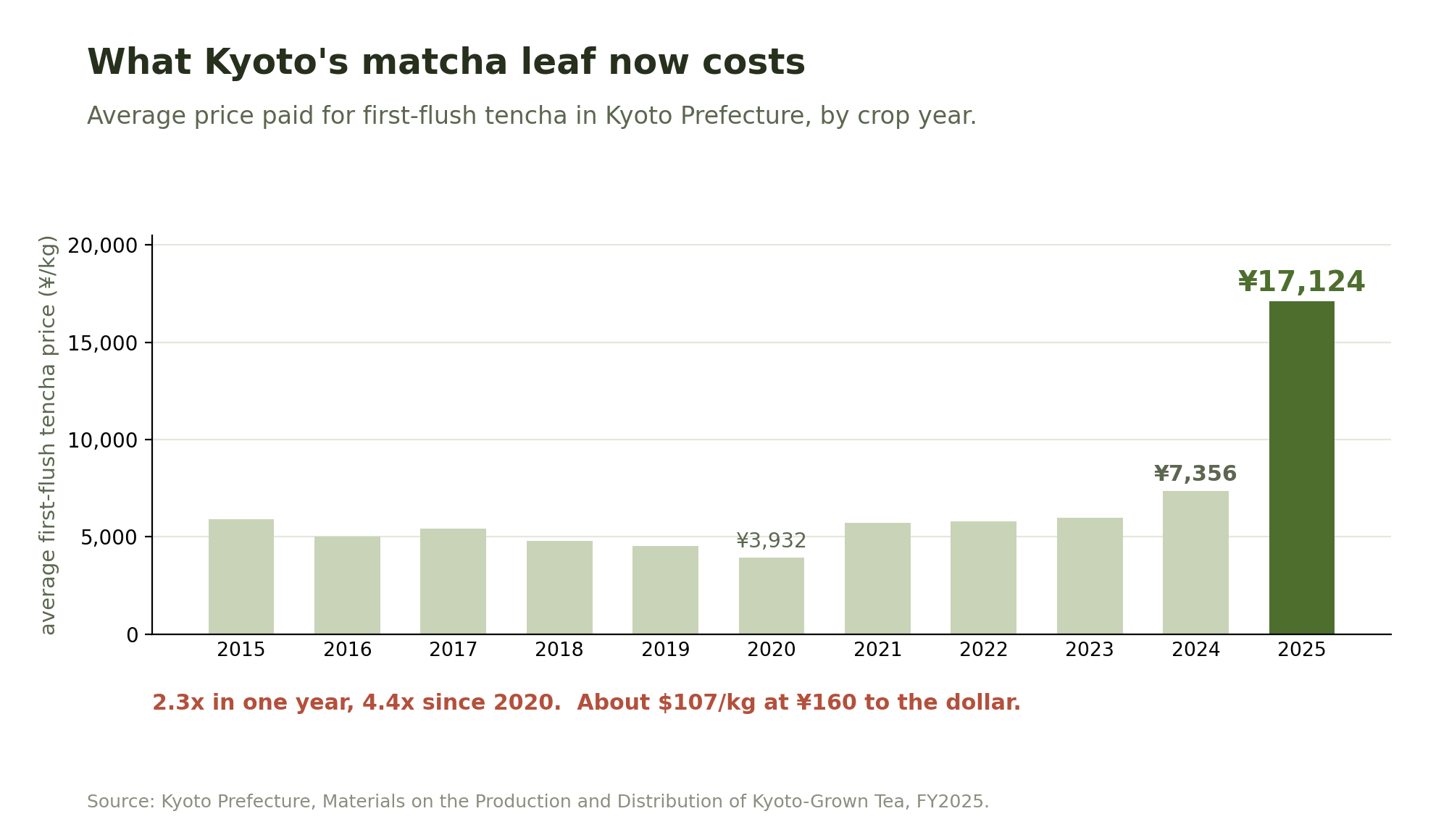
More than it did, by a wide margin. The average price of first-flush tencha in Kyoto reached 17,124 yen per kilogram in the 2025 crop year, against 7,356 yen the year before and 3,932 yen in 2020, according to Kyoto Prefecture's production and distribution survey. At 160 yen to the dollar that is roughly $107 per kilogram of raw tencha, before destemming, milling, packaging, export or anyone's margin.
Volume moved the other way. Kyoto's tencha output fell to 973.8 tonnes in the 2025 crop year, about 92 percent of the previous year, and total crude tea output dropped to 1,973.3 tonnes, around 79 percent of the prior year. The number of tea-producing households in the prefecture fell to 612 from 625. Less leaf, sharply more money per kilogram, from a shrinking grower base.
For a cafe this shows up as higher wholesale prices on anything carrying an Uji or first-flush claim, longer lead times on named-origin lots, and suppliers asking for volume commitments they would not have asked for two years ago. If the Uji premium is not doing specific work on your menu, price it against a well-chosen lot from another region this year. If it is doing work, lock the volume early.
Ask questions the label cannot answer. The Uji designation covers four prefectures and says nothing about grade, so the only way to know what you are buying is to ask for specifics and see whether they arrive. Five questions do most of the work.
If you get four or five straight answers, you have a supplier who knows their own supply chain. If you get marketing language, you have a reseller, which is not automatically bad but should be priced as such. The trade-offs between buying farm-direct and buying through a trading company are laid out in our farm-direct versus trading company guide.
From the sourcing floor
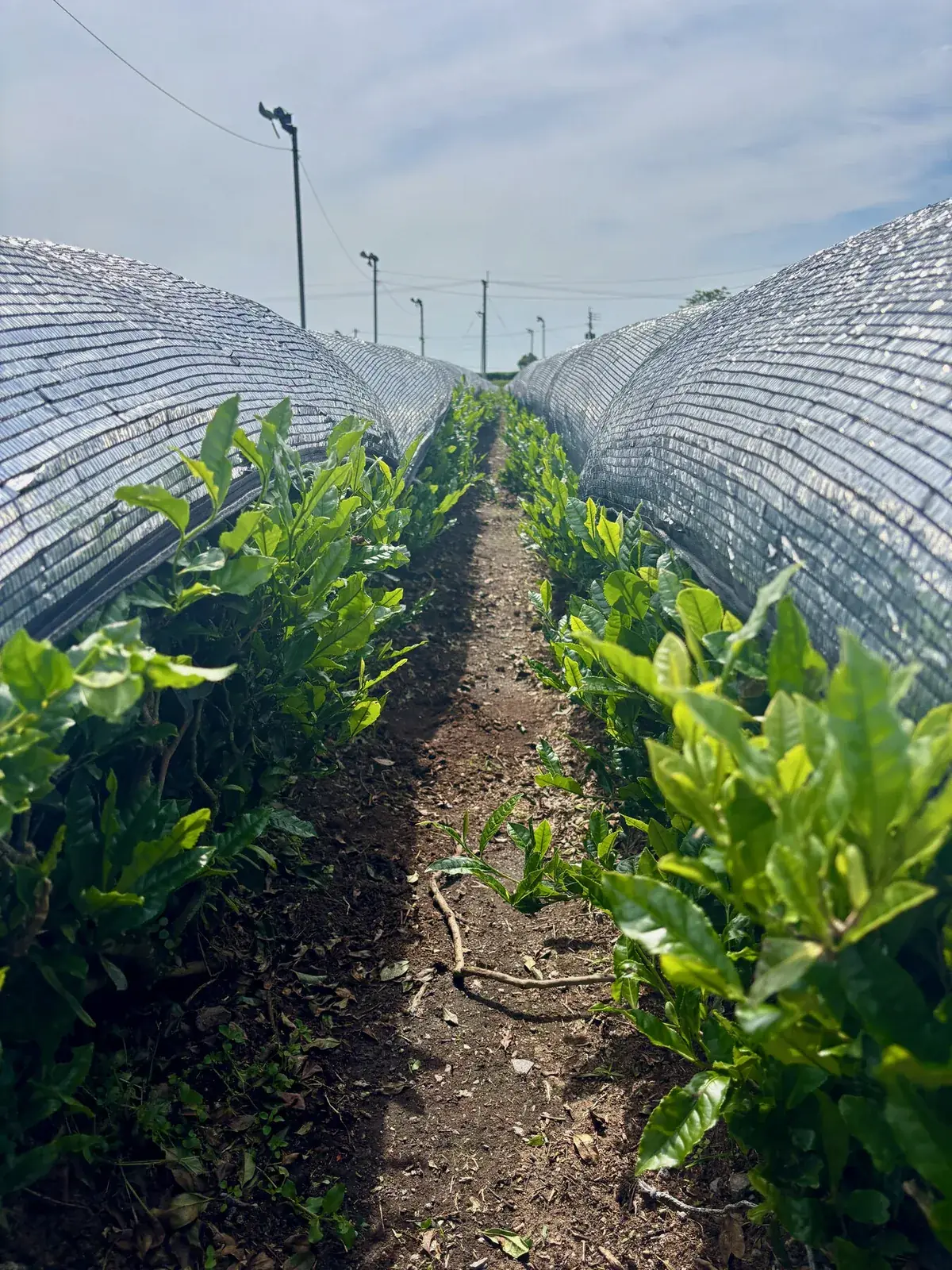
When we walk cafe owners through a farm, the thing that changes their buying is never the mill room. It is standing under the covers and seeing how long the field has been shaded, and hearing the grower explain why they picked on the day they picked. That is the fifty-versus-hundred conversation, held in the field where it is actually decided.
Uji matcha is matcha meeting the Uji tea definition adopted by the Kyoto Prefectural Tea Industry Assembly in 2004: tea grown in Kyoto, Nara, Shiga or Mie and finished by a Kyoto business inside Kyoto Prefecture, with Kyoto-grown leaf prioritized. It is a trade designation covering four prefectures, not a single-farm or single-town claim, and it does not indicate grade.
Not automatically. Uji is a designation, not a quality tier, and Kagoshima now produces more tencha than Kyoto. What Uji reliably carries is depth of experience: shaded cultivation began there in the 16th century, and its finishing and blending houses are long established. Judge the lot on harvest, shading and cultivar rather than on the regional name.
No. Hand-rolling, temomi, is a sencha craft, and matcha's raw leaf is never rolled at all. Tencha is steamed and dried flat without rolling, then destemmed and stone-milled. Hand-rolling survives as a preserved cultural technique, designated an intangible folk cultural property by Kyoto Prefecture in 2009, rather than as a commercial matcha process.
Kyoto supplied about 23 percent of Japan's tencha in the 2023 crop year, 970 tonnes out of a record national total of 4,176 tonnes, second to Kagoshima at 1,585 tonnes, according to Japan's agriculture ministry. Kyoto accounts for only about 3 percent of the country's total crude tea output, so it is a small tea prefecture with an outsized matcha position.
Kyoto's average first-flush tencha price reached 17,124 yen per kilogram in the 2025 crop year against 7,356 yen a year earlier, per Kyoto Prefecture's survey, while the prefecture's tencha output fell to 973.8 tonnes and grower households dropped to 612. Export demand rising against a shrinking, aging production base is the short explanation.
Ask for the town, the harvest, the shading duration and method, the cultivar, and the milling date. Those five answers describe the lot in your cup far more precisely than the words Uji or ceremonial on the packaging. A supplier who can answer all five without checking is working close to the farm.
Uji earned its reputation over eight centuries, and the craft traditions still practiced there are worth knowing about. But the reason a hand-rolling master's line about fifty-strength leaf matters to a buyer is that it points away from the label and toward the field. Uji tells you a tea was finished in Kyoto. The town, the harvest, the shading and the cultivar tell you what is in the cup.
If you would rather taste that difference than read about it, we can put single-origin lots in front of you with the town, farm, cultivar and milling date attached, side by side against whatever you pour now.
Hiroshi Asami is the founder of Japanomars, which exports Japanese matcha to cafes in the US, Canada and the Philippines. We buy from growing regions including Sayama, Ibi, Ureshino, Yame, Kirishima and Chiran, work directly with farms alongside wholesalers, and have hosted four tours bringing overseas cafe owners to Japanese tea farms.
Sources
%E7%99%BD_%E5%A4%A7%E3%81%8D%E3%81%84.png)