Matcha Wholesale in Saudi Arabia: SFDA Registration, VAT and Shipping from Japan
By Hiroshi Asami · Japanomars · Updated November 10, 2026
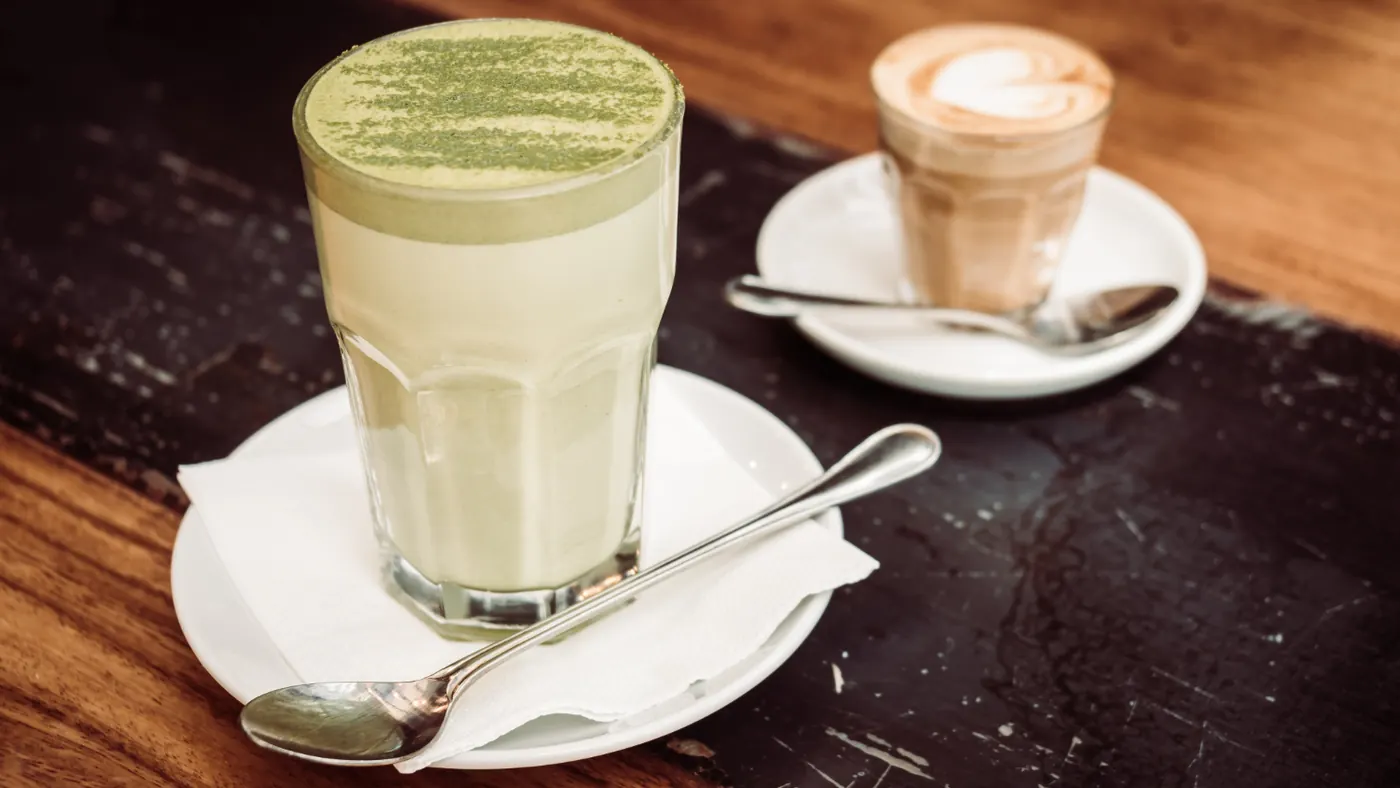
A matcha latte at a cafe. This page is about the paperwork that gets the powder from Japan into Saudi Arabia.
We supply Japanese matcha to cafes and importers from 5 kg per order, milled after you order in Japan. Saudi Arabia has become one of the fastest-growing destinations for Japanese matcha: Japan’s green tea exports to the Kingdom roughly tripled in 2025, to about 114 tonnes, and almost all of it was powder. Duty is not the hurdle here. The hurdle is the Saudi Food and Drug Authority (SFDA): who registers the matcha, what the bag has to say, and how it is allowed to arrive. This page walks through each step, using ZATCA’s tariff and SFDA’s own clearance rules.
Key takeaways
Duty depends on the line: ZATCA’s 12-digit tariff shows no duty on green tea (0902.10 and 0902.20) and 6% on black tea, so matcha has to be declared as green tea. Your broker confirms the line on the first declaration.
VAT is 15%: every import pays 15% VAT on the customs value (cost, insurance and freight) plus fees. There is no reduced rate for food.
SFDA first: the importer registers its business and each matcha in SFDA’s Ghad system, then files the clearance in Fasah. Both tea lines are flagged for SFDA release at the port.
A small importer can skip the warehouse: SFDA waives the licensed-warehouse requirement for importers with up to 5 shipments and 2,000 kg a year.
Labels: retail packs need Arabic. Matcha that a cafe or restaurant prepares into drinks, rather than selling the bag, can come in with an English label against a commitment filed in Fasah.
Post with care: Japan Post says plant-derived products to Saudi Arabia need SFDA approval in advance, or the parcel goes back to Japan. Bulk lots go by air cargo through your forwarder.
No DDP for Saudi Arabia: the importer of record has to be registered in Saudi Arabia, so your importer clears each shipment and pays the VAT. We prepare the documents for it.
Uji included: matcha from the Uji area of Kyoto is available alongside our other regions.
Japanomars at a glance
Who we are: Japanomars is a Japan-based matcha wholesale supplier for independent cafes, run by founder Hiroshi Asami. We work with tea farmers in more than eight regions: Kyoto (Joyo and Wazuka, in the Uji area), Sayama, Ibi, Yame, Ureshino, Kirishima, Chiran and Miyazaki.
Who we supply: cafes and matcha brands in the United States, Canada, the Philippines and Europe.
How a Saudi order works: 5 kg per order in total (grades can be mixed), milled after you order, shipped from Japan to the importer registered with SFDA, or handed to your forwarder in Japan. Your importer clears the shipment and pays the VAT in Saudi Arabia (we do not ship DDP to Saudi Arabia). 2 to 4 weeks from order to delivery, shipping included, not counting the time your importer needs for SFDA registration.
Price: latte grade about $100 to $160 per kg, ceremonial about $160 to $210, quoted at 1 kg.
Samples: about US$20 per bag plus US$25 shipping. The sample cost comes off your first bulk order if you place it within a month of the samples arriving.
Traceability: every lot is tied to its region and its grower, so you can tell your customers who grew the matcha in their cup.
Saudi Arabia does not let a parcel of food find its own way to a cafe. Under SFDA’s Conditions and Requirements for Food Clearance (August 2026 edition), the importer has to have done three things before the first shipment leaves Japan:
A commercial registration (CR) that covers trading in food, which is also what the importer uses to register on ZATCA’s Fasah platform, where every import is declared.
Its business registered in Ghad, SFDA’s integrated platform for food establishments.
Each product registered in Ghad. Registration is per importer, so a matcha already registered by another company still has to be registered again under yours. Plain matcha is an ordinary food, not one of the health, infant or special-purpose foods that need SFDA’s pre-registration evaluation.
SFDA also expects a licensed warehouse, but it exempts importers whose shipments in a calendar year are no more than 5, with a combined weight of no more than 2,000 kg. For a cafe group bringing in matcha a few times a year, that exemption is the difference between a project and a paperwork exercise.
That leaves two setups that work for a cafe:
Buy through a Saudi food importer or distributor that is already registered in Ghad and adds our matcha to its product list.
Register your own company as the importer. Realistic for a cafe group or a brand with a CR that covers food: register in Fasah and Ghad, register each matcha, and stay within the 5-shipment, 2,000 kg exemption or use a licensed warehouse.
Either way, tell us the importer’s name and SFDA registration details before we pack. We put them on the bag label so the goods match what was registered.
What you pay: duty, 15% VAT and a small customs fee
Saudi Arabia applies its own 12-digit tariff. These are the lines ZATCA shows for tea from Japan:
Tariff line (ZATCA)
What it covers
Duty
0902.10.00.00.00
Green tea, in immediate packings of 3 kg or less (matcha in 1 kg bags)
0%
0902.20.00.00.00
Other green tea, for example larger bulk packs
0%
0902.30 and 0902.40
Black tea
6%
Rates from the ZATCA integrated tariff, checked November 9, 2026. Neither green tea line is split further at 12 digits.
Matcha is green tea, so it is declared under 0902.10 or 0902.20, not as a "tea product" under a black tea or flavoured line. Saudi Arabia raised duty on a list of foods in June 2026; the green tea lines still show 0% in ZATCA’s tariff after that change. There is no trade agreement between Japan and Saudi Arabia, or Japan and the GCC, in force (negotiations on a Japan-GCC agreement were in their third round in May 2026), but on green tea lines that already show no duty, the missing agreement costs nothing.
What the importer does pay:
VAT at 15% on the customs value, which includes freight and insurance, plus any duty and customs fees. ZATCA applies it to all imported goods whatever their duty rate, and food has no reduced rate. A VAT-registered importer normally recovers it in its VAT return.
The customs fee: since October 6, 2024, 0.15% of the value of the goods including insurance and freight, with a minimum of SAR 15 and a maximum of SAR 500. On a typical 5 kg matcha order that is the SAR 15 minimum.
At the port: SFDA release and lab samples
Both green tea lines carry a note in ZATCA’s tariff: on import, the shipment is referred to SFDA, which approves its release or refuses it. That release is where a Saudi matcha import is won or lost, and it depends on the documents matching the goods.
What goes into the Fasah clearance request for food:
Commercial invoice naming each item, its quantity, its expiry date and lot number. We issue it this way for every Saudi shipment.
Certificate of origin. ZATCA lists it as unnecessary when the origin is clearly established, but importers usually want one. We obtain a certificate of origin from the Japan Chamber of Commerce and Industry on request.
Bill of lading or air waybill. The declaration is due at least 48 hours before the goods reach the port, so we send you the documents as soon as the shipment is booked.
A health certificate or phytosanitary certificate, if asked for. SFDA’s import rules tie health certificates to products of animal origin and phytosanitary certificates to fresh produce and grain, and Japan’s Plant Protection Station marks green tea to Saudi Arabia as a case that may fall outside plant quarantine. If your broker says a certificate is needed for your shipment, we arrange it in Japan.
SFDA can take samples from an imported shipment and send them to its designated laboratories, with the cost of the analysis on the importer. Your importer may want a lab report on the lot before it ships. If you need a test report, raise it at the sample stage. What a producer can provide varies, so we confirm it lot by lot.
Two things you do not need to plan for. A halal certificate is required for meat, for foods containing meat derivatives, gelatine or animal fats, and for any product that carries a halal logo. Pure matcha is none of these. And Saudi Arabia lifted its post-2011 restrictions on Japanese food in November 2017, so matcha from Japan needs no radiation certificate.
The label: Arabic for shelves, English for the kitchen
SFDA’s labelling regulation for prepackaged food (SFDA.FD/GSO 9) requires the label in Arabic. Another language may appear alongside it, but it has to say the same thing as the Arabic. For retail tins on a shelf in Riyadh or Jeddah, plan on a full Arabic label from the start; we can apply your approved Arabic label to each pack before it leaves Japan.
For cafes there is a lighter route. SFDA exempts food imported for factories and restaurants from the Arabic label clause, where the product is not served or consumed directly by the consumer and is prepared or processed first. The importer files a commitment in Fasah that the label will be in English. Matcha whisked into lattes behind the counter fits that description, while a bag sold to customers does not. Ask your broker to confirm how SFDA will read your setup before the first shipment.
Two other points on the bag:
No nutrition table needed. SFDA’s nutrition labelling regulation (SFDA.FD 2233) does not apply to single-ingredient foods, and it names tea as an example. Pure matcha qualifies.
Dates. SFDA checks expiry dating against SFDA.FD/GSO 150-1 at clearance. Each bag carries the production date and the expiry date.
Why we do not just post it: the plant-product rule
On paper, EMS to Saudi Arabia looks easy. Japan Post puts the Kingdom in EMS zone 3, where a parcel of around 5 kg costs 13,000 yen, and lists 12 days from Tokyo, not counting the day of posting. EMS is delivered Sunday to Thursday, and every parcel with goods in it is charged VAT on arrival.
Japan Post’s conditions for Saudi Arabia carry one more line. Drugs, medicines, plant-derived products and foods for medical purposes need the prior approval of the Saudi Food and Drug Authority, and parcels containing them without that approval are returned to the sender. Neither Japan Post nor SFDA says whether a food like matcha counts as a plant-derived product here. We do not find out by losing your parcel, so:
EMS, once cleared in advance. We post matcha to Saudi Arabia by EMS only after your importer has confirmed with SFDA how the parcel will be released, and we address it to the importer registered in Ghad.
Air cargo for bulk. Your importer’s freight forwarder picks the lot up in Japan on EXW terms and books the flight to Riyadh, Jeddah or Dammam. On our side, the bags are sealed and labelled and the invoice, packing list and certificate of origin are ready on the pickup day.
Not by ordinary airmail or SAL. Japan Post has suspended SAL to Saudi Arabia, and a small parcel without an importer behind it has no one to take it through SFDA.
We do not hold milled stock: each order is milled for you, so plan on 2 to 4 weeks between order and delivery including transport, or 8 to 10 weeks in the spring first-harvest season. Ghad registration is a separate clock on your importer’s side, so start it before you order. Our dosing chart turns drinks per day into kilograms per month.
Samples
SFDA has a route for samples that are not for sale: the label carries the phrase "Free Sample", and the importer submits a commitment in Fasah that the samples will not be sold. So for Saudi Arabia there are two ways to get samples:
By EMS to your importer, marked "Free Sample", once your importer has confirmed the release with SFDA as above.
To your agent or forwarder in Japan. You pay only for delivery within Japan, and the samples travel to Saudi Arabia with your agent’s next consignment.
The sample cost comes off your first bulk order if you place it within a month of the samples arriving.
How a Saudi order runs, step by step
Volume and importer of record. How many matcha drinks you sell a day (or kilograms a month), the matcha you use today, and whose name goes on the Fasah declaration: your company, a Saudi distributor, or a forwarder collecting in Japan.
Samples. By EMS marked "Free Sample" once your importer has the release confirmed, or to your agent in Japan.
Registration. Your importer registers each chosen matcha in Ghad, using the product details and label we send.
Label. English for matcha your cafe prepares into drinks, with the Fasah commitment, or your approved Arabic label for retail packs. We apply it before shipping.
Milling and packing. The matcha is milled for your order and sealed in 1 kg bags carrying the importer’s details. We issue the invoice with lot numbers and expiry dates, plus a certificate of origin on request.
Clearance in Saudi Arabia. Your importer declares the shipment in Fasah at least 48 hours before arrival, SFDA releases it, and your importer pays the 15% VAT and the customs fee.
What you get from us
What you get from us is not one farm but access to many. We are connected with farms all over Japan, including the Uji area of Kyoto, and we choose each one ourselves: we visit, we look with our own eyes, and we taste the samples before deciding which farms are the right fit for cafe owners.
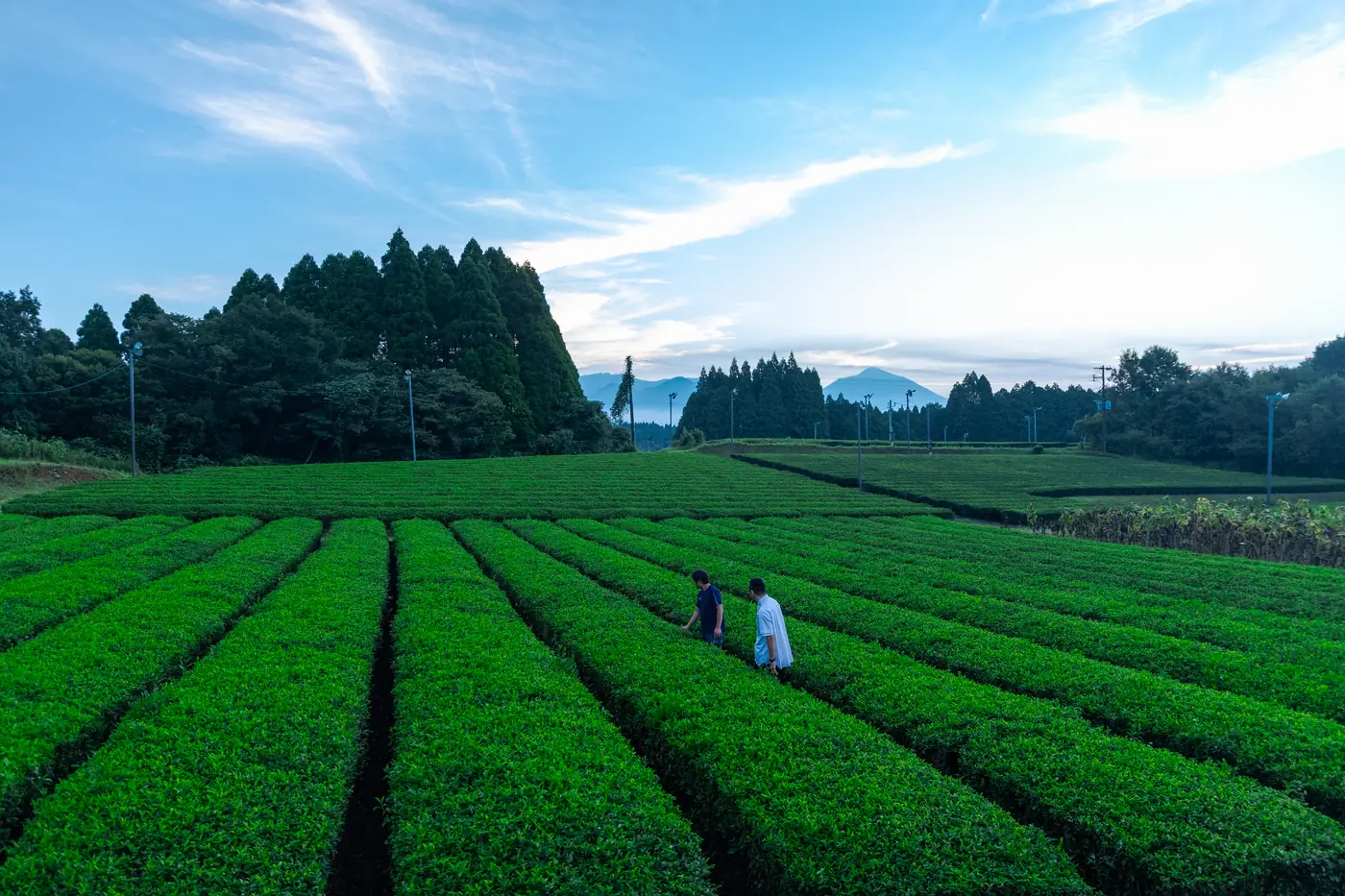
Walking the rows of a tea field in Japan early in the morning, on one of our farm visits.
We then help connect you directly with those farmers, which gives your brand a real story to tell. And we can invite you to each of those farms on a farm tour.
Tell us your drinks per day, what you pour now, and who will import. We will pick lots that fit your menu and send samples the way that works for your setup. The sample cost comes off your first bulk order if you place it within a month of the samples arriving.
Is there import duty on Japanese matcha in Saudi Arabia?
ZATCA’s tariff lists green tea under 0902.10 (packs of 3 kg or less) and 0902.20 (larger packs) with no duty, checked November 9, 2026, while black tea is 6%. Ask your broker to confirm the line on the first declaration. Import VAT of 15% and a customs fee of 0.15% (minimum SAR 15) are charged on top.
Does matcha need to be registered with SFDA?
Yes. The importer registers its business and each product in SFDA’s Ghad platform before importing, and files the clearance in Fasah. Registration is per importer, so each importing company registers the matcha under its own account.
Can a cafe import matcha into Saudi Arabia itself?
A cafe company with a commercial registration that covers food can register as the importer in Fasah and Ghad. SFDA waives the licensed-warehouse requirement for importers with no more than 5 shipments and 2,000 kg a year. Otherwise, a cafe buys through a Saudi importer that is already registered.
Does the bag need an Arabic label?
Retail packs do. Food imported for restaurants and similar businesses that prepare it before serving can carry an English label, with a commitment filed in Fasah. Pure matcha does not need a nutrition table, because SFDA’s nutrition labelling rule exempts single-ingredient foods such as tea.
Do I need a halal certificate for matcha?
Not for pure matcha. SFDA requires halal certificates for meat, foods with meat-derived ingredients such as gelatine or animal fats, and products that carry a halal logo.
Can you send matcha to Saudi Arabia by EMS?
EMS to Saudi Arabia is zone 3 at Japan Post, 13,000 yen for around 5 kg and 12 days from Tokyo. Japan Post requires SFDA’s prior approval for plant-derived products and returns parcels without it, so we post matcha by EMS only after your importer has confirmed the release with SFDA. Bulk lots go by air cargo through your forwarder.
Do you ship DDP to Saudi Arabia?
No. The importer of record has to be registered in Saudi Arabia, so your importer clears the shipment and pays the VAT and customs fee. We prepare the commercial invoice and packing list, obtain a certificate of origin on request, and arrange a phytosanitary or health certificate if your broker says it is needed.
What is the minimum order?
5 kg per order in total, the same everywhere we ship, and you can mix grades. It can be split into sealed 1 kg bags.
About the author & sources
Hiroshi Asami is the founder of Japanomars, which exports Japanese matcha to cafes in the United States, Canada, the Philippines and Europe. He sources through direct relationships with growers and processors across Japan, including the Uji area of Kyoto.
Sources
Zakat, Tax and Customs Authority (ZATCA), integrated tariff search: 0902.10.00.00.00, 0902.20.00.00.00, 0902.30 and 0902.40, duty rates and import procedures, accessed November 9, 2026.
ZATCA, Guideline on Imports and Exports under VAT Provisions, second edition (May 2026); customs fee announcement (September 6, 2024); import instructions and Fasah registration pages.
Saudi Food and Drug Authority (SFDA), Conditions and Requirements for Food Clearance (August 2026); Conditions and Requirements for Importing Food; FAQs on Arabic labelling (SFDA.FD/GSO 9) and nutrition labelling (SFDA.FD 2233); warning on food purchased via the internet.
Ministry of Foreign Affairs of Japan, Japan-GCC EPA negotiations, press release of May 21, 2026.
Japan Ministry of Agriculture, Forestry and Fisheries: lifting of Saudi import restrictions on Japanese food (November 21, 2017). Plant Protection Station, export inspection quick-reference tables (October 15, 2026).
Japan Tea Central Association, green tea exports by country and form, 2025 and January to September 2026 (based on Ministry of Finance trade statistics).
JETRO, Saudi Arabia import procedures (December 2025).
Japan Post, EMS rate table (zone 3), EMS delivery-day table from Tokyo, and country conditions and conditionally admitted articles for Saudi Arabia, accessed November 9, 2026.
Japanomars terms (minimum, price bands, samples, lead time) as published on our collection list.