%E5%A4%A7%E3%81%8D%E3%81%84.png)
Menu · Dosing · 2026
A cafe matcha dose runs between 0.17 and 0.28 grams per fluid ounce of finished drink, which is 2 grams in a 12 ounce hot latte, 3 to 4 in a 16 ounce iced, 4.5 in a blended, and 1 in a 4 ounce cold foam. Traditional whisked usucha is about 0.99 grams an ounce, four to six times stronger, which is why every recipe that scales a tea-ceremony measure to a cafe cup gives the wrong answer.
Key takeaways
This page is the dosing reference for the whole menu, then the arithmetic that follows from it: how many drinks a kilogram makes, how many kilograms a month your bar actually needs, and how to split that order so no tin goes stale before you reach the bottom of it.
In this guide
The builds a cafe actually serves, with the dose we use and the concentration it works out to. The last column is the one to read across, because grams alone do not transfer between cup sizes and grams per ounce do. Traditional preparations are at the top for reference and are not cafe specs.
| Build | Serving | Dose | Grams per fl oz | Grade |
|---|---|---|---|---|
| Koicha, whisked thick | 1 oz / 30 ml | 4.0 g | 3.95 | Ceremonial |
| Usucha, whisked straight | 2 oz / 60 ml | 2.0 g | 0.99 | Ceremonial |
| Hot latte | 8 oz | 2.0 g | 0.25 | Latte |
| Hot latte | 12 oz | 2.0 to 2.5 g | 0.17 to 0.21 | Latte |
| Iced latte | 16 oz | 3.0 to 4.0 g | 0.19 to 0.25 | Latte |
| Blended or frozen | 16 oz | 4.5 g | 0.28 | Latte |
| Cold foam, on an iced matcha | 4 oz foam | 1.0 g | 0.25 | Latte |
| Cold foam, as the only matcha | 4 oz foam | 1.5 g | 0.38 | Latte |
| Matcha concentrate | per 8 oz serving | 2.0 g | 0.25 | Latte |
| Kakigori syrup | per serving | 7.0 g | n/a | Latte or culinary |
| Baking | per 100 g flour | 2 to 6 g | n/a | Culinary |
Japanomars house specs, August 2026. The latte, cold foam and iced figures are the specs published on our own build guides; the traditional rows are Ippodo Tea recipes, converted. Grams per fluid ounce is calculated on the finished drink, ice included.
The two lines that surprise people are the cold foam and the iced. A foam looks like it should take less than a latte and by weight it does, but per ounce it matches an 8 ounce latte because it is drunk undiluted and first. An iced 16 ounce looks like it takes almost double a hot latte, and per ounce it sits in the same band, because the ice is part of the volume you are dosing. Both are in our cold foam guide and our iced matcha guide in full.
Because the number most people quote was set for a 2 ounce bowl. The familiar 2 gram figure is the usucha measure, the thin tea of the Japanese tea ceremony, which Ippodo whisks into 60 millilitres of water. That is 0.99 grams per fluid ounce. Carry the concentration rather than the 2 grams and a 12 ounce latte would take about 12.
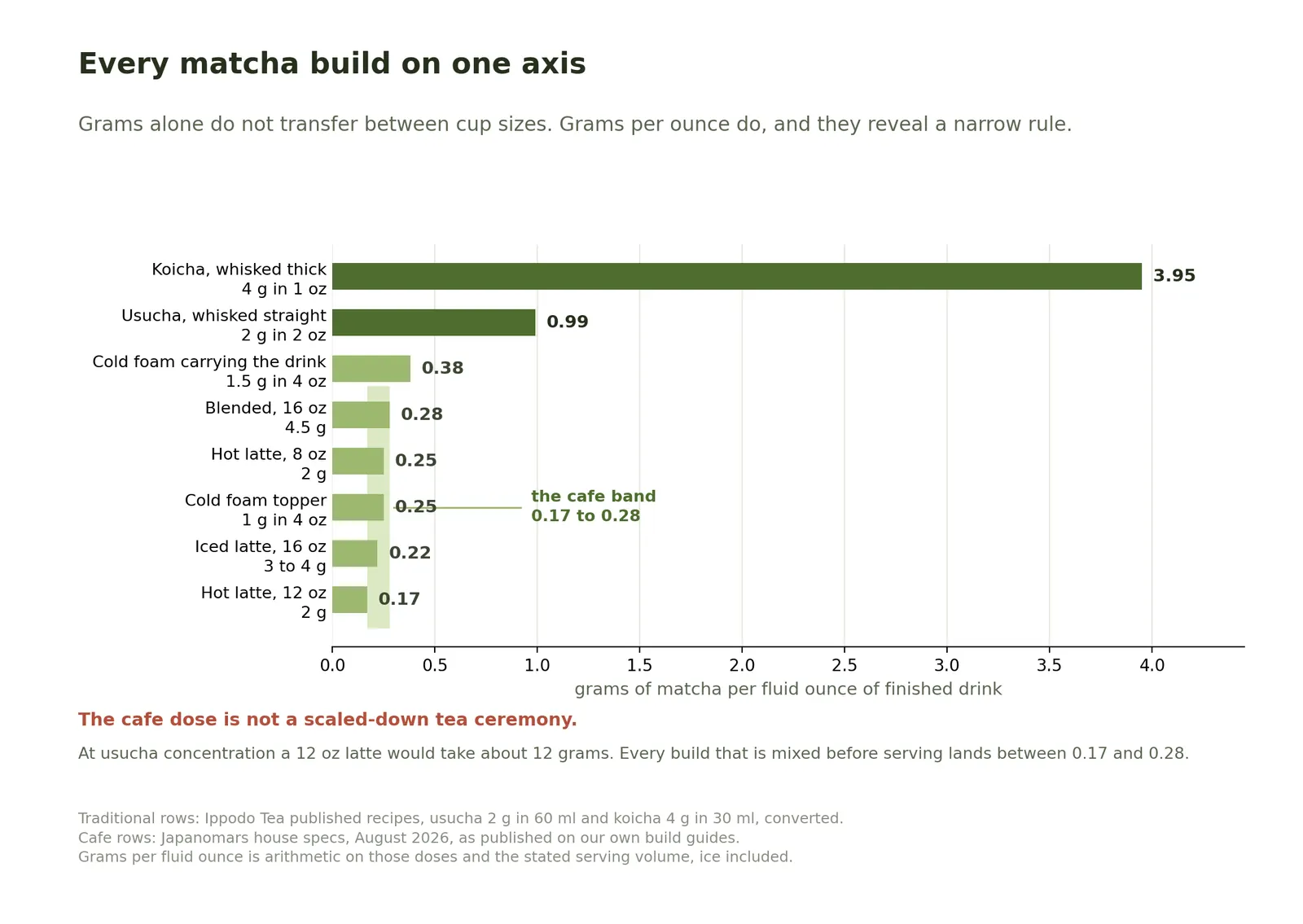
No cafe pours 12 grams into a latte, so in practice everyone already abandoned the ceremonial concentration and then kept quoting its number. What replaced it is a much narrower band. Across the builds that are mixed before they are served the concentration lands between 0.17 and 0.28 grams per fluid ounce, roughly a quarter of a gram an ounce, and that band is the actual rule.
It holds because a cafe dose is set by what the matcha has to taste through rather than by how much liquid is in the cup. Milk fat, sugar and ice all mask, and they mask in proportion to volume, so a bigger cup needs more powder to arrive at the same drink. The exception proves it: the only row above 0.28 is the cold foam that carries a drink on its own, where there is nothing to taste through and nothing to dilute it.
Two grams, level. Ippodo, the Kyoto tea house trading since 1717, gives its usucha recipe as 2 grams described as one teaspoon or one and a half chashaku scoops, and its koicha recipe as 4 grams described as two teaspoons or three scoops. That is the same conversion stated twice in two independent recipes, which is about as firm as a volume measure for a powder gets.
It is still a volume measure for a powder, and matcha is unusually light and easy to compact. The same spoon carries a different mass depending on whether the tea was sifted and how it was scooped, which makes the conversion a useful sanity check and a poor production tool.
The arithmetic is what settles it. On a 12 ounce latte, half a gram of drift moves you from 0.17 to 0.21 grams per ounce, which is a quarter more tea in the cup and a visibly different drink. At a mid-band 160 US dollars per kilogram that same half gram is 8 cents, and across 40 drinks a day it is roughly 96 dollars a month. Our cost per drink guide has the full price grid, and our guide to matcha mistakes baristas make covers why the scale wins.
About 475 at a 2 gram dose, 317 at 3 grams and 238 at 4 grams. A kilogram is 1,000 grams, so the arithmetic says 500 two-gram drinks, but no bar gets all of it into cups. Sifting residue, the dust in the bottom of a tin, dial-in shots at open and ordinary spill take roughly 5 per cent, which is the allowance built into every figure here.
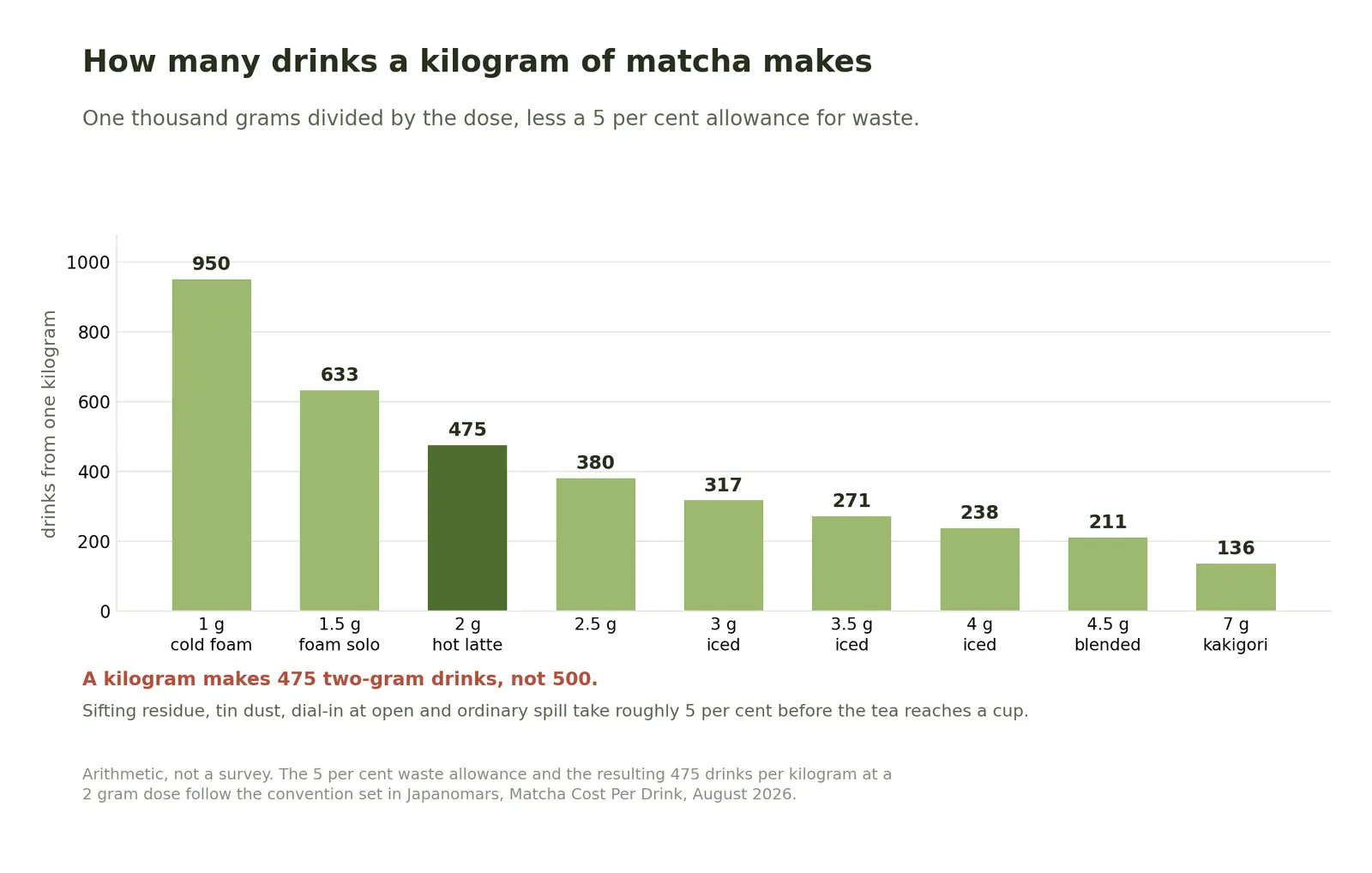
Read it in whichever direction you need. A cafe judging whether a quoted kilogram is a lot of tea finds that at a 2.8 gram average it is about five weeks of a ten-drink-a-day menu and four or five days at eighty. A cafe sizing a standing order reads the other way, from drinks sold back to weight bought, which is the next section.
Multiply matcha drinks per day by your average dose in grams, multiply by the days you open, divide by 1,000, then add 5 per cent. That is the whole calculation. At 40 matcha drinks a day, a 2.8 gram blended average and 30 days open, a cafe needs about 3.4 kilograms in cups and should order about 3.5.
The average dose is the part worth doing properly, because it moves more than people expect. A menu that is 40 per cent hot lattes at 2 grams, 35 per cent iced at 3.5, 15 per cent blended at 4.5 and 10 per cent cold foam at 1 averages 2.8 grams. The same drink count on an all-hot menu averages 2.0, which is nearly a third less tea. Summer shifts a menu toward the expensive end of the chart at exactly the moment volume rises.
| Matcha drinks per day | Grams per day | Kilograms per month | Order per month | Two-week tin |
|---|---|---|---|---|
| 10 | 28 g | 0.84 kg | 0.9 kg | 400 g |
| 20 | 56 g | 1.68 kg | 1.8 kg | 800 g |
| 40 | 112 g | 3.36 kg | 3.5 kg | 1.6 kg |
| 60 | 168 g | 5.04 kg | 5.3 kg | 2.4 kg |
| 80 | 224 g | 6.72 kg | 7.1 kg | 3.1 kg |
| 120 | 336 g | 10.08 kg | 10.6 kg | 4.7 kg |
At a 2.8 gram blended average across a mixed menu and 30 days open. Order per month adds the 5 per cent waste allowance. The last column is fourteen days of pour, which is the size the working tin should be. Japanomars, August 2026, arithmetic rather than a survey.
Two numbers in that table are worth memorising. A cafe crosses 5 kilograms a month at about 60 matcha drinks a day, which is the point where most suppliers start treating you as a standing account rather than a repeat order. And at 10 drinks a day the monthly requirement is under a kilogram, which means the discount tier a supplier will happily sell you is several months of tea.
Buy the month in sealed units sized to about fourteen days of pour, not as one large bag. Opened matcha holds peak quality for roughly two weeks even when it is resealed carefully after every use, so the question is never only how many kilograms a month but how much air the tea meets on the way through.
The working tin column in the table above is that number. At 40 matcha drinks a day the bar pours about 112 grams a day, so a fourteen-day tin is about 1.6 kilograms and a 3.5 kilogram month is right as three or four sealed units. At 10 drinks a day it is 400 grams, and the same 3.5 kilogram order would be four months of tea that spends most of its life going flat.
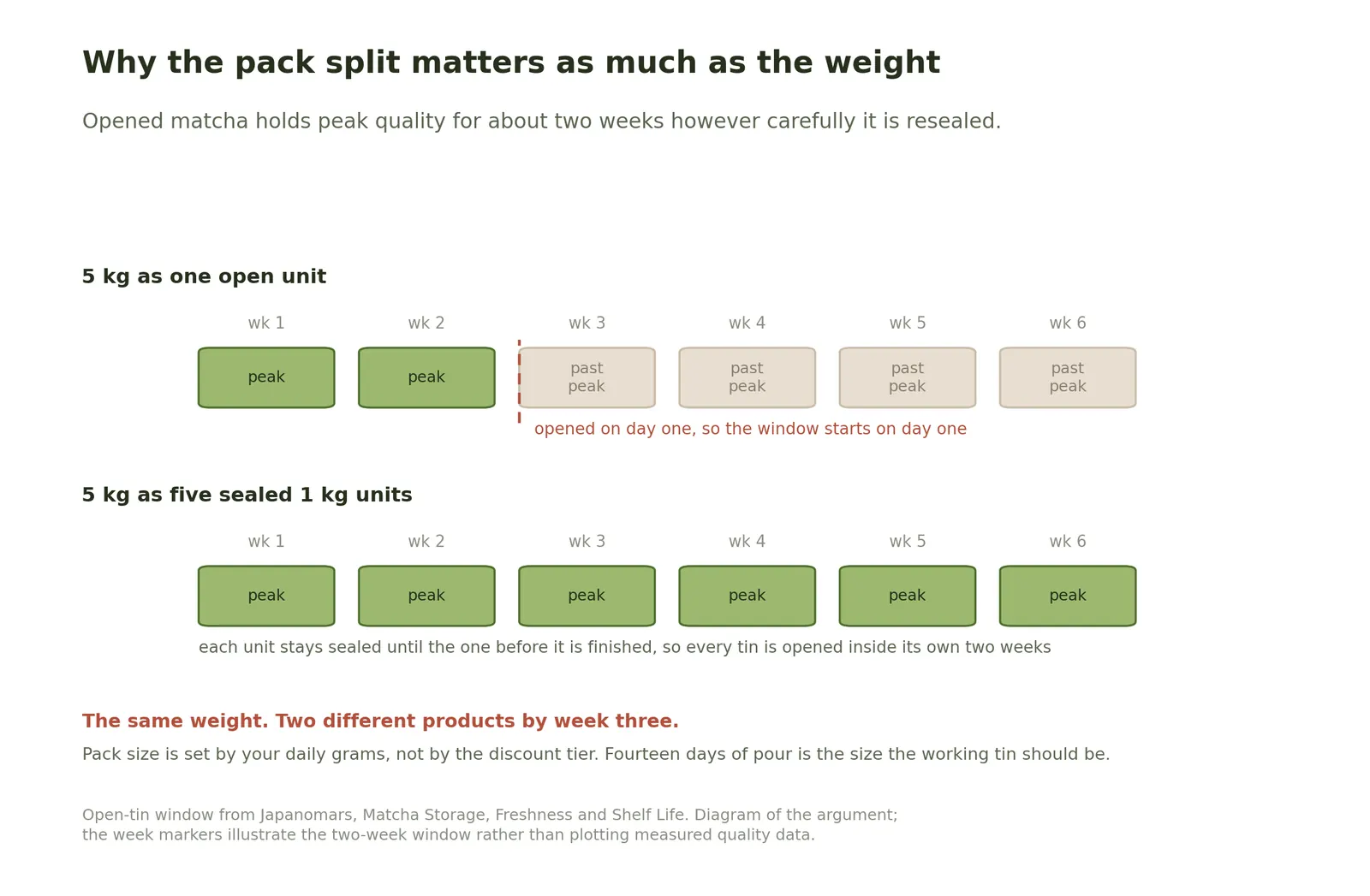
This is the one place a supplier and a cafe can want different things on the invoice while wanting the same thing in the cup, so it is worth being straightforward about it: at around ten matcha drinks a day, the volume tier often is not the saving it looks like, because the tea ages faster than the bar can pour it. If the volume price is what makes your numbers work, take it as sealed one kilogram units rather than one large sack and open them one at a time. Our storage and freshness guide covers oxygen absorbers, freezing and where to keep the working tin.
Write the dose on a card, weigh it for a week, then check it monthly. Dose drift is not a knowledge problem, it is a rush problem: the recipe card says 2 grams, the scoop is faster than the scale, and by the third month the bar is pouring something nobody chose. The fix is a routine rather than a rule.
| Step | What to do | Why it matters |
|---|---|---|
| 1. Write the card | One line per build: cup size, grams, grade | A dose that lives in one person’s head leaves with them |
| 2. Weigh for a week | Scale every drink while the card is new | It calibrates the eye that will do it later |
| 3. Pre-portion the rush | Weigh the peak-hour doses into cups at open | Removes the scale from the busiest ninety minutes |
| 4. Audit monthly | Weigh ten random doses against the card | Half a gram of drift is 8 cents a drink at 160 dollars a kilogram |
| 5. Reconcile the tin | Check grams used against drinks sold | The gap is your real waste rate, not the assumed 5 per cent |
The five-step routine. Step 5 is the one almost nobody runs, and it is the only way to replace the 5 per cent assumption in this article with your own number.
Step five is also the cheapest audit in the building. If the POS says 1,200 matcha drinks last month and the store room says 4.2 kilograms went out at a 2.8 gram average, the arithmetic expects 3.5 and you have found 700 grams that never reached a customer. That is worth more than any price negotiation at cafe volumes.
Because a cafe that cannot state its monthly kilograms is the cafe that gets offered a substitute. Japan is not short of matcha by accident and it is not catching up quickly. Tencha, the shaded leaf milled into matcha, reached 5,336 tonnes in 2024, about 2.7 times its level a decade earlier, and it still accounts for only around 7.3 per cent of all Japanese tea.
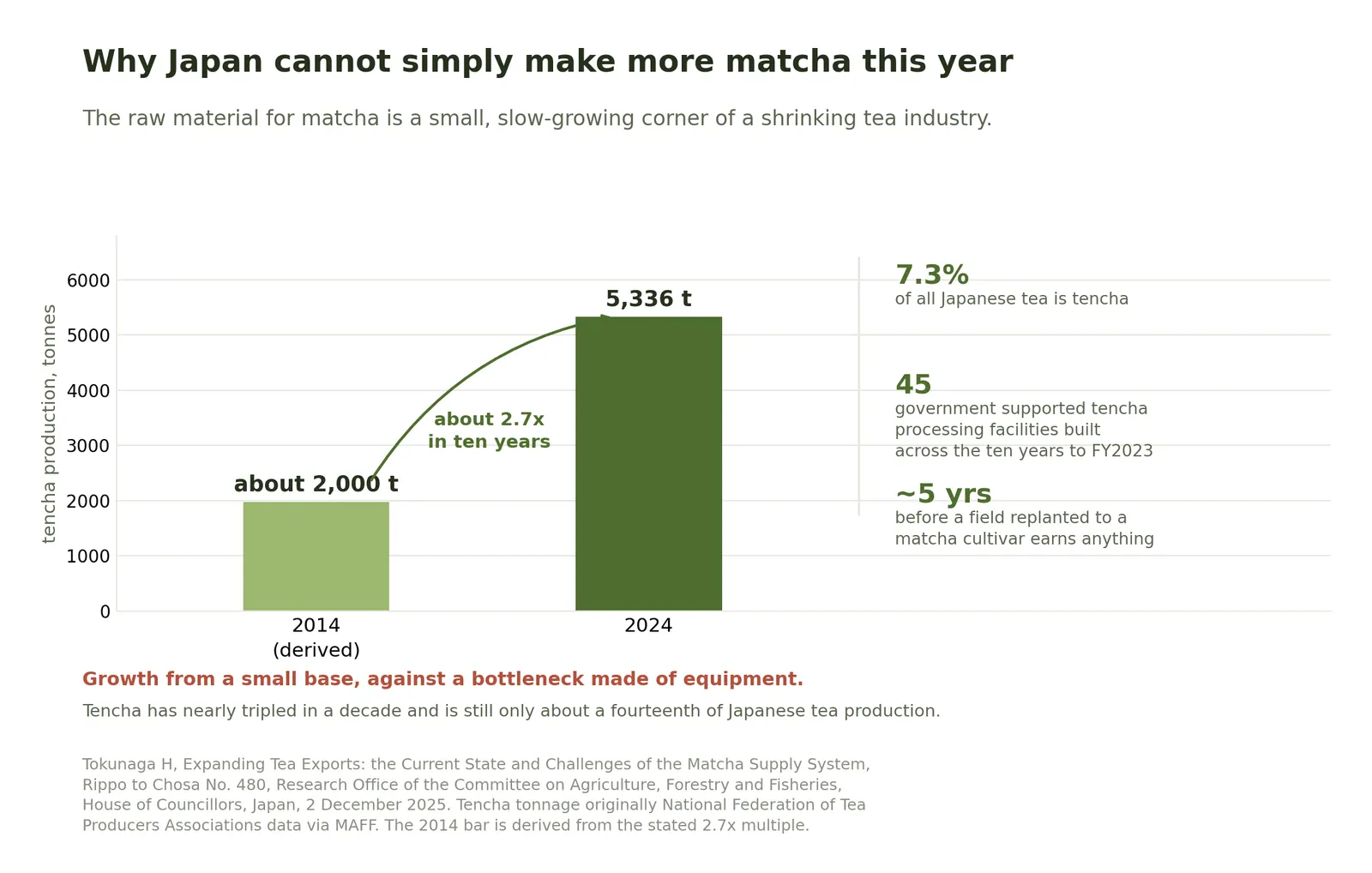
The bottleneck is equipment rather than enthusiasm. That same paper records just 45 tencha processing facilities installed with government support across the ten years to fiscal 2023, notes that grinding mills are also in short supply to the point that some tea merchants have looked at contracting milling out to flour companies, and points out that replanting a field to a matcha-suited cultivar costs about five years before it earns anything.
What that felt like to buyers is recorded month by month. The Japan Tea Export Promotion Council’s 2025 export reports describe April as a month when matcha orders could not all be accepted, and June as one where raw material procurement problems left advance orders unfilled and customers were re-offered a substitute in place of the product they normally buy. A substitute is a different lot, and a different lot is a different dose.
Which is the commercial argument for the whole chart. Knowing your kilograms is what lets you commit ahead of a season instead of buying into one, and committing ahead is what keeps the same lot behind the bar all year. Our US matcha wholesale price index tracks where the bands sit if you want to check your number against the market.
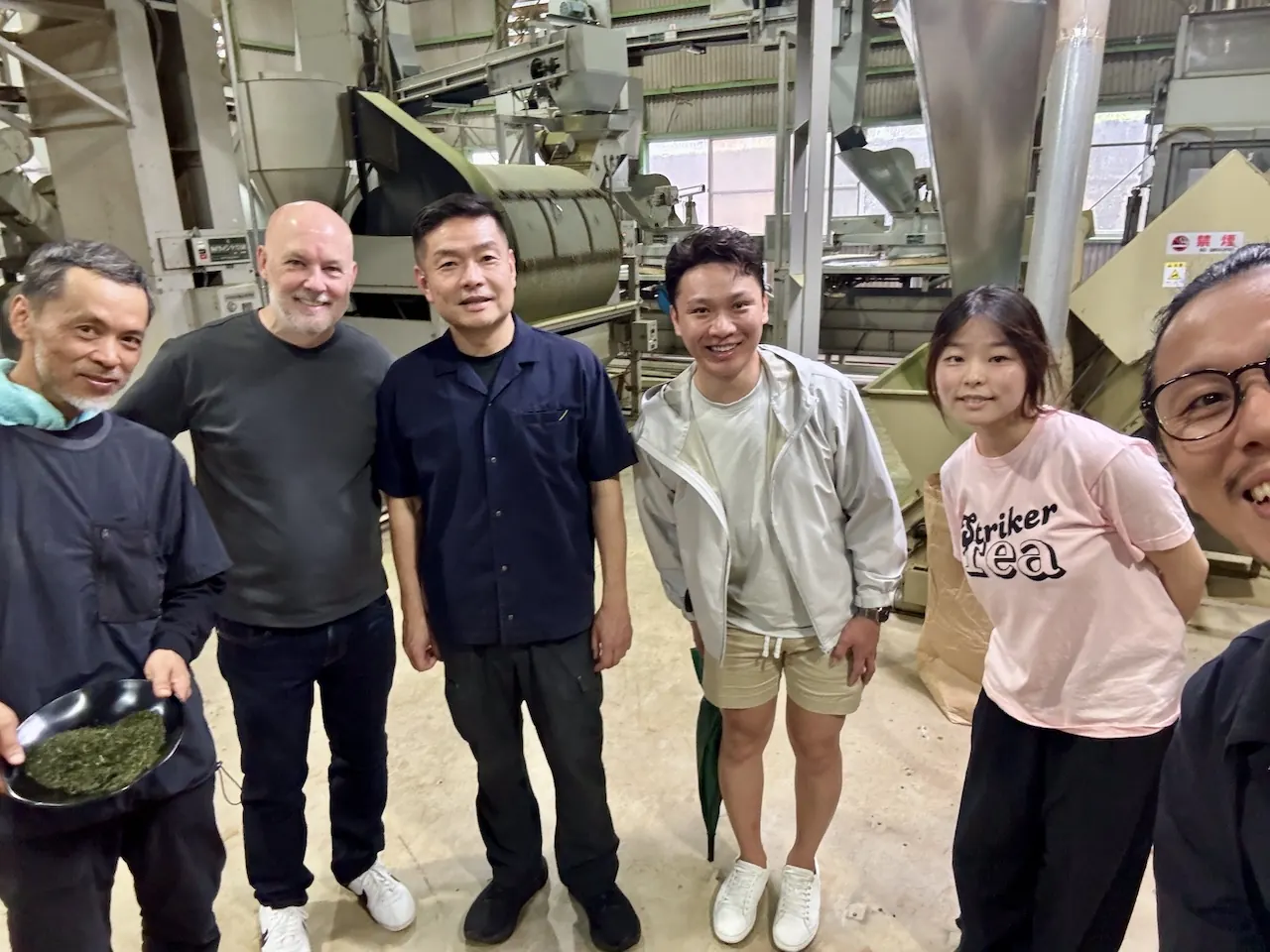
We supply cafes in the United States, Canada and the Philippines from six regions in Japan, milled to order rather than pulled from stock. Send us your matcha drinks per day and the builds on your menu and we will come back with the monthly kilograms, the pack split that keeps every tin inside its two-week window, and current pricing for the grade that has to cover all of it.
Between 0.17 and 0.28 grams per fluid ounce of finished drink. In practice that is 2 grams in a 12 ounce hot latte, 3 to 4 grams in a 16 ounce iced latte, 4.5 grams in a 16 ounce blended drink and 1 gram in a 4 ounce cold foam. Dose to the cup size rather than to a single house number.
Two grams, level. The Kyoto tea house Ippodo specifies 2 grams of matcha as one teaspoon in its usucha recipe and 4 grams as two teaspoons in its koicha recipe, which is the same conversion twice. A heaped spoon carries more, so weigh the dose on a bar where the cost per gram matters.
About 475 drinks at a 2 gram dose, 317 at 3 grams and 238 at 4 grams. Those figures already allow about 5 per cent for dial-in and spill waste, which is why a kilogram makes 475 two-gram drinks rather than the 500 the arithmetic alone suggests.
Multiply your matcha drinks per day by your average dose in grams, multiply by the days you open, divide by 1,000 and add 5 per cent. At 40 matcha drinks a day and a 2.8 gram blended average that is about 3.5 kilograms a month. A cafe crosses 5 kilograms a month at roughly 60 matcha drinks a day.
Yes. An iced 16 ounce build takes 3 to 4 grams against 2 in a 12 ounce hot latte, because melting ice dilutes the drink and cold blunts aroma. Per ounce the two land in the same band, so this is dosing to the cup rather than making the iced drink stronger.
One that holds about fourteen days of pour, because opened matcha holds peak quality for roughly two weeks. At 40 matcha drinks a day that is about 1.6 kilograms, so a 5 kilogram order is right as five sealed 1 kilogram units and wrong as one open sack.

Hiroshi Asami is the founder of Japanomars, which exports Japanese matcha to cafes in the United States, Canada, and the Philippines. He sources through direct relationships with growers and processors in six regions across five Japanese prefectures, and has led four sourcing tours bringing overseas cafe owners to Japanese tea farms. The Japanese sources on this page were read in the original.
Sources
%E7%99%BD_%E5%A4%A7%E3%81%8D%E3%81%84.png)