%E5%A4%A7%E3%81%8D%E3%81%84.png)
Menu · Cold drinks · 2026
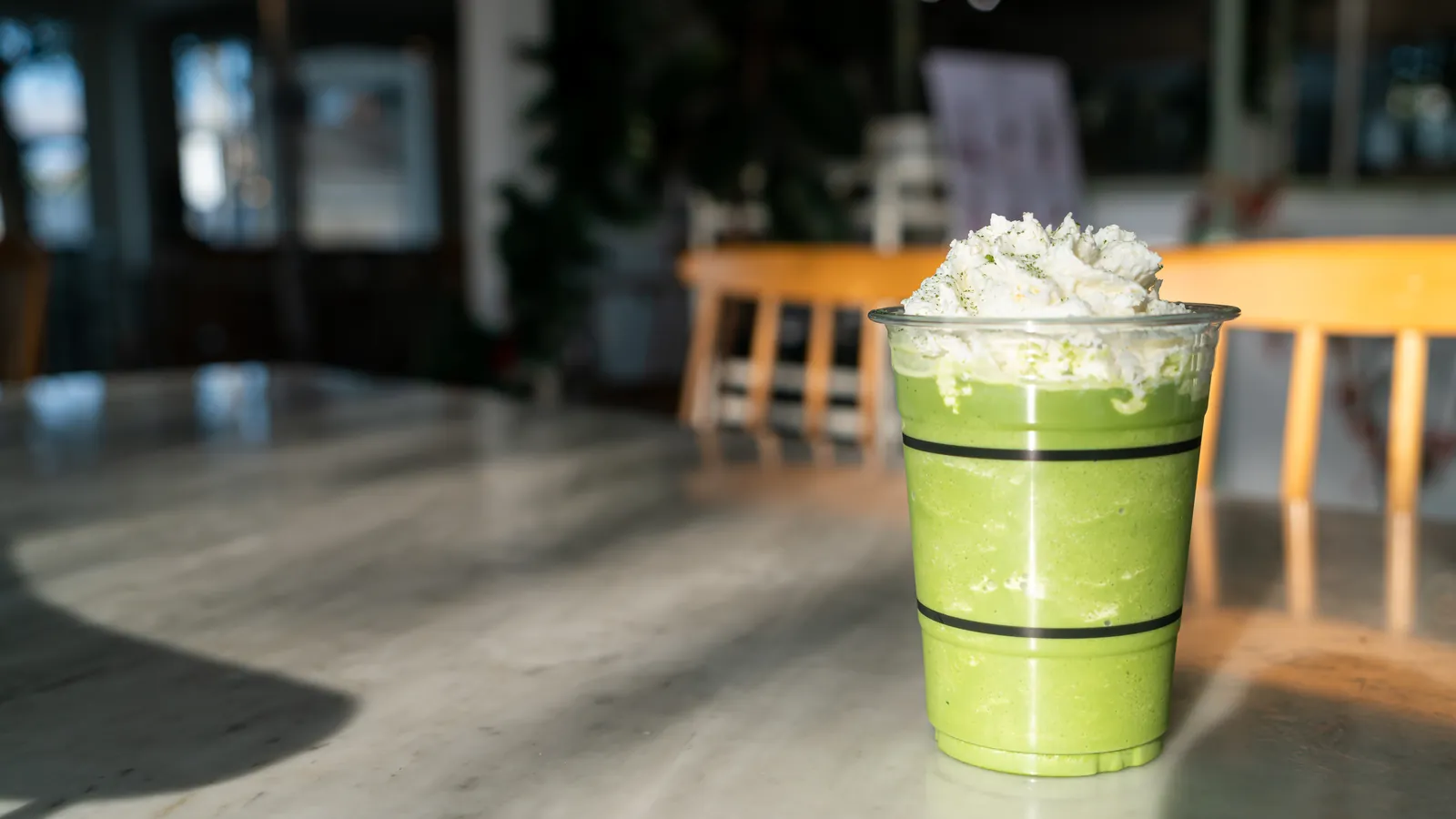
Matcha cold foam is the cheapest second matcha item a cafe can add, because it runs off the tin already open behind the bar and needs no new SKU, no new equipment and about a gram of powder. The dose is where most bars get it wrong. Foam floats rather than mixes, so the first sips carry nearly all of the matcha, and reading across from your latte spec gives a drink that opens at roughly double strength.
Key takeaways
This is a guide to the spec rather than a recipe: how much matcha belongs in a foam, which milk holds one, why the powder has to be wetted before it is aerated, what it costs against what you charge, and the one claim not to put on the menu board.
In this guide
Because it is a modifier rather than a drink. A matcha cold foam is a few ounces of aerated milk with matcha dispersed through it, floated on a cold drink you already sell. It draws on the tin behind the bar, uses the frother already on the counter, and adds a line to a build card rather than to a stock sheet.
That distinction matters more in 2026 than it used to. Our own index put ceremonial grade at about 171 US dollars a kilogram landed on 4 August 2026 and latte and culinary grade at about 86, and the raw leaf behind those figures is dearer again this season. A second matcha drink means a second forecast, a second reorder point and a second thing that can go stale. A modifier means none of that.
The commercial reason to bother is that it sells matcha to people who did not order matcha. A foam goes on cold brew, iced tea and lemonade as readily as on an iced matcha, so it reaches the customer who was never going to buy the latte. Our guide to adding matcha to a cafe menu covers the wider menu question.
About 1 gram in a 4 ounce foam, which is far less than most bars assume. The instinct is to read across from the latte, and the latte is the wrong reference. Our published spec is 2 grams of latte grade in 8 to 10 ounces of finished drink. Put that same 2 grams in a 4 ounce foam and the concentration roughly doubles.
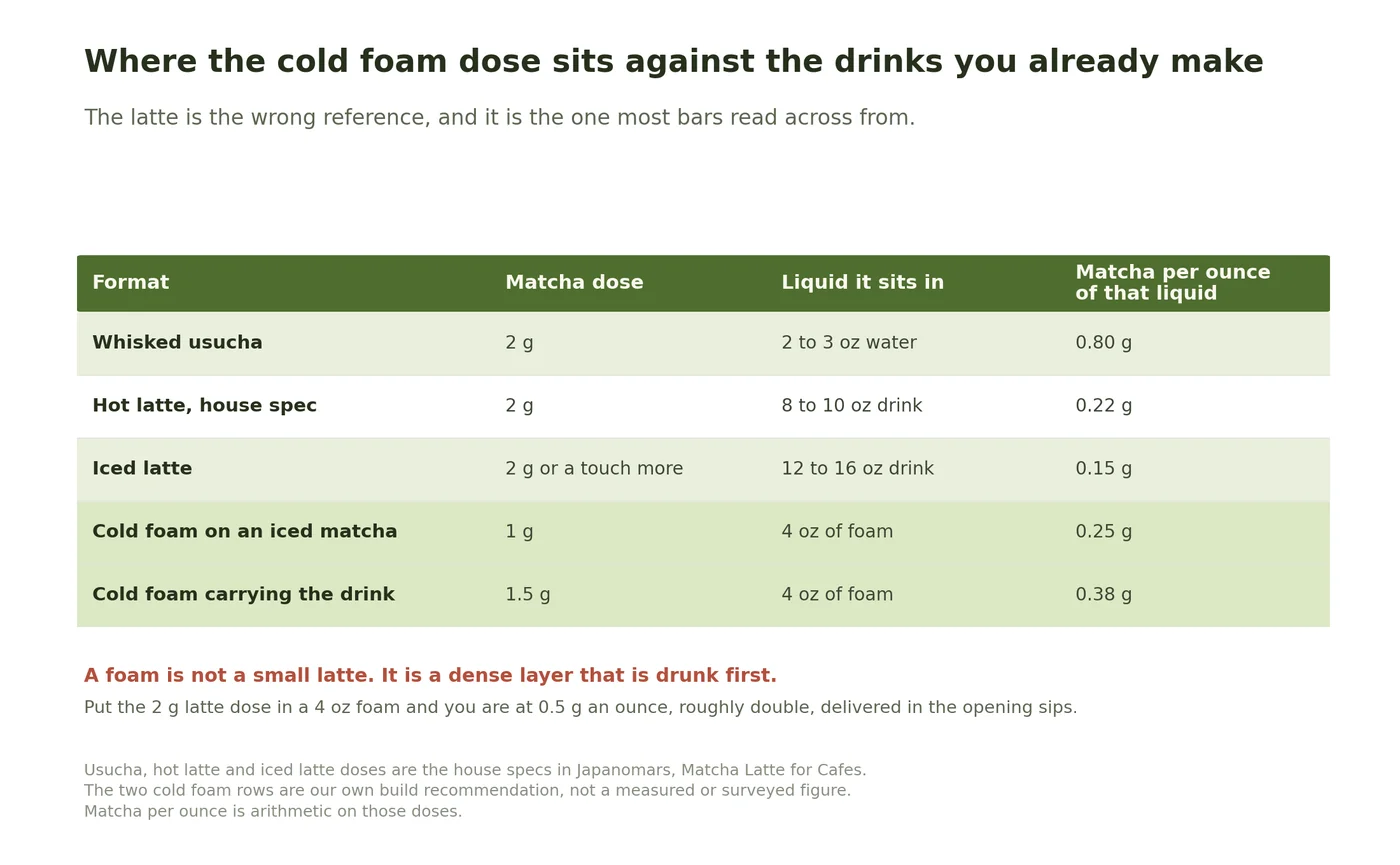
Concentration is only half of it. A latte is mixed, so every mouthful is the same drink. A foam sits on top and is drunk first, so the opening sips deliver the matcha almost undiluted and the bottom of the glass delivers none. A foam dosed at latte strength is not a slightly strong latte. It is a concentrated shot followed by a plain cold brew.
So the spec has two settings. When the foam sits on an iced matcha and the drink underneath already carries tea, 1 gram is plenty and the foam is there for texture and aroma. When the foam sits on cold brew, lemonade or plain milk and is the only matcha in the glass, go to 1.5 grams so it still reads as matcha once it has drained down. Our matcha latte guide has the base spec these numbers are set against.
Skim, if you are pouring dairy, and a purpose-built product if you are not. Cold foam has no steam to help it, so it depends on what is at the surface of each air bubble, and in dairy that is protein. Fat competes for the same surface. Skim milk carries about 3.4 grams of protein and 0.1 grams of fat per 100 millilitres against 3.2 and 3.3 for whole, which is why the thinnest milk makes the stiffest foam.
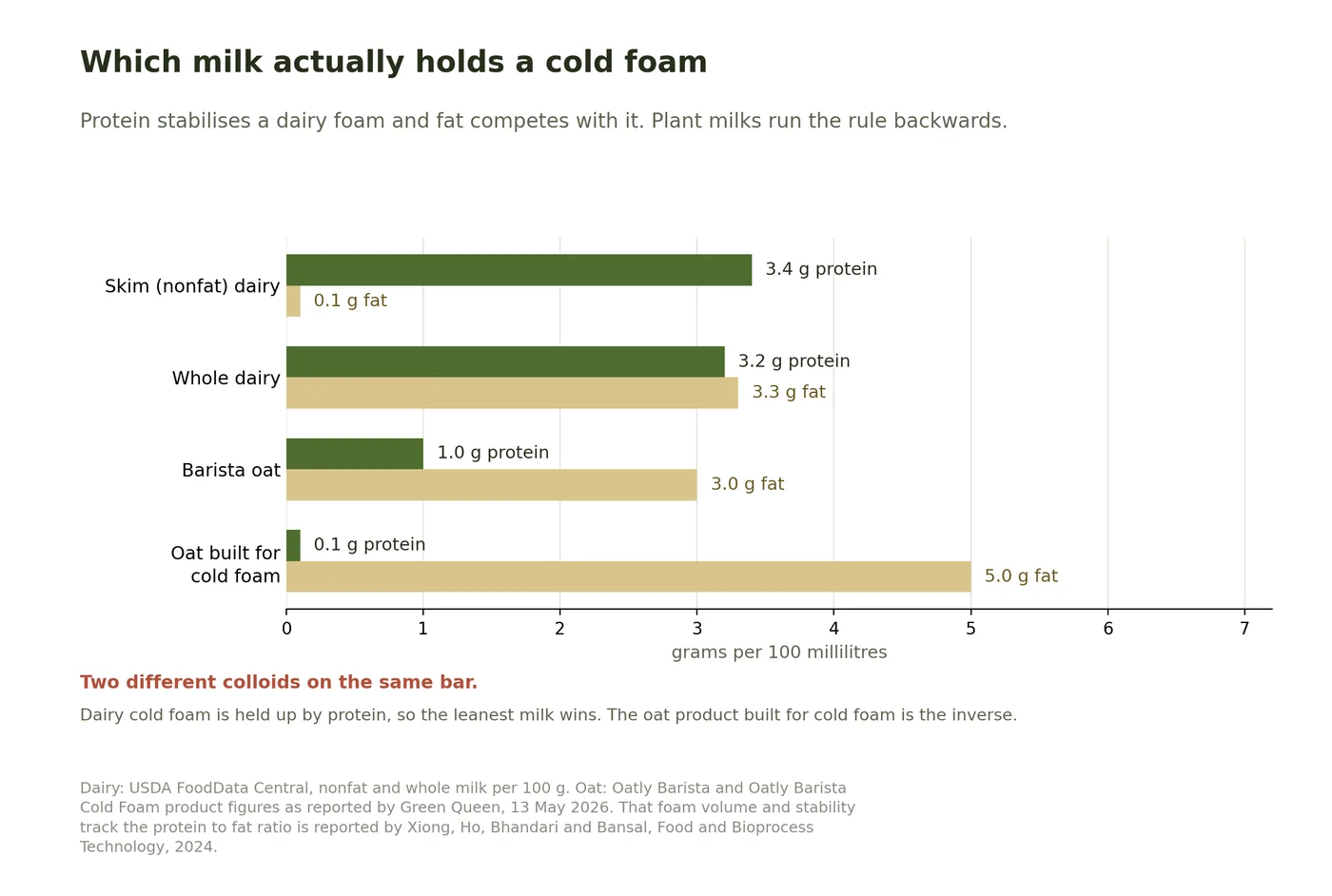
Plant milk inverts the rule, and the clearest evidence is that the largest oat brand had to build a separate product. Oatly launched a barista cold foam oat milk in May 2026, and its barista development director explained that ordinary barista milks do not have "enough fat content" to hold one. The formulation says the same thing: 0.1 grams of protein and 5 grams of fat, coconut oil chosen because it stays firmer when cold, plus xanthan, gellan and hypromellose.
The working consequence is that one rule does not cross both milks. On dairy, going leaner improves the foam. On oat, going leaner destroys it, and a standard oat will disappoint no matter how long you spin it. Write the menu item for one milk and be honest about the substitution.
Wet the matcha before you aerate it, and the rest is ordinary. Matcha does not dissolve. It is milled leaf held in suspension, so the powder that goes into a frother is solid particles, not a solution. Foam colloid research holds that whether a particle helps or harms a bubble depends on how well it is wetted, and poorly wetted particles act against the foam.
That is the mechanism behind the instruction every recipe gives without a reason. Dry powder tipped onto spinning milk arrives at the surface unwetted, which is the condition that works against the bubbles you are building. Paste it first and the same powder becomes harmless.
| Step | What to do | Why it matters |
|---|---|---|
| 1. Sift | The dose through a fine sieve into the pitcher | A clump never wets through |
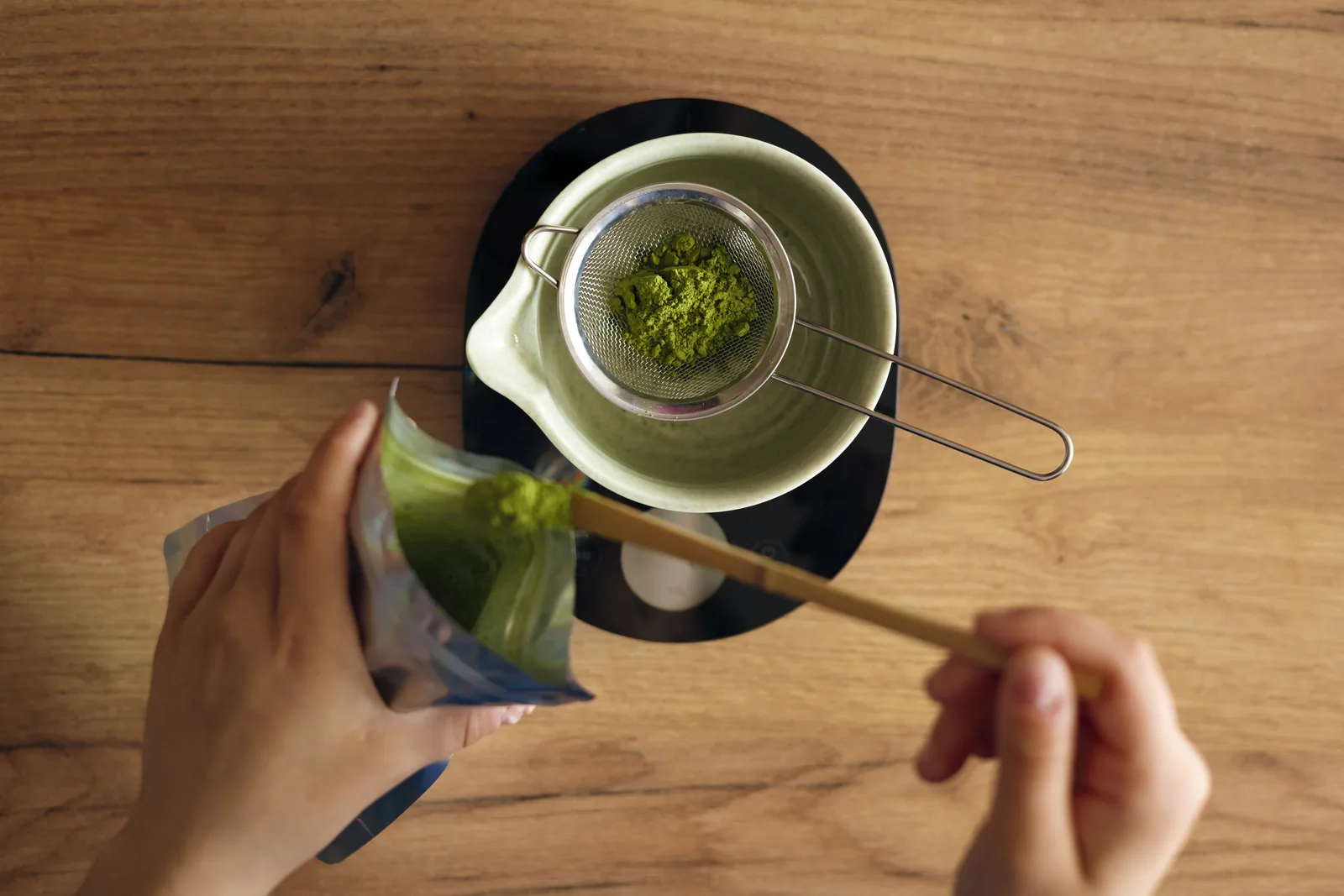
| 2. Paste | About 1 oz of water at 175 F, worked smooth | Warm water disperses fast, and an ounce will not warm the drink |
| 3. Fill | Cold milk to volume | Cold liquid drains out of the foam more slowly |
| 4. Sweeten | Syrup now, before aerating | Sugar raises viscosity, which holds the foam longer |
| 5. Aerate | Spin to a pourable foam, not a stiff one | Overworked foam sits like meringue and will not drink through |
| 6. Pour to order | Build it for the glass in front of you | It is a three to five minute product |
The house build. Steps 1 and 2 decide whether the foam holds; the rest is ordinary bar practice. Water temperature follows our matcha latte spec.
Two other failures show up in service. A batch made at open looks tired by mid-morning even though it still tastes fine, so the fix is portioning rather than chemistry. And an unsweetened foam drains faster than a sweetened one, so a sugar-free version is a shorter-lived drink and should be sold as one. Our guide to the matcha mistakes baristas make covers the errors that are not foam-specific.
Roughly 9 cents of matcha against a modifier most cafes price near a dollar. Our index put latte grade at about 86 US dollars a kilogram landed on 4 August 2026, so a 1 gram foam carries about 9 cents of tea and a 1.5 gram foam about 13. Even built on ceremonial grade at about 171 dollars, the tea in the foam is under 20 cents.
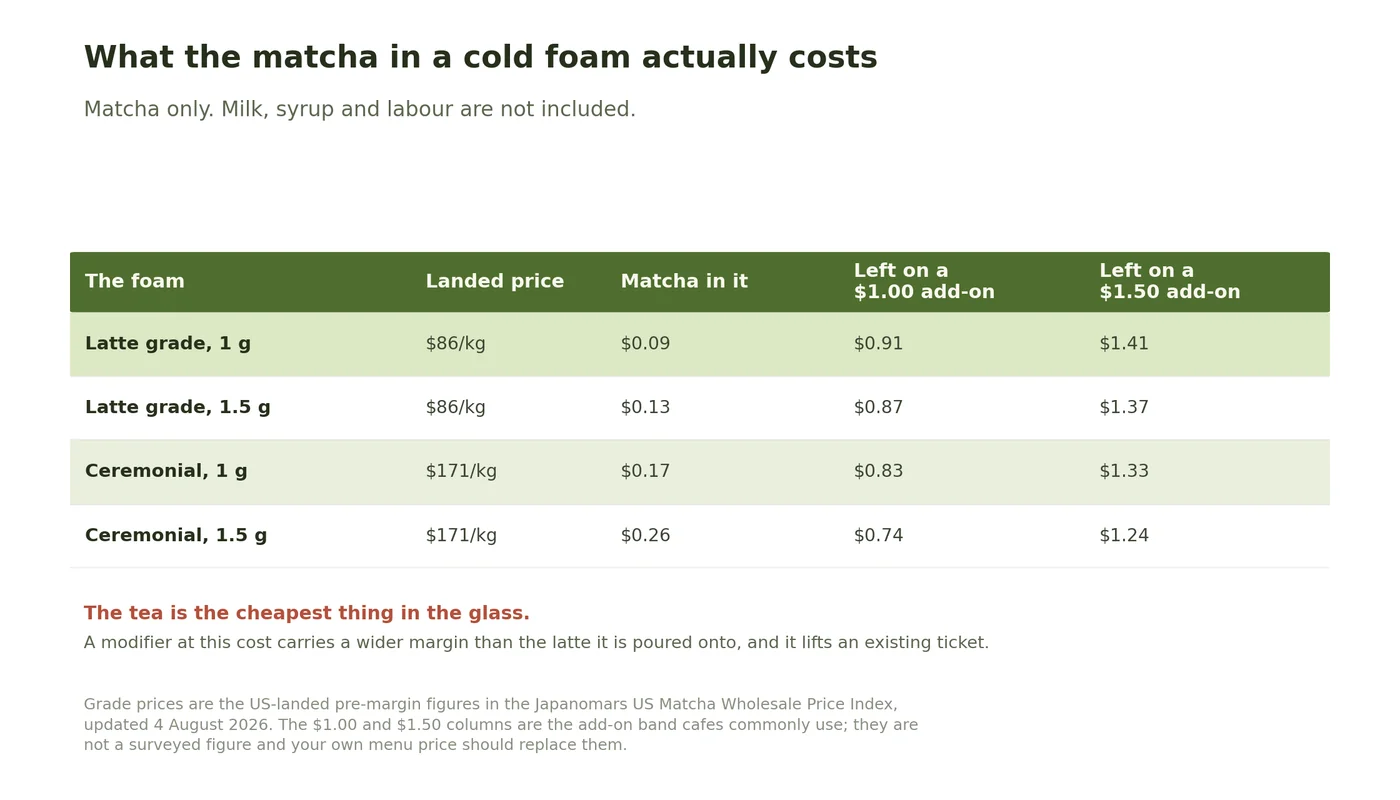
The arithmetic points at the right lever. A modifier at this cost carries a wider margin than the latte it is poured onto, and it lifts an existing ticket rather than competing for it. If you are trying to make matcha pay, adding a foam to the cold brew you already sell beats discounting the latte.
It also changes what you buy. A foam attached to even a fifth of your cold drinks adds real weight to the monthly order, and weight is what moves you into a better price band and a standing shipment. Our US matcha wholesale price index tracks the bands if you want to check where your volume lands.
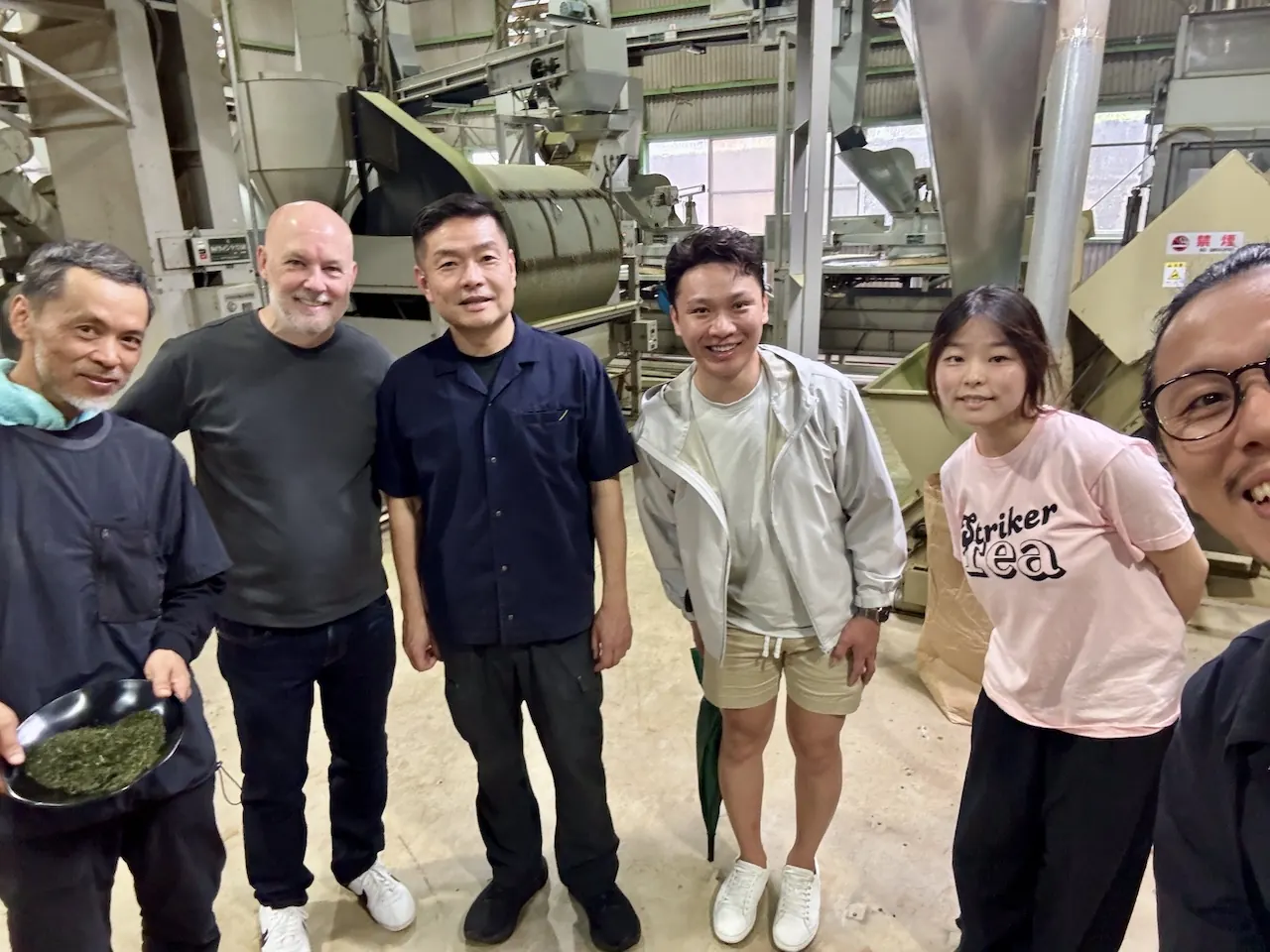
The same latte grade the bar already pours. The case for going cheaper is that the foam is sweetened and mixed into dairy, which hides a lot. The case against is stronger: the foam is the first thing on the tongue and arrives undiluted, so a coarse powder shows up harder here than in a latte that milk and ice have already softened.
Going dearer is the other temptation and it is also wrong. Ceremonial grade is bought for aroma and sweetness in a bowl of water, and a sweetened dairy foam is the least likely place on the menu for those to survive. Our guide to matcha grades covers what actually changes as you climb a supplier's ladder.
Which returns the article to its own thesis. Cold foam is worth adding because it needs nothing new, and buying a third tin to serve it gives that away. One latte-grade line, poured hot at 2 grams, iced at a touch more, foamed at 1. Our iced matcha guide covers the other cold builds that tin has to carry.
That a cold build has less caffeine. It is the most repeated thing on the wellness internet about cold green tea, the underlying research is real, and it does not apply to matcha. A review by Manami Monobe of Japan's National Agriculture and Food Research Organization reports that infusing leaf in water at around 10 degrees Celsius yields about 20 per cent of the EGCG and 50 per cent of the caffeine of a hot infusion.
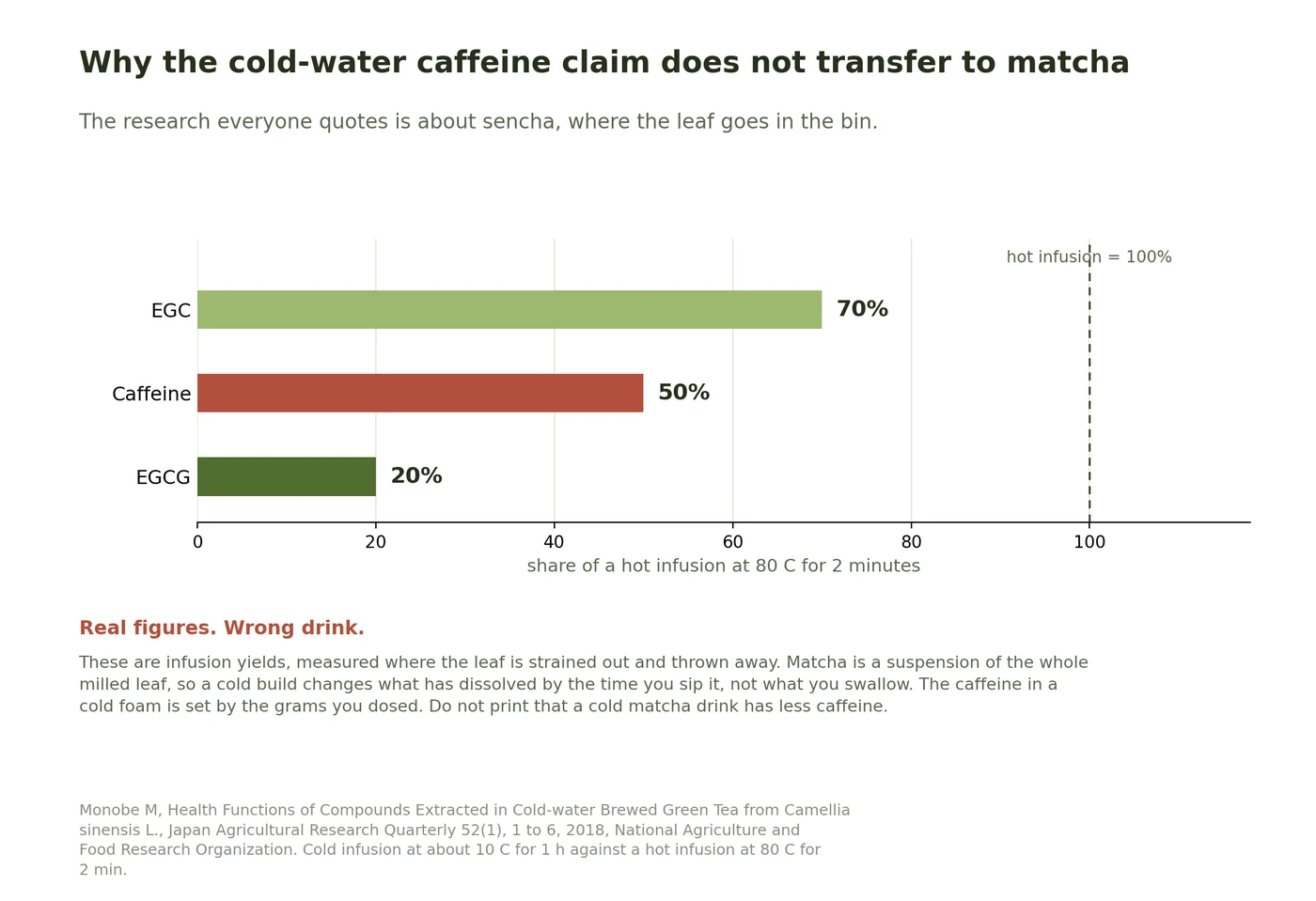
The distinction is the whole point of matcha. Those figures describe what came out of the leaf into the water, because in sencha the leaf is strained away and thrown out. In matcha nothing is strained: the milled leaf is in the glass and goes down with the drink. So the caffeine in a cold foam is set by the grams you dosed and nothing else.
A cold foam does genuinely taste milder, and the reason is dispersion rather than chemistry. Say that on the board if you like. Do not say it has less caffeine, because a customer avoiding caffeine deserves the real answer. Our comparison of matcha and coffee caffeine has the numbers that do transfer.
We supply cafes in the United States, Canada and the Philippines from six regions in Japan, milled to order rather than pulled from stock. Tell us what your cold menu looks like and we will send the band that has to cover all of it, so you can foam it on your own bar.
From the sourcing floor
The matcha that holds up in milk is the one with more bitterness. It keeps its character in a foam, and it does so at a smaller dose. A lot with strong umami or natural sweetness gets lost in the milk, and you end up dosing 6 or 7 grams before it tastes like matcha at all, where a more bitter lot does the job at around 3 grams. For a foam, that is the selection rule we use.
Start at 1 gram in a 4 ounce foam and taste before you move. Our house latte spec is 2 grams in 8 to 10 ounces, so the same 2 grams in a 4 ounce foam is about twice the concentration, and foam is drunk first and undiluted. Go to 1.5 grams only when the foam is the drink's only matcha.
Skim, or skim with a little heavy cream for body. Cold foam has no steam to help it, so it leans on protein at the surface of each bubble and fat competes for that surface. Skim carries about 3.4 grams of protein and 0.1 of fat per 100 millilitres against 3.2 and 3.3 for whole.
Only with a product formulated for it. Oatly's barista development director says standard barista milks lack "enough fat content" to hold a cold foam, and the oat cold foam the company launched in May 2026 runs 0.1 grams of protein and 5 grams of fat. That is the opposite build to the dairy answer.
Usually because the powder went in dry. Matcha does not dissolve, it stays suspended as milled leaf, and foam science holds that a poorly wetted particle works against a bubble rather than for it. Make a paste with a small amount of liquid first, then aerate.
No, and do not print that it does. The cold-water figures people quote come from infusing leaf and throwing the leaf away. Matcha is a suspension, so you swallow the whole leaf and the caffeine is set by the grams you dosed. A cold build tastes milder because less has dissolved by the time you sip it.
Price it as a modifier rather than a drink. One gram of latte grade cost about 9 cents landed at our August 2026 index figure of 86 dollars a kilogram, so an add-on in the usual one to one and a half dollar band clears a wider margin than the latte under it.

Hiroshi Asami is the founder of Japanomars, which exports Japanese matcha to cafes in the United States, Canada, and the Philippines. He sources through direct relationships with growers and processors in six regions across five Japanese prefectures, and has led four sourcing tours bringing overseas cafe owners to Japanese tea farms. The Japanese source on this page was read in the original.
Sources
%E7%99%BD_%E5%A4%A7%E3%81%8D%E3%81%84.png)