%E5%A4%A7%E3%81%8D%E3%81%84.png)
Health & Science · 2026
A 2 g serving of matcha carries roughly half the caffeine of an 8 oz drip coffee. That number matters less than what rides along with it. Matcha is the one drink on a standard cafe menu that delivers its caffeine together with L-theanine, an amino acid that changes how the caffeine feels: focused and alert, without the edge or the crash that follows a large coffee. Customers call it calm energy. This guide covers what is actually in each cup, what the research does and does not show, and how to use the difference on your menu without overclaiming.
Quick facts
In this guide
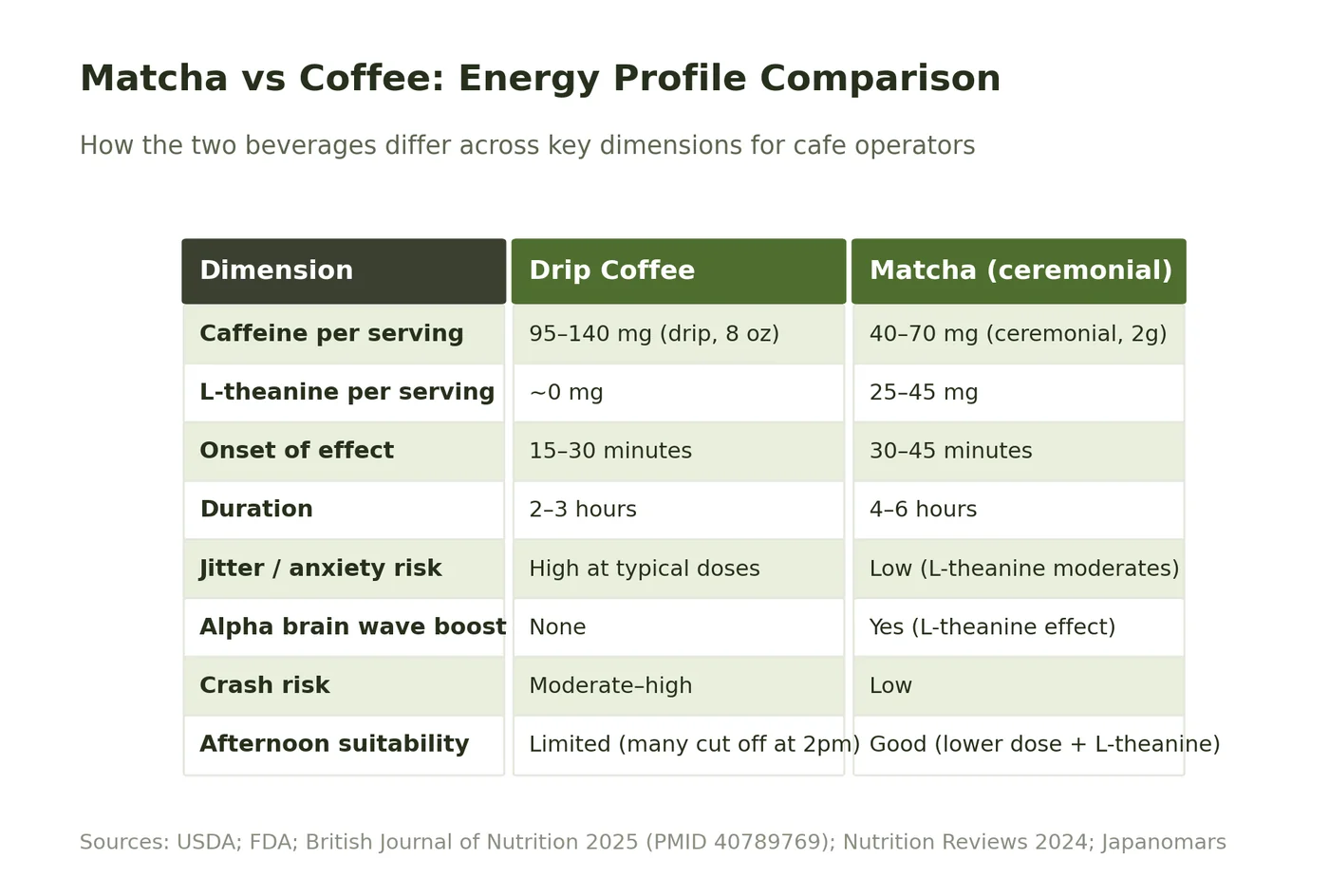
Start with the number every cafe owner asks for, and the honest caveat that published figures disagree. Japan's Standard Tables of Food Composition, the official reference Japanese food manufacturers work from, list matcha at 3.2 g of caffeine per 100 g of powder, which is 32 mg per gram. A standard 2 g latte serving therefore carries about 64 mg. Peer-reviewed laboratory work has measured commercial powders considerably lower, at 14 to 16 mg per gram, which would put the same serving near 30 mg. We tell cafes to plan on the official figure, because it is the conservative one for customer conversations about caffeine.
On the coffee side the references are steadier. The FDA puts an 8 oz cup of drip coffee at 80 to 100 mg. USDA FoodData Central puts espresso at 63.6 mg per fluid ounce, so a standard double shot lands around 127 mg. Whichever matcha figure you use, the ranking holds: a matcha latte delivers roughly half the caffeine of a drip coffee, and half or less of a double-shot latte.
| Drink as poured | Caffeine | Where the number comes from |
|---|---|---|
| Matcha latte, 2 g dose | About 64 mg (labs have measured as low as about 30 mg) | Japan Standard Tables of Food Composition 2020; Antioxidants 2022 |
| Iced matcha, 3 g dose | About 96 mg | Arithmetic on the official 32 mg per gram |
| Drip coffee, 8 oz | 80 to 100 mg | US FDA |
| Double espresso, 2 fl oz | About 127 mg | USDA FoodData Central |
| Dirty matcha, 2 g dose plus a double shot | About 190 mg | Arithmetic on the two rows above |
Serving-size note for operators: most cafe recipes use 2 to 3 g of matcha per drink, and the dose scales the caffeine directly. At 3 g, the official figure puts the drink near a full drip coffee. Standardizing your recipe weight standardizes the caffeine profile, which matters when staff talk to customers about energy effects. For the full dose, grade and drink math, including why published matcha figures disagree by roughly two to one, use our matcha caffeine chart. This page is about the part of the story the milligrams cannot see.
L-theanine is a non-protein amino acid found almost exclusively in the tea plant (Camellia sinensis). It crosses the blood-brain barrier, raises alpha brain wave activity in EEG studies (the pattern associated with relaxed focus, the state you are in when meditating or deep in a task), and modulates how caffeine interacts with adenosine receptors. The practical effect: L-theanine blunts the anxiety spike and jitteriness that high-dose caffeine produces, while preserving alertness and mood lift. Drinkers typically describe the result as a longer, flatter arc of energy rather than coffee's spike and dip.
How much is in the cup? Peer-reviewed HPLC analysis measured matcha at about 9.9 mg of L-theanine per gram, which is roughly 20 mg in a 2 g serving, and intensely shaded first-flush powders test higher, so a realistic band for a latte is about 20 to 40 mg. Coffee has essentially none. That is the pharmacological basis of the calm-energy claim. It is not marketing; it is a measurable difference in what the two beverages put into the body.
For cafes, this has a downstream consequence that is easy to miss: customers who drink matcha tend not to complain about crashing or feeling anxious. That translates to repeat orders later in the day and fewer complaints about a drink being "too strong."
From the sourcing floor. Farmers I visit describe the shading decision as a balance. Cut the period short and bitterness and astringency stay in the leaf; leave the covers on too long and the tea plant itself starts to weaken. There is a right shading window for each field, and finding it every season is the farmer's judgment call.
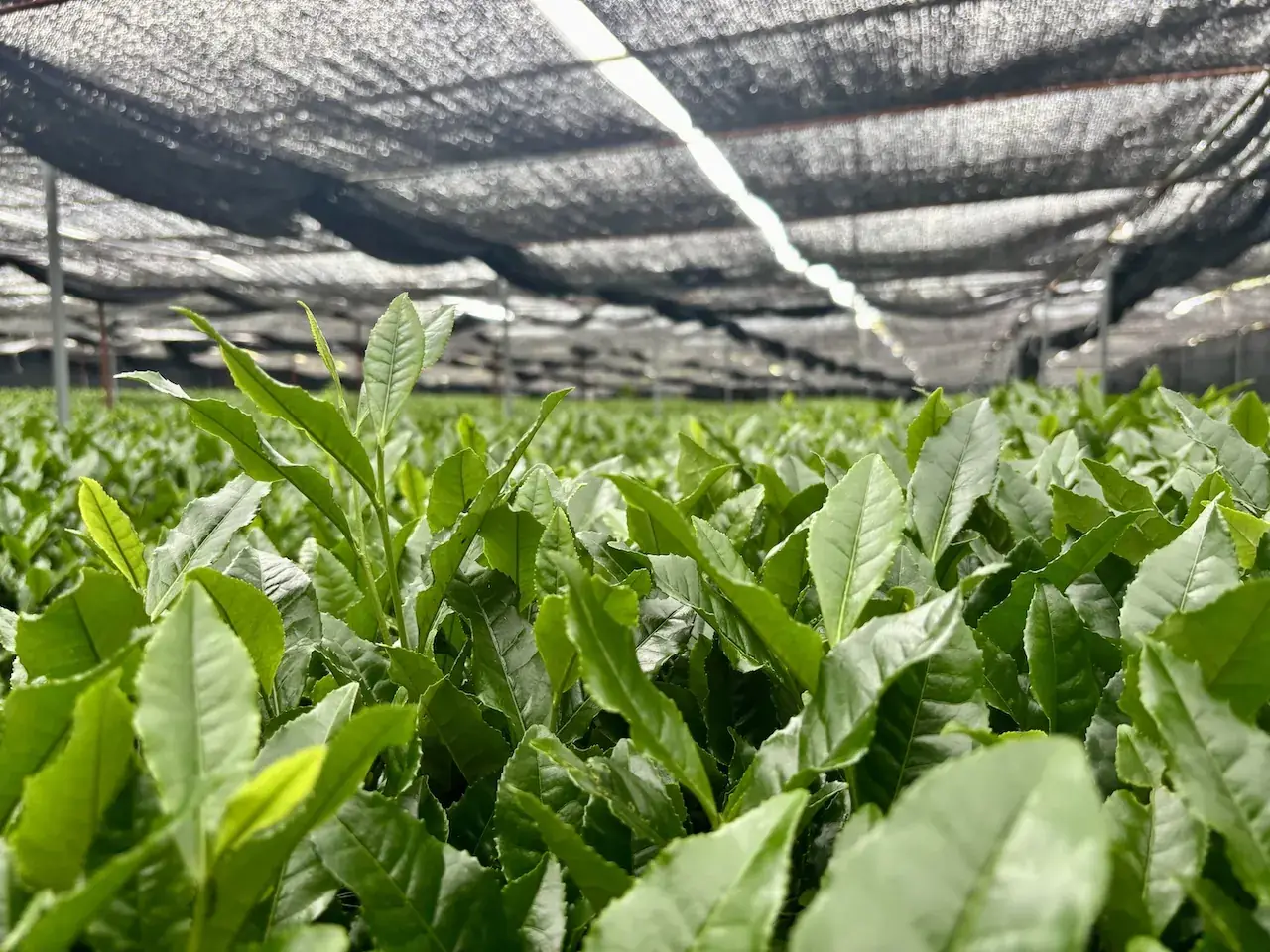
Matcha is made from tencha, leaf that is shaded for roughly three to four weeks before harvest (ISO/TR 21380 describes 20 to 30 days under covers that block 70 to 98 percent of light). The shade triggers a cascade of biochemical changes in the plant. Without full sunlight, the pathway that would normally break L-theanine down toward bitter catechins slows dramatically, and the amino acid accumulates instead. Shading trials have reported L-theanine increases of up to 50 percent compared with unshaded tea. At the same time chlorophyll surges, which is where matcha's intense green comes from, and the leaf develops the umami, sweetness and low bitterness that mark high-grade matcha.
This is why matcha is categorically different from ordinary ground green tea: the whole production chain, from field coverage to steaming to milling into a powder fine enough to whisk straight into water, is engineered toward keeping L-theanine and chlorophyll in the cup. A powder that skipped the shade step carries less of the amino acid and a harsher flavor. For the production walkthrough, see how real matcha is made; for how those steps shape a buying decision, see what makes matcha good.
Grade moves both molecules in the same direction. First-flush (ichibancha) shade-grown tencha tests highest for L-theanine, and a 2025 study that compared grades found ceremonial grade about 81 percent above food grade for caffeine. Treat that as a relative difference rather than a menu number: the gap between published sources is wider than the gap between grades. If the calm-energy experience is part of your menu story, first-flush shade-grown matcha from a supplier who can verify harvest and shading is the ingredient that delivers it consistently.
The L-theanine plus caffeine combination has been studied in peer-reviewed trials, and the evidence is stronger than most wellness claims. A 2025 double-blind, placebo-controlled crossover trial in the British Journal of Nutrition found that a high-dose combination (200 mg L-theanine with 160 mg caffeine) significantly improved selective attention, hit rate and target-distractor discrimination versus placebo in sleep-deprived adults. An earlier crossover trial by Giesbrecht and colleagues found that a moderate dose (97 mg L-theanine with 40 mg caffeine) significantly improved accuracy during task switching and reduced self-reported tiredness.
A 2024 systematic review and meta-analysis in Nutrition Reviews (50 randomized controlled trials screened, 15 eligible for meta-analysis) concluded that the combination improved accuracy and cognitive performance, and a 2024 clinical trial in Neurology & Therapy found that 28 days of L-theanine supplementation reduced perceived stress and improved attention versus placebo.
| Evidence | Dose studied | What one matcha latte delivers |
|---|---|---|
| British Journal of Nutrition 2025 RCT (selective attention) | 200 mg L-theanine + 160 mg caffeine | About 20 to 40 mg L-theanine + about 30 to 64 mg caffeine per 2 g serving |
| Giesbrecht et al. 2010 (task switching, alertness) | 97 mg L-theanine + 40 mg caffeine | Closer, but still above one serving's L-theanine |
| Nutrition Reviews 2024 meta-analysis (accuracy) | Varies across 15 RCTs, mostly supplement doses | A latte sits at or below the bottom of the studied ranges |
Important nuance for the menu conversation: the trials used isolated supplements at doses higher than a typical 2 g serving provides. The calm-energy effect is real but proportional: a matcha latte is not a cognitive supplement, and the honest story is a smoother, gentler lift than coffee, supported by biochemistry and research, without promising clinical outcomes. The full research rundown, including what the focus studies do and do not support, lives in matcha, focus and productivity.
Matcha's caffeine and L-theanine profile opens menu opportunities that coffee cannot fill.
Because matcha is lower-caffeine and associated with less anxious energy, customers who cut off coffee at 2 pm often extend their cafe visit with a matcha latte. Blank Street Coffee reports that 50 percent of its customers now choose matcha over coffee, a sign of matcha becoming a credible afternoon beverage (World Coffee Portal, The Matcha Report 2026). We wrote the full revenue playbook for this window in matcha and the afternoon daypart.
"Dirty matcha" (matcha plus espresso) is now a recognized menu category, and it works precisely because the L-theanine from the matcha side moderates the hard hit of the espresso shot. Note the caffeine math: a 2 g dose plus a double shot lands around 190 mg, so it belongs in the morning lineup, not the 4 pm one. For builds, ratios and batching, see our matcha latte guide for cafes.
Functional drinks are one of the strongest beverage trends in 2026. Matcha menu items grew over 30 percent year over year and social mentions climbed 107 percent (Tastewise, 2026). The catch: the story holds only if the matcha you are using is actually first-flush, shade-grown, and from a supplier who can verify it. Low-quality matcha will not deliver the L-theanine profile the story promises.
If you are using matcha as a menu story ingredient (the calm-energy pitch), serve first-flush for sip-as-is drinks, and a good latte grade for milk-and-syrup drinks where the nuance is masked. See our guide on understanding matcha grades for what to actually look for on a spec sheet.

For a broader guide to why the 2026 matcha shortage is reshaping sourcing options, and how to build a supply strategy that keeps quality consistent, the sourcing guide covers the full picture.
The gap between what the research supports and what wellness marketing claims is where cafes get into trouble. A workable rule: describe the drink, not a medical outcome.
Safe to print: "about half the caffeine of drip coffee," "smoother, longer energy," "naturally contains L-theanine, an amino acid studied for calm focus," "shade-grown first-flush matcha, milled to order." Each of those is either arithmetic on published figures or a plain description of the ingredient.
Avoid printing: "reduces anxiety," "treats stress," percentages lifted from supplement trials, or anything that reads like a clinical promise. Those results come from isolated compounds at doses a latte does not deliver, and a menu that borrows them invites a conversation you cannot win. The same goes for caffeine milligrams: if you print a number, base it on your supplier's COA or the official 32 mg per gram figure, and keep the recipe weight fixed.
The staff one-liner that covers the most common question: "Yes, matcha has caffeine, about half a drip coffee, and it comes with L-theanine so the energy feels smoother." Customers asking about daily limits, pregnancy or sensitivity can be pointed to a barista card built from our side effects and safety guide.

Matcha has significantly less caffeine than a standard drip coffee. Japan's official composition tables put a 2 g matcha serving at about 64 mg, and independent labs have measured commercial powders lower, near 30 mg per 2 g. An 8 oz drip coffee runs 80 to 100 mg and a double espresso about 127 mg. Matcha's L-theanine content also changes how the caffeine is experienced, with a slower onset and lower anxiety risk, so the comparison is about more than milligrams.
L-theanine is a naturally occurring amino acid found almost exclusively in Camellia sinensis, the tea plant. All tea types contain some L-theanine, but matcha delivers the most per cup among common cafe drinks because you consume the whole shade-grown leaf as a powder rather than an infusion. Shade-growing slows the breakdown of L-theanine in the leaf, so the amino acid accumulates. Coffee contains no meaningful L-theanine.
Matcha is less likely to cause jitteriness than an equivalent caffeine dose from coffee. The L-theanine in matcha raises alpha brain wave activity and modulates caffeine's stimulant effect on adenosine receptors, reducing anxiety and edginess. At a typical 2 g serving, most people report no jitter effect. Very high doses or sensitive individuals may still feel it, but the threshold is materially higher than with coffee.
Generally yes. Ceremonial-grade matcha is made from younger, first-flush, more intensely shaded leaves, which carry more of both compounds than the older leaves used in culinary grades; one 2025 grade comparison found ceremonial grade about 81 percent above food grade for caffeine. Grade terms are unregulated, so the meaningful specs are harvest season, shade duration and origin region, confirmed in writing by your supplier.
A dirty matcha stacks the two drinks, so the caffeine stacks too. A 2 g matcha dose at the official 32 mg per gram figure carries about 64 mg, and a double espresso adds about 127 mg, so the drink lands around 190 mg. That is close to double a drip coffee, which is worth telling customers who order it for the calm-energy story.
The FDA cites 400 mg per day as the caffeine level not generally associated with adverse effects in healthy adults. Using the official figure of about 64 mg per 2 g serving, that allows roughly five to six matcha lattes per day, though many operators treat three as a sensible practical ceiling. Pregnant individuals and those with caffeine sensitivity should follow their clinician's advice.
Health authorities advise stricter caffeine limits during pregnancy, and a 2 g matcha serving carries about 64 mg by the official figure, so one latte typically fits within common guidance but the decision belongs to the customer and their clinician. Train staff to state the caffeine content rather than give advice. Our side effects and safety guide covers pregnancy, iron absorption and the other common questions in detail.
Print with care: published matcha figures disagree by roughly two to one. Japan's composition tables say 32 mg per gram while peer-reviewed lab analyses of commercial powders measured 14 to 16 mg per gram. If you want a number on the menu, use your supplier's COA for the specific powder you pour, or state the conservative official figure with your fixed recipe weight.
No. The trials showing improved attention used isolated supplements, typically 97 to 200 mg of L-theanine with 40 to 160 mg of caffeine, while a 2 g matcha serving delivers roughly 20 to 40 mg of L-theanine. The direction of the effect is supported; the magnitude in a single latte is smaller. Describe the drink as smoother, longer energy rather than a cognitive enhancer.
Yes, and this is one of the clearest commercial opportunities for cafes. Matcha's lower caffeine dose and L-theanine-moderated effect make it suitable for mid-to-late afternoon customers who have cut off coffee. Operators report that matcha orders cluster differently through the day, extending beverage revenue into the 2 to 5 pm window. A good iced matcha latte is an effective afternoon anchor SKU.
The calm-energy story only holds if the matcha is genuinely first-flush, shade-grown, and from a supplier who can verify it. We export directly from farms in Uji (Kyoto), Yame, Kagoshima and other producing regions, mill after you order so the powder arrives weeks old rather than months old, and can provide spec sheets with harvest dates and amino acid data on request.
Request samples & pricingHiroshi Asami is the founder of Japanomars and exports single-origin Japanese matcha to specialty cafes in the US and Canada, working directly with farmers in Uji (Kyoto), Yame (Fukuoka), Kagoshima, Ibigawa (Gifu), Sayama (Saitama) and other producing regions. Japanomars has taken overseas cafe buyers on farm visits four times.
Sources
%E7%99%BD_%E5%A4%A7%E3%81%8D%E3%81%84.png)