%E5%A4%A7%E3%81%8D%E3%81%84.png)
Health · Caffeine · 2026
Plan on 32 milligrams of caffeine per gram of matcha. That is the figure in Japan's official food composition tables, and it makes a 2 gram latte 64 milligrams, a 3 gram one 96, and a 4 gram one 128. Your dose decides the number far more than your grade does, which is the opposite of what most matcha marketing implies.
Key takeaways
This is a reference page rather than an argument. It gives you the per gram figure, the per drink numbers at every dose a cafe actually pours, how matcha lands against the coffee on your own menu, and an honest account of why published sources disagree by a factor of two. It ends with what you can and cannot put in writing.
In this guide
About 32 milligrams. Japan's Standard Tables of Food Composition, the reference the Japanese government publishes and that Japanese food manufacturers work from, list matcha powder at 3.2 grams of caffeine per 100 grams. Divide that down and every gram of powder you scoop carries roughly 32 milligrams into the cup, because there is nothing left behind.
Matcha is unusual among caffeinated drinks in that the arithmetic is genuinely this simple. There is no extraction yield to estimate and no grind or contact time to account for. You weigh a powder, you whisk all of it into a cup, and the customer drinks all of it.
The caveat, which the rest of this page takes seriously, is that 32 is a reference value for matcha as a category rather than a measurement of your tin. Independent laboratories that have bought commercial matcha and run it have come in lower, sometimes much lower. Treat 32 as the conservative planning number, which is what it is, and not as a fact about the lot on your shelf.
At 32 milligrams per gram, a 1.5 gram drink is 48 milligrams, 2 grams is 64, 2.5 grams is 80, 3 grams is 96 and 4 grams is 128. Those five numbers cover almost every matcha drink poured in a US cafe, because almost every cafe sits somewhere between a 2 gram hot latte and a 4 gram large iced one.
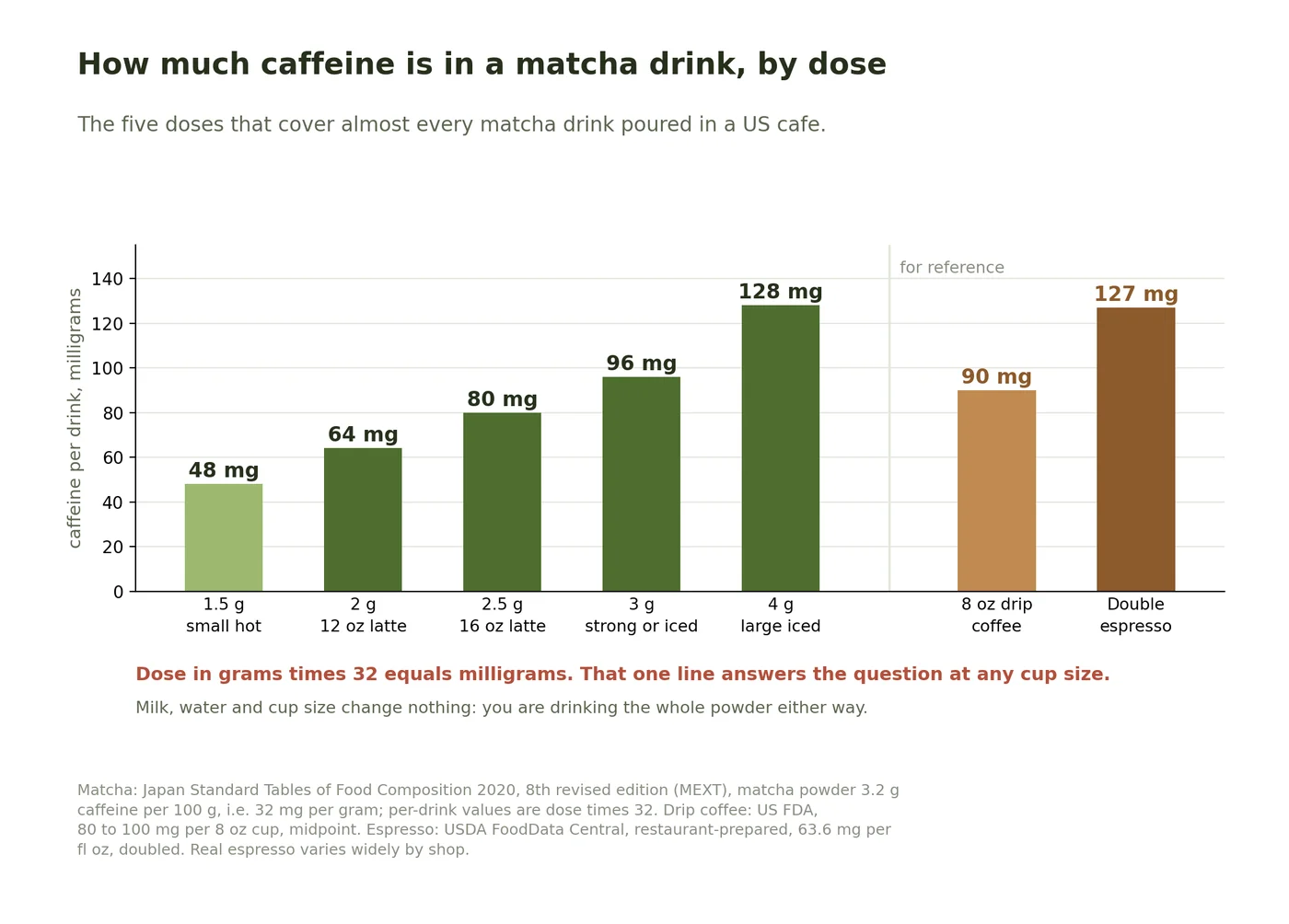
The practical consequence is worth sitting with. Two cafes can both sell a 12 ounce matcha latte, use the same supplier and the same tin, and put a 64 milligram drink and a 96 milligram drink in front of the same customer, simply because one dials in at 2 grams and one at 3. That is a 50 percent difference in the thing customers are asking about, produced entirely by a decision made at your bar.
It also means the caffeine question is a dosing question, and dosing is where matcha programmes usually drift. A cafe sets 2 grams in training, the scoop gets replaced, nobody reweighs, and eighteen months later the bar is pouring 3. Our guide to adding matcha to your cafe menu covers the workflow side of holding a dose steady. If your dose has drifted, your caffeine figure has drifted with it, and so has your cost per drink.
On average yes, and the direction is real, but the effect is smaller than the marketing suggests and smaller than your own dosing decision. A 2025 study in Plants measured caffeine falling steadily from ceremonial grade 1 through grade 4 to food grade, with grade 1 running about 81 percent above food grade in the same analysis.
The mechanism behind that is not mysterious. Higher grades are made from younger leaves picked earlier in the first flush, and from bushes shaded longer before harvest. Young leaves carry more caffeine than mature ones, and several studies find shading raises it further, though the shading literature is not unanimous. Whatever the exact split, the plant is doing the same thing that makes the tea taste better.
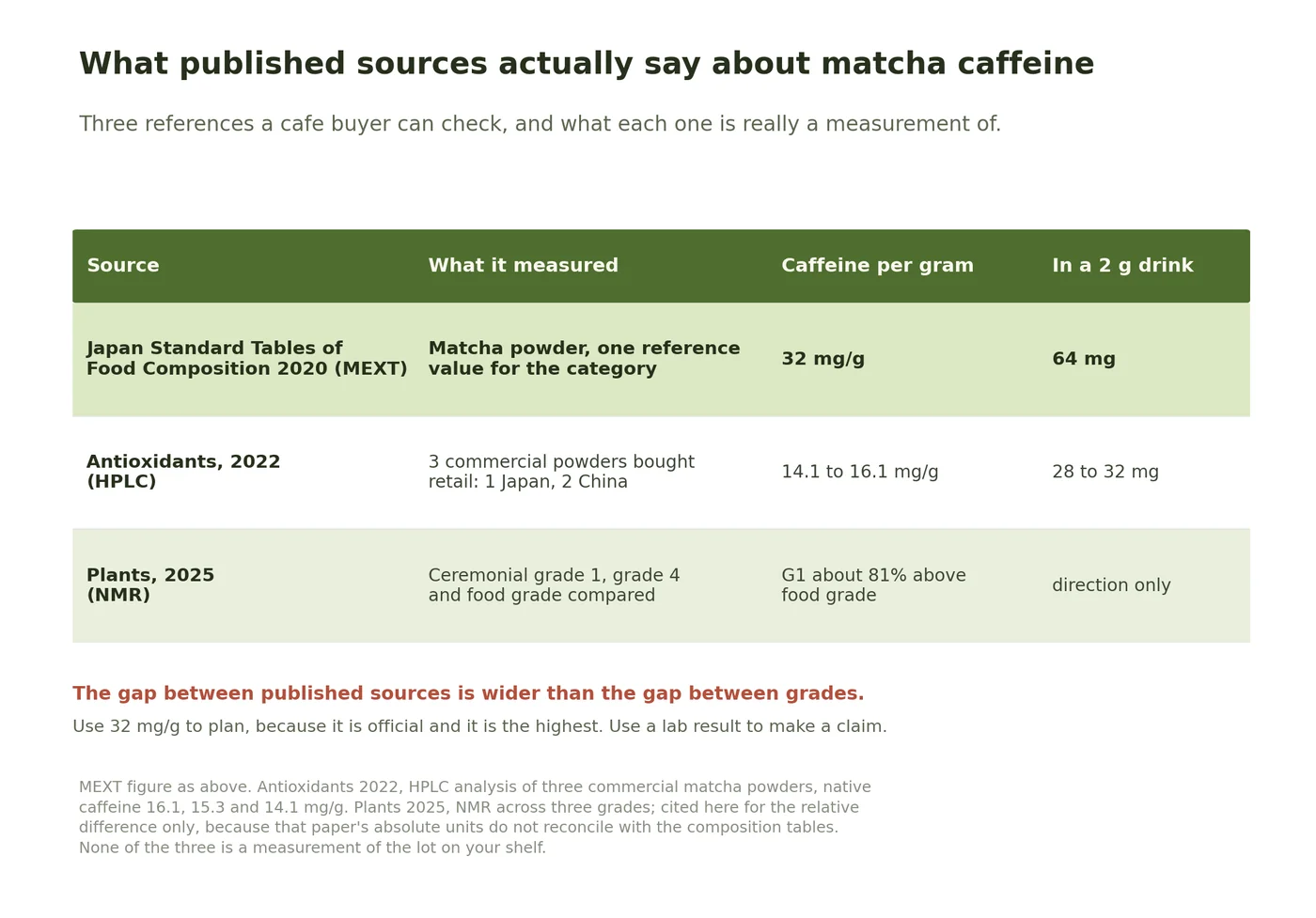
Here is why that 81 percent should not become a number on your menu. It is a relative finding inside one study, and the absolute values that study reports do not reconcile with Japan's composition tables at all. Meanwhile a 2022 analysis in Antioxidants ran three commercial matcha powders by HPLC and found 14.1, 15.3 and 16.1 milligrams per gram, roughly half the official figure. So the published range for matcha in general is wider than the published gap between its grades.
For a buyer the useful reading is this. Grade is a quality and flavour decision, not a caffeine lever. If you want to understand what you are paying for when you move up a grade, our guide to matcha grades is the better page, and what counts as real matcha covers the definitional ground underneath it. Caffeine is not where the money goes.
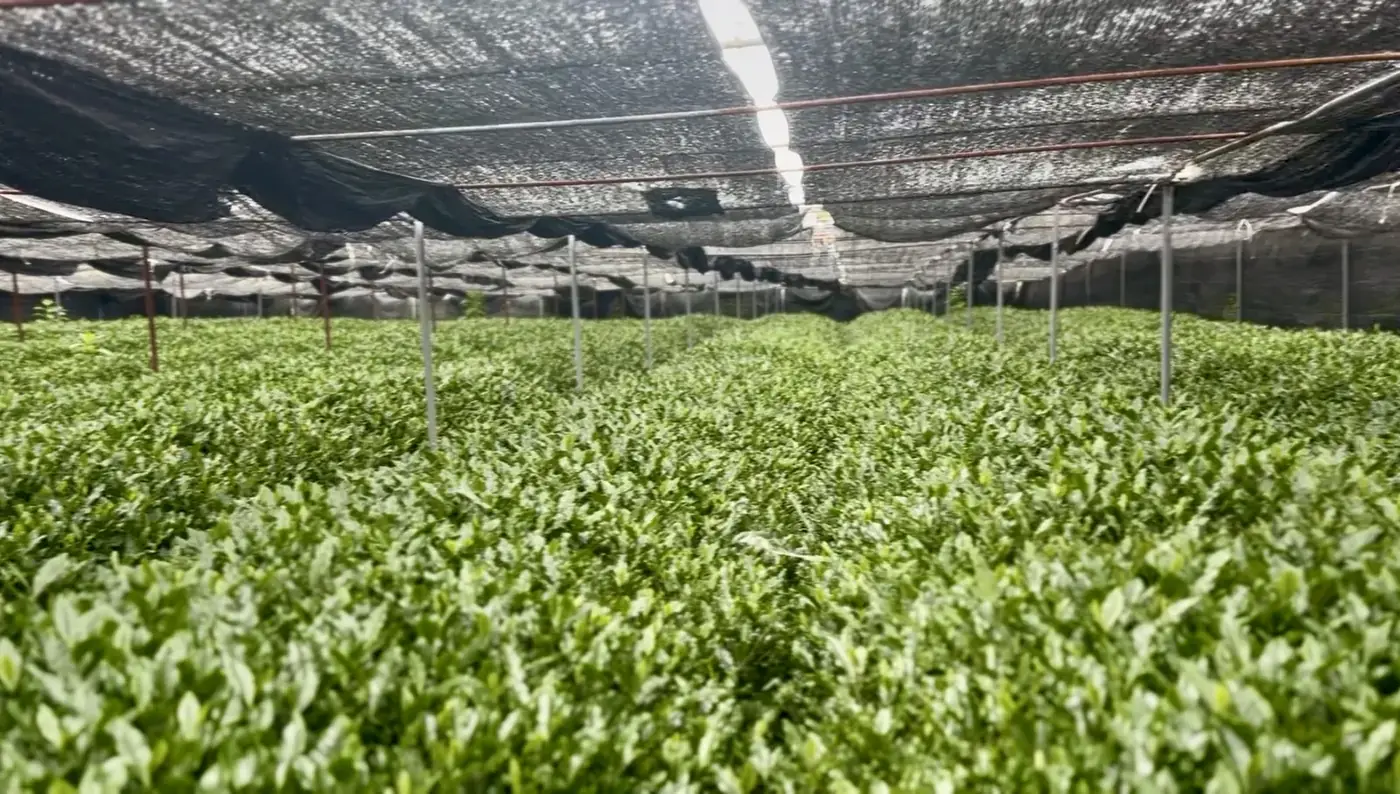
Because nothing gets thrown away. When you brew sencha, most of the caffeine stays locked in the spent leaf and goes in the bin. When you whisk matcha, the leaf is the drink. Japan's own tables imply that a standard sencha brew moves only about a third of the leaf's caffeine into the cup, while matcha moves all of it.
| What you use | Caffeine in the dry leaf | Caffeine in the cup | Reaches the customer |
|---|---|---|---|
| Matcha, 2 g whisked | 64 mg | 64 mg | all of it |
| Sencha, 10 g brewed in 430 mL | about 230 mg | about 86 mg | roughly a third |
| Gyokuro, 10 g brewed in 60 mL | not compared here | about 96 mg | a small, strong cup |
Arithmetic on Japan's Standard Tables of Food Composition 2020: matcha powder 3.2 g/100 g, sencha leaf 2.3 g/100 g, sencha infusion 0.02 g/100 g at the table's own spec of 10 g of leaf in 430 mL, gyokuro infusion 0.16 g/100 g at 10 g in 60 mL. The infusion values are published to one significant figure, so treat the cup column as approximate.
This is the honest version of the claim that matcha is somehow stronger than green tea. It is not a different plant and it is not a different molecule. It is the same leaf with the filter removed. A cafe that understands this will answer the customer question correctly, which matters more than it sounds, because the wrong version of this claim is everywhere and it makes staff sound like they are selling something.
It also explains why the matcha number is stable and the brewed tea number is not. Brewed tea caffeine moves with water temperature, steep time and how hard the leaf is pushed. Matcha caffeine moves with one variable, and it is sitting on your scale.
A 2 gram matcha latte at 64 milligrams sits below an 8 ounce drip coffee at roughly 90, and a 4 gram iced matcha at 128 sits alongside a double espresso at about 127. So matcha is not the low-caffeine option and it is not the high one. Across a normal cafe dose range it spans almost the entire coffee menu.
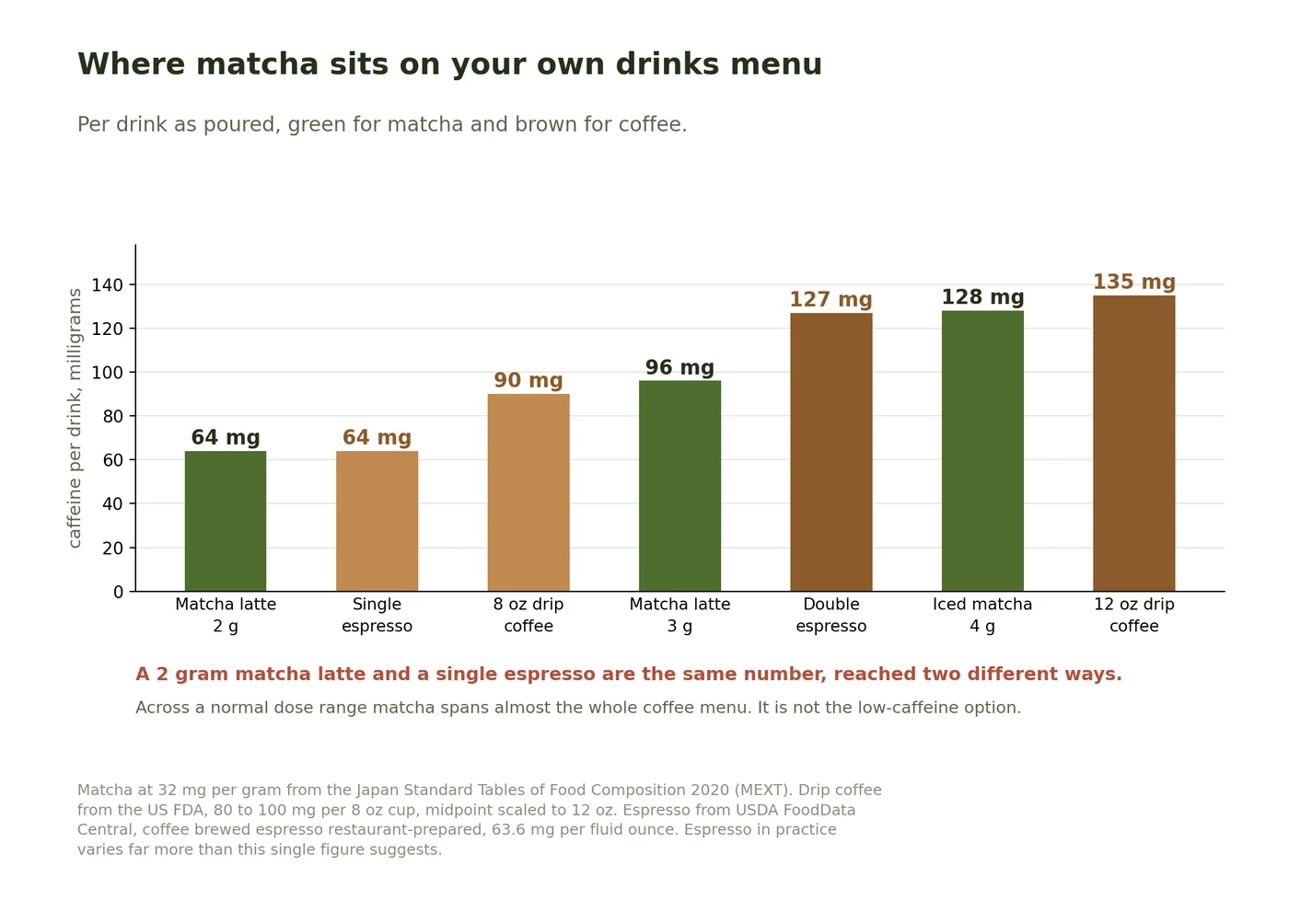
The pairing that lands with customers is the single espresso and the 2 gram matcha latte, because they are the same number, 64 milligrams, arrived at completely differently. It is a useful thing for a barista to be able to say, and it is true on published figures rather than on vibes.
What makes matcha feel different at the same dose of caffeine is L-theanine, not the caffeine itself. That is a real, studied effect and it deserves its own treatment, which our matcha versus coffee guide gives it. This page is deliberately only about the milligrams. Do not let the two questions collapse into each other on your menu copy, because the second one is where overclaiming usually starts.
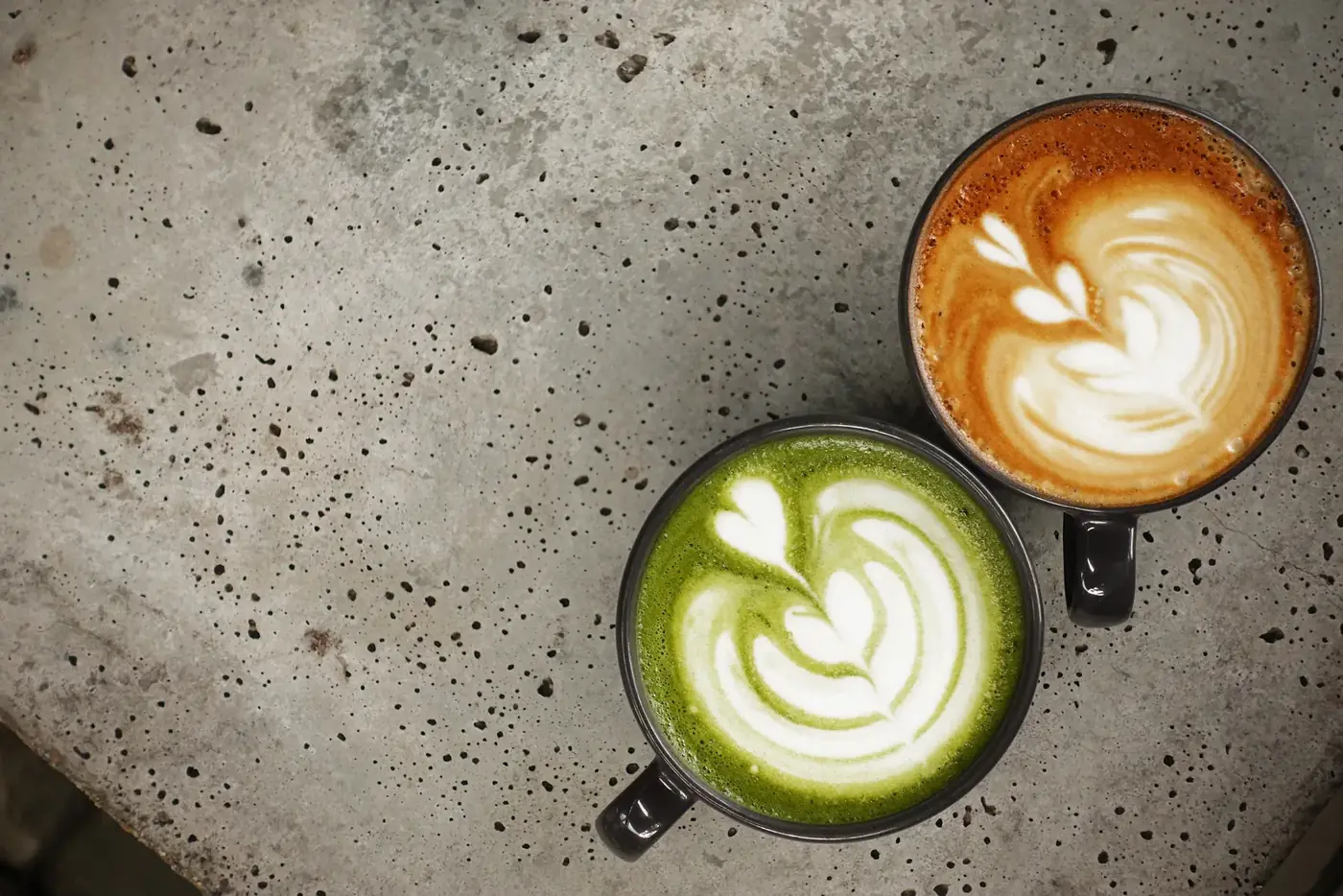
You can print a calculated figure if you label it as calculated, and you can print a measured figure if you have a lab result on the lot. What you cannot honestly do is print a number you inherited from a supplier's marketing page, or describe matcha as low caffeine, which the numbers on this page do not support at any dose a cafe pours.
The safest wording we see working is a range tied to the dose rather than a single figure: about 64 milligrams in a 12 ounce, about 96 in a 16 ounce, calculated from published composition data. That is accurate, it is defensible, and it survives a lot change without you having to reprint anything. It also quietly tells a knowledgeable customer that you know what you are doing.
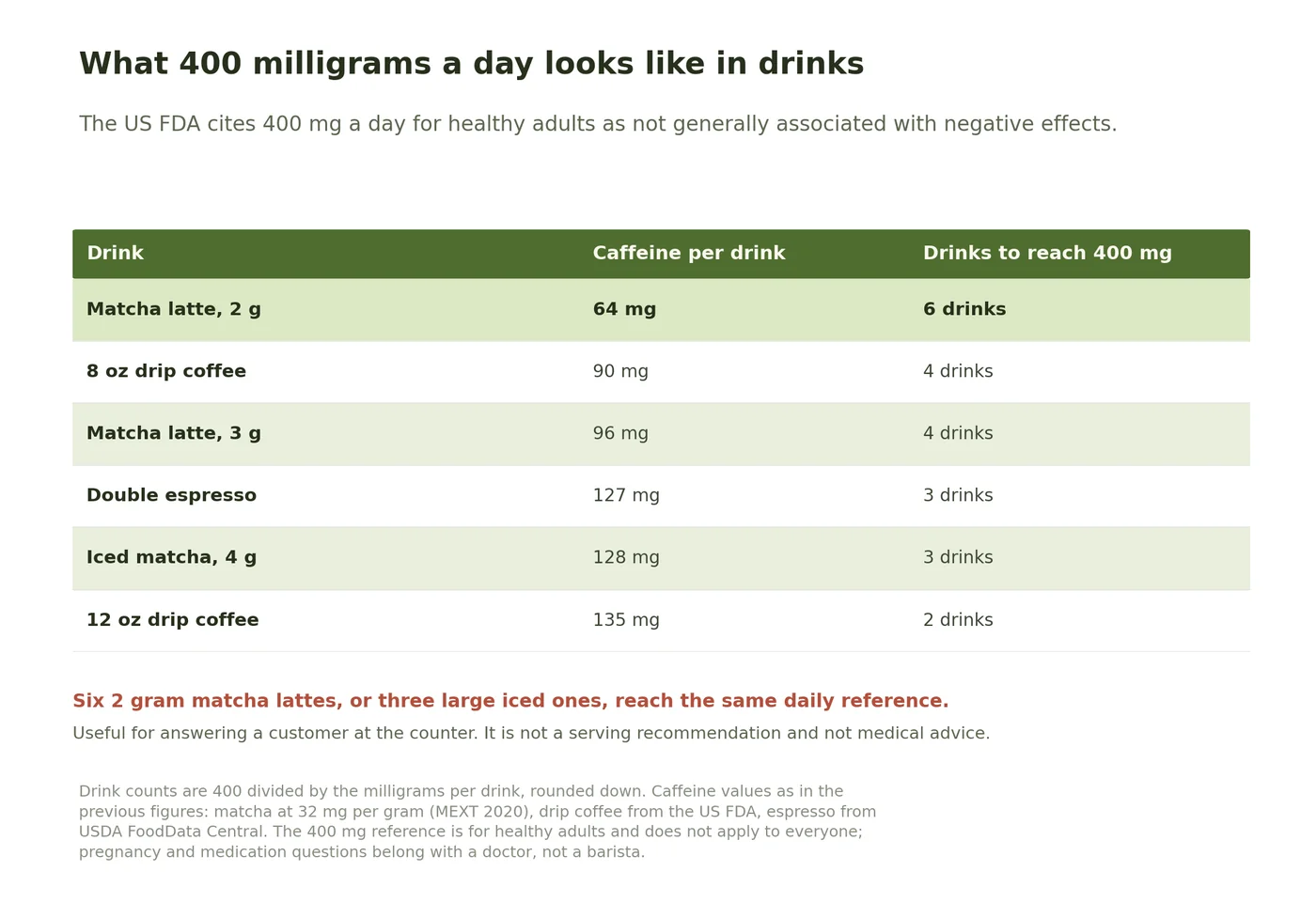
Two things to avoid outright. The first is loose decaf language: decaffeinated matcha exists only as a processed specialty product that has to be sourced by name, it is not a grade and it is not what is in your tin, so a customer avoiding caffeine should be steered to something else rather than to a smaller matcha unless you actually stock a decaffeinated product. The second is the pregnancy and medication conversation, which belongs with a doctor and not with a barista. Give the number, give the FDA reference, and stop there.
If you want a measured figure rather than a calculated one, ask your supplier for a certificate of analysis that includes caffeine on the specific lot. Many suppliers can produce heavy metal and pesticide panels but have never been asked for caffeine, so expect a delay rather than a refusal the first time.
A supplier who can put a caffeine number on your lot is telling you something beyond the number itself. Lot-level testing means they know which lot you got, which means they know which harvest and which field it came from. A supplier who quotes 32 milligrams per gram back at you has read the same composition table you did.
Three questions separate the two quickly. Can you give me a caffeine result on the lot you are shipping, rather than a typical value? What harvest is this lot from, and how long was it shaded? And if I reorder in four months, will it be the same lot or a new one, and will the figure move? None of these are hard questions for a supplier who is close to the field. All three are hard for one who is not.
That last question is the one that catches people. Matcha is an agricultural product blended from a harvest, so the honest answer is usually yes, the number moves a little. What you want is a supplier who says so and tells you when the lot changes. Our guide to finding and vetting a supplier sets out the wider version of this conversation, and our main matcha for cafes guide is the place to start if you are building a programme from scratch.
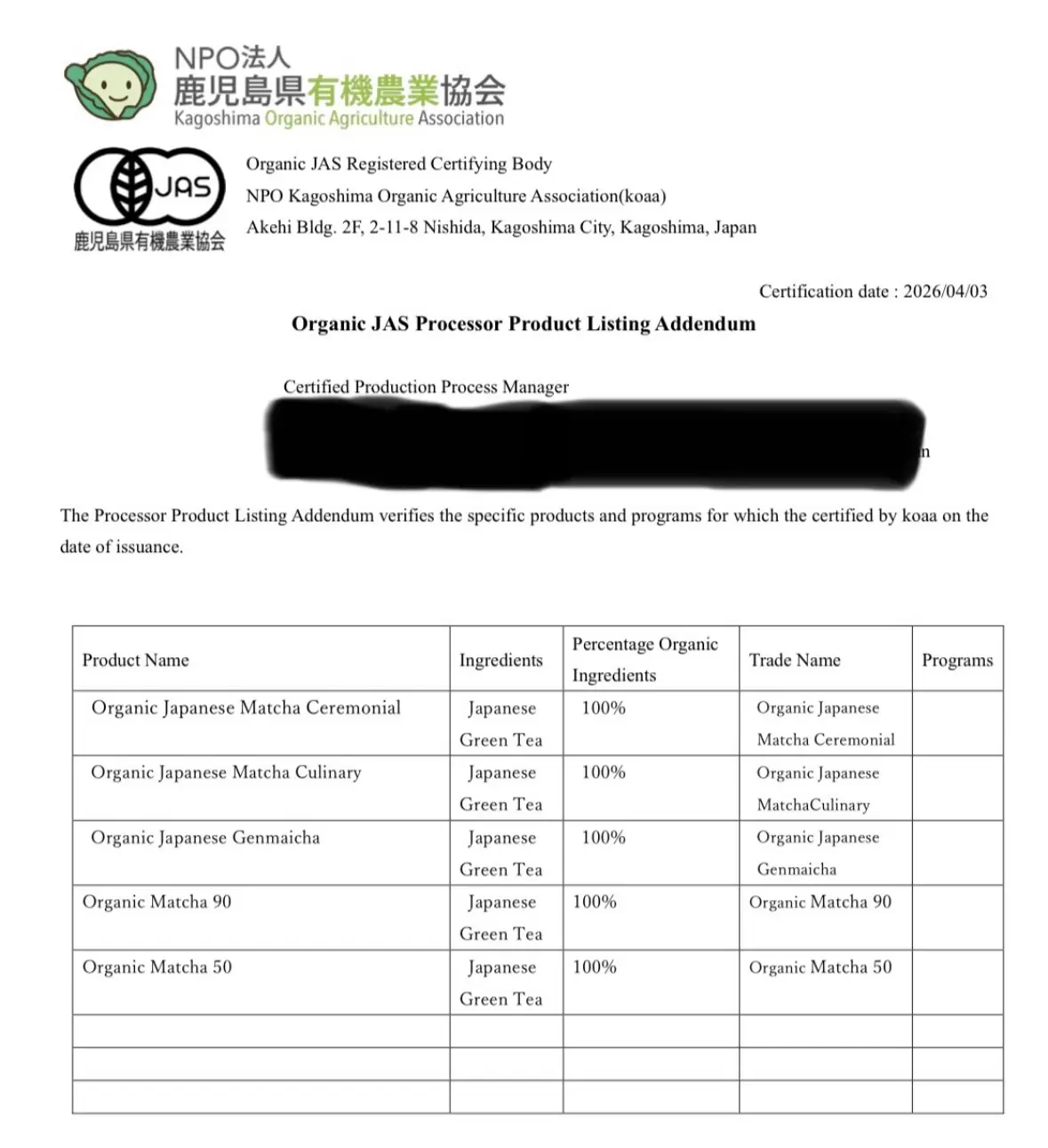
From the sourcing floor
None of the growers or processors we currently buy from issues a caffeine figure with the lot. If a cafe needs one for a label or an app, the lot has to go to a specialist analysis lab, and that can mean waiting a few months for the number. If what the customer actually wants is a low-caffeine or caffeine-free option, that is a sourcing question rather than a testing one, and it is something we can supply.
About 32 milligrams per gram of powder, using the figure in Japan's Standard Tables of Food Composition, which list matcha at 3.2 grams of caffeine per 100 grams. Independent laboratory analyses of commercial powders have come in lower, as far down as 14.1 milligrams per gram, so 32 is the conservative planning number rather than a guaranteed one.
Multiply your dose in grams by 32. A 2 gram latte is about 64 milligrams, a 2.5 gram one about 80, a 3 gram one about 96, and a 4 gram iced build about 128. Milk, water and cup size change nothing, because you are drinking the whole powder either way.
On average yes, but not by enough to plan around. A 2025 study in Plants measured caffeine falling steadily from ceremonial grade 1 down to food grade, with grade 1 about 81 percent higher. The spread between published sources for matcha as a whole is larger than that, and your dose swings the drink further than either.
Per cup, usually less. A 2 gram matcha latte is about 64 milligrams against roughly 90 for an 8 ounce drip coffee, using the US FDA's range. Per gram of dry material matcha is higher, but a cafe pours 2 to 4 grams of matcha and 15 to 20 grams of coffee, so the drink lands lower.
Because they measure different things. Japan's composition tables publish one reference value for matcha as a category. Laboratory papers measure whichever powders they bought, and cultivar, shading, harvest and blend all move the result. A 2022 analysis of three commercial matchas found 14.1 to 16.1 milligrams per gram, roughly half the table figure.
Only one you can support. A calculated figure from the composition tables is a reasonable internal planning number, but it is not a measurement of your lot. If you want a figure on a board, an app or a label, ask your supplier for a certificate of analysis covering caffeine on the lot you bought, and restate it when the lot changes.
The whole page reduces to one line you can tape inside a cupboard: dose in grams times 32 equals milligrams of caffeine. Everything else here is about knowing how firm that 32 is, which is firm enough to plan a menu on and not firm enough to print without a lab result. If you take one action from it, reweigh your dose this week, because that is the number that actually moved.
We supply cafes in the United States, Canada and the Philippines from growers in six regions across five Japanese prefectures, and we mill to order rather than from finished stock, so we know which harvest your lot came from. Tell us your dose and your monthly volume and we will send samples with current wholesale pricing and the lot documentation we hold.
Request samples & pricing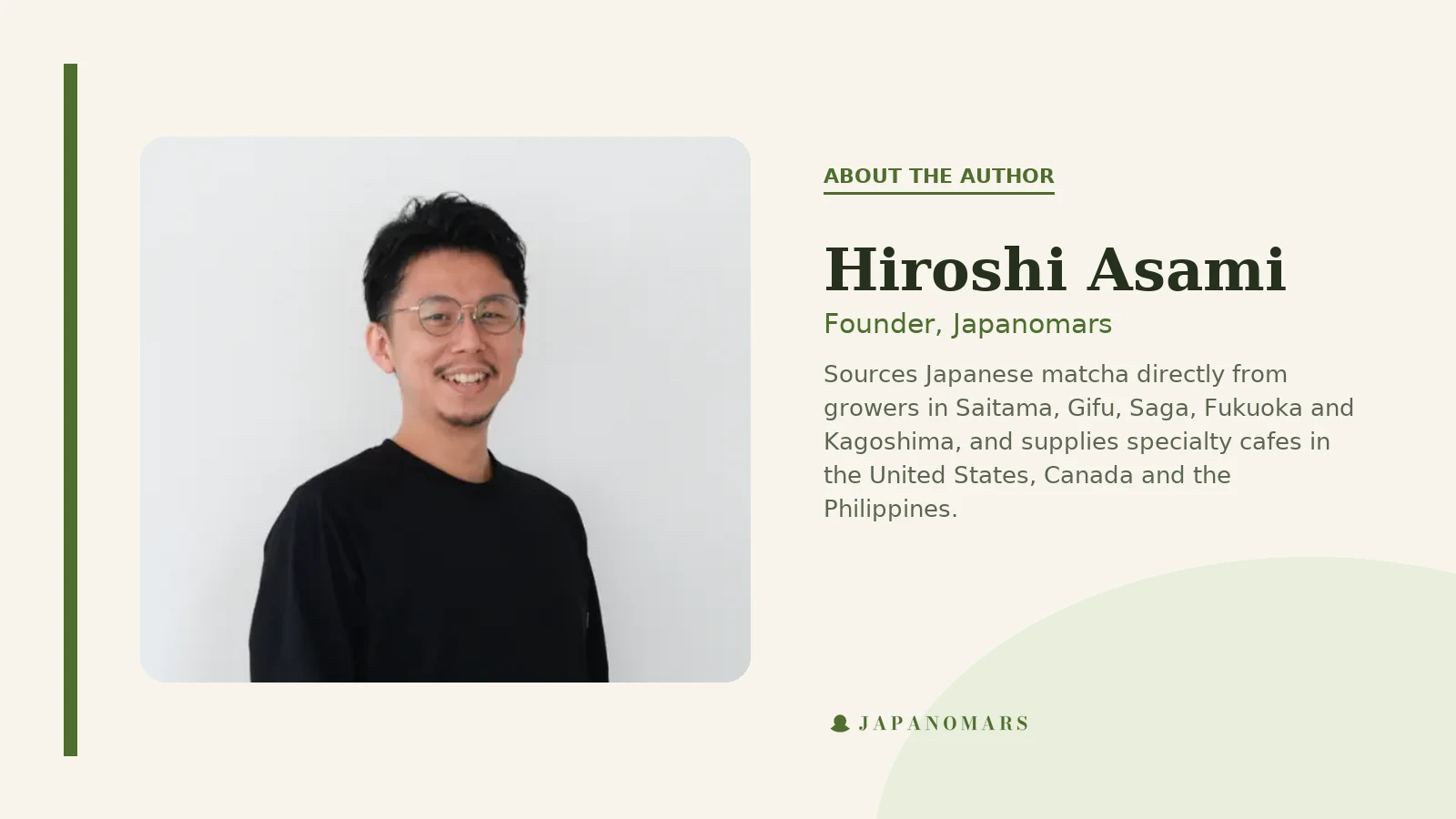
Hiroshi Asami is the founder of Japanomars, which exports Japanese matcha to cafes in the United States, Canada, and the Philippines. He sources through direct relationships with growers and processors in Saitama, Gifu, Saga, Fukuoka, and Kagoshima, and has led four sourcing tours bringing overseas cafe owners to Japanese tea farms.
Sources
%E7%99%BD_%E5%A4%A7%E3%81%8D%E3%81%84.png)