%E5%A4%A7%E3%81%8D%E3%81%84.png)

If you run a cafe in the US, the way to secure Japanese matcha during the shortage is to stop spot-buying and build a direct, committed relationship with a Japanese exporter: lock in grade, price, and allocation ahead of the spring harvest instead of chasing whatever stock is left. Matcha is picked once a year, and demand has outrun the crop, so the buyers who plan supply, not just place orders, are the ones still serving matcha.
I'm Hiroshi Asami, and I source and export matcha from Japan to cafes overseas through Japanomars. This is the supply-side view, updated in July 2026 with results from this spring's harvest.
Key takeaways
The shortage comes down to one stubborn fact: matcha is harvested once a year, and global demand has grown far faster than the crop. Extreme heat cut recent Japanese harvests, tencha (the shaded leaf matcha is ground from) is scarce, and the 2026 auctions have already set fresh price records.
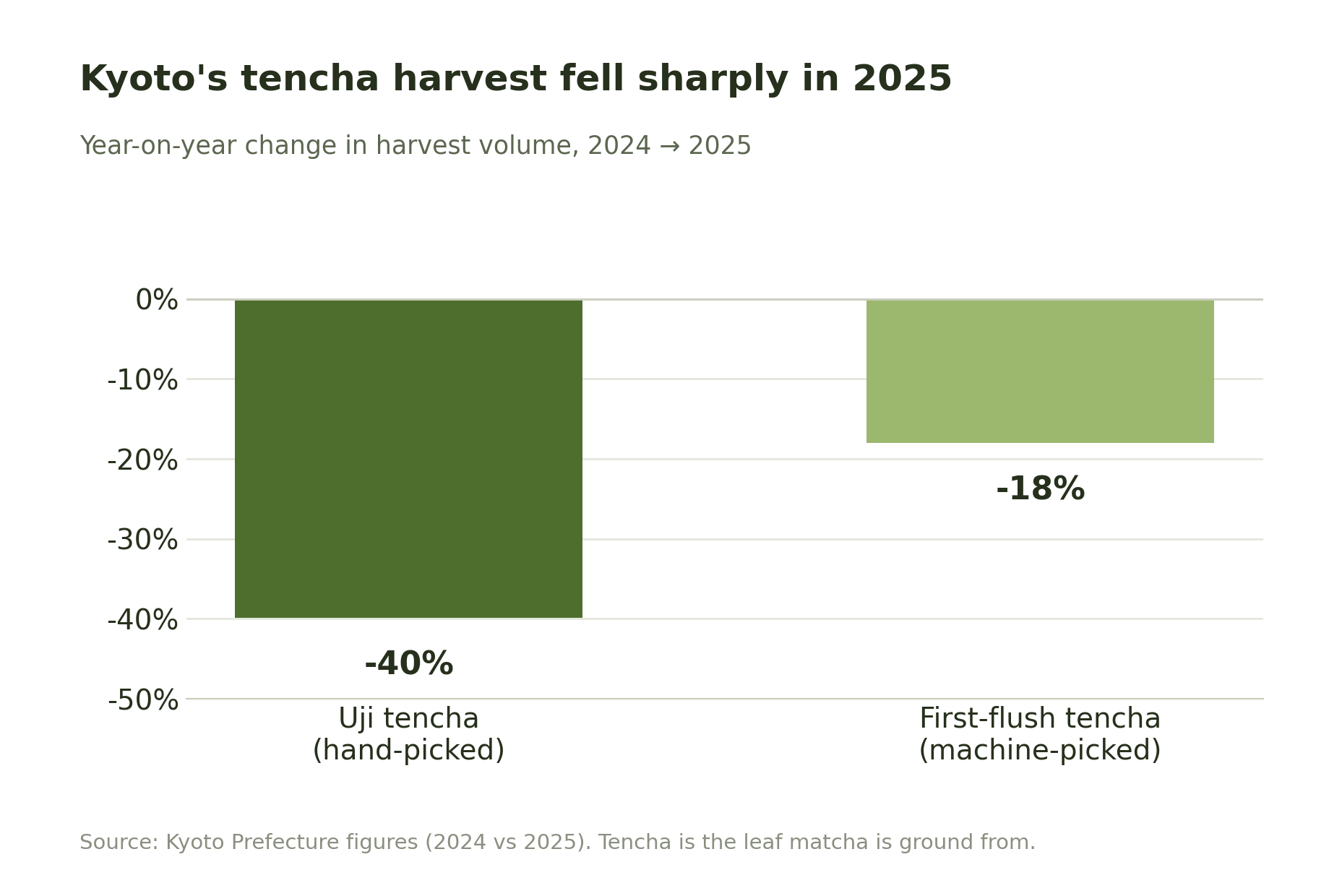
The raw material is the bottleneck. According to Kyoto Prefecture figures, hand-picked Uji tencha dropped from around 10,200 kg to 6,100 kg between the 2024 and 2025 harvests, a fall of roughly 40%, while machine-picked first-harvest tencha declined about 18%. On the demand side, Japan's green-tea export value roughly doubled in 2025, to about 72 billion yen, as overseas orders surged. This is not the first US-driven squeeze, either: earlier matcha booms in the 1990s and 2000s were set off by Haagen-Dazs and then Starbucks.
The 2026 first-flush results confirm the squeeze is not over. At the JA Zennoh Kyoto tea market in Joyo, the season's first tencha auction on May 13 averaged 14,127 yen per kg, 1.7x last year and the highest first-auction price in a decade (Kyoto Shimbun). In Kagoshima, first-flush prices more than doubled, up 106% to their highest level since 1975, with tencha averaging 13,910 yen per kg, 2.3x year on year (Minami Nippon Shimbun, June 2026). Traded volume rose 12.5%, so supply is responding, just far more slowly than demand.

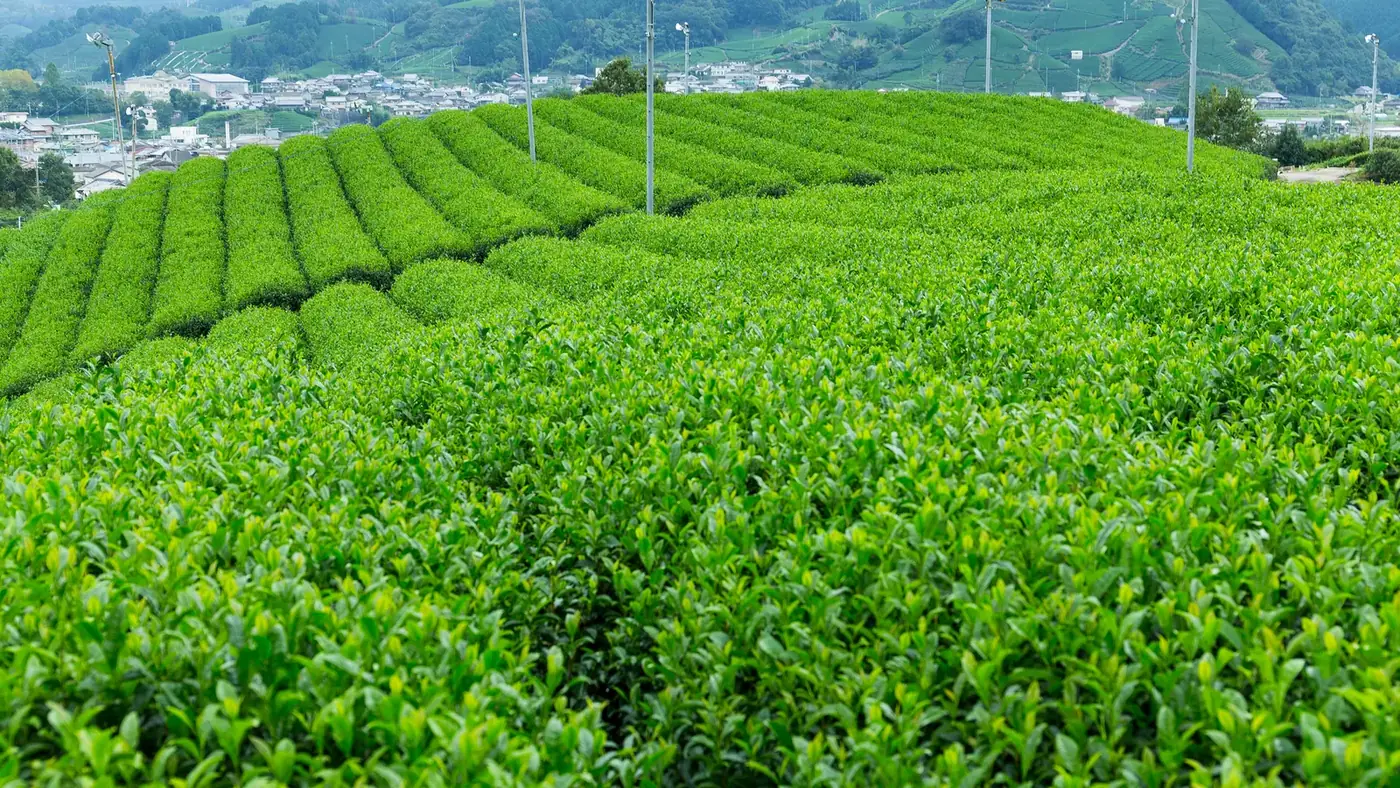
Japan cannot ramp up matcha quickly even at record prices. A newly planted tea bush takes about five years to reach its first harvest, growers are aging, total tea acreage is flat to declining, and tencha processing equipment costs tens of millions of yen. The ceiling is structural, not seasonal.
The numbers behind that sit mostly in Japanese-language sources. Japan's Ministry of Agriculture, Forestry and Fisheries (MAFF) warns that grower attrition is accelerating and domestic supply may not keep up with demand. Tencha output hit a record of roughly 4,176 tonnes in 2023, nearly triple the 2008 level, but that growth came from converting existing sencha fields, not from new land. And a single tencha furnace can cost around 40-50 million yen (roughly $300,000), which keeps new entrants out.
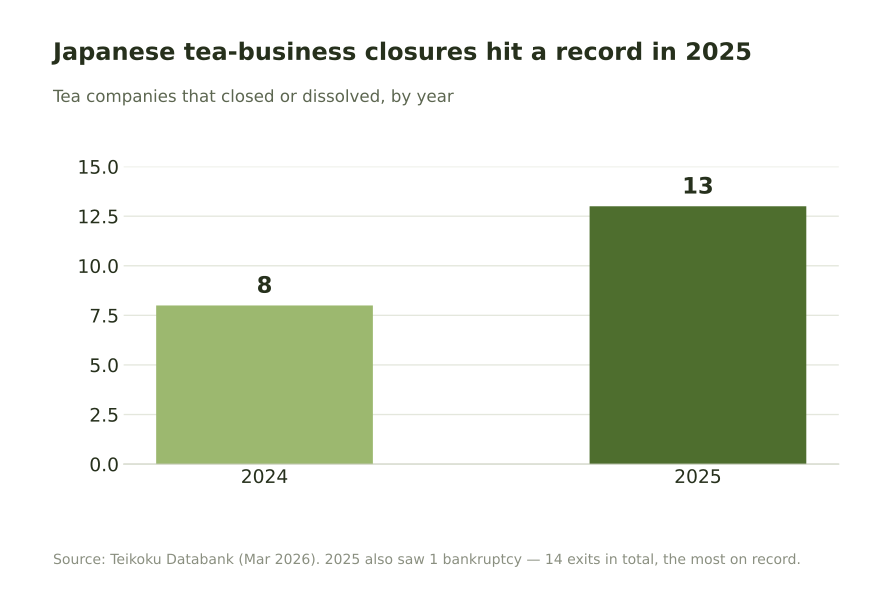
The middle of the chain is thinning too: Teikoku Databank reports that 2025 set a record for Japanese tea companies leaving the market, with 13 closures or dissolutions plus one bankruptcy. For a cafe buyer, the takeaway is blunt: do not assume your supplier's supply is guaranteed. For the full picture, see our matcha market outlook.
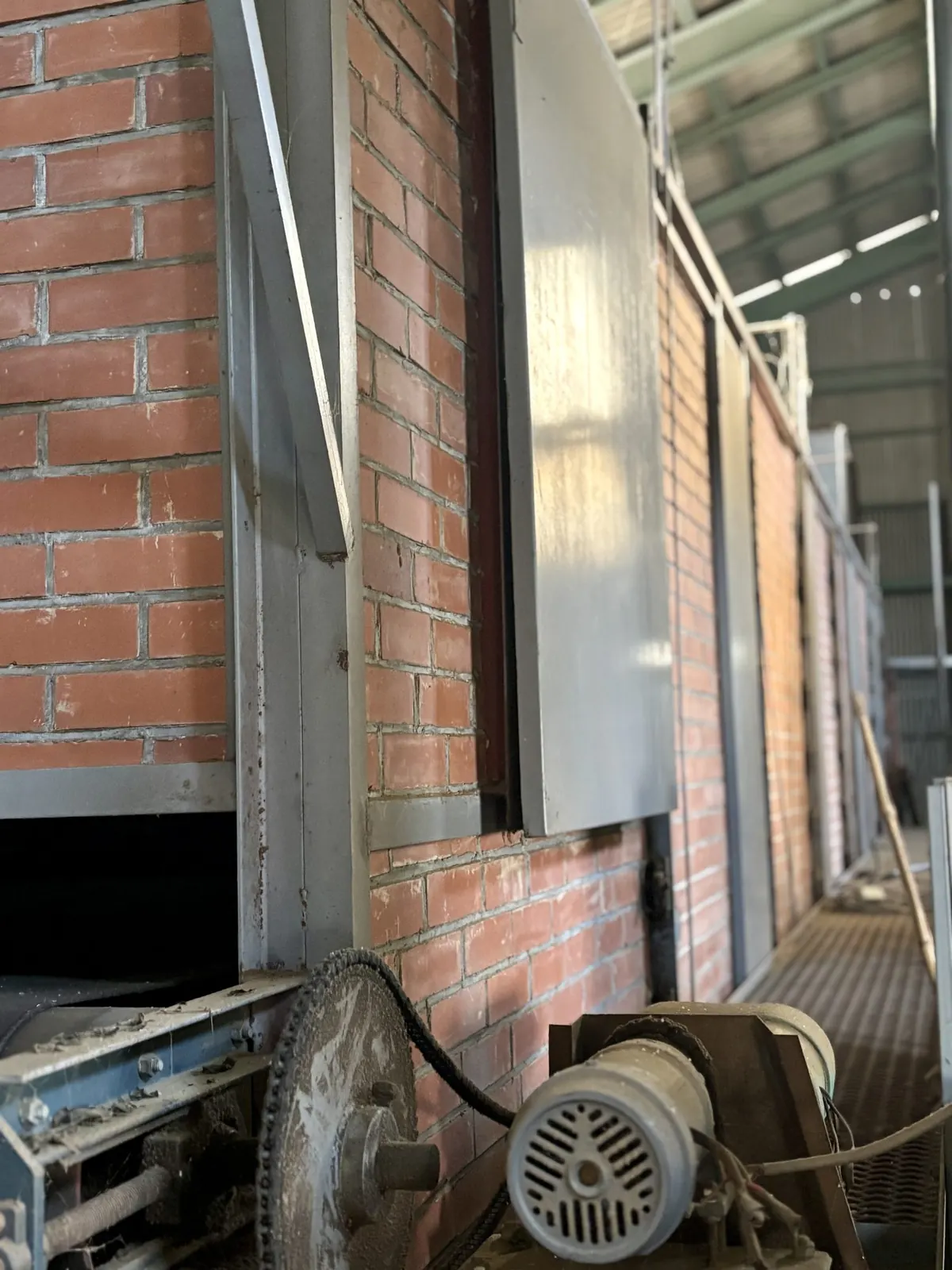
Expect ceremonial grade in the low-to-mid hundreds of dollars per kilogram at origin, and latte or culinary grade at roughly $60-140 per kg, before freight, customs clearance, and brokerage. Distributor-intermediated stock typically runs 25-40% above buying direct from a qualified Japanese exporter at the same grade and volume.
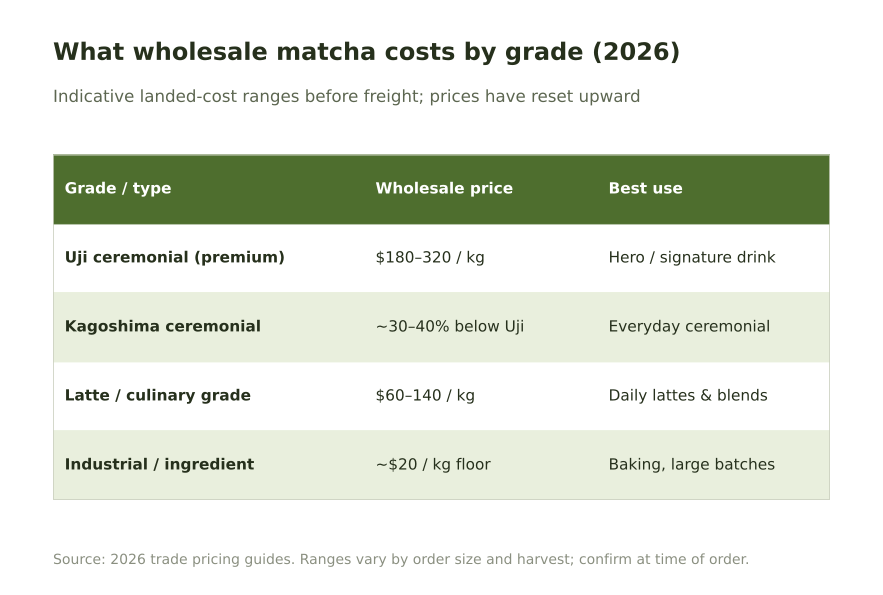
By current market reporting, premium Uji ceremonial sits around $180-320 per kg at small order sizes, with comparable Kagoshima ceremonial often 30-40% lower. Legitimate culinary product now floors around $20 per kg at larger volumes; the old sub-$20 pricing has effectively disappeared. Analysts broadly agree the price floor has reset: budget for steady annual increases in the mid-single digits, not a return to 2023 levels. For what each grade actually gets you, see our guide to matcha grades. For the auction numbers behind these bands, dated and sourced, see our US matcha wholesale price index.
From the sourcing floor
Talking directly with farmers and wholesalers, we see finished matcha prices up roughly 1.5x across the board. The increase started in Kagoshima and is now rippling across the country; Kyoto, already priced higher, is running about 1.3-1.5x. Auction headlines track raw tencha, which spiked far more sharply, but 1.5x is the practical number to plan around for the matcha that lands in your cup.
No. Matcha from Japan enters the US at 0% duty. Green tea, the category matcha falls under (HTSUS heading 0902), has long been duty-free under the US-Japan Trade Agreement. The temporary Section 122 surcharge that ran from February 2026 expired on July 24, 2026, and the Section 301 forced-labor tariff that took effect the same day excludes the green-tea lines under heading 9903.05.86. The 10-15% figures quoted in many articles are simply wrong, and so is any 2026 guidance that still tells your broker to file under 9903.03.03, which stopped meaning anything in July.
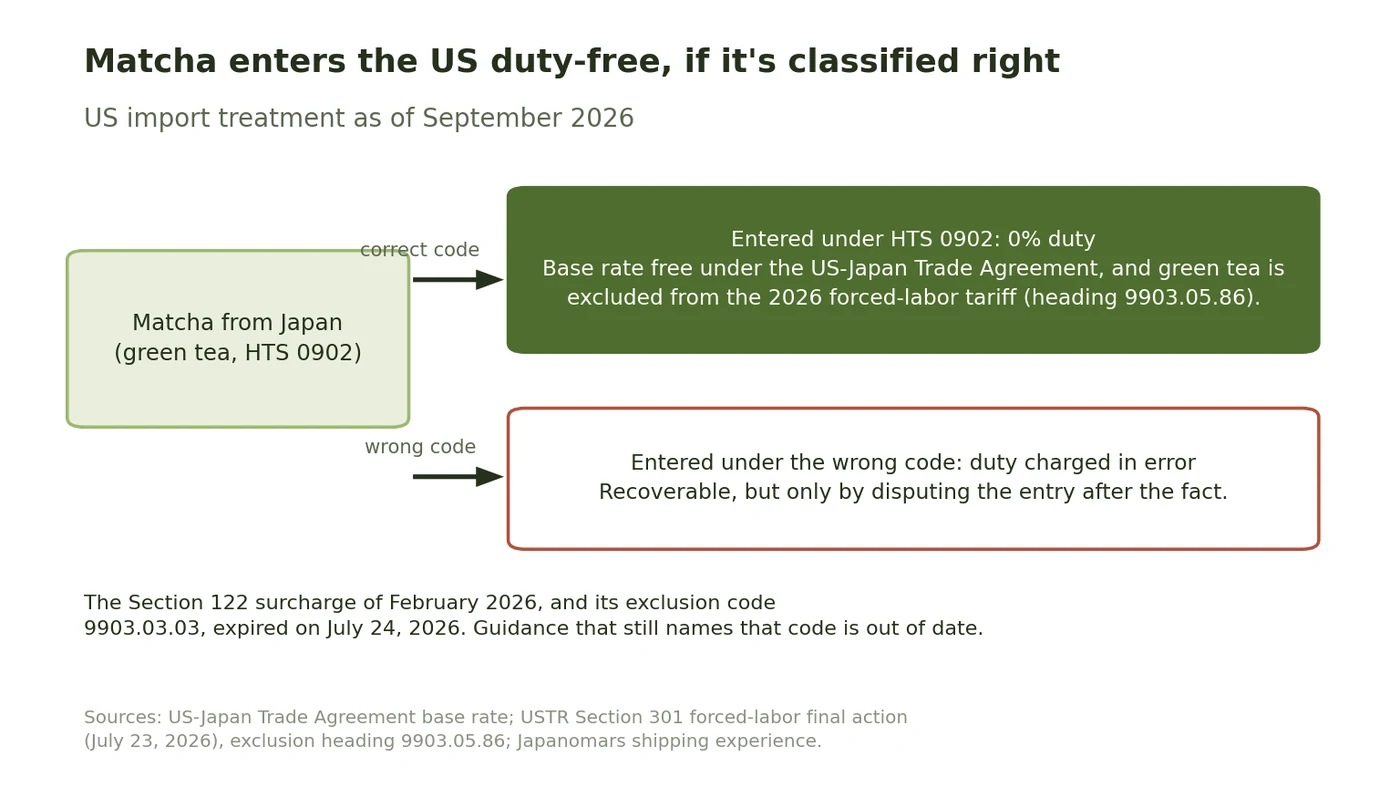
We have lived this with our own shipments: cargo through carriers like DHL and FedEx clears with no duty. On one occasion the wrong code was applied at customs and a duty was charged in error; we disputed it, and the amount is being refunded. The practical move is simple: make sure your broker or carrier classifies matcha under HTS 0902.
Match the region to the job. Uji (Kyoto) is the heritage origin, best reserved for a hero drink or seasonal special where the name justifies the price. For the matcha you pour all day, Kagoshima and Nishio deliver consistent quality at a workable cost.
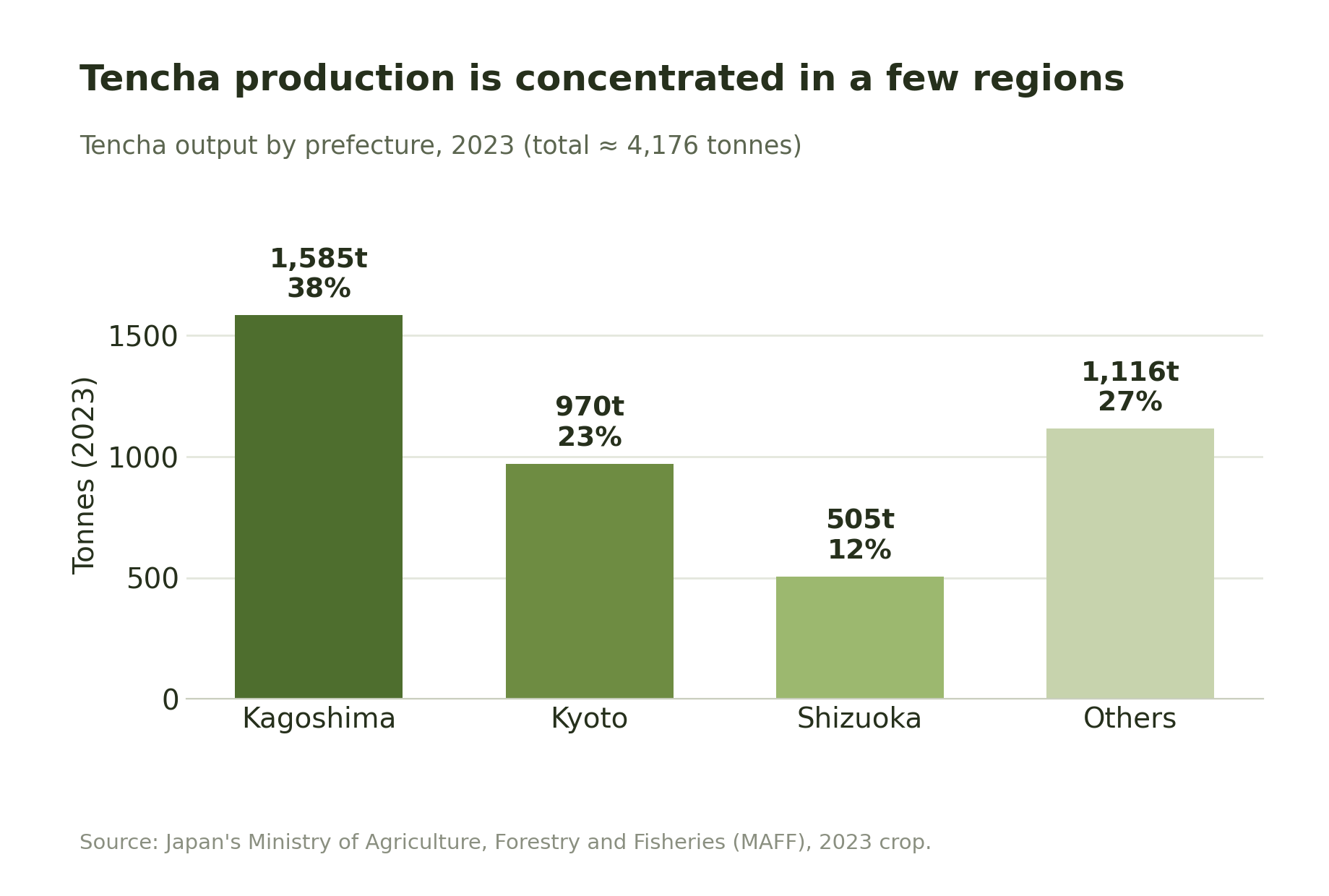
Kagoshima is now Japan's largest tea-producing prefecture by volume, with a longer harvest window that makes supply more stable and recent national production awards to its name, so "value origin" no longer means lesser quality. Nishio (Aichi) is the traditional high-volume source for dependable culinary grade. Uji remains the premium narrative, but increasingly as an allocation-limited SKU. Channel matters as much as region: farm-direct gives the best story but the least consistency, a tonya (wholesaler) blends across farms for a consistent cup year to year, and an established exporter handles quality control, compliance, and logistics for you. For an origin-by-origin breakdown, see our Japanese matcha regions guide.
Buying direct is more accessible than the old "you need a pallet" reputation suggests. A qualified exporter will typically accept orders from around 5-10 kg, enough to cover a single cafe for roughly 8-12 weeks, ship by air freight, and land product in about 7-14 days from dispatch, milled within the previous 30-60 days.


The buyers who never run out treat matcha as a planned supply line, not a purchase. The first-flush harvest runs April-May, processing through June, and long-term purchasing opens from around July, by which point much of the year's supply is already claimed. So the time to start the conversation is March-April.
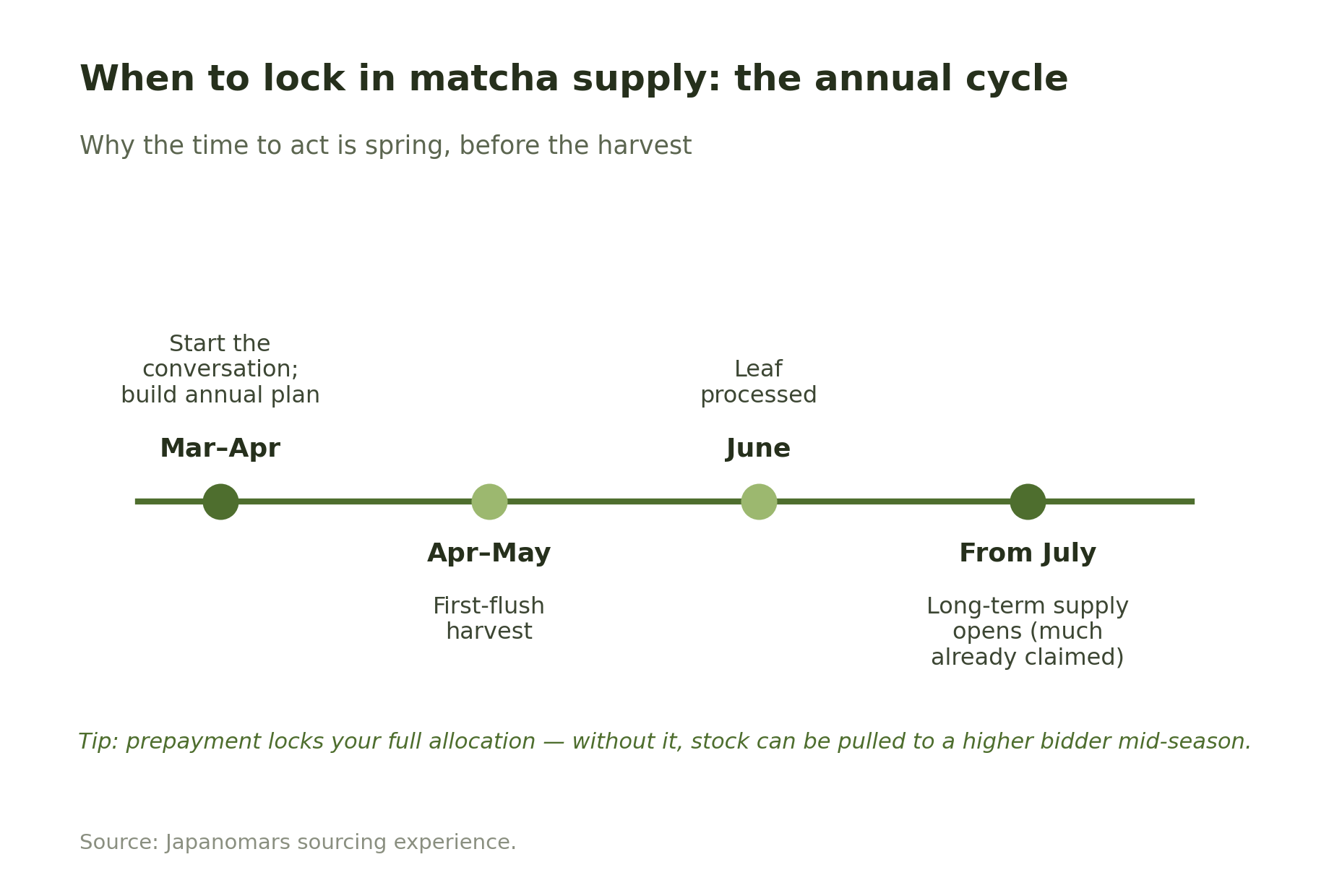
Producers under allocation reward buyers with an order history and a standing relationship, and quietly deprioritize one-off spot orders. The single most effective lever is prepayment: paying upfront locks the entire allocation. Without it, a supplier will usually reserve volume for you, but if a higher bidder appears, stock can get pulled away, and you can find yourself getting a "we have run out" call in January after starting purchases in July. For who is actually taking new accounts this season, see our comparison of the best wholesale matcha suppliers for US cafes.
A simple supply-security playbook:
In a constrained market, access is the product.
The shortage attracted opportunists, so verification is non-negotiable. Insist on a named prefecture, recent third-party heavy-metal and pesticide reports, disclosed milling and harvest dates, and a sample that whisks a vivid emerald green. Suspiciously cheap "premium ceremonial" is a red flag, because legitimate product simply costs more now.
The specific scams that surfaced during the squeeze: counterfeit Uji-origin labels, ordinary sencha powder sold as matcha, and aged stock relabeled as current harvest. A vague "Product of Japan" with no prefecture proves nothing. Before committing volume, check five things: a named origin, lab reports within the last 12-18 months, disclosed milling and harvest dates, export competence (can they produce certificates of analysis and clean customs documentation), and honest pricing. A supplier quietly holding 2023 prices through 2026 is a question, not a bargain. For what quality looks like in the cup, see what makes matcha good.
No. The 2026 first-flush auctions set fresh records: Kagoshima tencha traded at 2.3x last year and Kyoto's first auction hit a 10-year high. Volume is growing, but far more slowly than demand, so tight supply and elevated prices remain the baseline into 2027.
Not to the old baseline. The cost increases behind the spike have stabilized at higher levels, and the trade broadly expects steady mid-single-digit annual drift rather than a drop.
No. Green tea (HTSUS heading 0902) enters the US duty-free under the US-Japan Trade Agreement. The temporary Section 122 surcharge expired on July 24, 2026, and green tea is excluded from the Section 301 forced-labor tariff that replaced it, under heading 9903.05.86.
Often 5-10 kg, which covers a single cafe for roughly 8-12 weeks, with sample quantities available below that. You do not need pallet-scale commitments to source direct.
Start in March-April, before the harvest. Long-term supply opens from around July and is claimed quickly. Prepayment is the strongest lever to secure an allocation.
Keep only about a week's worth open at a time, squeeze out the air and re-seal after every use, and store it cool, dark, and dry. Skip the fridge unless it is dedicated and odor-free. More detail in our guide to storing matcha to protect freshness.
Generally yes. The per-serving dose is small, about 2 g, so a matcha latte typically carries a higher gross margin than a standard caffe latte at comparable menu pricing.
The matcha shortage rewards planning and punishes improvisation. Quality Japanese matcha is still available to US cafes that source direct, verify what they buy, and commit to a supply relationship ahead of the harvest instead of scrambling on the spot market. Access, not price, is what is scarce: the cafes that secure a reliable partner now are the ones that will still have matcha on the menu next year.

Japanomars works with cafes on long-term sourcing, direct from Japan, with named origins and full documentation. Request samples and current first-harvest pricing, and we'll help you build a supply plan rather than sell you a one-off order.
Request samples & pricing
%E7%99%BD_%E5%A4%A7%E3%81%8D%E3%81%84.png)