%E5%A4%A7%E3%81%8D%E3%81%84.png)
Matcha demand is rising faster than Japan can grow the leaf for it, and that gap is structural, not seasonal. Global appetite, led by US cafes, keeps climbing, while Japan's tea acreage, farms, and processing capacity have shrunk for two decades, and the raw leaf for matcha is only about 7% of an already-small industry. For cafe buyers, tight supply and elevated prices are the baseline for 2026, not a passing spike.
Key takeaways
Industry analysts put the global matcha market at roughly 5 to 6 billion dollars in 2026, with forecasts converging on about 9 billion dollars by 2033, implying growth of 7 to 10% a year. Those are retail-level estimates and they vary by firm, but the direction is consistent, and every dollar of it funnels back to a few thousand tonnes of Japanese tencha.
The cleanest official measure sits in Japan's customs data. Green-tea exports reached about ¥72.1 billion (roughly $480 million) in 2025, up from ¥36.4 billion in 2024, the sixth consecutive annual record, with export volume up 43.3% year on year, per Ministry of Finance trade statistics and the Japan Tea Export Promotion Council. Matcha is the engine: powdered tea was about three quarters of export value in 2024 (¥27.2 billion of ¥36.4 billion), and the United States is the largest destination, taking 44% of export value (¥16.1 billion in 2024).

Two things follow for a cafe buyer. First, the matcha boom is not a social-media mirage; it shows up in customs data as a near-doubling of export value in a single year. Second, every new cafe, ready-to-drink brand, and grocery line is bidding on the same thin layer of leaf, which is why the market's growth reaches your inbox as a price revision rather than a stockout notice.
Because demand jumped while Japan's harvest shrank, at the same time. Global, US-led matcha consumption has surged on wellness and latte trends, but Japan's 2025 first-flush crop was hit by record heat: national crude-tea output fell roughly 10% year on year, and in Uji, hand-picked matcha leaf dropped about 40%. Demand up, supply down, in the same season: that is the squeeze.
The demand side is no longer a niche. Japan's green-tea exports to the United States reached about 16.1 billion yen (roughly $110 million) in 2024 and have grown about 17% a year since 2020, according to JETRO. Matcha is the engine of that growth. US specialty cafes, ready-to-drink brands, and DTC matcha companies are all bidding for the same limited leaf.
The supply side moved the other way. MAFF reported the 2025 fresh-leaf harvest down about 11% and crude-tea (aracha) output down about 10% year on year, hammered by an unusually hot spring and summer. In Kyoto, a core tencha region, some areas reported yields off roughly 25%. Kyoto's tea market averaged about 1.7x the prior year in 2025, and the benchmark tencha price jumped from roughly 20,024 yen/kg in 2024 to 43,330 yen/kg in 2025, a 116% increase (Kyoto Shimbun).
In cafe terms: a kilogram of matcha makes roughly 500 servings at 2 g each, so a $50 to $100 per kg swing in your wholesale cost is only about $0.10 to $0.20 per drink, small next to milk and labor on any single latte, but it compounds across thousands of cups. The bigger risk in a shortage usually is not the per-cup cost; it is whether you can secure consistent, named-origin leaf at all.
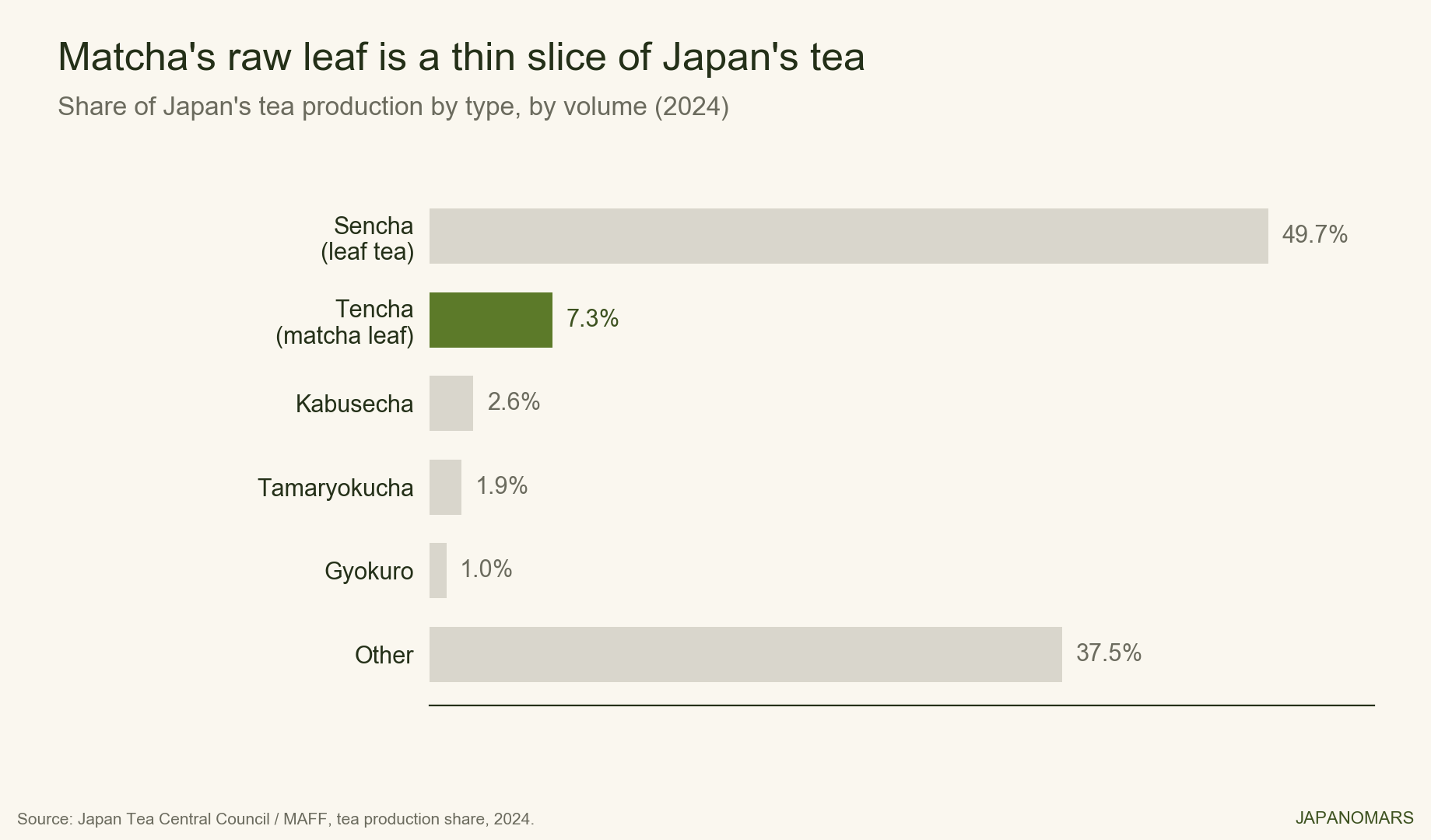
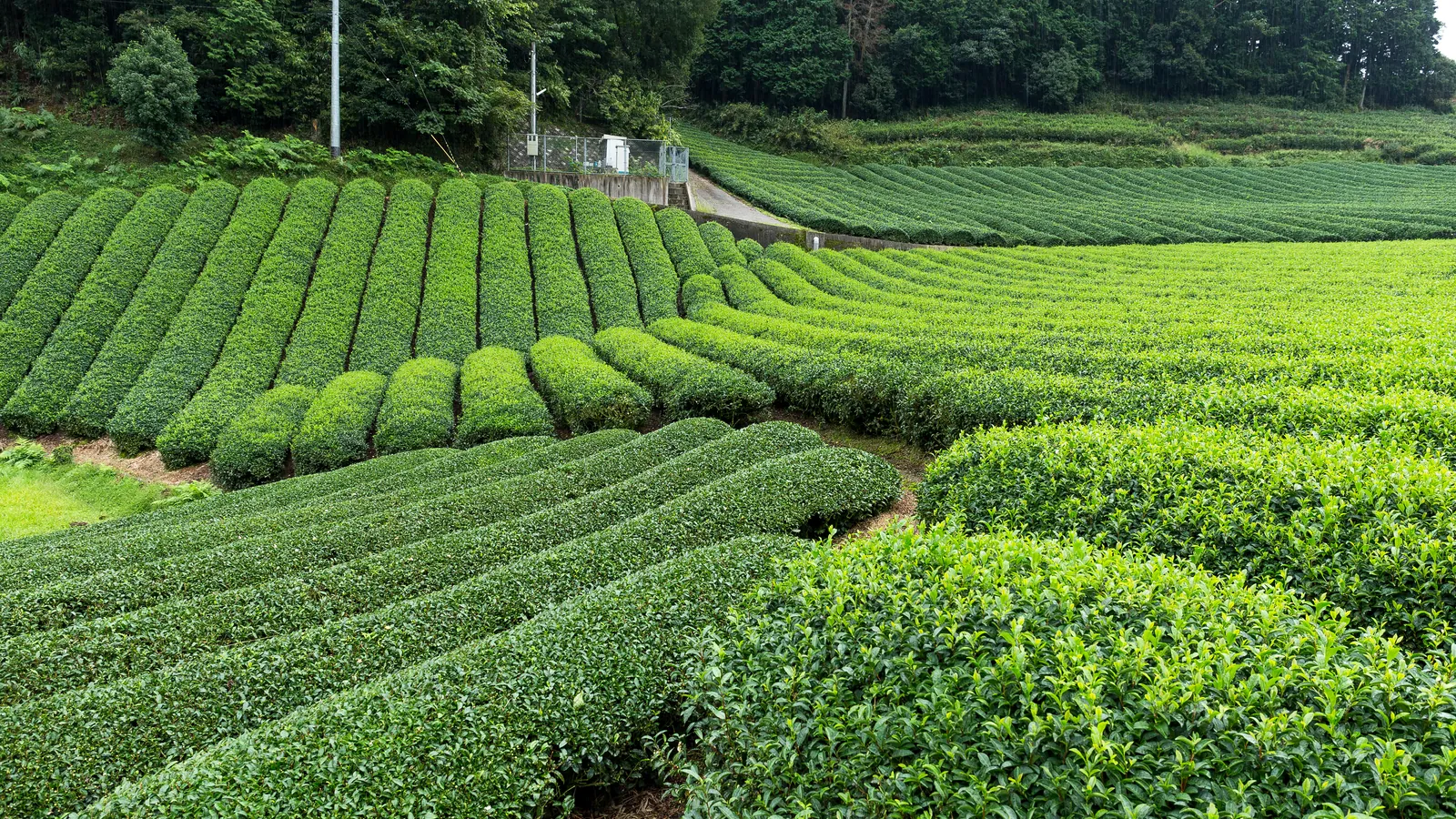
Matcha is made from tencha: leaf grown under shade for about three to four weeks before harvest, then steamed and dried without rolling, and finally stone-milled into powder. Tencha is only about 7.3% of Japan's tea production by volume; the rest is mostly sencha (about 50%) and other leaf teas. So even a small jump in global matcha demand lands on a very thin supply layer.
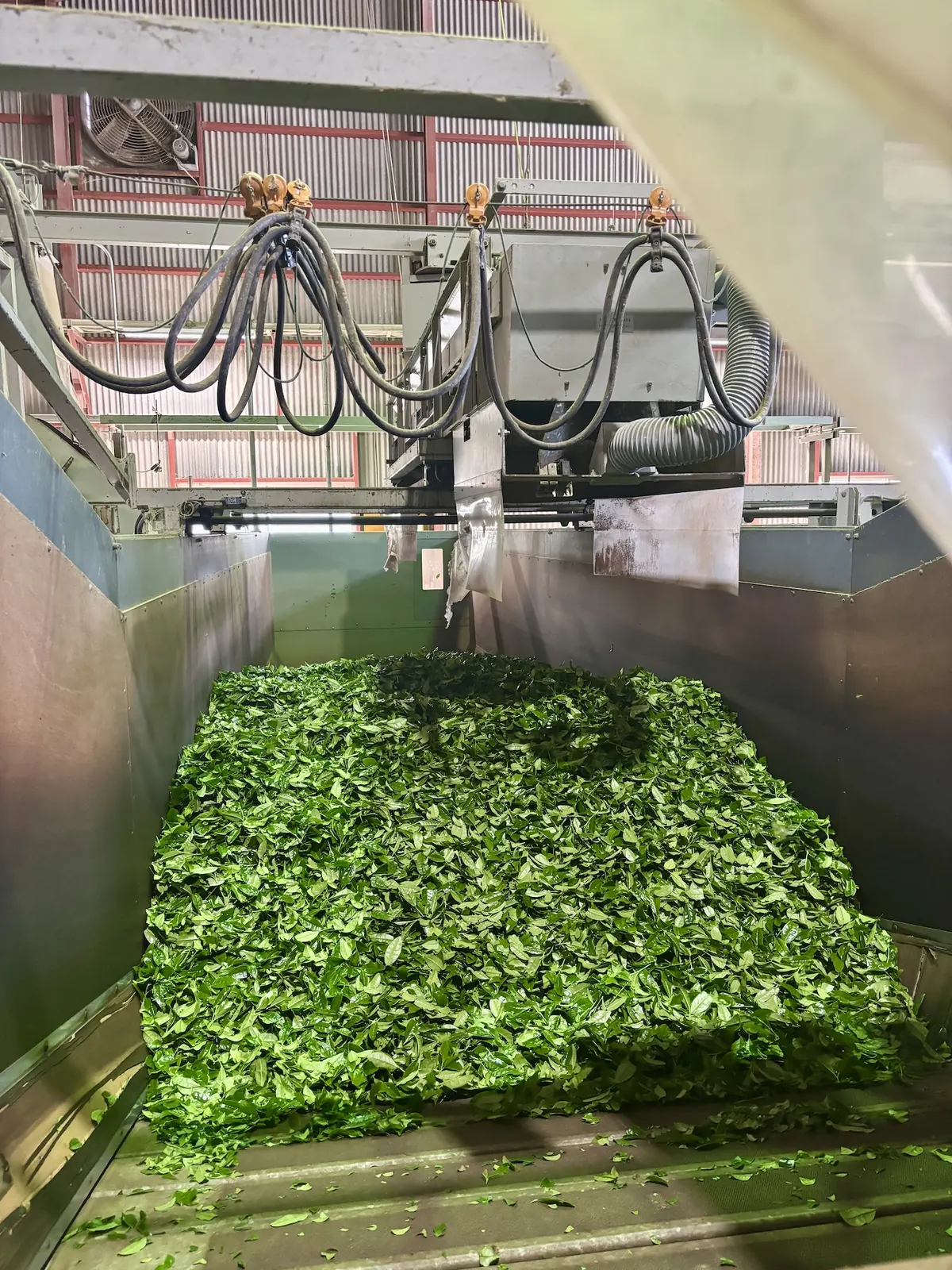
Tencha is also structurally expensive to make. Shading cuts yield and demands extra labor and materials, and the leaf is processed in a dedicated tencha furnace rather than a standard rolling line. That is why tencha's average crude-tea price (about 3,278 yen/kg in 2024) ran well above sencha (about 1,197 yen/kg) even before the recent spike (Japan Tea Central Council). And a farmer cannot flip a switch to make more: converting fields to shaded tencha and installing furnace capacity is a multi-year capital project, the classic setup for a sustained shortage rather than a quick correction.
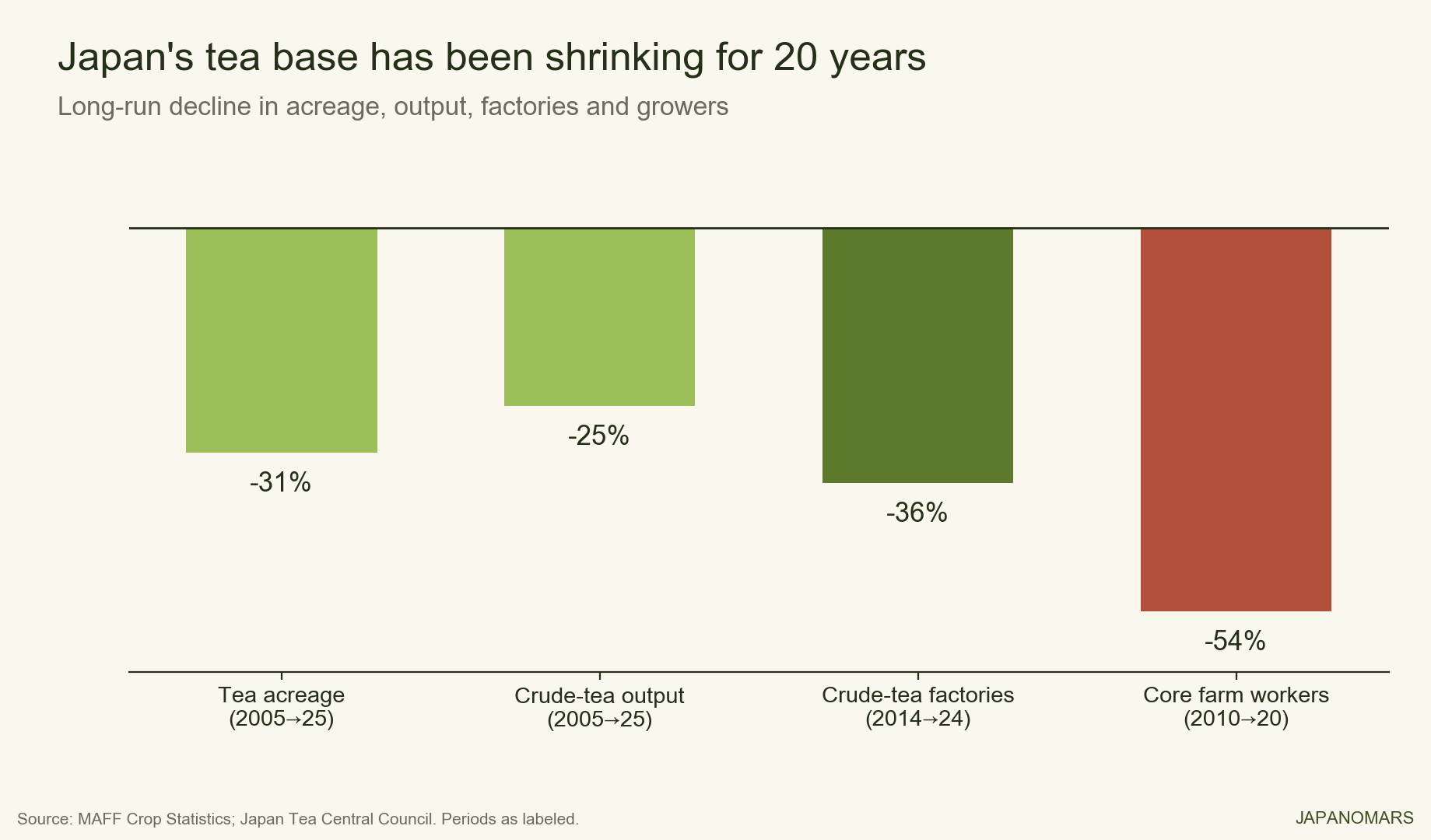
It is structural. Behind the headline shortage is a tea industry that has been shrinking for twenty years: acreage, output, factories, and farmers are all in long-term decline. A demand boom hitting a contracting supply base is not a one-season event; it is a repricing of Japanese matcha that is likely to persist.
The long-run numbers are stark. Over roughly two decades, Japan's tea-growing acreage fell about 31% (from about 48,700 to 33,400 ha) and crude-tea output fell about 25% (to about 75,100 tonnes), per MAFF. Processing capacity shrank even faster: the number of crude-tea factories dropped about 36% in a single decade, from 5,466 (2014) to 3,519 (2024).
And the squeeze is now visibly bankrupting the middle of the chain. Teikoku Databank reports that tea-processor closures and bankruptcies hit a record 13 in 2025, up from 8 the prior year, with the matcha boom itself a driver: surging raw-leaf costs crush processors who cannot pass them through, even as small tea retailers also disappear. The supply chain is thinning at both ends. This is the backdrop to the broader matcha shortage and how cafes can source through it.
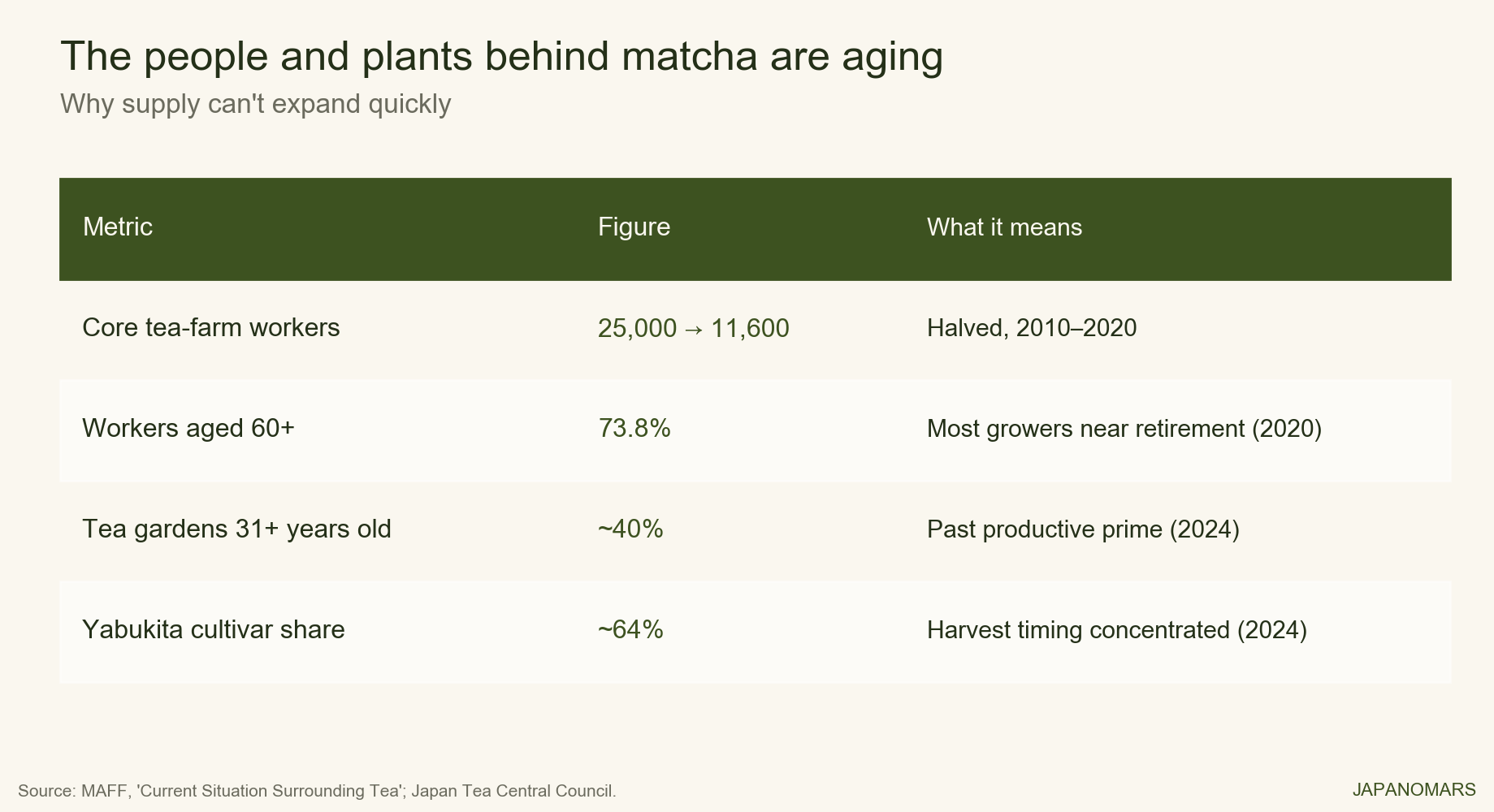
Two reasons: the people who grow tea are aging out faster than replacements arrive, and matcha is effectively a Japan-only product. Expanding tencha takes new growers, new shaded fields, and new furnaces, all in short supply, and there is no large overseas source of ceremonial-grade matcha to fall back on. Supply can grow, but slowly.
The grower problem is demographic. The number of core tea-farm workers fell from about 25,000 in 2010 to about 11,600 in 2020, and by 2020 roughly 74% of them were 60 or older (MAFF). The fields are aging too: about 40% of Japan's tea gardens are 31 years old or more, past their productive prime. Compounding it, the crop leans heavily on one cultivar, yabukita, about 64% of national acreage, which concentrates harvest timing and limits flexibility.
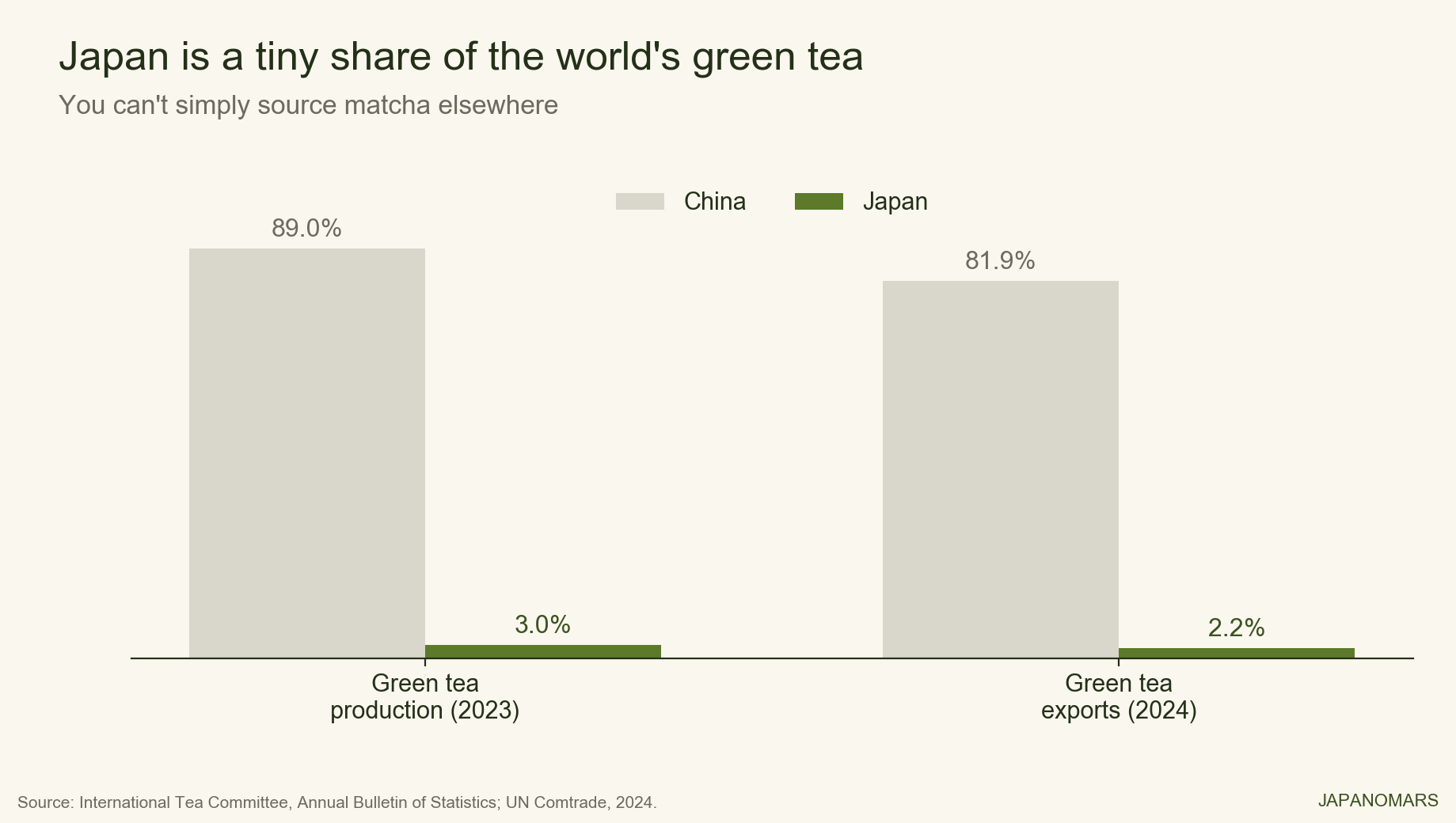
So why not source matcha from China, which dominates green tea? Scale will not help here. China produces about 89% of the world's green tea; Japan only about 3% (International Tea Committee). But ceremonial matcha (shade-grown tencha, stone-milled, from named Japanese regions) is essentially a Japanese product. The world can grow more green tea; it cannot quickly grow more authentic Japanese matcha. That is exactly why provenance and a direct relationship with a Japanese matcha region matter more in a shortage, not less.
Expect elevated prices and tight-but-improving supply. The 2026 first-flush auctions came in at fresh records: at the JA Zennoh Kyoto market in Joyo, the season's first tencha auction on May 13 averaged 14,127 yen/kg, 1.7x last year and the highest first-auction price in a decade (Kyoto Shimbun). In Kagoshima, first-flush prices more than doubled, up 106% to their highest level since 1975, with tencha averaging 13,910 yen/kg, 2.3x year on year (Minami Nippon Shimbun, June 2026). Traded volume rose 12.5%, so supply is responding, just far more slowly than demand.
The squeeze is now visible on the US side of the chain too. Ippodo has paused new wholesale applications in the US and Canada and, from March 2026, limited its hojicha and genmaicha lines to concentrate raw material on matcha; Jade Leaf removed its bulk discounts; specialty importers are running waitlists for new cafe accounts.
For planning purposes, treat 2026 as a high, still-volatile year. New tencha fields planted into the boom take several seasons to mature, so meaningful supply relief is a multi-year story, not a next-quarter one. Heat remains the wild card: another hot summer like 2025 could re-tighten the market quickly, since tencha yields are sensitive to spring and early-summer conditions. The practical read: do not budget as if 2024 prices are coming back, and do not assume your current supplier can absorb unlimited volume.
From the sourcing floor
Auction headlines track raw tencha, which spiked hardest. On the ground, the finished matcha that actually lands in your cup is up roughly 1.5x across the board, led by Kagoshima, with Kyoto (already priced higher) running about 1.3 to 1.5x. That 1.5x is the practical number we tell cafes to plan around for the coming season, not the auction multiples.

Treat matcha as a managed supply line, not a spot purchase. In a structurally short market, the cafes that protect both quality and margin are the ones that forecast volume, commit early, build flexibility into grade, and partner directly with a supplier close to the leaf. A concrete checklist:
Once you know how much you need, the next decision is where it comes from. Our region-by-region sourcing guide walks through Uji, Kagoshima, Ureshino and other origins, and our full shortage sourcing playbook covers MOQs, lead times, and customs. For the health claims you can honestly make to customers, see our guide to the real health benefits of matcha.
It is real and supported by data. Japan's 2025 crude-tea output fell about 10% year on year (MAFF) while US-led demand kept rising (about 17% annual export growth since 2020, JETRO), and benchmark tencha prices roughly doubled between 2024 and 2025. Tencha is only about 7.3% of Japan's tea, so even modest demand growth strains supply.
Industry analysts estimate roughly $5 to 6 billion at retail in 2026, heading toward about $9 billion by 2033. On the supply side, Japan's green-tea exports hit a record ¥72.1 billion in 2025, roughly double 2024, with powdered tea about three quarters of the value and the US the largest destination (44% of 2024 export value).
Matcha's raw leaf, tencha, is shade-grown for weeks, processed in a dedicated furnace without rolling, and stone-milled: all costly, low-yield steps. Even before the recent spike, tencha averaged about 3,278 yen/kg versus 1,197 yen/kg for sencha (2024). The current shortage stacked a 100%-plus price jump on top of that structural premium.
Unlikely to fall to pre-boom levels. The 2026 first-flush auctions set fresh records (Kagoshima tencha 2.3x last year, Kyoto's first auction a 10-year high), and most of the trade expects prices to hold near this elevated plateau rather than drop. New shaded acreage takes years to mature, and another hot summer could re-tighten supply.
Not for authentic matcha. China grows about 89% of the world's green tea, but ceremonial-grade matcha (shade-grown tencha, stone-milled, from named Japanese regions) is effectively a Japanese product. Substitutes exist for culinary uses, but they are not the same product your customers expect.
Forecast annual volume, reserve against the first flush (harvested about April to May), and lock pricing through a direct, long-term supplier relationship rather than buying spot. Build grade flexibility into your menu, and require named-origin provenance in writing to guard against mislabeling in a tight market.
Because the boom rewards tencha specifically, while the broader tea economy keeps shrinking and the workforce ages out. About 74% of core tea-farm workers were 60 or older as of 2020 (MAFF). Rising raw-leaf costs also squeezed processors, pushing tea-business closures to a record 13 in 2025 (Teikoku Databank).
Matcha's price and scarcity in 2026 are not a blip; they are what happens when fast-rising global demand meets a Japanese tea industry that has been contracting for twenty years, on a raw leaf that is only about 7% of the crop. Supply will grow, but slowly. The cafes that come out ahead will treat matcha as a planned, partnered supply line and secure quality leaf early.
We export premium matcha directly from named Japanese regions and work with cafes on long-term supply, not one-off orders. Request a sample set of ceremonial- and culinary-grade matcha with current first-harvest wholesale pricing, and we'll help you lock in volume for the season.
Request samples & pricing%E7%99%BD_%E5%A4%A7%E3%81%8D%E3%81%84.png)