%E5%A4%A7%E3%81%8D%E3%81%84.png)

Matcha's most sellable health benefit is the one your customers can actually feel: calm, focused energy without the coffee crash, from the L-theanine and caffeine that occur together in shade-grown tea. What it is not is "137 times the antioxidants of green tea," a marketing distortion of a single 2003 study. The good news for your menu: the real benefit is also the more distinctive and profitable one.
I'm Hiroshi Asami, and I source and export matcha directly from farmers across Japan through Japanomars. This guide separates what is real from what is hype, shows what you can legally put on your menu, and explains why the best functional story comes from the best-sourced leaf.
Key takeaways
Matcha delivers three things worth talking about: caffeine paired with L-theanine (calm, sustained focus), catechin antioxidants like EGCG, and the fact that you drink the whole leaf rather than discarding it. But only one is both distinctive and defensible enough to build a menu story on: the calm-energy effect. Antioxidants are real but not unique to matcha, and disease claims are off-limits.
The honest hierarchy for a cafe owner:
The practical takeaway: build your matcha's identity around calm, focused energy, the one benefit that is true, distinctive, and legal.
Because matcha pairs caffeine with L-theanine, an amino acid that softens caffeine's edge. In controlled trials the two together improve attention more than caffeine alone, and EEG studies show L-theanine raises alpha brain-wave activity, a state of wakeful relaxation, within about 40 minutes. The result your customers describe is focus without the jitters or the crash.
The evidence, specifically: a frequently cited 2008 trial (Owen et al.) found that 97 mg of L-theanine with 40 mg of caffeine significantly improved attention-switching accuracy versus placebo. A 2025 systematic review and meta-analysis (Journal of Clinical Medicine) concluded the combination increased attention accuracy in the first one to two hours, while honestly calling the overall evidence "promising, but not completely conclusive." EEG research shows 50 to 200 mg of L-theanine increases alpha-band activity linked to relaxed alertness. Mechanically, L-theanine stretches caffeine into a smoother 4 to 6 hour curve instead of coffee's sharp spike and crash.
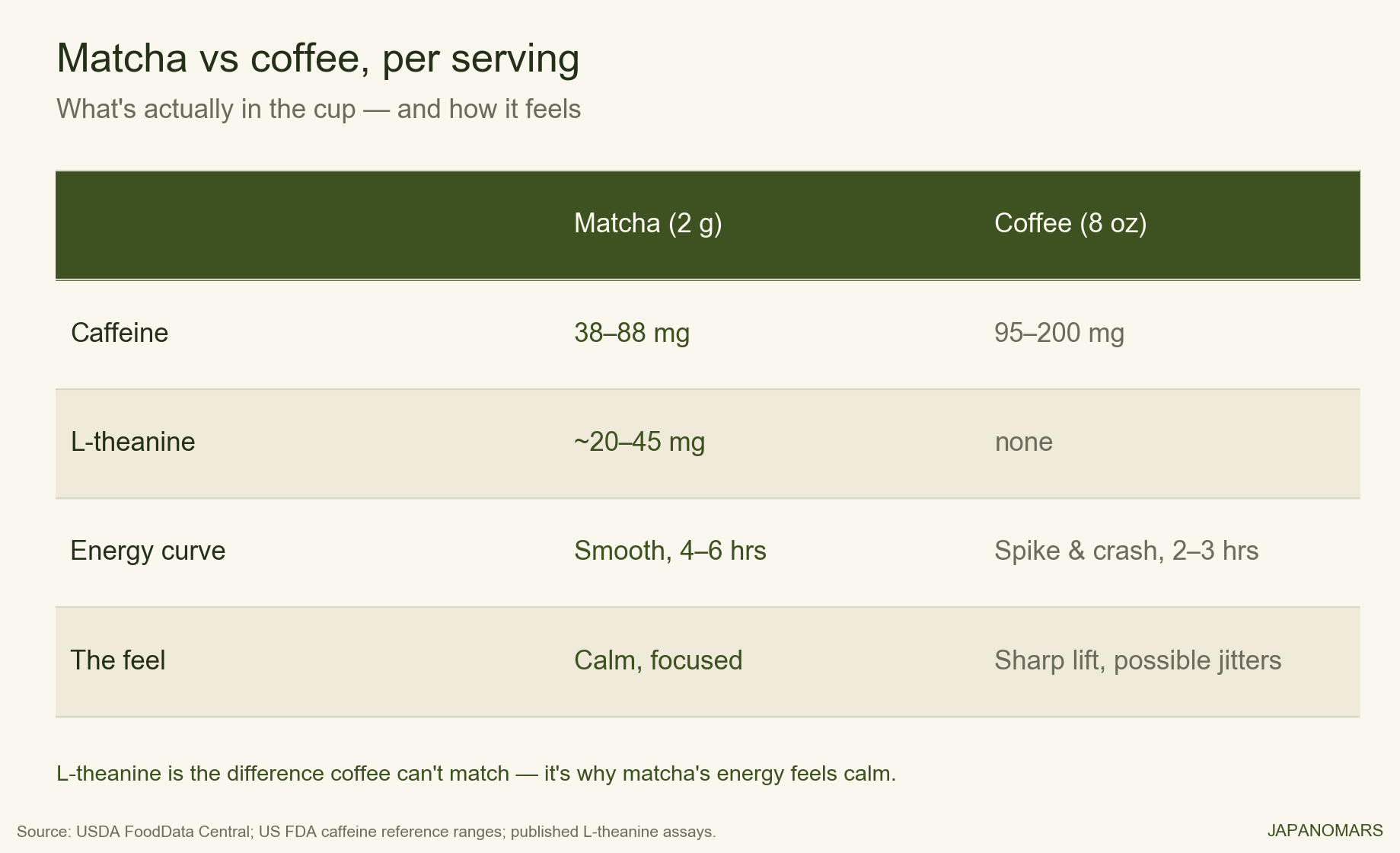
On the numbers: a standard 2 g serving of matcha contains roughly 38 to 88 mg of caffeine, versus about 95 to 200 mg in an 8 oz cup of brewed coffee, so a matcha drink lands at about half the caffeine of coffee. Gram for gram, matcha powder is more caffeine-dense than coffee beans (about 19 to 44 mg/g vs 10 to 12 mg/g); you just use far less per cup. For your menu, the useful framing is positioning: matcha is the all-day, afternoon-friendly calm-energy option for customers who love coffee's lift but not its jitters.
No, and repeating that line can quietly hurt your credibility. It comes from a 2003 University of Colorado study that measured EGCG in matcha against one specific product, Starbucks "China Green Tips," not green tea as a category. Marketers dropped the qualifier and turned a narrow finding into a blanket claim.

A 2023 study in Plant Foods for Human Nutrition analyzed 15 commercial green teas and found that bagged and gunpowder green teas had higher total antioxidant capacity than matcha, and that cheaper culinary matcha out-measured premium ceremonial grade. To be fair to matcha, it edged out the others on EGCG specifically (ceremonial about 57 mg/g vs bagged and gunpowder about 46 mg/g), and as a whole-leaf powder it delivers compounds a steeped leaf leaves behind. But "matcha has dramatically more antioxidants than all green tea" is simply not true. Why does premium matcha test lower on total antioxidants? That is not a flaw; it is the whole point of how matcha is made, and it leads directly to your best sourcing decision.
Because the very process that makes premium matcha, shade-growing, is what creates its calm-energy chemistry. Covering the plants for the weeks before harvest raises L-theanine and other amino acids, nudges up caffeine, and lowers bitter catechins. So the matcha with the strongest calm-focus story is the same well-shaded, higher-grade leaf you would buy for the best cup.
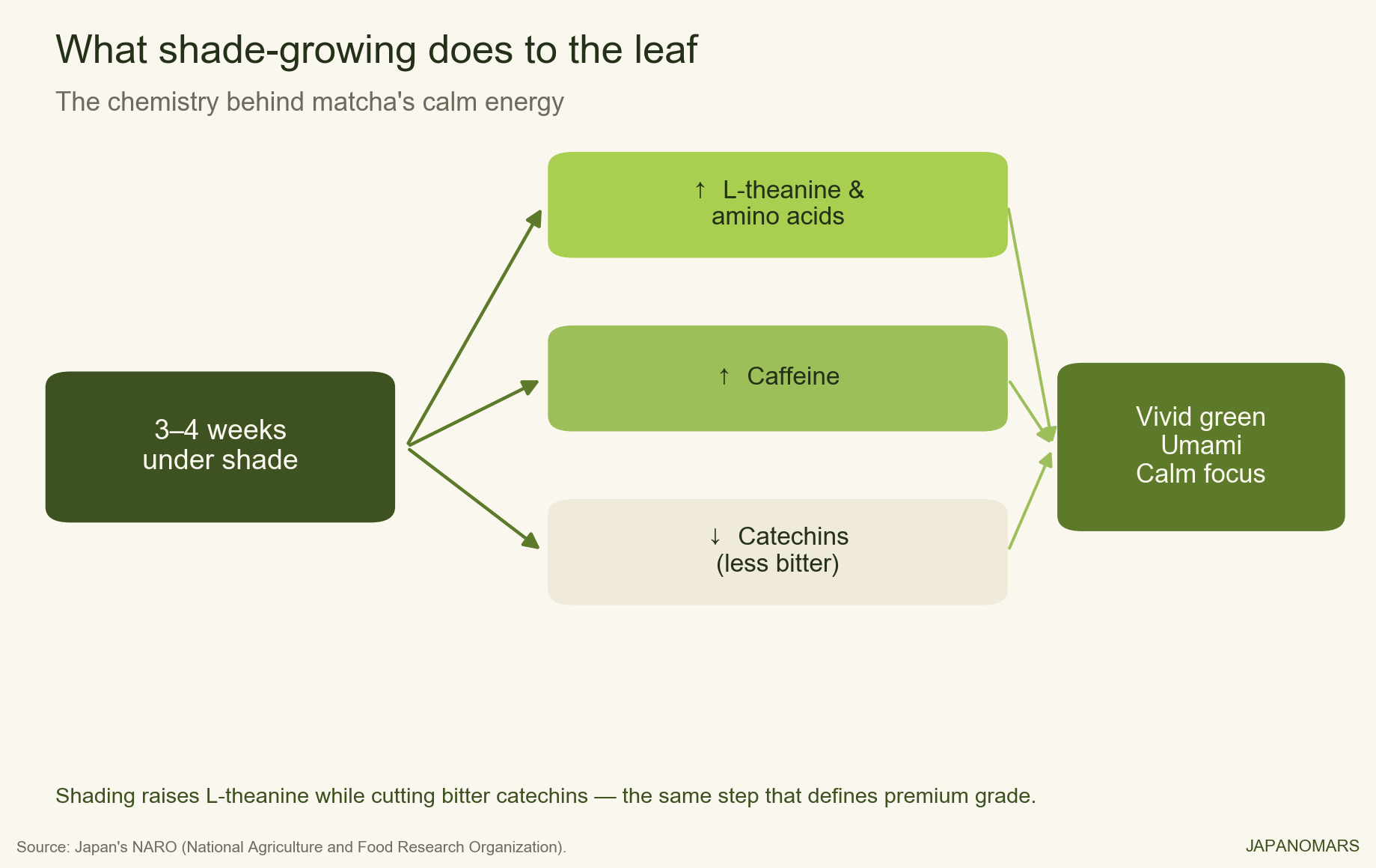
This is well documented by Japan's NARO (National Agriculture and Food Research Organization): shade cultivation increases free amino acids and theanine while reducing the catechins responsible for astringency. High-quality matcha typically exceeds 1% theanine by weight, and NARO has bred a dedicated matcha cultivar, "Seimei," selected for theanine levels around 4%. So a bright, sweet, well-shaded first-harvest matcha both tastes better and carries more of the L-theanine behind the calm-energy story. A cheap, sun-grown, late-harvest culinary powder is more bitter and, ironically, often higher in the catechins everyone calls "antioxidants." This is exactly why grade and origin matter, a topic we cover in our guide to Japan's matcha regions.
From the sourcing floor
Here is the catch for a buyer: you usually cannot verify any of it. "Ceremonial" and "premium" are not regulated terms, and most distributors will not tell you the farm, the cultivar, the harvest date, or how the leaf was shaded, so you cannot confirm the very thing that makes the calm-energy story true. The only reliable way to know what you are pouring is a traceable, direct-from-farm supply chain that can name it.
You may have seen headlines that matcha "builds muscle." The honest answer: one small, industry-funded study found a hint that matcha might support training adaptation, but the popular write-ups oversell it, and it is not something to put on your menu. Treat it as a curiosity to watch, not evidence to sell on.

In a 2023 study in the peer-reviewed Nutrition Journal, Kyoto Prefectural University researchers had 17 to 19 untrained young men resistance-train for 8 to 12 weeks while drinking a matcha beverage (1.5 g, twice daily) or a placebo. Japanese media later popularized the figures: roughly 600 g of muscle gained versus about 100 g for placebo, and about 13% more leg strength. Keep the salt handy for three reasons:
The honest takeaway is more modest and very on-brand: the researchers' proposed mechanism is theanine easing exercise stress and fatigue, pointing once again to theanine as matcha's real differentiator rather than any magic muscle effect. Good material for a blog post, not a reason to rewrite your menu.
In the US you can make structure/function claims (how a nutrient supports the body's normal functioning) but not disease claims without FDA authorization. So "supports focus and calm, steady energy" is fine; "prevents disease" or "burns fat" is not. The FTC adds a second rule: any claim must be truthful and substantiated.

A practical cheat sheet. Generally safe (structure/function): "calm, focused energy," "supports concentration," "smooth caffeine without the crash," "rich in antioxidants (catechins)," "a source of L-theanine." Risky, avoid on a menu: "boosts metabolism," "burns fat," "detoxes," "boosts immunity," "prevents cancer," and the "137x more antioxidants" line. You do not need disease claims anyway: "Calm, focused energy, about half the caffeine of coffee, none of the jitters" is honest, distinctive, and sells.
To turn that into sales, position matcha as the calm-energy coffee alternative and let the true story do the selling. Name the benefit on the menu honestly, target the afternoon and all-day dayparts and the coffee-cutting crowd, and tell the provenance story: shade-grown, single-origin, first-harvest are not just flavor notes, they are why the calm-energy effect is stronger, and they justify a premium price. Above all, make the quality real, because a bitter, dull, late-harvest powder undercuts every claim you make. It is a sourcing decision before it is a marketing one.
It depends what you mean by "healthier." Matcha has about half the caffeine of coffee per serving and adds L-theanine, an amino acid linked in trials to calmer, steadier focus, so many people find it gentler. Both contain antioxidants. Matcha's edge is the calm-energy experience, not a dramatic nutritional advantage.
A 2 g serving of matcha has roughly 38 to 88 mg of caffeine, versus about 95 to 200 mg in an 8 oz cup of brewed coffee (USDA and FDA reference ranges), so matcha delivers around half. Gram for gram matcha is more caffeine-dense, but you use far less powder per cup.
L-theanine is an amino acid found in tea and especially concentrated in shade-grown matcha (about 5 to 46 mg per gram). Paired with caffeine, controlled trials link it to improved attention, and EEG studies show it raises alpha brain waves associated with relaxed alertness. It is the main reason matcha's energy feels calm.
No. That figure comes from a 2003 study comparing matcha to one specific product (Starbucks "China Green Tips"), not green tea generally. A 2023 peer-reviewed analysis found inexpensive bagged and gunpowder green teas actually had higher total antioxidant content than premium ceremonial matcha.
Probably overstated. The headlines come from a small 2023 Kyoto Prefectural University study (17 to 19 untrained men) where a matcha beverage showed only a statistical trend toward more muscle gain than placebo. It was tiny, preliminary, and industry-funded (matcha supplied by Nestle Japan). Treat it as a curiosity, not a menu claim.
In the US you can make structure/function claims like "supports focus" or "calm, steady energy," as long as they are truthful. You cannot make disease or weight-loss claims ("detoxes," "burns fat," "prevents disease") without FDA authorization, and the FTC requires any claim be substantiated, so avoid the "137x antioxidants" line.
Generally yes. L-theanine builds up during the weeks of shade-growing that define premium matcha, so well-shaded, first-harvest, higher-grade leaf tends to be richer in theanine (often above 1% by weight). Cheaper, sun-grown, late-harvest culinary powder is more bitter and lower in theanine.
Matcha's health story sells best when it is honest. Skip the debunked "137x antioxidants" line and lead with what is real, distinctive, and legal: the L-theanine plus caffeine combination that delivers calm, focused energy without the crash. That effect is not a marketing accident; it is the direct result of shade-growing, the same process that defines matcha's grade, origin, and quality. The best functional story and the best cup come from the same well-sourced leaf.
Tell us your menu and volume, and we'll send a sample set, a well-shaded first-harvest matcha next to a typical commodity powder, with the farm, cultivar, harvest date, and shading for each, plus current wholesale pricing. We work with cafes on long-term supply, not one-off orders.
Request samples & pricingFor the supply backdrop behind all this, why quality matcha is scarce and how to secure it, see our companion guide, How to Source Japanese Matcha During the Shortage. For the price and supply picture, see The Matcha Market in 2026.
%E7%99%BD_%E5%A4%A7%E3%81%8D%E3%81%84.png)