%E5%A4%A7%E3%81%8D%E3%81%84.png)
Health & Science · 2026
The "calm focus" people describe from matcha is real and has a genuine mechanism behind it: L-theanine, an amino acid concentrated in shade-grown tea, works alongside caffeine to smooth its edge into steadier attention instead of a jittery spike. But the research is more modest than most marketing suggests, and a single cafe serving of matcha delivers less L-theanine than the studies that show the clearest effects. This guide walks through what the L-theanine and caffeine research actually found, how much of it is in a real serving of matcha, and how a cafe can talk about it honestly, which matters more than hype for building trust.
Key takeaways
In this guide
L-theanine is an amino acid found almost exclusively in tea (and a few mushrooms) that is associated with a state of relaxed alertness. It's the compound most often credited for the distinctive "calm energy" of matcha, and it's concentrated in matcha specifically because of how matcha is grown: shading the tea plants for several weeks before harvest raises the leaf's amino acid content, including L-theanine, while lowering bitter catechins. That same shading is what gives matcha its vivid green color and umami taste, covered in what makes matcha good.
Because you whisk and drink the whole powdered leaf rather than steeping and discarding it, a serving of matcha delivers more L-theanine than a typical cup of steeped green tea. This is the mechanistic reason matcha feels different from coffee: coffee delivers caffeine alone, while matcha delivers caffeine and L-theanine together in the same drink. Whether that difference rises to the level of a measurable productivity boost is the part worth looking at carefully.
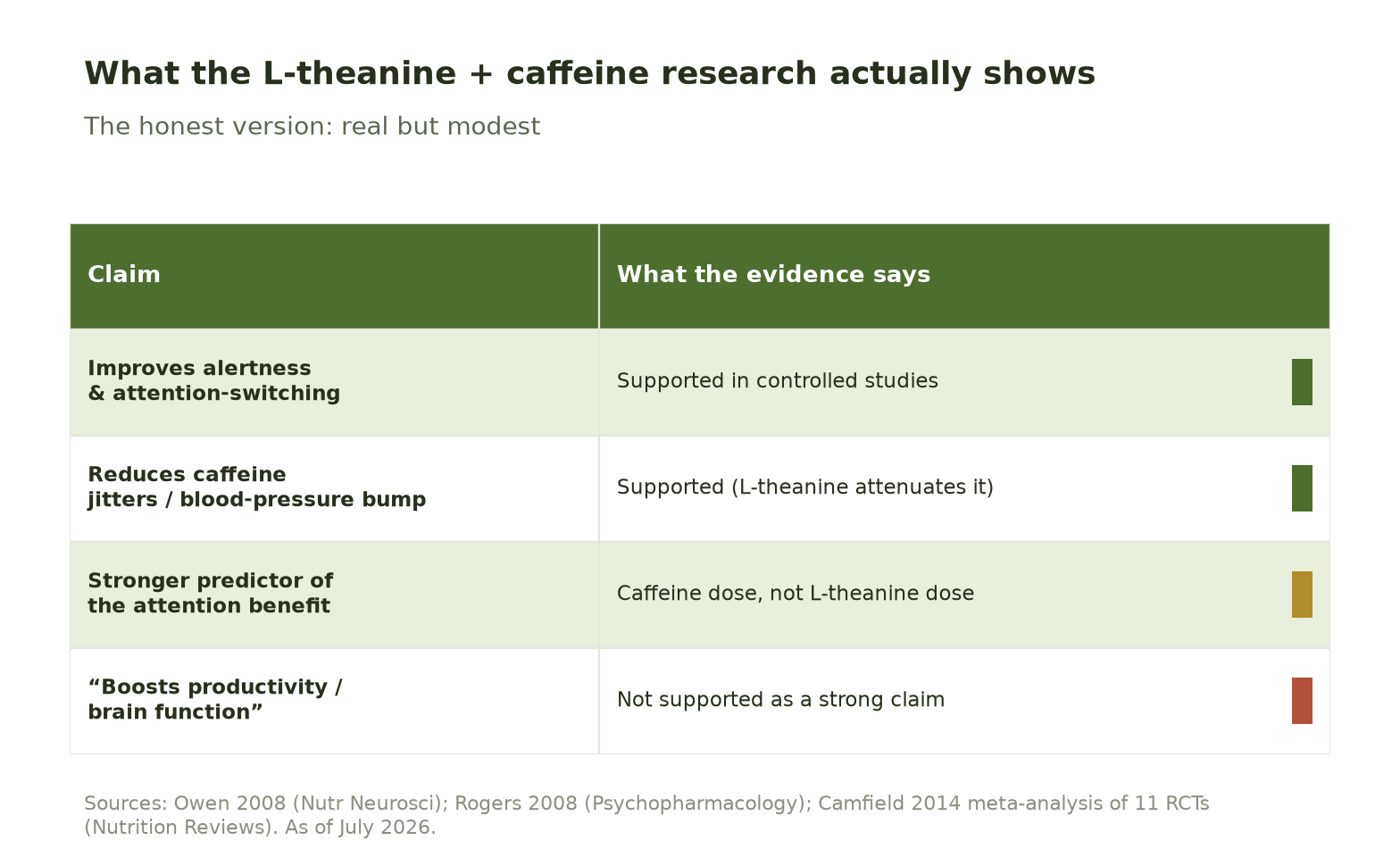
The research on L-theanine plus caffeine is real and generally positive, but more modest than marketing implies. Multiple randomized controlled trials have found that the combination improves alertness and the speed and accuracy of attention-switching tasks, and reduces susceptibility to distraction, with effects showing up around 60 minutes after intake. Notably, L-theanine also appears to blunt caffeine's downsides: one trial found it attenuated caffeine's rise in blood pressure without cancelling its alertness benefit, which fits the everyday "no jitters" experience.
The important honest caveat comes from the pooled evidence. A 2014 systematic review and meta-analysis of eleven randomized placebo-controlled trials found moderate effect sizes in favor of combined caffeine and L-theanine on alertness and attention-switching accuracy in the first two hours after a dose, but also found that caffeine dose, rather than L-theanine dose, was the stronger predictor of that effect. L-theanine's clearest contribution is to smooth the experience rather than to independently supercharge cognition. In other words, the science supports "calmer, steadier focus," not "a cognitive superpower."
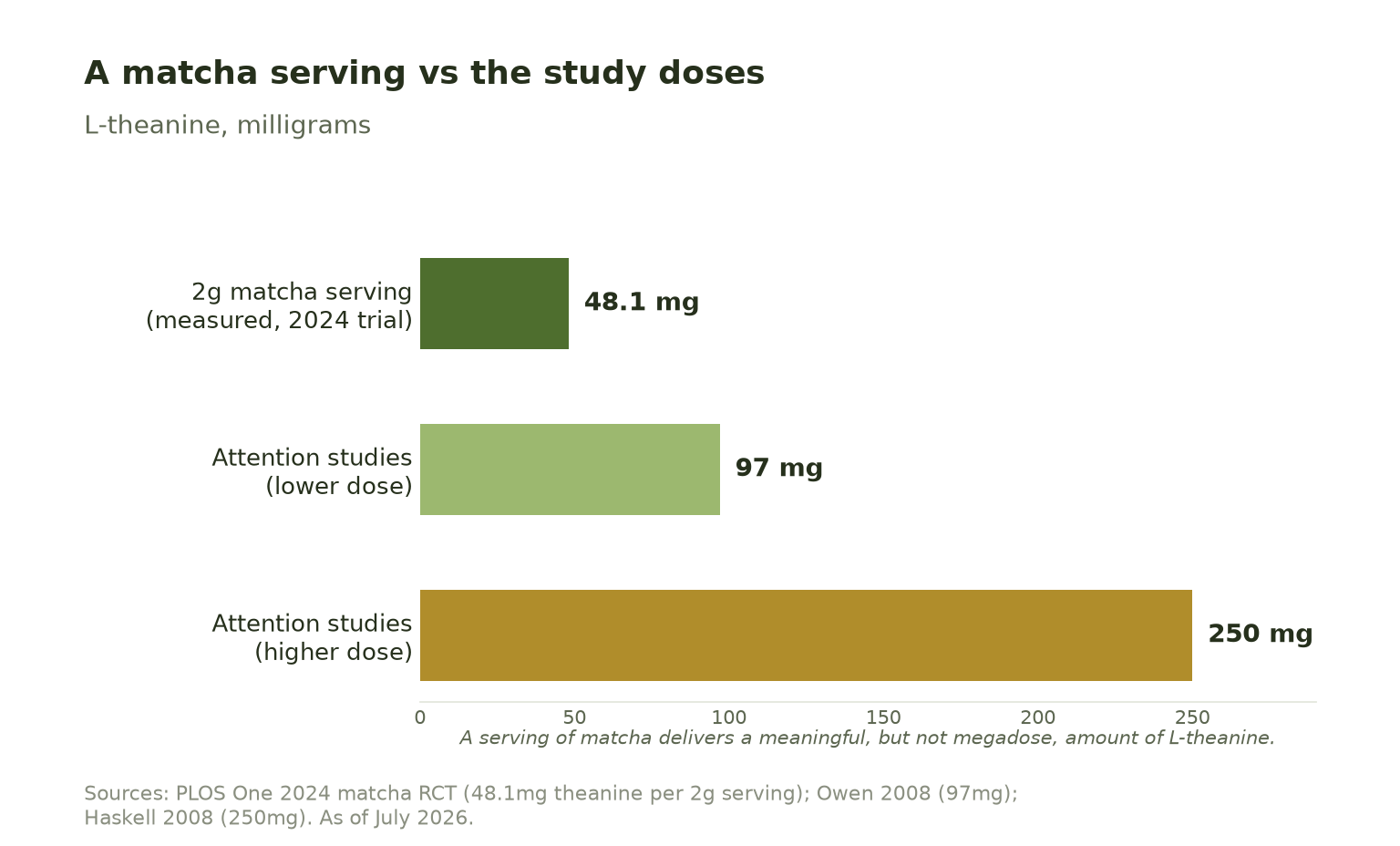
This is the detail most matcha marketing skips: a normal cafe serving of matcha contains less L-theanine than the doses used in the clearest studies. The matcha used in a 2024 year-long clinical trial measured 48.1mg of theanine and 66.2mg of caffeine per 2-gram daily serving, which is a fair anchor for a standard cafe dose. Published figures vary widely by cultivar, shading, and harvest, so treat that as a typical serving rather than a constant. For comparison, the randomized trials that show the sharpest attention effects use around 100mg of L-theanine, and some use 250mg, often paired with a comparable or higher caffeine dose than a single matcha.
That same trial is worth reading carefully, because it is the study most often cited loosely. Published in PLOS One, it gave older adults with cognitive decline 2 grams of matcha daily for twelve months. Its two primary outcomes, the Montreal Cognitive Assessment and an activities-of-daily-living score, showed no significant change. What did improve significantly was social acuity, the ability to read emotion from facial expressions; sleep quality improved only at trend level, short of statistical significance. So it is a real, well-run trial, but it is not evidence that matcha sharpens attention, and it studied a specific population over a long period rather than one afternoon cup for a healthy adult. The honest read: a serving of matcha gives you a meaningful, but not megadose, amount of L-theanine.

Matcha genuinely supports calm, focused attention, but calling it a "productivity aid" oversells what a single serving does. The mechanism is real: you're getting caffeine's well-established alertness benefit, delivered with L-theanine that measurably softens the jittery, spiky quality caffeine has on its own. That's why people reliably describe matcha as focus without the crash, and that description is defensible. What isn't defensible is implying matcha will make someone measurably smarter, more productive, or sharper than they'd be on an equivalent amount of caffeine from another source.
The most accurate framing is experiential, not clinical. Matcha delivers a steadier, calmer version of a caffeine lift, and for many people that steadier curve genuinely feels better to work through than coffee's peak-and-crash, which is a real and valuable difference even if the peak cognitive numbers are driven mostly by the caffeine. That calm-energy experience, and the caffeine and L-theanine science behind it, is covered in depth in matcha vs coffee: caffeine, L-theanine, and the calm-energy difference.
There's a simple way for a skeptical customer or barista to feel the difference for themselves: on two different mornings, have the same person compare a matcha and a coffee with a roughly similar caffeine level, then notice not the peak but the shape of the next few hours, whether the energy holds steady or spikes and drops. Most people report the matcha curve as flatter and easier to work through, which is exactly the honest, verifiable claim a cafe can stand behind. It also connects naturally to matcha's afternoon appeal, when that steadier, lower-caffeine curve matters most, covered in matcha for the afternoon daypart.

A cafe should sell matcha's focus appeal on the experience, calm, steady energy without the crash, rather than on clinical or medical claims. "The focus without the jitters" is honest, resonant, and matches both the research and what customers actually feel. "Boosts your productivity" or "improves your brain function" drifts into territory the evidence doesn't fully support and that regulators treat as a health claim, which is a line a cafe menu shouldn't cross.
Practical language that stays on the right side of the line:
Framing it this way isn't just about compliance; it also happens to be the more compelling pitch, because it describes the thing customers can actually verify in their own cup rather than a claim they have to take on faith.
From the sourcing floor
Let me say the thing a supplier is not supposed to say: some of this is placebo, and I do not think that is a problem. How strongly any compound acts differs enormously from person to person, so some of your customers will feel it clearly and some will feel nothing, and no amount of marketing changes that. I am allergic to coffee, so matcha is what I reach for when I want to talk myself into concentrating, and the ritual of drinking something I believe is doing me good genuinely lifts how I feel. None of that changes the other half of my view, which is that the numbers matter and should be passed on as they actually are.
Honesty about matcha's effects is a competitive advantage, not a limitation, because the matcha market is already crowded with overclaiming and customers are getting wary of it. A cafe that describes matcha accurately, real calm-energy benefit, honest about the limits, builds the kind of trust that turns a first-time matcha buyer into a regular, and it's the same trust-first posture that separates a serious specialty cafe from a trend-chaser. This is the same reason we debunk the myths on the health side, like the "137 times the antioxidants" claim, in the real health benefits of matcha.
There's also a straightforward risk angle: health and cognitive claims on a menu or in marketing can create regulatory exposure, and "productivity" and "brain function" claims are exactly the kind regulators scrutinize. Selling matcha on its genuine, verifiable experience, the calm, steady focus a customer feels in their own cup, sidesteps that risk entirely while making the more honest and, ultimately, more durable pitch.
Matcha supports calm, focused attention through caffeine paired with L-theanine, an amino acid that smooths caffeine's jittery edge. Controlled studies show the combination improves alertness and attention-switching, though in the pooled analysis of those trials the caffeine dose predicted the attention benefit more strongly than the L-theanine dose, with L-theanine's clearest role being to make the experience steadier and calmer.
The matcha used in a 2024 year-long clinical trial measured 48.1mg of theanine and 66.2mg of caffeine per 2-gram serving, which is a reasonable anchor for a cafe dose, though the figure varies by cultivar, shading, and harvest. That's a meaningful amount, but less than the roughly 100mg of L-theanine used in the clinical studies that show the sharpest attention effects.
Not in raw cognitive numbers, since caffeine dose is the stronger predictor of the measurable attention benefit in the pooled trials, and coffee provides caffeine too. Matcha's real difference is the experience: L-theanine smooths the caffeine curve into calmer, steadier focus with less of the jittery spike and crash, which many people find easier to work through even if the peak alertness is similar.
L-theanine is an amino acid found in tea that promotes a state of relaxed alertness. Paired with caffeine, it's been shown to improve attention-switching accuracy and reduce distraction, and to blunt some of caffeine's downsides, like the rise in blood pressure, without cancelling its alertness benefit. It's the compound most responsible for matcha's calm energy reputation.
It shouldn't. The evidence supports describing matcha as calm, steady energy or focus without the jitters, which is honest and resonant, but claims like boosts productivity or improves brain function are health claims the research doesn't fully support and that regulators scrutinize. Selling the verifiable experience is both safer and more compelling.
Matcha's calm-focus reputation is real and mechanistically grounded: L-theanine genuinely smooths caffeine's edge into steadier attention, and that's a difference customers can feel in their own cup. But the honest version of the story is "calm, steady energy," not "a productivity superpower", a single serving delivers less L-theanine than the strongest studies use, and caffeine dose is what best predicts the measurable attention benefit. For a cafe, selling that honest experience builds more trust, and carries less risk, than hype ever will.
Japanomars supplies specialty cafes with premium shade-grown matcha direct from Japan, the kind with the L-theanine and umami that come from proper cultivation. Request samples and current wholesale pricing to taste the calm-energy difference for yourself.
Request samples & pricingHiroshi Asami is the founder of Japanomars, a Japanese matcha exporter supplying specialty cafes across the US, Canada, and the Philippines, working farm-direct with growers and regional tea factories in six producing regions. The research summarized here is read from the published papers, and this guide deliberately reports what those trials did not find as well as what they did.
Sources
%E7%99%BD_%E5%A4%A7%E3%81%8D%E3%81%84.png)