%E5%A4%A7%E3%81%8D%E3%81%84.png)
Craft & Process · 2026
Updated October 2026: the process numbers now come from Japan's Green Tea Labeling Standard (last revised July 10, 2026) and ISO/TR 21380. We corrected an earlier claim that stone milling is part of the definition. It is not.

Matcha is made in three steps. The tea plants are covered for about two to four weeks before picking. The fresh leaf is steamed and dried flat without rolling, which turns it into tencha. Then the tencha is milled into a very fine powder. Japan's labeling standard and the ISO technical report on matcha both describe it this way, and neither one requires a stone mill. A stone mill is the traditional tool, but other mills are allowed. This guide walks through each step with the actual numbers, and shows what each one means for the matcha you buy.
What this page is for. This page covers the process: what happens on the farm, in the factory, and in the mill, and what to ask a supplier about each stage. It does not argue the definition. For that, see what officially counts as real matcha. To judge a sample in the cup, use what makes matcha good. For why one grade costs more than another, read matcha grades explained.
Quick facts
In this guide
Each stage has a number you can check and a question you can ask. The figures below come from Japan's Green Tea Labeling Standard and ISO/TR 21380:2022. The ISO report is informative only, so treat it as a common reference, not a law.
| Stage | What happens | Reference numbers | What to ask your supplier |
|---|---|---|---|
| Shade | Plants are covered before picking | About 2 to 3 weeks (Japan); 20 to 30 days under a roof frame, about 20 days with direct covers (ISO) | How long was this lot shaded, and with what method? |
| Steam | Fresh leaf is steamed to stop oxidation | 15 to 30 seconds at 100 °C (ISO) | How soon after picking was the leaf steamed? |
| Dry | Leaf is dried flat in a tencha furnace, never rolled | 150 to 220 °C, usually 3 to 5 conveyor stages (Japan and ISO) | Is this tencha, or a rolled tea that was ground? |
| Refine | Stems and veins are removed, leaving the leaf blade | No numeric rule | Which harvest and which prefecture is the tencha from? |
| Mill | Tencha is milled to a fine powder | Mean 10 to 30 µm, median under 20 µm (ISO) | Stone mill, ball mill or jet mill? |
| Pack | Powder is packed and shipped | No numeric rule | When was this lot milled? |
Short answer: matcha leaf is grown under cover for roughly two to four weeks before picking, and that shade is where its color and smooth taste come from.
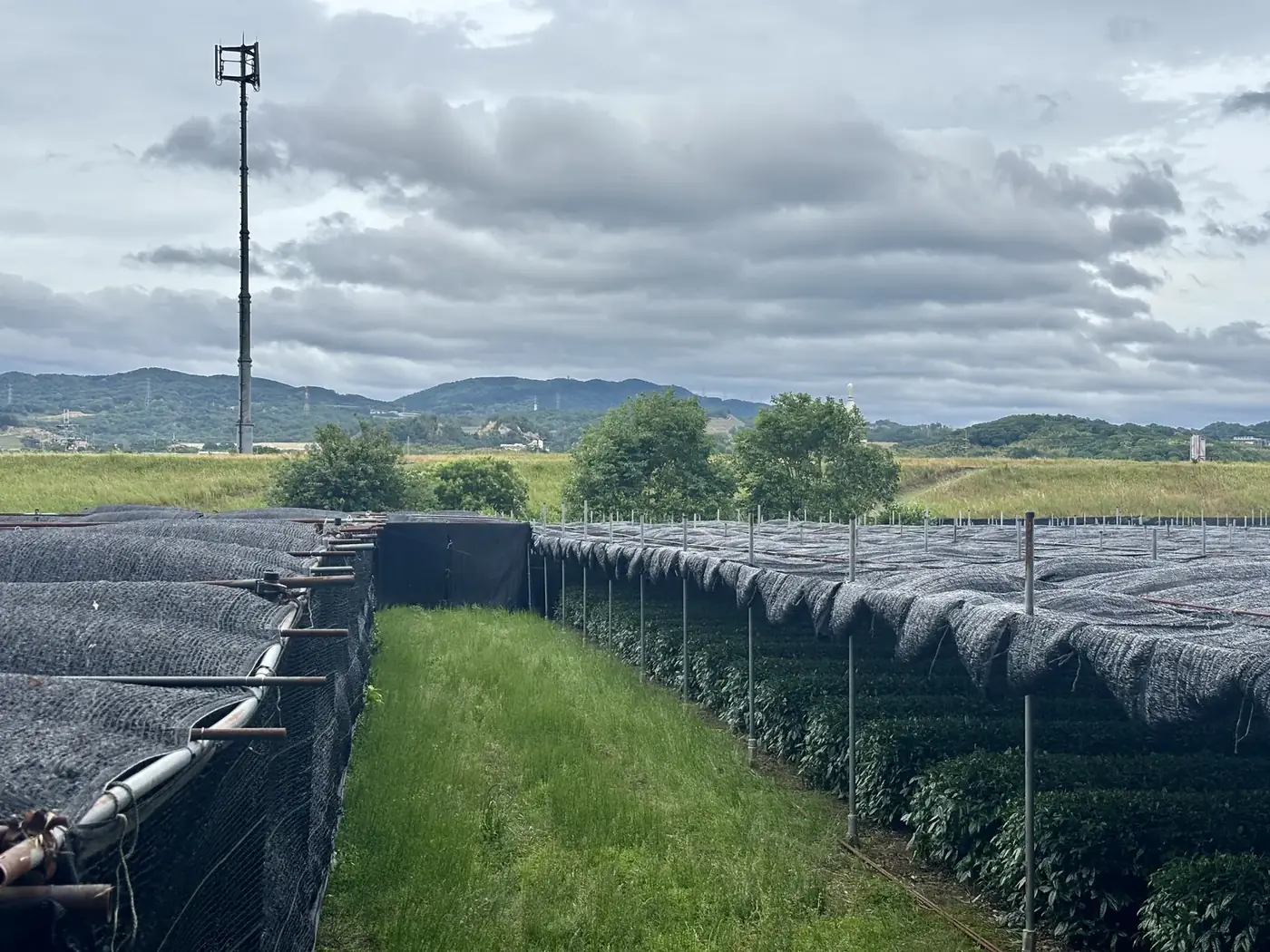
Before the spring harvest, growers cover the tea plants to block most of the sunlight. Japan's Green Tea Labeling Standard defines tencha, the leaf that becomes matcha, as leaf from a tea field covered for about two to three weeks. ISO/TR 21380 gives more detail and describes two methods. Under a roof frame, the cover blocks 70 to 80% of the light at first, rises to 95 to 98% after about ten days, and the new shoots are picked after 20 to 30 days. With covers laid directly on the bushes, about 85% of the sunlight is cut and the shoots are picked after about 20 days.
Shading changes the chemistry of the leaf. Studies comparing shaded and sun-grown tea find more amino acids, including L-theanine, the source of matcha's savory umami, and fewer of the catechins that taste bitter and astringent. The leaf also comes out a deeper green. That is why good matcha tastes rounder and looks brighter than ordinary green tea.
Shade alone does not make matcha. Gyokuro is shaded for about 20 days and kabusecha for about 7 days under the same Japanese standard, and both are still leaf teas. What makes the shaded leaf into matcha is the next two steps. Our guide to what officially counts as real matcha sets the three teas side by side.
Short answer: the shaded leaf is steamed, then dried flat without rolling. That unrolled, dried leaf is called tencha, and only tencha can become matcha.
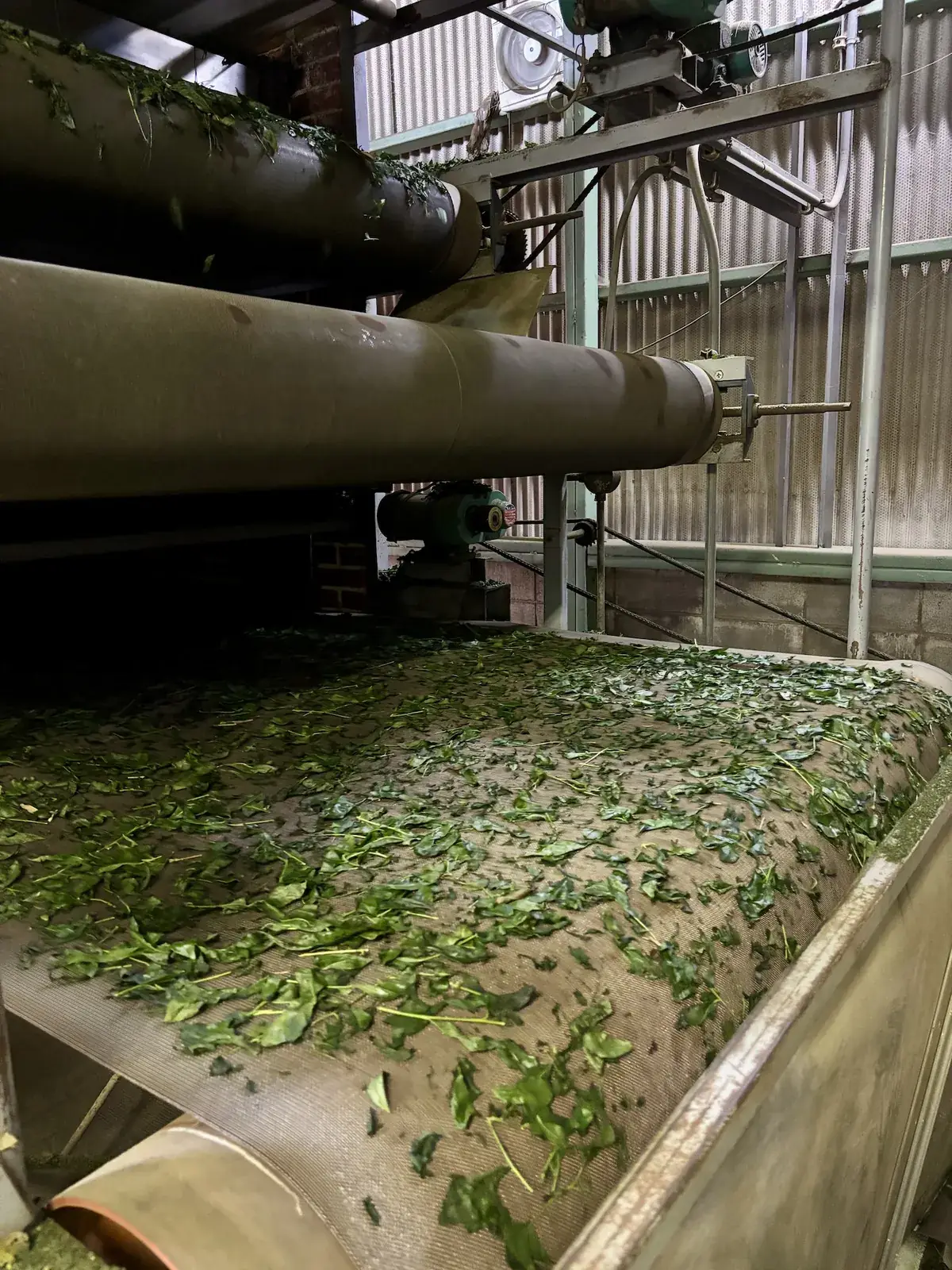
After picking, the leaf goes to the factory quickly. ISO/TR 21380 describes steaming for 15 to 30 seconds at 100 °C. Steaming stops the leaf's enzymes from oxidizing it, which keeps it green. The leaf is then dried in a tencha furnace, a tunnel dryer that Japan's standard describes as normally having three to five conveyor stages. ISO puts the dryer at 150 to 220 °C.
The key word is unrolled. Sencha, gyokuro and most other Japanese teas are rolled and shaped while they dry. Tencha is not. The leaf stays flat and open, which is why it crumbles easily and mills cleanly. After drying, the stems and veins are removed, leaving the soft leaf blade.
Most buyers never see tencha, but it is the real commodity behind matcha. In Japan much of it is traded at tea markets and auctions, where the price is set before any milling happens. To follow those prices, see what Japan's 2026 tencha auctions mean for your matcha price.
Short answer: tencha becomes matcha when it is milled into a very fine powder. A granite stone mill is the traditional way, but neither Japan's standard nor ISO says it must be stone.
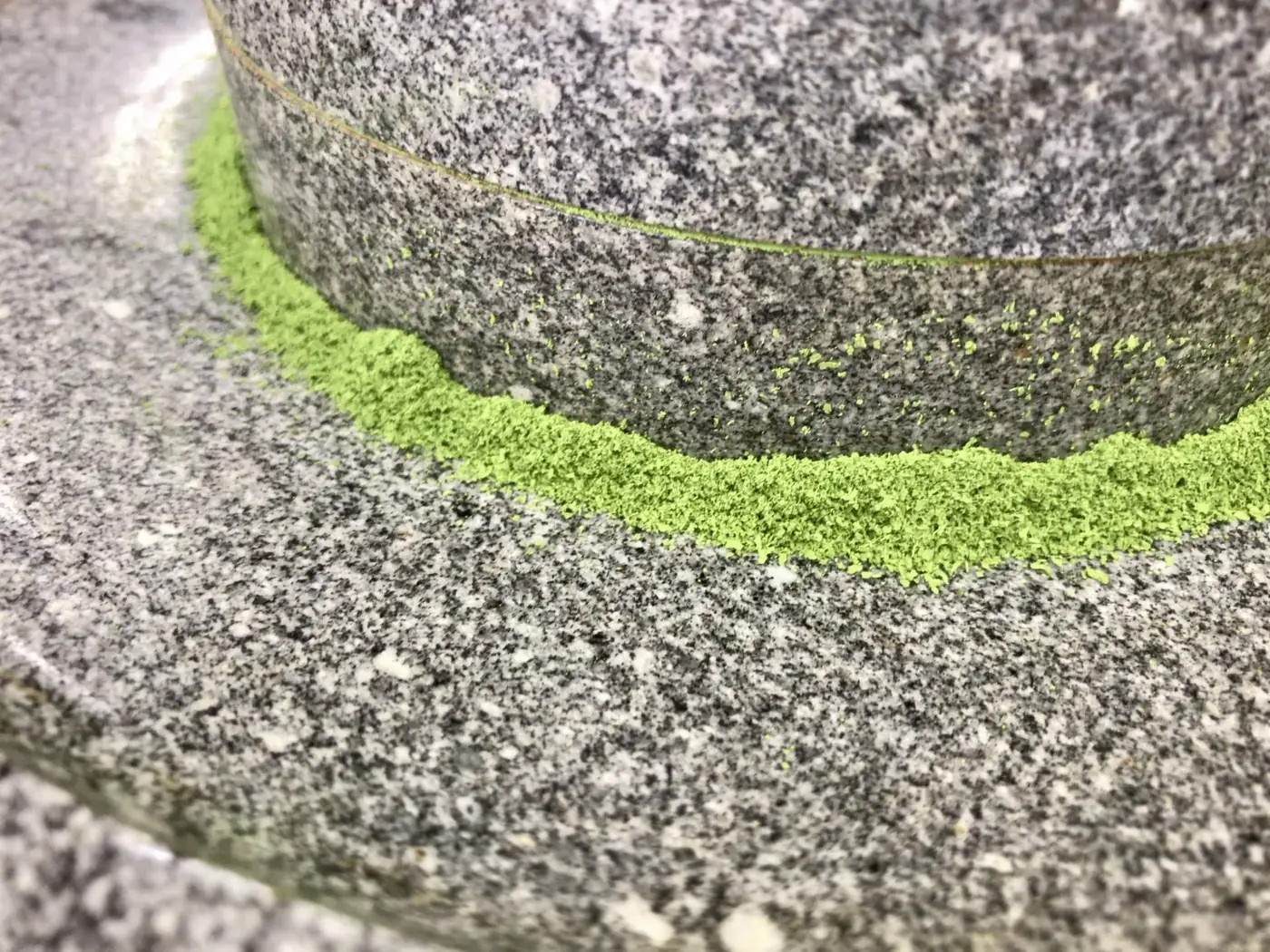
Japan's standard defines matcha as tencha milled into a fine powder with a tea mill or similar equipment. A note in the same standard says this covers any milling method that does the job of a stone mill. ISO/TR 21380 is more direct: normal-grade matcha may be made with milling methods other than the stone mill, including ceramic ball mills and jet mills. What ISO does specify is the result, a mean particle size of 10 to 30 µm with a median under 20 µm, and no additives, colors or flavors.
This matters because many English-language pages say that if it is not stone-ground, it is not matcha. Neither defining document says that. A stone mill is slow and traditional. But "stone-milled" describes a production method. It does not decide whether a powder is matcha.
Short answer: the mill type changes the cost and the claim you can print on your menu. It is not what makes the powder matcha.
| Mill | What the documents say | What it means for your menu and invoice |
|---|---|---|
| Granite stone mill | The traditional tea mill named in Japan's standard | You can say "stone-milled" only if the supplier confirms it for that lot. Expect to pay more than for the same tencha milled another way. |
| Ceramic ball mill | Allowed for normal-grade matcha (ISO/TR 21380, 4.4.2) | Still matcha if made from tencha. Do not print "stone-milled". |
| Jet mill | Allowed for normal-grade matcha (ISO/TR 21380, 4.4.2) | Still matcha if made from tencha. Do not print "stone-milled". |
| Generic grinder on rolled tea | Japan's standard calls powder from any ground tea "funmatsucha" (powdered tea), a different name from matcha | This is green tea powder, not matcha. See matcha vs green tea powder. |
Among the lots we supply, some are stone-milled and some are ball-milled, and the same region can offer both at different prices. We tell you which one each lot is, so the word on your menu matches the product in your tin.
Short answer: tencha keeps much better than powder, so matcha is normally milled after the order comes in.
Powder has far more surface exposed to air than whole leaf, so it loses color and aroma faster. For that reason the standard practice among Japanese wholesalers, including ours, is to hold tencha and mill it when an order is placed. It is a step most buyers never hear about, but it has two practical effects. First, the lead time you are quoted usually includes milling. Second, a supplier that says it has "fresh matcha in stock, milled months ago" is describing a weakness, not a strength. Once you receive the powder, how you store it decides how long it stays bright. See matcha storage, freshness and shelf life.
Short answer: each step needs extra work or special equipment, and supply can only grow as fast as shaded fields and tencha furnaces can be added.
Shading means weeks of putting up and managing covers in the spring. Tencha is dried in its own furnace, not on the rolling lines used for sencha, so it needs dedicated equipment. Milling, stone milling in particular, is slow. None of these steps can be sped up much without changing the product, which is why matcha costs more than other green tea and why supply has struggled to keep up with demand.
For the wider supply picture, see the matcha market in 2026. For how growing region shapes taste and price, see Japanese matcha regions: a cafe sourcing guide.
Short answer: a supplier who knows its process can answer all five without checking. If the answers are vague, treat that as information.
Tencha is the leaf that matcha is made from: shade-grown tea leaf that has been steamed, dried flat without rolling in a tencha furnace, and had its stems and veins removed. It is a finished, shelf-stable product, but it is not matcha until it is milled into powder.
No. Japan's Green Tea Labeling Standard includes any milling method that does the same job as a stone mill, and ISO/TR 21380 lets normal-grade matcha be made with ceramic ball mills or jet mills. Stone milling is the traditional method, but it is not part of the definition.
About two to three weeks under Japan's standard. ISO/TR 21380 describes 20 to 30 days under a roof frame, starting at 70 to 80% light blocking and rising to 95 to 98%, or about 20 days with covers laid directly on the bushes at about 85%.
No. Matcha is made from tencha, which is shaded, steamed and dried without rolling, then milled. Ordinary green tea powder is usually rolled leaf put through a grinder, and Japan's standard gives it a different name, funmatsucha (powdered tea).
Both come from shaded leaf. Gyokuro is shaded for about 20 days, then rolled and sold as leaf tea. Matcha's leaf is dried without rolling to make tencha and then milled into powder. The difference is in the processing, not only the shade.
ISO/TR 21380 describes a mean particle size of 10 to 30 µm with a median under 20 µm. That fineness is what lets matcha whisk into a smooth suspension instead of settling like ground leaf.
Powder exposes far more surface to air than whole leaf, so it fades faster. Holding tencha and milling when the order arrives keeps the color and aroma fresher by the time the matcha reaches your cafe.
Only if your supplier confirms that your specific lot was stone-milled. Many matchas are milled with ball or jet mills, which is allowed, but then "stone-milled" would be inaccurate.
Matcha is defined by shade, by tencha that is steamed and dried without rolling, and by milling into a fine powder. The stone mill is the traditional finish, not a requirement. When you buy, ask about the shade, the harvest, the mill and the milling date. A supplier who answers all four clearly is selling you a process you can explain to your customers.
Japanomars works directly with tea farms across Japan, including Kyoto (Uji), Kagoshima and Yame. We tell you the region, harvest and mill for each lot, and we mill after you order. Samples come with the process spelled out.
Request samples & pricingHiroshi Asami is the founder of Japanomars, which exports Japanese matcha to specialty cafes in the US, Canada, Europe and Asia. Japanomars works directly with tea producers in Kyoto (Uji, Joyo), Sayama, Ibi, Ureshino, Yame, Kirishima, Chiran and Miyazaki, and has guided cafe owners on visits to Japanese tea farms.
Sources
%E7%99%BD_%E5%A4%A7%E3%81%8D%E3%81%84.png)