%E5%A4%A7%E3%81%8D%E3%81%84.png)
Price data · Tencha auctions · 2026
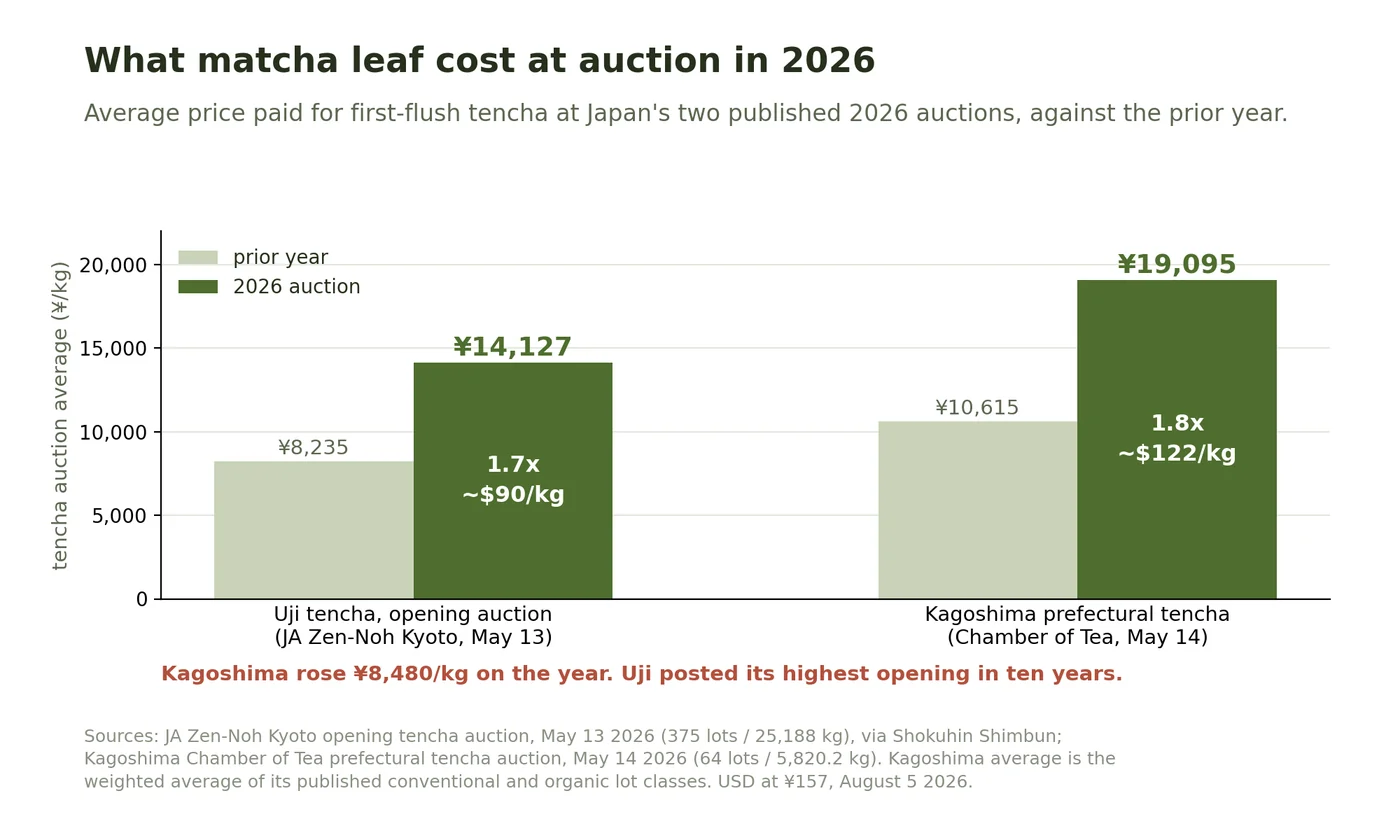
Japan's 2026 tencha auctions repriced the raw material behind every cup of matcha you pour. Kagoshima's prefectural tencha auction averaged 19,095 yen per kilogram on May 14, roughly 1.8 times the prior year, and Uji's opening auction averaged 14,127 yen per kilogram, a ten-year high. A second auction on July 16 then cleared at less than half the spring price. Between them, those three prints explain most of what happened to your matcha quote this year.
This guide takes the figures from the auction organizers' own published records, not from secondary summaries, and walks them forward to a landed cost per kilogram you can check any supplier's quote against.
Key takeaways
In this guide
Tencha is the shade-grown, steamed, de-stemmed leaf that gets milled into matcha, and it is the single largest line in any matcha quote. Japan trades it at prefectural auctions where buyers bid lot by lot. Whatever those auctions print in May sets the floor under every finished matcha price for the following twelve months.
The mechanics are simple enough to do on the back of an envelope. Roughly one kilogram of auction tencha yields 0.88 to 0.90 kilograms of finished matcha after final sorting, so the raw-leaf cost gets divided by about 0.885 before anything else is added. Milling comes next, and it is grade-dependent: stone milling for ceremonial runs several times the cost of ball milling for latte and culinary work. Then packaging, freight, and customs. If you want the full process behind those steps, we cover it in how real matcha is made.
What matters for a buyer is the direction of causation. Your supplier did not decide to raise prices in 2026. The auction did, in a room in Kagoshima on a Thursday in May, and everything downstream is arithmetic on top of that number.
Two first-flush tencha auctions published usable averages in 2026. Kagoshima's prefectural auction on May 14 averaged 19,095 yen per kilogram across 64 lots and 5,820 kilograms. Uji's opening auction on May 13 averaged 14,127 yen per kilogram across 375 lots and 25,188 kilograms, the highest opening in ten years. Both roughly doubled from a low 2025 base.
Here are the two prints in full, with the lot-class breakdown that most coverage leaves out.
| 2026 first-flush tencha auction | Lots | Quantity | Average | Top lot |
|---|---|---|---|---|
| Kagoshima, all lots (May 14) | 64 | 5,820.2 kg | ¥19,095/kg (~$122) | ¥47,100/kg (~$300) |
| Kagoshima, conventional | 26 | 2,164.2 kg | ¥16,853/kg (~$107) | ¥27,511/kg (~$175) |
| Kagoshima, organic | 38 | 3,656.0 kg | ¥20,423/kg (~$130) | ¥47,100/kg (~$300) |
| Uji / JA Zen-Noh Kyoto (May 13) | 375 | 25,188 kg | ¥14,127/kg (~$90) | ¥40,021/kg (~$255) |
Sources: Kagoshima Chamber of Tea, first prefectural tencha auction of FY2026, May 14 2026; JA Zen-Noh Kyoto, opening tencha auction at the Uji-cha Distribution Center in Joyo, May 13 2026. USD at 157 yen to the dollar, August 5 2026.
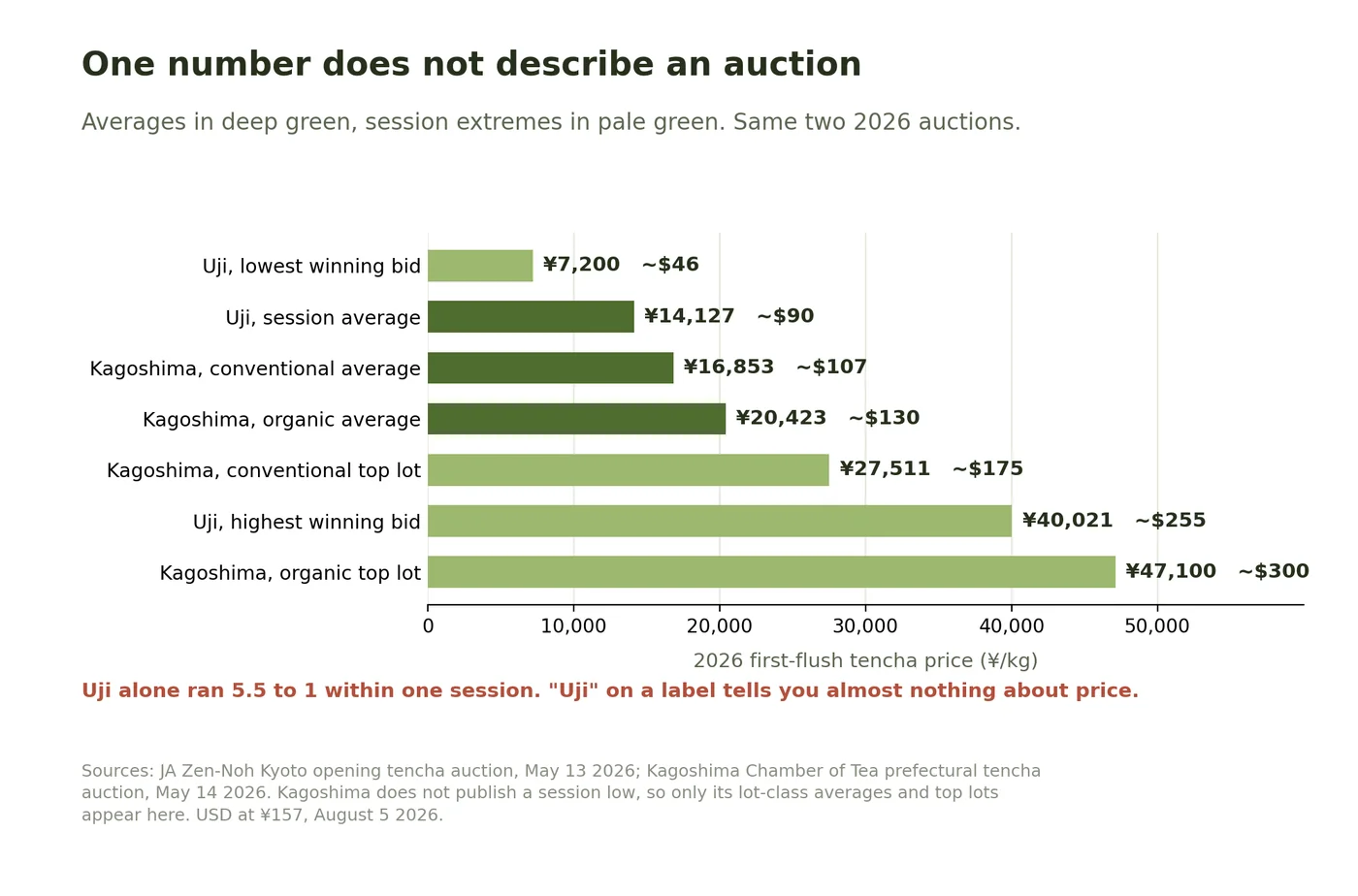
The year-on-year moves are the part worth internalizing. Kagoshima rose 8,480 yen per kilogram against 2025, from 10,615 to 19,095 yen. Uji rose from 8,235 to 14,127 yen. The lowest winning bid at Uji was 7,200 yen and the highest was 40,021 yen, so a single auction average conceals a spread of more than five to one.
Because most English-language matcha writing quotes secondary summaries rather than the organizers' own records, and the summaries blur what is being measured. A 13,910 yen per kilogram figure for Kagoshima's 2026 tencha has circulated widely in English, usually described as the auction average. It is a real number, but a different one: the JA Kagoshima Prefectural Economic Federation's season average for all first-flush tencha traded through the Kagoshima market, announced on June 4. The May 14 prefectural tencha auction, run by the Kagoshima Chamber of Tea on its selected lots, printed 19,095 yen. Quote either, but say which one you mean, because that is a 37% gap on the number your entire cost stack sits on.
There is a second, subtler error worth knowing about, because we made it ourselves and caught it. Japanese press coverage of the May 14 auction reported the organic lot average as 24,422 yen per kilogram. The Chamber of Tea's own record says 20,422.6 yen. You can settle it without picking a side: the weighted average of the two lot classes has to reproduce the published overall average.
At 20,422.6 yen for organic, (2,164.2 x 16,853 + 3,656 x 20,422.6) divided by 5,820.2 comes to 19,095 yen, which matches the published figure. At 24,422 yen it comes to 21,608, which does not. The organizer's figure is the correct one, and the 24,422 in circulation is a transposition of 20,422.
We publish that check rather than hiding it because it is the whole argument for anchoring on primary records. Four things go wrong in the English-language chain: season averages get quoted as auction prints, auctions get conflated across sessions, conventional and organic lot classes get averaged together or reported as if one were the other, and figures get copied between blogs without anyone recomputing them. When a number matters to a purchase order, ask which body published it, which auction, which session, and which lot class.
On the 2026 auction averages, yes: 19,095 yen in Kagoshima against 14,127 in Uji. But the comparison needs a caveat before you act on it. These are two different auctions with different lot compositions, and Kagoshima's is a dedicated tencha sale of 5,820 kilograms while Uji's opening moved 25,188 kilograms across a broader quality range.
What the numbers do support is narrower and more useful: organic tencha, not geography, is where the 2026 ceiling sits. Kagoshima's organic lots averaged 20,423 yen and topped out at 47,100, above both its own conventional lots and the Uji average. If your specification says organic and ceremonial, you are bidding into the tightest, most expensive corner of the market regardless of which prefecture you pick.
The practical read for a cafe buyer: stop treating origin as a proxy for grade. Uji's range in a single session ran from 7,200 to 40,021 yen per kilogram. A supplier saying "Uji" has told you almost nothing about where in that 5.5x band your lot came from. Ask for the lot class and the auction session instead. Our guide to Japan's matcha regions covers what each origin actually contributes to the cup, and matcha grades explained covers the grade language suppliers use.
From the sourcing floor
Every auction we follow printed higher this spring, and so did every quotation that reached us. The pattern from the supplier side is that the regions that were already expensive rose less in proportion than the regions that used to be cheap, some of which roughly doubled. What every grower and every buyer I talk to worries about is the same thing: whether cafes can follow.
About half. Kagoshima ran a second tencha auction on July 16, 2026, and it averaged 8,738 yen per kilogram across 42 lots and 4,155 kilograms, against 19,095 yen at the same auction in May. That is a 54% drop between first and second flush at the same market, run by the same organizer, in the same prefecture and the same year.
The lot-class detail matters as much as the headline.
| Kagoshima tencha, 2026 | Organic avg | Conventional avg |
|---|---|---|
| First flush, May 14 | ¥20,423/kg (~$130) | ¥16,853/kg (~$107) |
| Second flush, July 16 | ¥9,859/kg (~$63) | ¥7,050/kg (~$45) |
| Second flush as % of first | 48% | 42% |
Source: Kagoshima Chamber of Tea, first and second prefectural tencha auctions of FY2026, May 14 and July 16 2026. Second-flush top lots were 15,911 yen/kg organic and 8,329 yen/kg conventional.
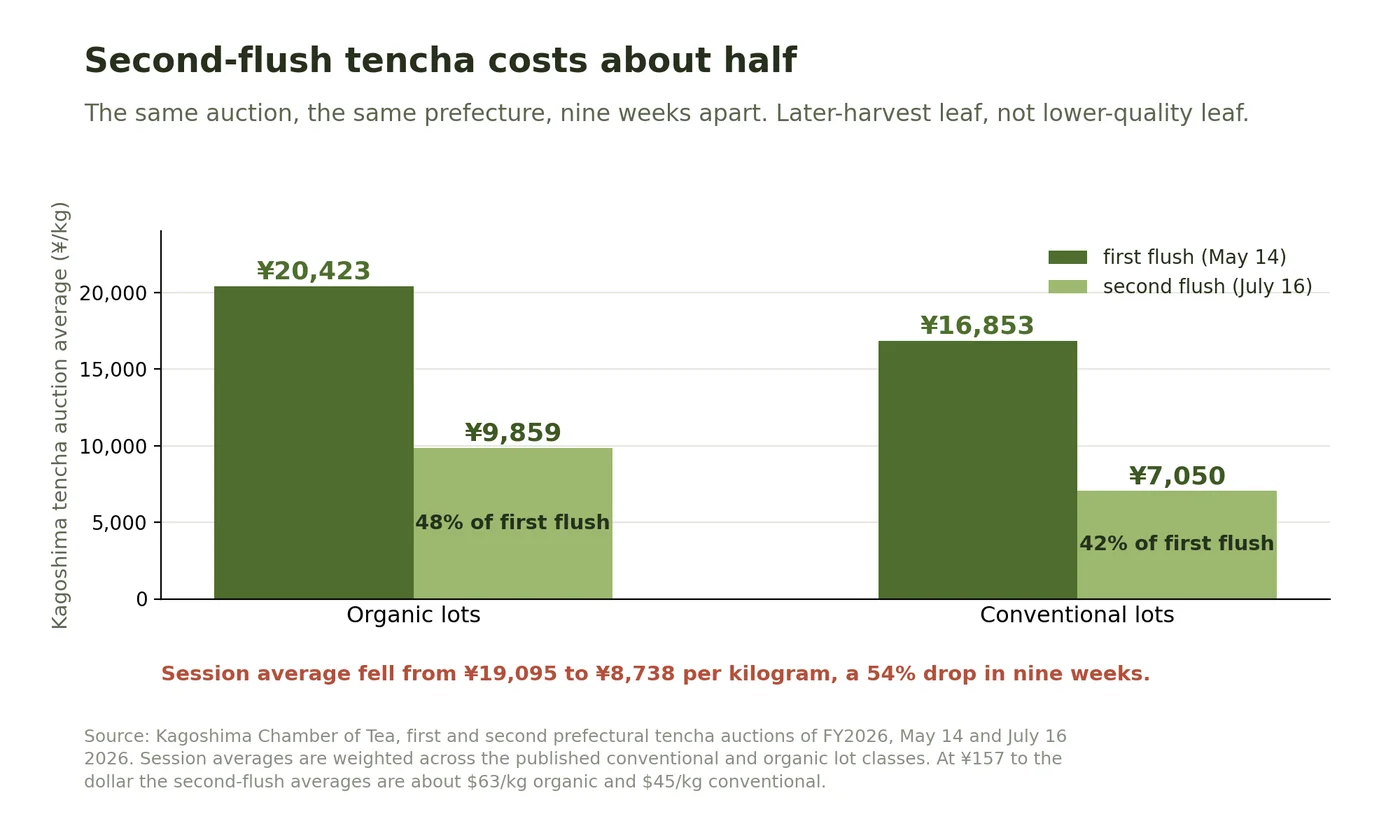
This is the single largest lever most cafes are not pulling. Second-flush tencha is not defective; it is later-harvest leaf with a stronger, more astringent profile and less of the amino-acid sweetness that first flush is priced for. In a 12-ounce latte with oat milk and a pump of syrup, most of what first flush is charging for does not survive the build. If your matcha is going into milk drinks at volume, asking your supplier to quote a second-flush lot is a legitimate way to take a large amount of cost out without touching your ceremonial tin.
We have not found the July 16 figures reported anywhere in English, which is a reasonable indicator of how far behind the English-language price picture runs.
Once you know the tencha auction band for your grade, your landed cost is largely determined. The bridge is public: auction price, divided by a milling yield of about 0.885, plus milling, plus nitrogen-flushed bulk packaging at roughly 500 yen/kg, plus export freight near $20/kg, plus about $3/kg in US handling. Green tea under HTS heading 0902 carries 0% duty in normal treatment.
| Grade | Tencha input (2026 auction) | Milling | US-landed cost, pre-margin |
|---|---|---|---|
| Ceremonial | ¥18,000/kg (Uji upper band) | stone | ≈ $175/kg |
| Premium organic | ¥20,423/kg (Kagoshima organic avg) | stone | ≈ $192/kg |
| Latte / culinary, first flush | ¥8,000/kg (low band) | ball | ≈ $89/kg |
| Latte / culinary, second flush | ¥7,050/kg (Kagoshima July) | ball | ≈ $82/kg |
FX 157 yen/USD, August 5 2026. Organic second-flush tencha at 9,859 yen/kg lands near $102/kg on the same basis. These are pre-margin landed costs, not our selling prices, and freight per kilogram falls with order size.
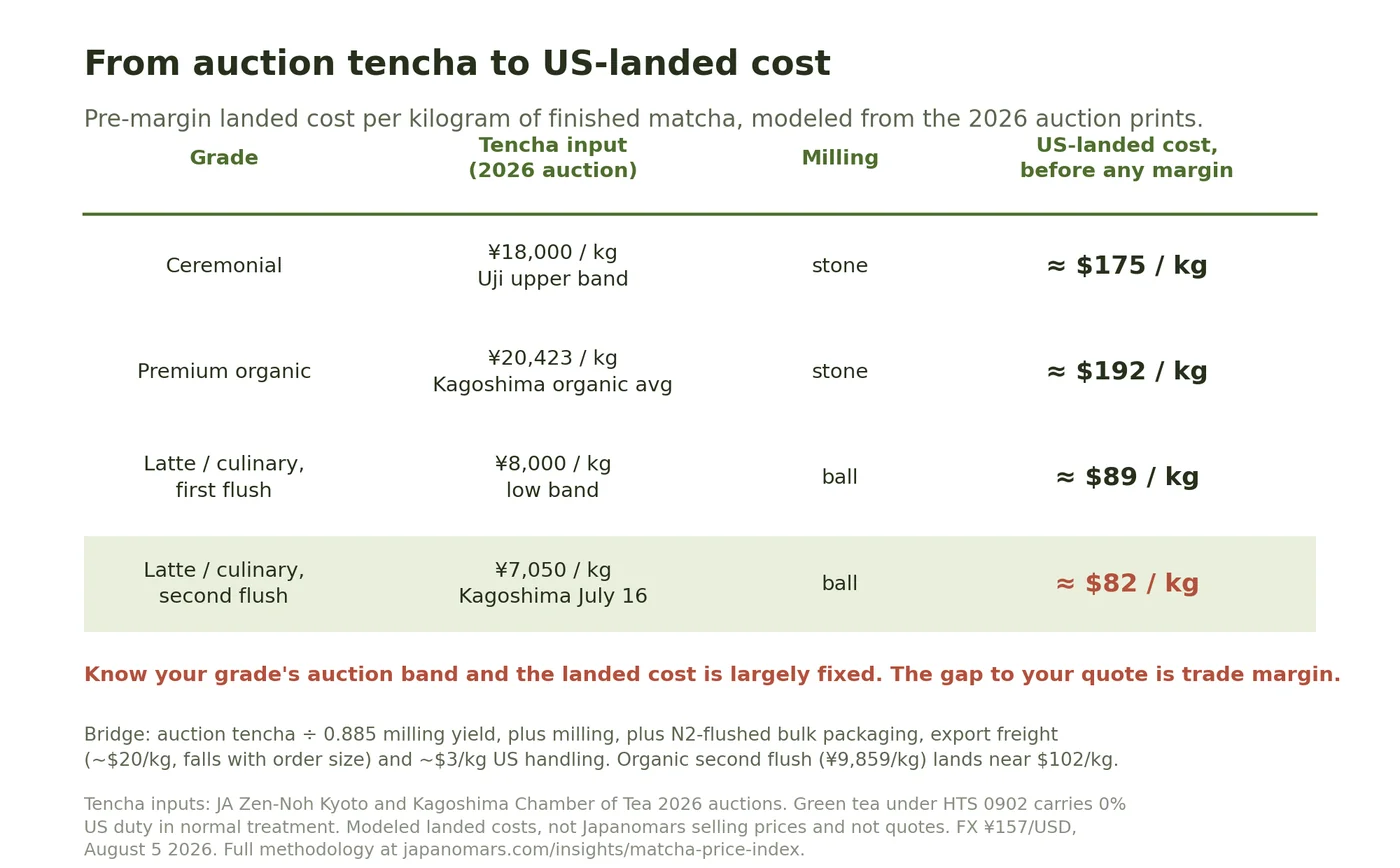
The point of publishing this is not to tell you what to pay. It is to give you a floor. Every quote you receive sits above one of these lines, and the gap is the supplier's trade margin plus whatever service sits inside it. That is a fair thing for a supplier to earn. It is not a fair thing to hide. The full methodology, the regional map, and the availability read live on our matcha wholesale price and availability index, and the duty and customs mechanics are in importing matcha into the US.
Five things, in the order they pay off. None of them require you to change supplier.
Tencha is the raw material. It is shade-grown tea leaf that has been steamed, dried without rolling, and de-stemmed. Matcha is tencha after milling into powder. Japan auctions tencha, not matcha, which is why auction prices are the honest starting point for any matcha cost discussion.
The auction organizers publish them. Kagoshima Chamber of Tea posts its prefectural tencha auction results, and JA Zen-Noh Kyoto reports the Uji opening. Both publish in Japanese only. Most English-language matcha price figures are secondary summaries of these records, and some contain transcription errors.
Three reasons. Different auction sessions get quoted as if they were the same event, conventional and organic lot classes get mixed, and figures get copied between sources without recalculation. A single Uji session in 2026 ran from 7,200 to 40,021 yen per kilogram, so almost any number can be defended if the lot is not specified.
Yes, for first-flush grades. Kagoshima's first-flush average rose 8,480 yen per kilogram year on year and Uji's rose about 5,900 yen, and those increases pass through to finished matcha almost fully because raw leaf is the largest cost line. Second-flush culinary grades are the exception and moved the other way.
It is different, not defective. Second flush is later-harvest leaf with more astringency and less amino-acid sweetness, so it is the wrong choice for a drink served plain. In milk-based lattes with syrup it performs close to first-flush culinary at roughly half the raw-leaf cost.
Not on the averages alone. Kagoshima's 2026 tencha average came in above Uji's, but the two auctions have different lot compositions, and the real signal is that organic tencha is the ceiling in both. Choose by lot class, cup profile, and confirmed availability rather than by prefecture.
Matcha pricing in 2026 is not a mystery, and it is not your supplier's opinion. It is a public number printed at two or three auctions a year, plus a chain of costs you can add up yourself. Kagoshima at 19,095 yen in May and 8,738 in July, Uji at 14,127: those are the figures the rest of the year runs on.
Send us the spec your cafe actually pours and we will quote it from the tencha cost up, showing the auction band, the milling, the freight and our margin as separate lines. You will be able to check every one of them against this page.
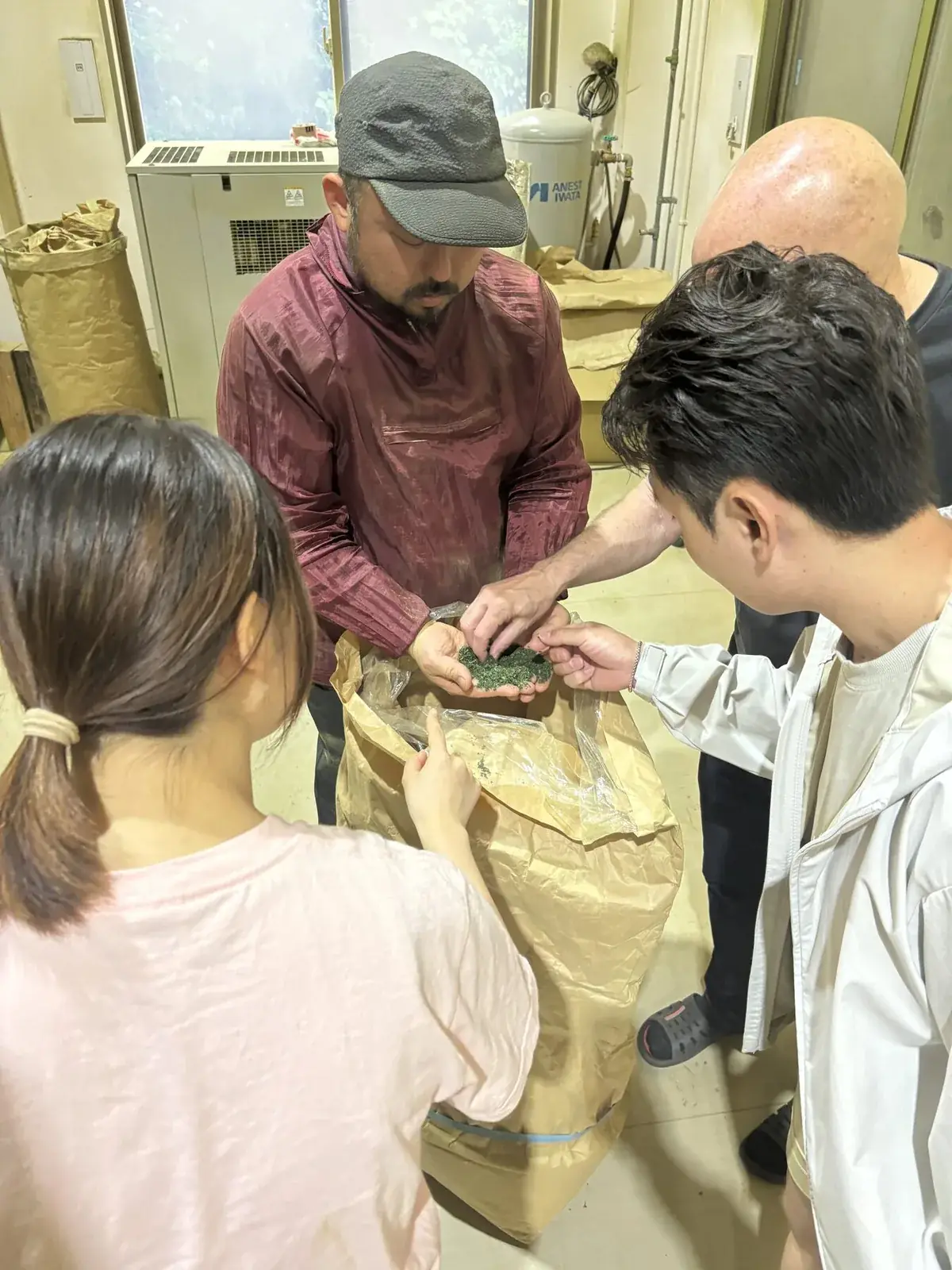
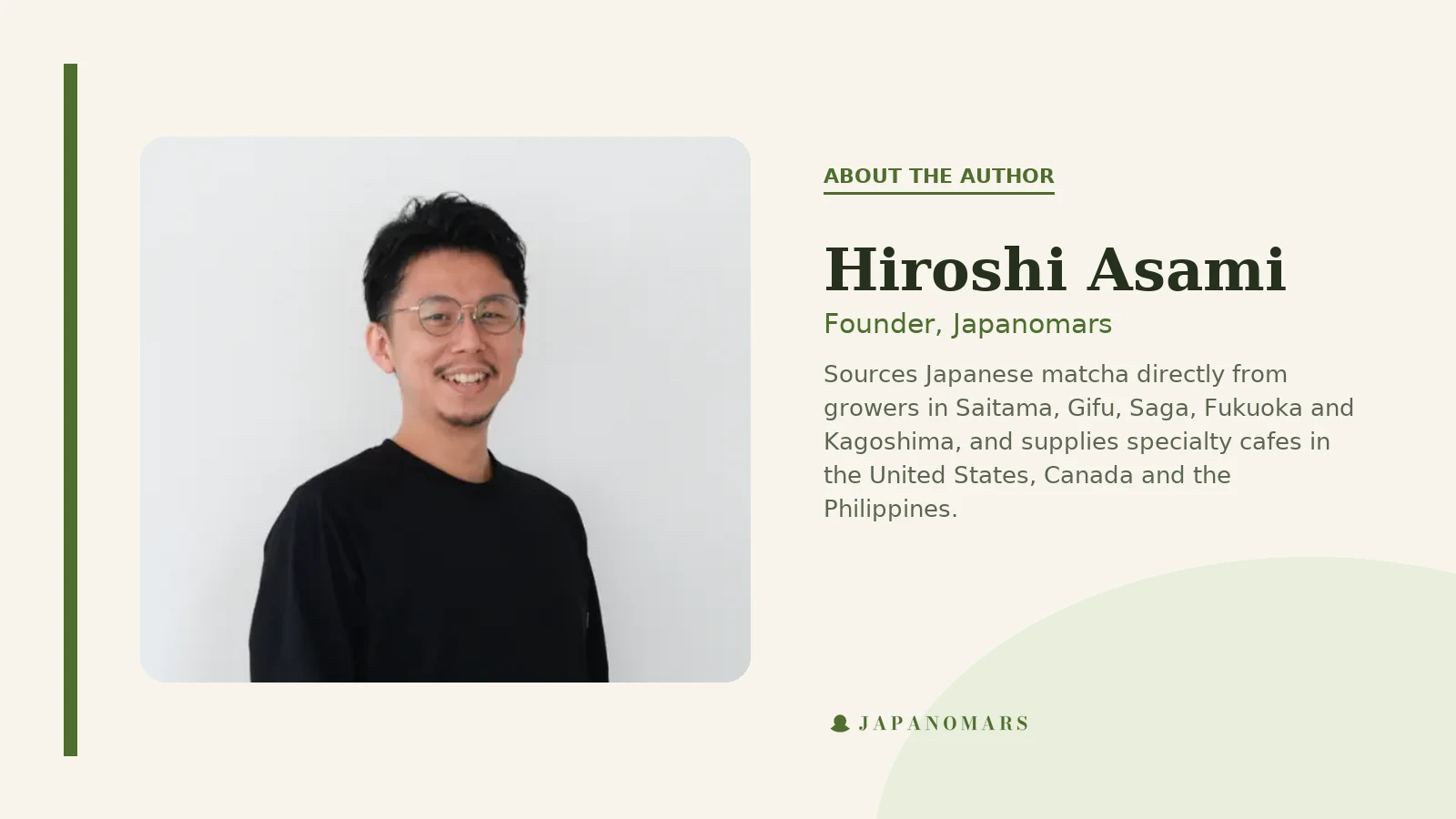
Hiroshi Asami is the founder of Japanomars, which exports Japanese matcha to specialty cafes in the United States and Canada. He buys directly from farms in Sayama, Ibi, Ureshino, Yame, Kirishima and Chiran, and has led four sourcing tours bringing overseas cafe owners to Japanese tea farms. He tracks the prefectural tencha auctions from the primary Japanese-language records.
Sources
%E7%99%BD_%E5%A4%A7%E3%81%8D%E3%81%84.png)