%E5%A4%A7%E3%81%8D%E3%81%84.png)
Sourcing & Supply · 2026

Importing matcha from Japan runs on three tracks: FDA paperwork (your supplier's facility registration, a Prior Notice per shipment, and your FSVP file), a US Customs entry (the right HTS code, duty, and fees), and a compliant label before the tin reaches your shelf. The duty question that made this confusing all spring is now settled: the temporary Section 122 surcharge expired on July 24, 2026, and the Section 301 forced-labor tariff that replaced it the same minute excludes green tea by name. What is not settled is the calendar. Two deadlines land on October 1, 2026, and one of them can put your January shipments on hold.
Key takeaways
| Question | Answer as of September 2026 |
|---|---|
| HTS classification | Heading 0902. Retail packings of 3 kg or less: 0902.10. Bulk: 0902.20. |
| Base duty, unflavored | 0% |
| Base duty, flavored | 3.2% |
| Section 122 surcharge | Expired July 24, 2026. No longer collected. |
| Section 301 forced-labor tariff | Does not apply. Green tea is excluded under heading 9903.05.86. |
| Merchandise Processing Fee | 0.3464% of value. Minimum $33.58 and maximum $651.50 through September 30, 2026; $34.58 and $670.86 from October 1, 2026. |
| Harbor Maintenance Fee | 0.125%, ocean freight only. |
| Prior Notice deadline | FDA confirmation at least 4 hours before arrival by air, 8 hours by sea. |
| Supplier registration renewal | October 1 to December 31, 2026. |
In this guide
Before a single tin of matcha can clear US Customs, two FDA requirements have to be satisfied: the Japanese processing facility needs an active FDA Food Facility Registration with a designated US Agent, and a Prior Notice has to be filed for that specific shipment. Both trace back to the Bioterrorism Act and FSMA, and missing either one is a fast route to a held or refused shipment.
Food Facility Registration. Any foreign facility that manufactures, processes, packs, or holds food for US consumption must register with FDA and hold an 11-digit registration number, plus a US Agent who is US-located and authorized to receive FDA notices. Registration has to be renewed every even-numbered year, and 2026 is a renewal year with a hard deadline of December 31. That is the next section, and it is the most time-sensitive thing on this page.
Prior Notice. Filed for every shipment before it arrives, via CBP's ABI/ACE system (up to 30 days ahead) or FDA's Prior Notice System Interface (up to 15 days ahead). Per JETRO's export guidance for tea shippers, FDA must confirm the notice at least 4 hours before arrival by air or 8 hours by sea. Your forwarder or broker usually files this using the supplier's facility registration number, but confirming they have that number, before the first pallet moves, is your job.
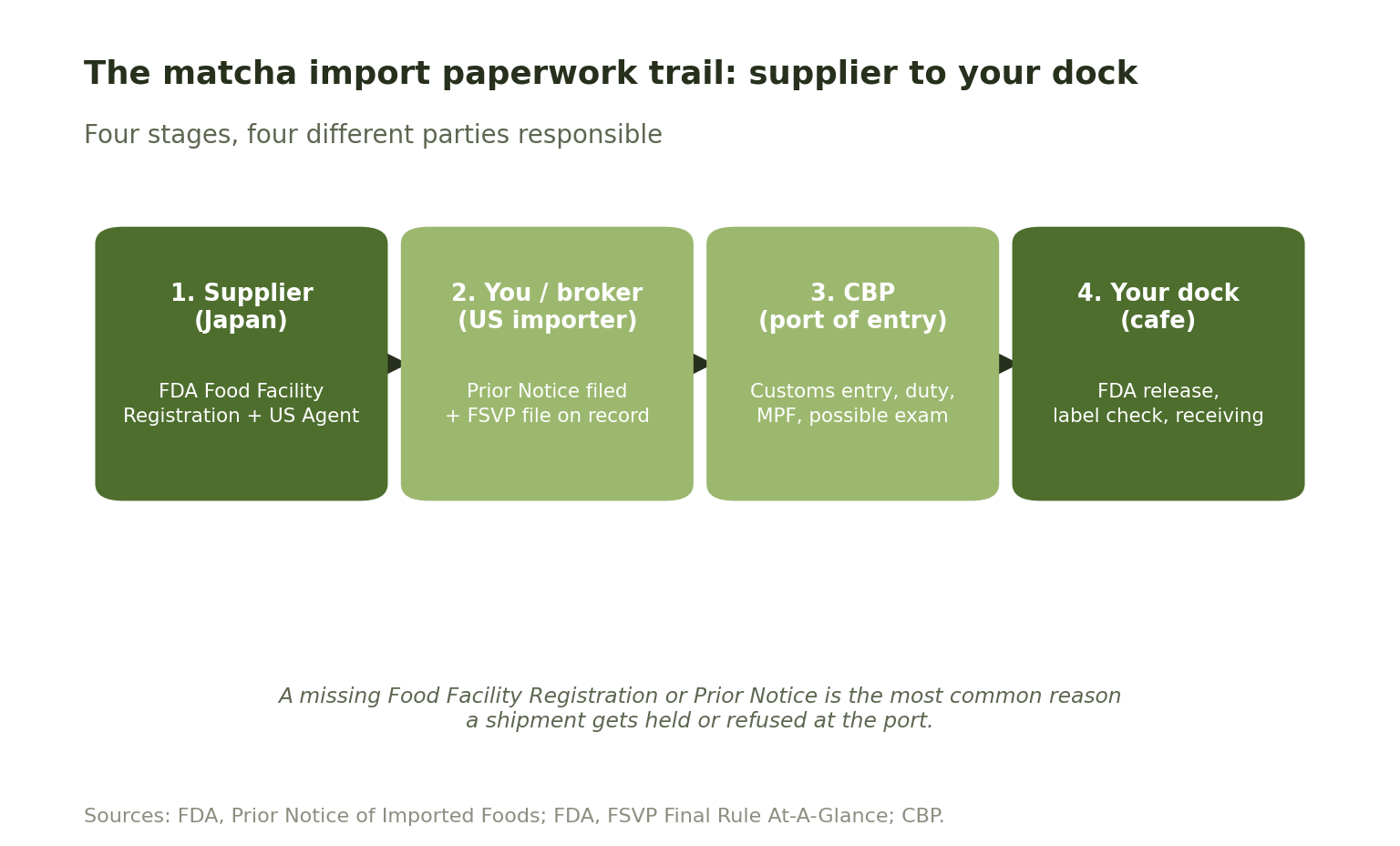
Every registered food facility has to renew its FDA registration between 12:01 a.m. on October 1, 2026 and 11:59 p.m. on December 31, 2026. If your Japanese supplier does not renew in that window, the registration is treated as expired and removed, and shipments from that facility can be refused entry at the border. This happens every even-numbered year and it catches importers every time, because nothing visible breaks until a January shipment is already on the water.
Three details do most of the damage, and all three are worth putting in an email to your supplier this month rather than in December.
Updating is not renewing. FDA treats them as separate functions. A supplier who changed an address or a contact in 2026 has updated, not renewed, and is not covered. During the renewal window FDA disables the update function until the renewal is done, precisely because facilities confuse the two.
A new registration this year does not carry over. A facility that registered for the first time in, say, March 2026 still has to renew before December 31. First registration and biennial renewal are independent obligations.
The US Agent has to confirm. A foreign facility's renewal is not complete until the designated US Agent accepts the designation. If your supplier's US Agent relationship lapsed quietly, the renewal will stall at that step, and the facility will not find out unless someone is watching.
The practical ask is one line: request the 11-digit registration number and the renewal confirmation from your supplier in January, not a promise in December. If you buy through an importer who already carries the compliance, ask them the same question about the facility behind the product.
The Foreign Supplier Verification Program (FSVP) puts legal responsibility on the US importer of record, not the Japanese supplier: if your business brings matcha into the US under its own name, you (or a broker acting for you) must document hazard analysis and supplier verification, not simply trust the supplier is compliant.
FSVP requires a hazard analysis specific to matcha and that supplier's facility, an evaluation of their food-safety compliance, ongoing verification (audit review, sampling, HACCP and pest-control records checks), and documentation kept on file for at least two years.
In practice, most small and mid-size cafes never carry this directly. Buy Delivered Duty Paid (DDP) from a US-based supplier and they're almost always the importer of record, carrying the FSVP file already. Buy EXW or FOB and clear it yourself, and FSVP is yours, so line up a broker before the first order ships, not after it's held at the port.
No, on both counts that mattered this year. Unflavored green tea, the HTS category matcha falls under (heading 0902), has long entered the US duty-free under the US-Japan Trade Agreement, per JETRO's official guidance for tea exporters. Flavored green tea carries a 3.2% duty under the same agreement; unflavored tea, which covers essentially all straight matcha, is free at the base rate. That part is durable and well established. The temporary layer that sat on top of it for five months is now gone.
The Section 122 surcharge expired on July 24, 2026. It was imposed by proclamation with effect from February 24, 2026, under Section 122 of the Trade Act of 1974, which permits a balance-of-payments surcharge of up to 15% for no more than 150 days unless Congress extends it. Congress did not extend it, so it ended by operation of law at 12:01 a.m. EDT on July 24, 2026, exactly 150 days in. The Court of International Trade had separately ruled it unlawful in May 2026 and the Federal Circuit stayed that ruling pending appeal, so CBP kept collecting until the clock ran out. If you imported between February 24 and July 24 and think you were charged in error, that is a refund conversation to have with your broker, not a forward-looking cost.
The tariff that replaced it excludes tea. A Section 301 forced-labor action took effect at the same minute the surcharge lapsed, imposing 10% to 12.5% on goods from 60 economies. Japan is covered, at 12.5%. But the carve-out is by product rather than by country, and Customs named the green-tea lines on the exclusion side: heading 9903.05.86 lists 0902.10.10, 0902.10.90, 0902.20.10, 0902.20.90, 0902.30.00 and 0902.40.00 among the provisions the duties do not apply to. Matcha enters under 0902.10 in retail packings of 3 kg or less or 0902.20 in bulk, so both of the lines a cafe order actually uses are excluded. We walk through the primary Customs document, and how to hand it to a broker, in matcha and the new US forced-labor tariff.
Two cautions survive all of this. First, the exclusion attaches to the tariff line, not to the word matcha: premixed matcha lattes and flavored or sweetened blends can classify outside 0902 and lose the carve-out, so align your supplier, forwarder and broker on the code before the commercial invoice is issued. Second, delete 9903.03.03 from your notes. That was the Section 122 exclusion code, it stopped meaning anything on July 24, and a fair amount of 2026 import writing still repeats it. (Weighing Chinese-origin matcha too? The tariff and quality picture there is entirely different, so see our Japanese vs Chinese matcha comparison.)
Beyond any duty, every commercial matcha shipment carries standard US Customs fees and paperwork: a Merchandise Processing Fee, a customs entry filing, a commercial invoice and packing list, and (ocean freight only) a Harbor Maintenance Fee and an Import Security Filing. None of these are matcha-specific, but they're easy to miss when budgeting a first order, and the MPF numbers change on October 1, 2026.
CBP adjusts its user fees for inflation every fiscal year under the FAST Act. For fiscal 2027, published on July 31, 2026, the ad valorem rate stays at 0.3464%, but the per-entry floor rises from $33.58 to $34.58 and the ceiling from $651.50 to $670.86, effective October 1, 2026. The floor is the one that matters to a cafe: on any entry valued below roughly $10,000, you pay the minimum rather than the percentage, so a first order of a few dozen kilograms pays $34.58 regardless of how small it is.
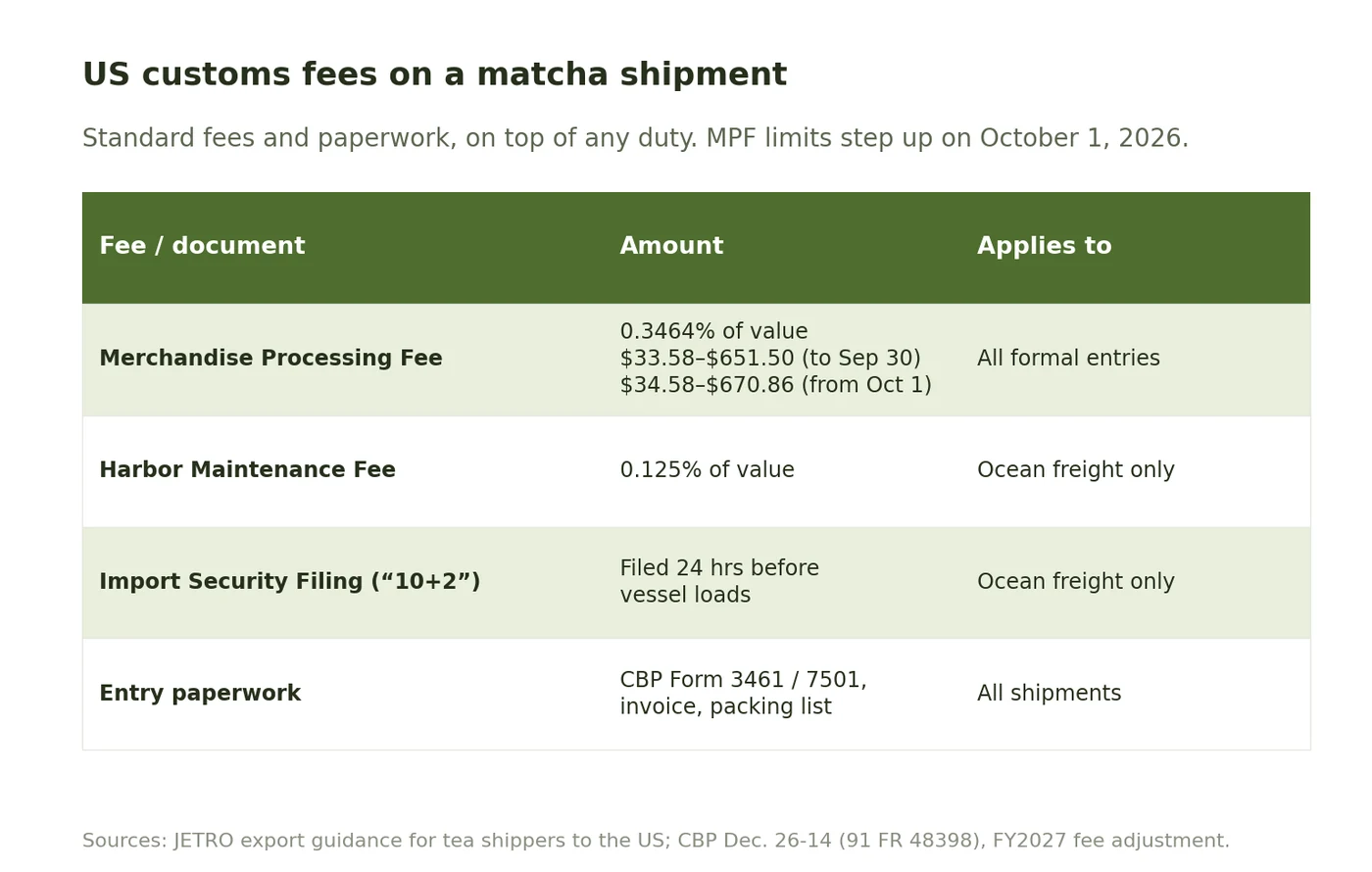
For a first order under a few hundred kilograms, air freight with a broker who bundles Prior Notice, ISF (where relevant), MPF, and entry filing into the service is simpler than sea freight, and most of these fees apply regardless of transport mode anyway. If you want to see how these land on a per-cup basis rather than per shipment, our matcha cost per drink breakdown does that arithmetic.
Country of origin is central here, and it now carries extra weight: in 2026 Japan registered "Japanese Tea" as a Geographical Indication for tea grown, processed, and packed in Japan, so your commercial invoice and labels should consistently read Japan, not a third country where blending or repacking happened.
A compliant US matcha label needs five elements regardless of what the original Japanese packaging says: a Nutrition Facts panel, an ingredient statement, net weight in both metric and US customary units, the name and address of a US manufacturer, packer, or distributor, and a legible country-of-origin mark. Miss any of these and the product itself, not just the paperwork, is technically misbranded.
The Nutrition Facts panel is required under 21 CFR 101.9. Matcha's nutrient profile is simple, but the panel itself is still mandatory, and the small-business exemptions most buyers assume apply generally don't once you're selling wholesale into interstate commerce. Country-of-origin marking is a separate US Customs requirement under 19 CFR Part 134, enforced at entry rather than by FDA: "Product of Japan" or an equivalent phrase, conspicuous and durable enough to survive normal handling, is the accepted standard.
Because the product is imported, the label also needs a "Distributed by" or "Imported by" line with a US name and address, since the Japanese producer's address alone doesn't satisfy this. If your supplier ships private-label tins directly, get in writing who owns getting this right; it's usually cheaper to buy from a US-based importer who already re-labels for the US market than to retrofit compliant labels yourself. If the vocabulary on a spec sheet is unfamiliar, our matcha glossary for cafe buyers decodes the terms that show up on Japanese documentation.
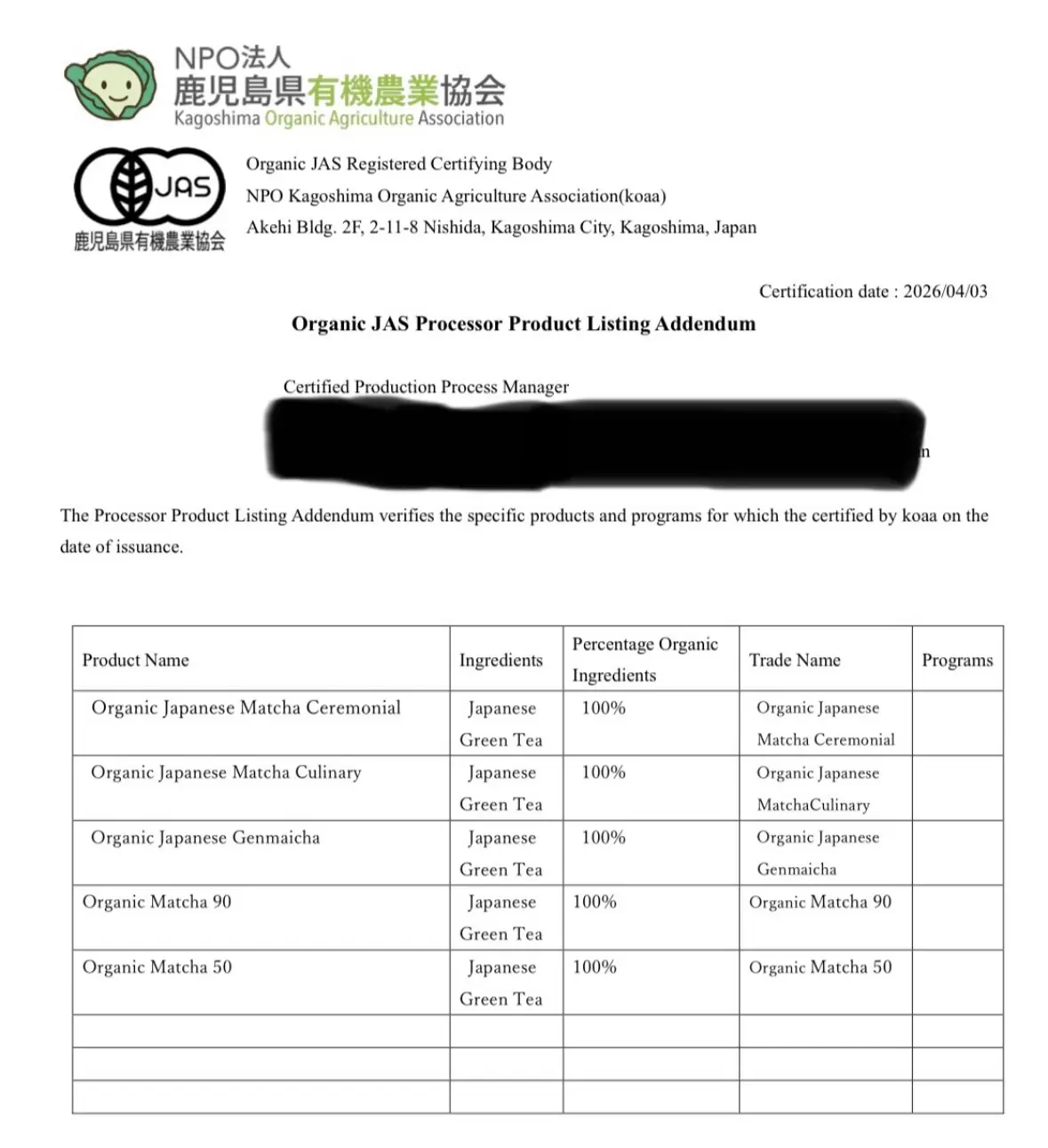
Only if it's backed by real certification. JAS, Japan's organic standard, is not automatically recognized as USDA Organic in the US, but a 2014 US-Japan Organic Equivalency Arrangement lets JAS-certified operations sell into the US as USDA Organic without separate NOP certification, provided the arrangement's specific conditions are met for that product and shipment.
This is narrower and more technical than most buyers expect, and deserves its own scrutiny. We cover JAS versus USDA certification, and how to verify a supplier's paperwork, in How to Find and Vet a Japanese Matcha Wholesale Supplier. The labeling takeaway: don't print "USDA Organic" until you've seen the certificate and confirmed it covers this specific product and shipment, not just the farm in general.
No. FDA lifted the Fukushima-era import restrictions on Japanese food, including tea, in 2021, and by 2024 even the narrower radiation-certificate requirement for tea grown outside the five most-affected prefectures, including Shizuoka, had been dropped in favor of standard proof-of-origin documentation. Some older buyer questions still treat radiation certificates as a current requirement, but for most of Japan's tea-growing regions today, they aren't. What's actually worth verifying is routine heavy-metal testing (lead, cadmium) as part of ordinary supplier quality control; our supplier-vetting guide covers which lab tests to request from any producer or growing region.
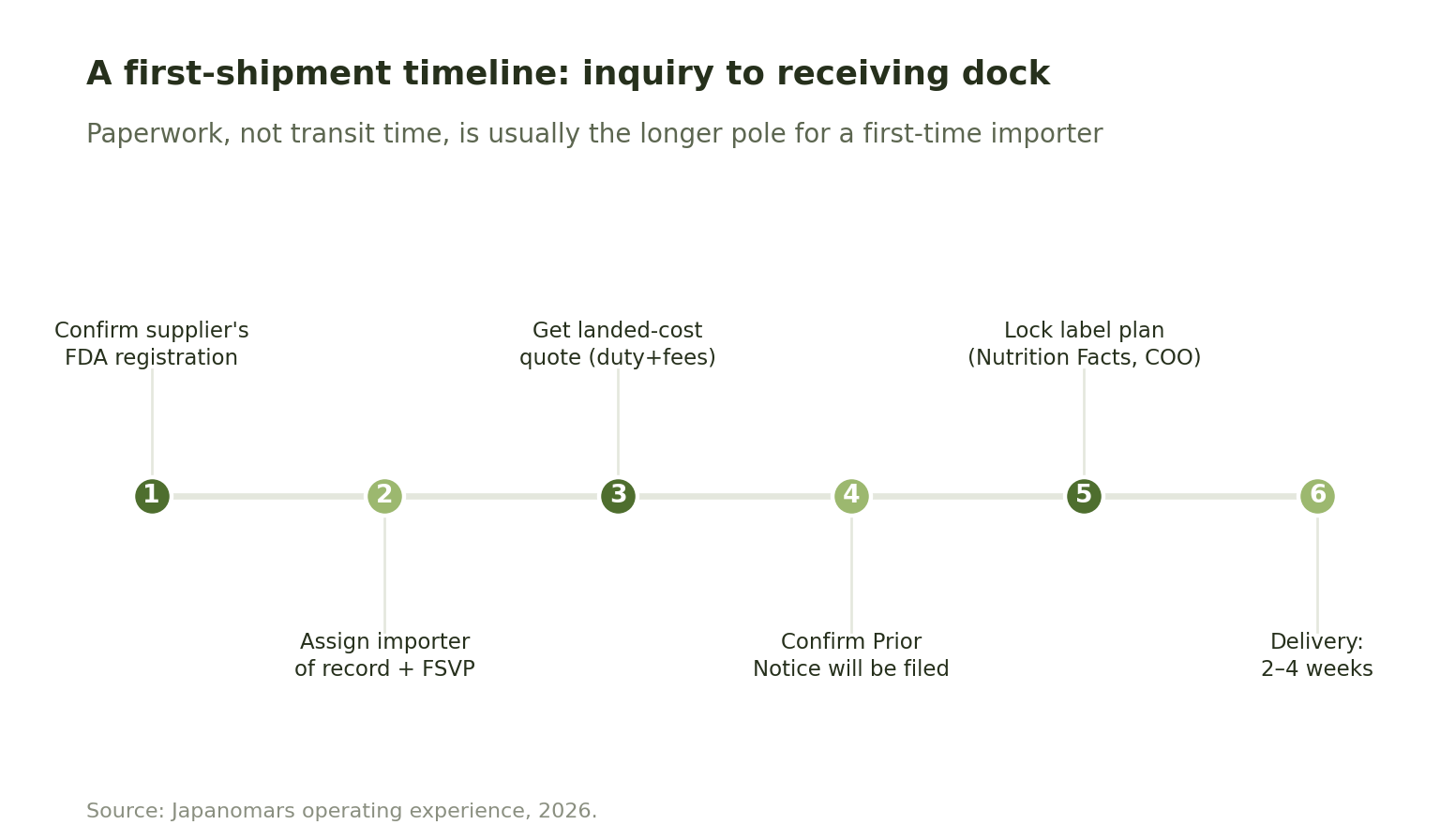
Here's the realistic order of operations for a first direct import order, from initial supplier conversation to matcha on the shelf. Most of these steps run in parallel with sourcing and sampling, not strictly after it.
Importing is the final step of sourcing, not the whole of it. For choosing a supplier and the wholesale price, MOQ, and lead-time picture, see our wholesale and bulk matcha for cafes guide, and for where sourcing fits your whole cafe program, the Matcha for Cafes guide. And for what the raw material actually costs at auction this year, our US matcha wholesale price index keeps the numbers current.
No single "import license" exists. What you actually need is your supplier's active FDA Food Facility Registration, a Prior Notice filed for each shipment, and an FSVP file naming the importer of record. Most first-time cafe buyers get all three handled through a customs broker or by buying from a US-based importer who already carries this compliance.
Beyond the matcha itself, budget for base duty (0% on unflavored green tea under HTS 0902), a Merchandise Processing Fee, freight, and broker fees. The MPF is 0.3464% of value with a $33.58 minimum and $651.50 maximum through September 30, 2026, rising to a $34.58 minimum and $670.86 maximum on October 1, 2026. On a small first order you will pay the minimum, and broker and freight costs will outweigh both the duty and the fee.
No. The surcharge expired by operation of law at 12:01 a.m. EDT on July 24, 2026, at the end of the 150-day maximum that Section 122 of the Trade Act of 1974 allows without a congressional extension. Congress did not extend it. Guidance that still tells you to file under HTS 9903.03.03 to claim the green-tea exclusion is describing a rule that no longer exists.
No. The Section 301 forced-labor action that took effect on July 24, 2026 covers 60 economies including Japan at 12.5%, but the carve-out is by product rather than by country. Customs listed the green-tea lines 0902.10.10, 0902.10.90, 0902.20.10, 0902.20.90, 0902.30.00 and 0902.40.00 under exclusion heading 9903.05.86, and matcha enters under 0902.10 or 0902.20. Flavored or premixed matcha products can classify elsewhere and fall outside the exclusion.
Between 12:01 a.m. on October 1, 2026 and 11:59 p.m. on December 31, 2026. This is the biennial renewal that falls in every even-numbered year. If the facility does not renew, the registration is treated as expired and removed, and shipments from it can be refused entry. Updating a registration detail does not count as renewing, and a facility that first registered earlier in 2026 still has to renew in this window.
Heading 0902, green tea. Retail packings of 3 kg or less classify under 0902.10 and bulk under 0902.20. Both parent lines are on the 2026 forced-labor exclusion list. Blended, sweetened or flavored matcha products can classify elsewhere, which changes both the duty rate and the exclusion, so confirm the exact line with your broker before the commercial invoice is issued.
Whoever's name is on the customs entry is legally responsible for duties, FSVP, and compliance. If you buy Delivered Duty Paid (DDP) from a US-based supplier, they're usually the importer of record. If you import directly under EXW or FOB terms, you are, and you'll need a customs broker of your own.
Yes, if it's sold as a packaged retail product for resale: a Nutrition Facts panel (21 CFR 101.9), ingredient statement, net weight, and a US distributor statement are required regardless of what the original Japanese packaging shows. Matcha poured from bulk as a bar ingredient, never resold in its original package, carries different labeling exposure; check with your supplier or a food-labeling consultant if you're unsure which applies to you.
Yes. FDA lifted the Fukushima-related import restrictions on Japanese food, including tea, in 2021, and by 2024 dropped the narrower radiation-certificate requirement for most tea-growing regions outside the five closest prefectures. Standard FSVP food-safety verification, not radiation-specific testing, is what applies to a matcha shipment today.
Only if the certification and shipment fall under the 2014 US-Japan Organic Equivalency Arrangement's specific terms, since JAS certification alone doesn't automatically transfer into a USDA Organic claim. Ask to see the actual certificate and confirm it covers this specific product before using "USDA Organic" on your menu or packaging.
Importing matcha into the US is no harder than importing any other specialty food, and it got simpler over the summer. The FDA paperwork is well-defined, the base duty has long been zero, the temporary surcharge that muddied the picture all spring expired in July, the tariff that replaced it excludes tea by name, and the safety worries some buyers still carry were resolved years ago. What is left is calendar discipline: the fee schedule steps up on October 1, and your supplier's registration has to be renewed before the year ends. Those are the two things worth an email this month. For everything else, a broker, or a supplier who is already the importer of record, is still the cheapest way to make a first order boring.
We handle FDA registration, Prior Notice, and duty classification on every shipment we send. Request current wholesale pricing and we'll walk you through what a landed cost actually looks like at your volume.
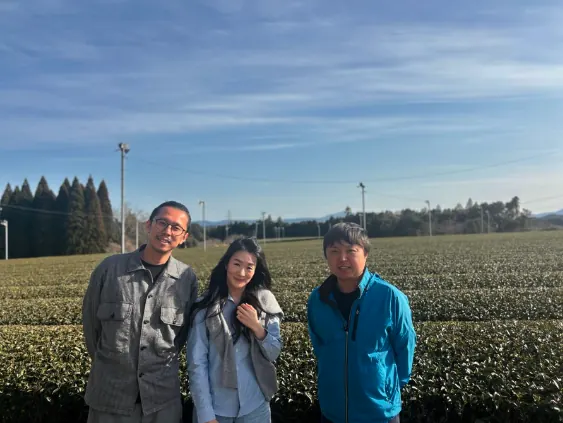
Request samples & pricingHiroshi Asami is the founder of Japanomars, exporting single-origin Japanese matcha directly from farms in Kyoto (Uji and Joyo), Sayama, Ibi, Ureshino, Yame, Kirishima, and Chiran to specialty cafes across the US and Canada. He has led four sourcing tours bringing overseas cafe owners to Japanese tea farms.
Sources
%E7%99%BD_%E5%A4%A7%E3%81%8D%E3%81%84.png)