%E5%A4%A7%E3%81%8D%E3%81%84.png)
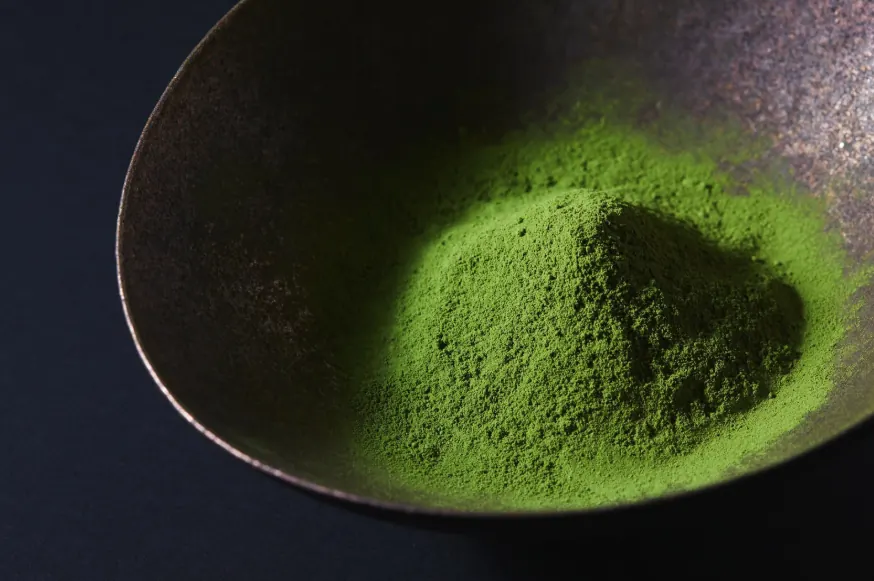
Japanese and Chinese matcha now look similar on a cafe shelf, but they come from two production systems that split apart roughly 600 years ago. Japanese matcha is made from shade-grown, de-stemmed tencha, stone-milled slowly; most Chinese matcha is made from open-grown leaf, machine-pulverized at industrial scale, and a Japanese government laboratory has measured the result as the difference between a sweet, toasty aroma and an earthy, soil-like one. For a US cafe owner in 2026, the practical question is not "which is better" but what you are actually buying, and how to prove it.
I'm Hiroshi Asami, and I source and export matcha directly from farmers across Japan through Japanomars. This guide answers that from the supply side, using Japanese-language data most English sources never cite.
Key takeaways
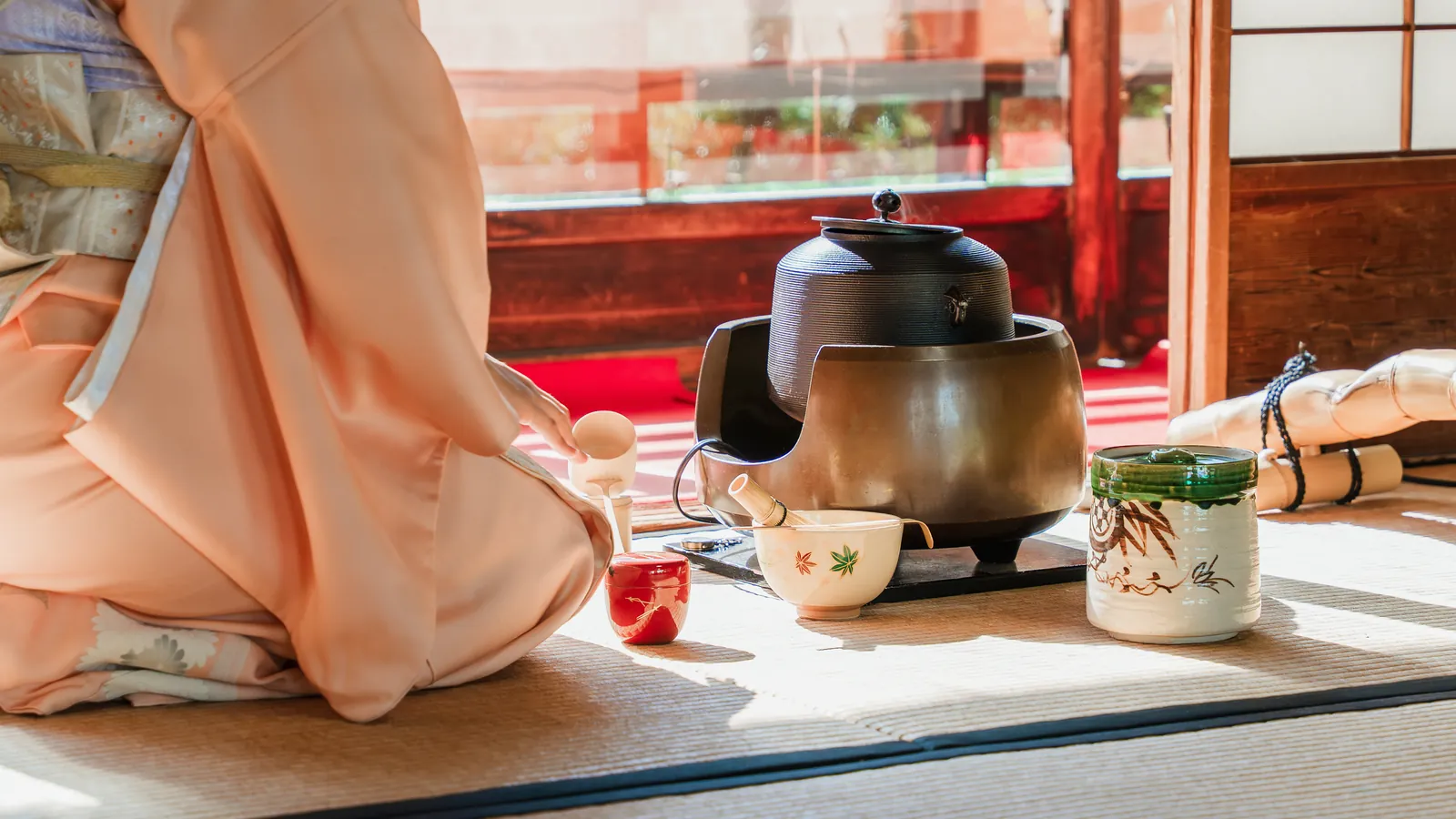
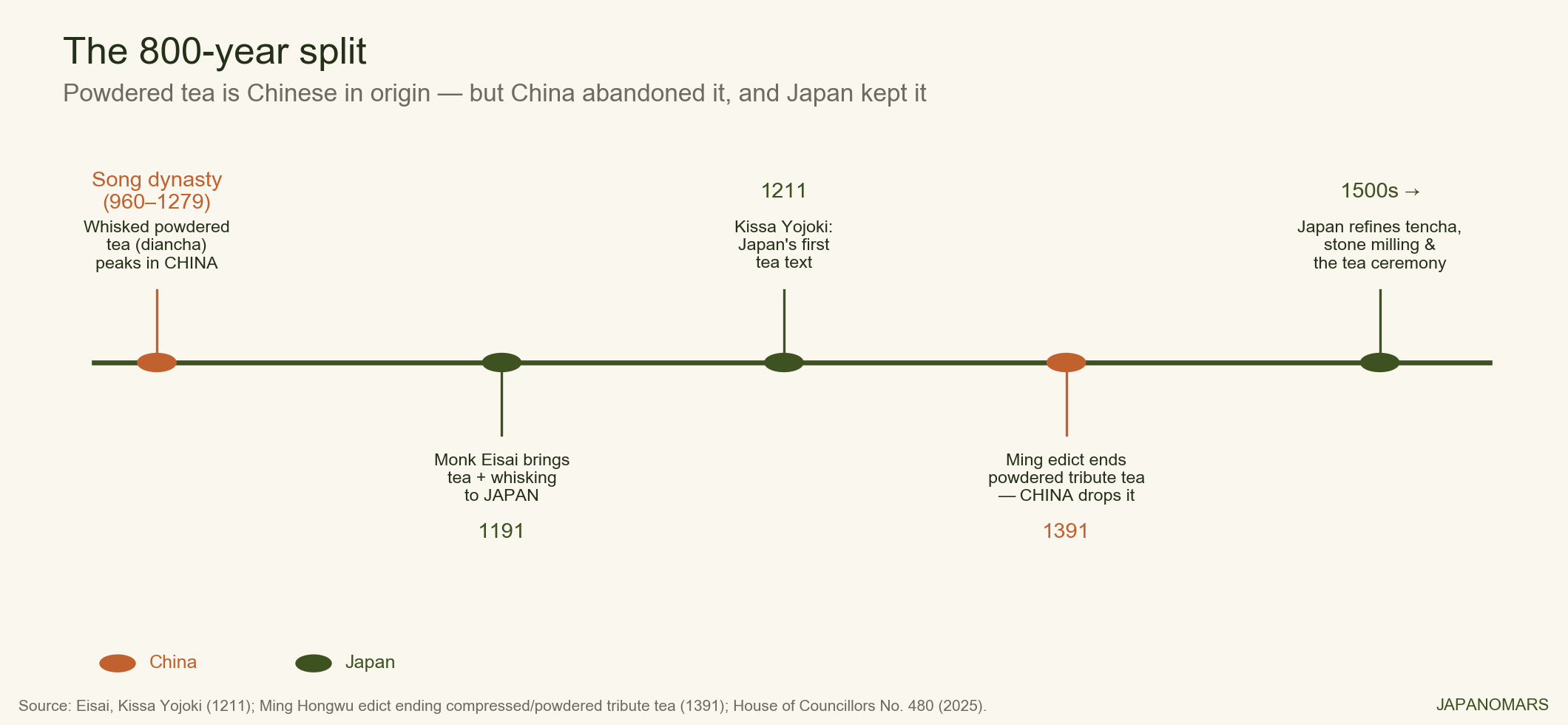
Powdered, whisked tea is originally Chinese, not Japanese. It peaked in China's Song dynasty (960 to 1279) as diancha, tea ground to powder and whisked, then was effectively banned out of existence in 1391, when the Ming founding emperor Hongwu abolished compressed and powdered tribute tea and pushed China toward loose-leaf steeping. Japan, which had imported the practice, kept it and spent 600 years turning it into something China no longer made.
The bridge was a Zen monk. Eisai (1141 to 1215) returned from Song-dynasty China in 1191 with tea seeds and the whisked-tea method, and his Kissa Yojoki ("Drink Tea, Stay Healthy," 1211) is Japan's first text on tea cultivation and use. Over the following centuries Japan developed shade-growing, the de-stemmed tencha leaf, and stone milling, and wrapped it in culture: the tea ceremony (chado) codified by Sen no Rikyu around the principles of wa-kei-sei-jaku (harmony, respect, purity, tranquility).
Why this matters commercially: Japan's House of Councillors research office (Rippo to Chosa, No. 480, December 2025) makes the point explicitly, that culture is the part competitors cannot copy. Chinese tea culture evolved as a literati pastime that prized individuality and changed with the times, so the formal, codified matcha tradition did not survive there; Japan's did. When you sell Japanese matcha, you are selling the only place on earth where this 800-year line was never broken, and, as our guide to Japan's matcha regions shows, a specific place within it.
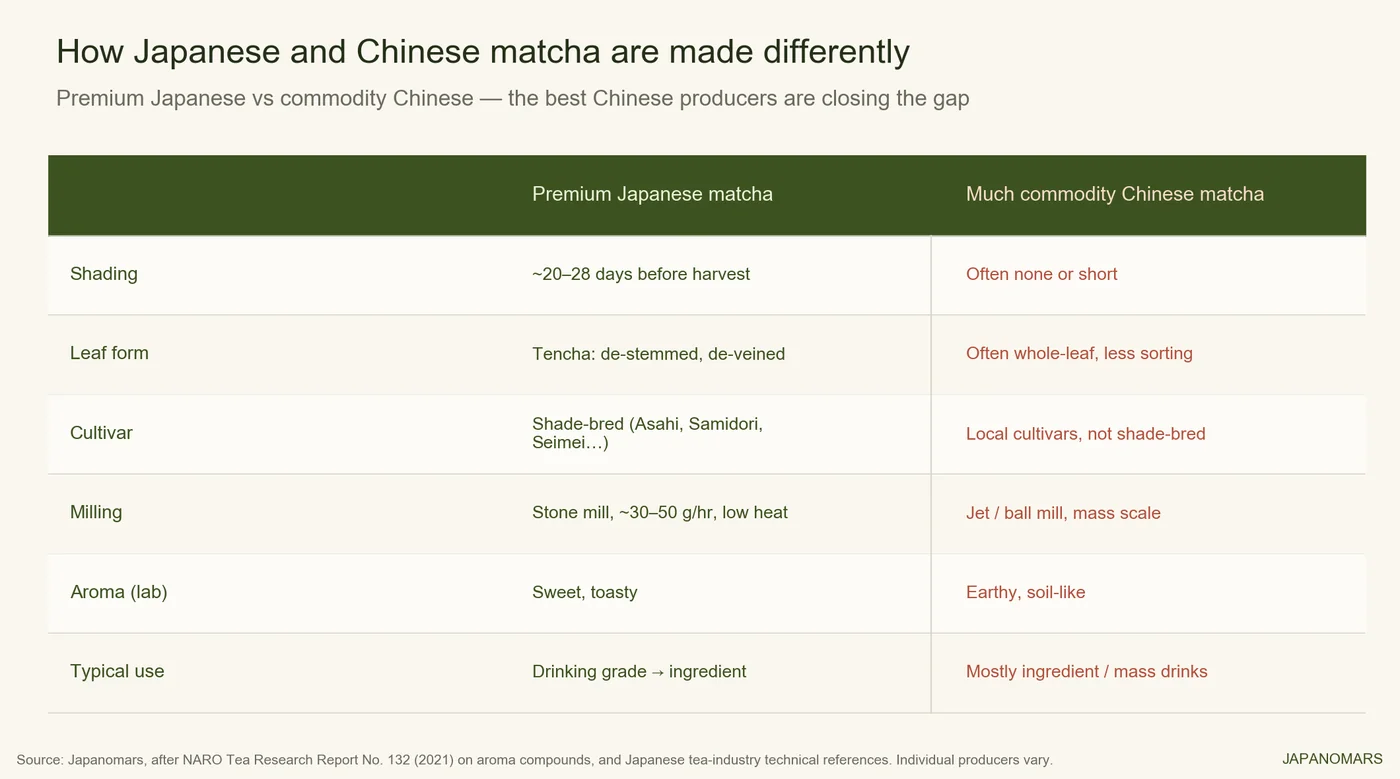
The difference is built in at three stages: how the leaf is grown, how it is processed, and how it is milled. Japanese matcha is made from leaf shaded for about 20 to 28 days before harvest, then steamed, de-stemmed and de-veined into tencha, and stone-milled slowly. A large share of Chinese matcha is grown in open sun or shaded briefly, processed without the same de-stemming, and machine-pulverized for volume. Each step changes color, texture, and, measurably, aroma.
A fair caveat before the specifics: these are tendencies, not laws. Japan also makes simple culinary grades, and a growing number of Chinese producers now shade and stone-mill to Japanese standards. The comparison below is the typical premium-Japanese vs typical commodity-Chinese bag in 2026, a buyer's mental model, not a verdict on either country.
Shading raises chlorophyll and L-theanine and suppresses bitter catechins, the source of matcha's vivid green, umami, and smoothness; skipping it is cheaper but yields a duller, more astringent powder (producers in Guizhou's Tongren and Hubei's Enshi are increasingly adopting Japanese-style shading). Cultivar matters too: Japanese tencha uses shade-bred cultivars like Asahi, Samidori, Goko, and Seimei, while even Japan's dominant Yabukita greens up poorly under cover, which is why Japan cannot convert fields overnight. Milling is the most visible gap: granite stone mills grind only about 30 to 50 grams an hour and stay cool, protecting aroma and color, while industrial jet and ball mills pulverize at mass scale but rely on impact and more heat.
From the sourcing floor
The quality gap is not just marketing. A study by a researcher at Japan's NARO (National Agriculture and Food Research Organization) on the aroma compounds that distinguish matcha found Japanese matcha reads as sweet and toasty, while foreign-grown matcha carries an earthy, soil-like note (Tea Research Report No. 132, 2021). When we set a premium Uji tencha next to a commodity Chinese powder for cafe owners on our sourcing tours, that toasty-versus-earthy split is the first thing they notice, before we say a word about origin.
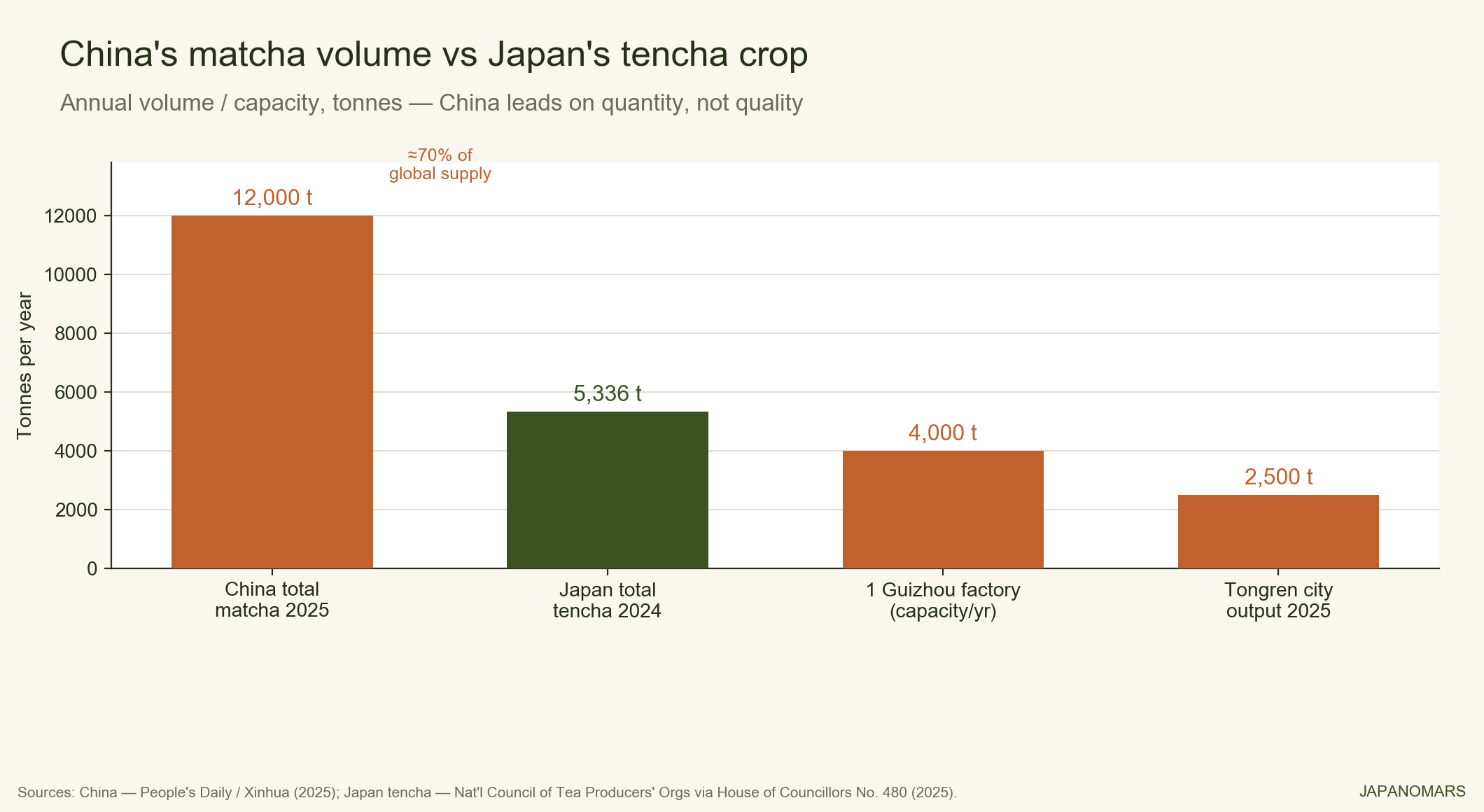
Bigger than most cafe owners realize: China is now the world's largest matcha producer by volume. Chinese state media (People's Daily, Xinhua) report national matcha output above 12,000 tonnes in 2025, roughly 70% of global supply. The center of gravity is Tongren, in Guizhou province, which calls itself "China's matcha capital"; one local group built what it bills as the world's largest matcha factory, 4,000 t/year capacity, in 2017, using Japanese experts and equipment.
The growth rate is the headline. Tongren's full-year matcha output hit 2,500 tonnes in 2025, with exports of 1,300 tonnes, up roughly threefold year on year, shipping to 50-plus countries including the US. For scale: Japan's entire tencha crop was 5,336 tonnes in 2024, so Tongren alone is targeting volume equal to about 40% of all Japanese tencha, from one Chinese city.
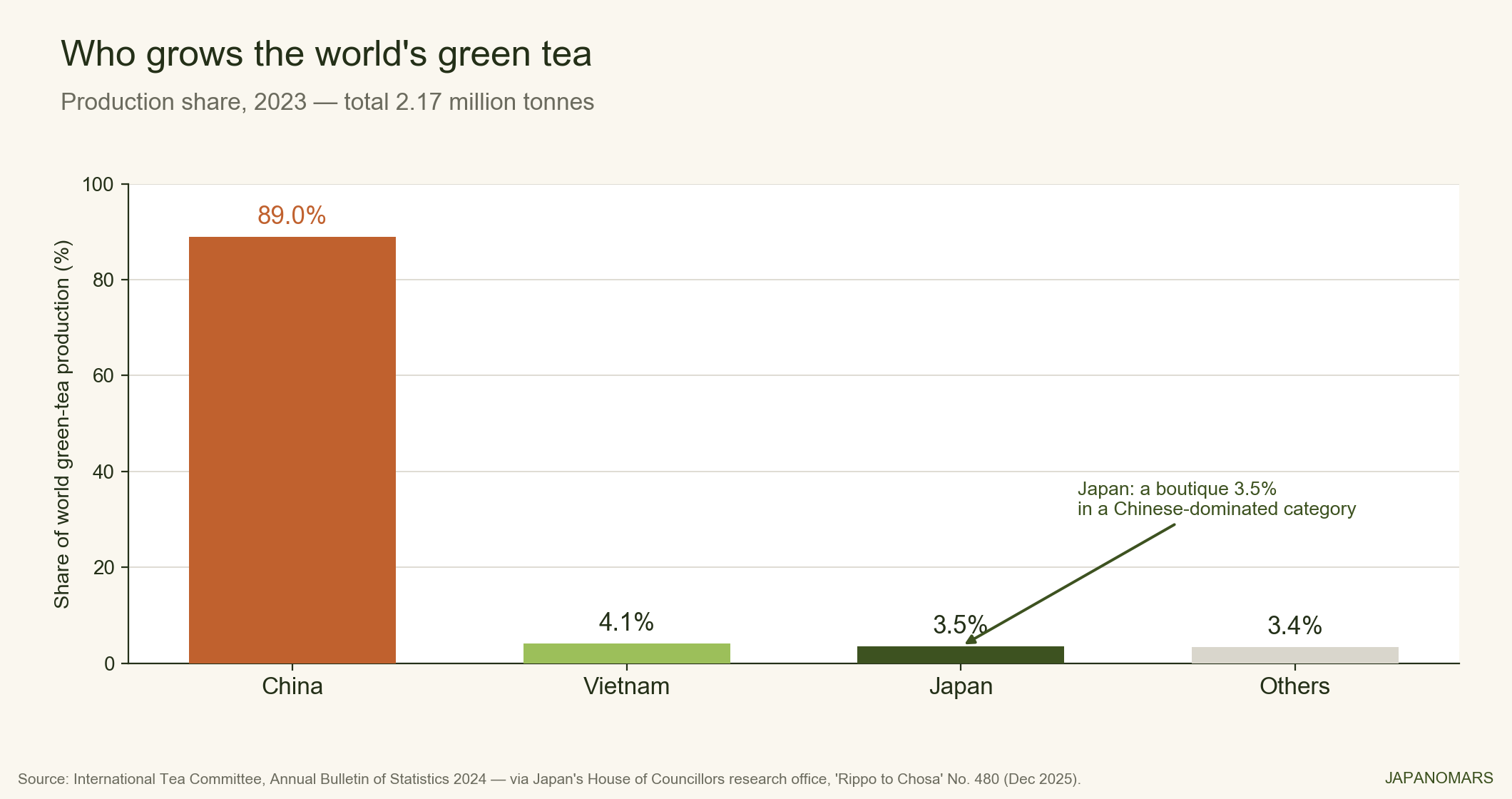
Step back to the whole green-tea picture and the asymmetry is stark. Of 2.17 million tonnes of green tea produced worldwide in 2023, China was 89.0%, Vietnam 4.1%, and Japan just 3.5% (International Tea Committee, 2024). On exports, China is 80.2% of world volume; Japan, 2.0%. Japan is a boutique producer in a Chinese-dominated category, and matcha is the one corner where Japan's quality reputation still commands a large premium.
And it is worth being fair about what China has built, because this is not a knockoff story. Tongren went from almost no matcha to the world's largest single production base in under a decade, lifted incomes for roughly 110,000 tea farmers, and got there by seriously importing Japanese cultivation and milling know-how. For high-volume uses (lattes, baking, ready-to-drink), well-made Chinese matcha is a legitimate, rational choice, and the best Chinese producers narrow the gap every season. So the honest dividing line in 2026 is not "Japan good, China bad." Both countries make a range. The useful question for a cafe is narrower: what specific product is in the tin, and can anyone prove where it came from?
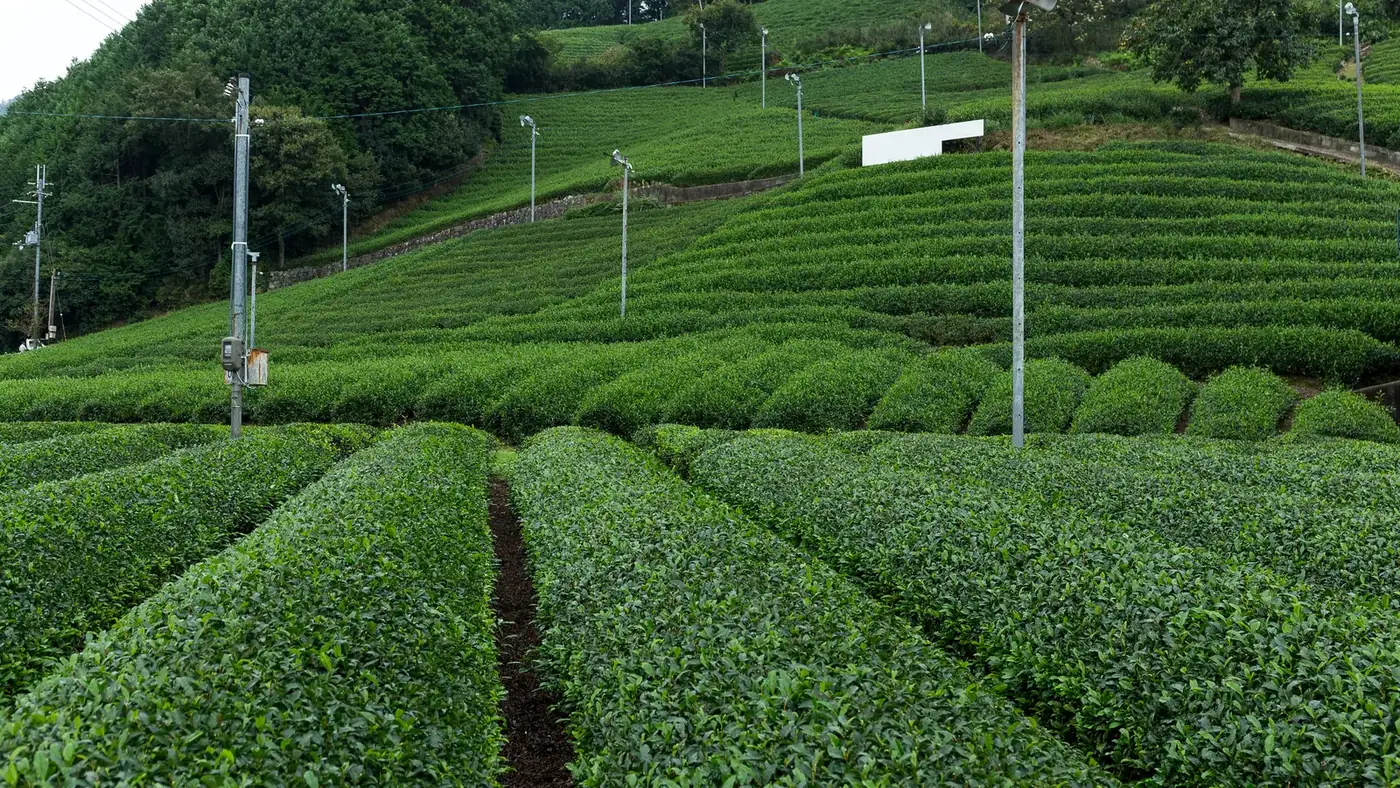
Because matcha supply is structurally slow to expand, for reasons that have nothing to do with willingness and everything to do with land, equipment, and people. Tencha is still only 7.3% of Japan's total tea crop, and even after rising about 2.7x in a decade, it is bottlenecked at every stage: fields, furnaces, mills, and farmers.
That is the supply side of the same shortage your cafe feels at the order desk. We cover the math in The Matcha Market in 2026, and the sourcing playbook in How to Source Japanese Matcha During the Shortage.
Probably not on quality, but possibly by default, and that is the part a cafe owner should plan around. When Japan's agriculture ministry interviewed exporters and producers, the consensus was that Japanese tea is differentiated enough on quality that a wholesale shift to Chinese matcha is unlikely. The risk is subtler: if Japanese supply stays short, buyers around the world get used to reliably-available Chinese matcha, and Japan's quality edge stops translating into orders. Reliability can quietly beat quality.
Two further risks are worth knowing because they affect what "Japanese matcha" will mean to your customers. First, cultivar leakage: Japan's research office warns about premium tea seedlings leaking abroad, the way Shine Muscat grapes did, after which cheaper foreign-grown versions flooded export markets and Japan lost the brand. Second, counterfeits and the "ingredient" trap: Japanese matcha is already being resold at inflated prices and faked on overseas marketplaces, and as matcha becomes a mass ingredient there is pressure to price it like a commodity input rather than a premium product.
What it means for your cafe: matcha is splitting into two tiers. There is a high-volume commodity tier (cheaper, machine-milled, increasingly Chinese but not only Chinese) and a provenance tier (shade-grown, single-origin, stone-milled, with a verifiable story). Neither is "wrong"; a high-throughput drive-thru and a third-wave bar may rightly choose differently. The risk is not picking the commodity tier, it is not knowing which tier you are buying. The cafes that win in 2026 pick a tier on purpose and can prove which one they are in.
Origin is the whole question here, and in 2026 Japan gave buyers a new official tool for it by registering "Japanese Tea" as a Geographical Indication: genuinely Japanese tea has to be grown, processed, and packed in Japan, which is exactly the line that separates it from relabeled Chinese powder.
You do not need a lab. You need to ask the questions a commodity supplier cannot answer cleanly:
It depends on the definition. There is no binding international legal standard for "matcha," so powdered green tea from China is often sold as matcha. But by the traditional Japanese definition (shade-grown, de-stemmed tencha, stone-milled) much Chinese matcha differs in growing and milling, which shows up as a coarser texture and a more earthy aroma. Some Chinese producers now use Japanese methods and narrow the gap.
Yes, usually substantially. China grows at scale on large terraces, often without lengthy shading, and mills with industrial jet or ball mills instead of slow stone mills (about 30 to 50 g/hour). That lowers cost dramatically. Japanese premium matcha carries the cost of shading, de-stemming, shade-bred cultivars, and stone milling, which is also why its export unit price runs about 2.2x other green tea.
By volume, yes. Chinese state media report 2025 output above 12,000 tonnes (roughly 70% of global), and one Guizhou factory alone has 4,000 t/year capacity. Japan's total tencha crop was 5,336 tonnes in 2024. Japan leads on premium drinking-grade quality and reputation, not on raw volume.
Powdered, whisked tea originated in China (Tang and Song dynasties) and reached Japan around 1191 via the monk Eisai. China later abandoned it (a 1391 Ming imperial edict pushed the country to loose-leaf tea) while Japan kept and refined it into the tea ceremony. So matcha is Chinese in origin but Japanese in development and survival.
Not directly; Chinese competition pressures the commodity end. Japanese matcha prices are rising because of its own structural shortage (limited tencha acreage, roughly 5-year replant lag, few processing facilities, aging farmers) against booming demand. Chinese supply may absorb some commodity demand, but it does not relieve the squeeze on premium Japanese matcha.
Buy from a supply chain that can name the region, the farm or cooperative, the cultivar, and the harvest, and ideally provide origin documentation. Single-origin, farmer-traceable matcha is hard to counterfeit. Vague "ceremonial grade, made in Asia" claims at commodity prices are the warning sign.
China has won the volume war (about 70% of global supply, factories in the thousands of tonnes, exports tripling) and earned it. But matcha's reputation was built on things volume cannot manufacture, and those are Japan's durable edge. There are five, and each is only worth something to your cafe if your supplier can actually name and prove it: a production system refined over centuries (shade-grown tencha, de-stemmed, slow stone-milled, different enough that a NARO lab can still measure it in the cup); cultivars bred specifically for matcha, not repurposed commodity bushes; named terroir (Uji, Yame, Kirishima and dozens more, like wine appellations); an unbroken 800-year culture; and traceability, the ability to say exactly whose leaf this is.
That is how we built Japanomars. We source only shade-grown, tencha-based, stone-milled matcha from specific regions (Sayama, Ibi, Ureshino, Yame, Kirishima, Chiran), never an anonymous blend; we can name the cultivar and the farm; and we buy direct from the growers, having taken cafe owners to Japan to meet them four times. In a market filling up with anonymous, machine-milled powder, Japanese and Chinese alike, verifiable origin is the product.
If you want matcha your customers can be told a true story about, single-origin, farmer-traceable, shade-grown, stone-milled Japanese matcha, let's talk about samples and current first-harvest pricing. We work with cafes on long-term supply relationships, not one-off orders, which is also the surest way to hold allocation while Japanese supply stays tight.
Request samples & pricing%E7%99%BD_%E5%A4%A7%E3%81%8D%E3%81%84.png)