%E5%A4%A7%E3%81%8D%E3%81%84.png)
Origin & Authenticity · 2026
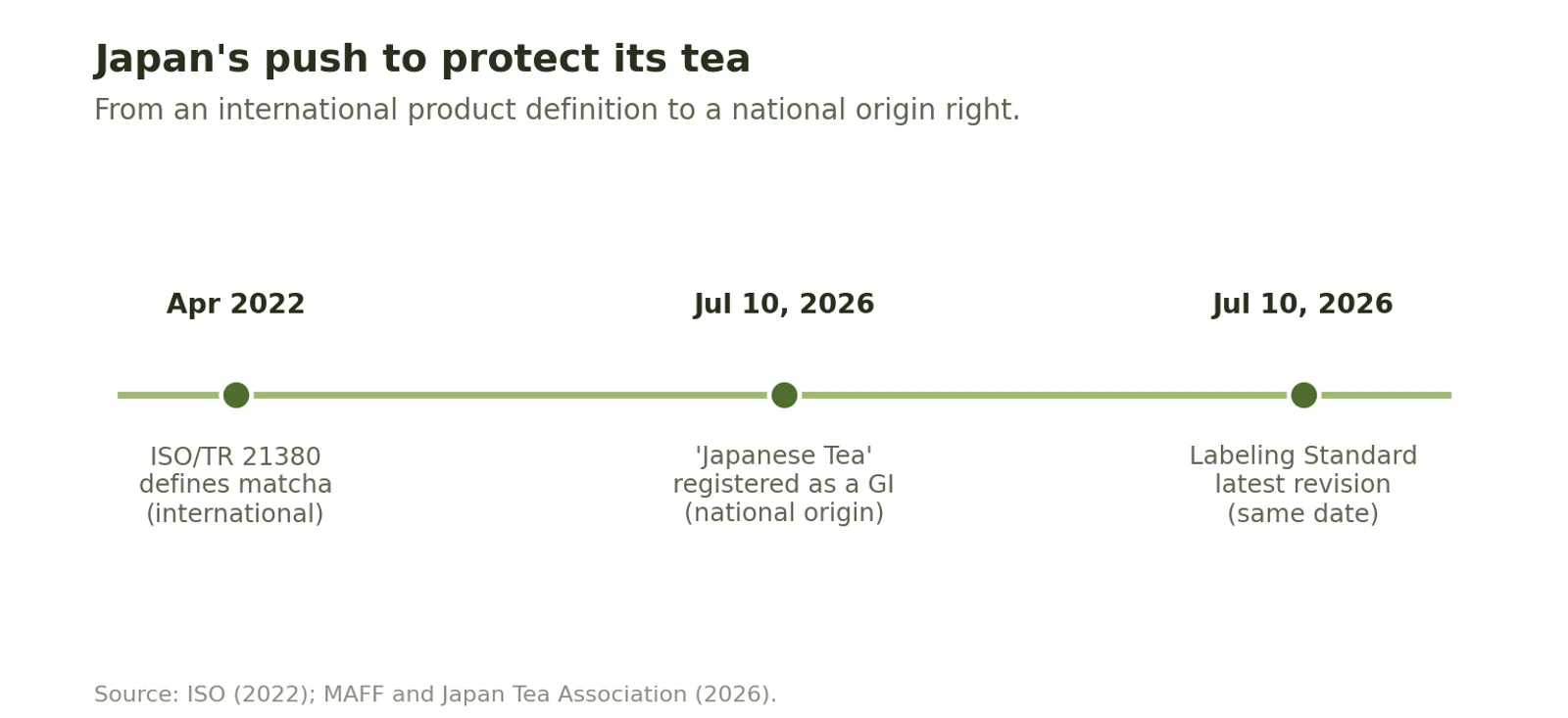
On July 10, 2026, Japan's Ministry of Agriculture (MAFF) registered "Japanese Tea" (日本茶) as a Geographical Indication, registration No. 179. It covers green, non-fermented tea made from Japanese leaves and processed in Japan, and it is the first product in MAFF's food GI system with no designated region. For a cafe buyer, the useful question is narrower than the headlines: what does this GI actually prove about the matcha you buy, and what does it not? Short answer: it is an official Japanese definition of origin, it is not a quality grade, the mark is not automatic, and today it has no legal force in the United States or Canada.
Key takeaways
In this guide
Japan's Ministry of Agriculture, Forestry and Fisheries registered "Japanese Tea" as a Geographical Indication on July 10, 2026. It is GI registration No. 179, and it brought the number of currently protected products in the national register to 170. The two numbers differ because some past registrations have been cancelled, so do not read No. 179 as "the 179th product" or 170 as its position in line. The registered producer group is the Japan Tea Association (Nihon Chagyo Chuokai). The registration names no specific production area: the whole country is the origin. But being genuinely Japanese green tea is not enough on its own. Only producers who register through the Association and follow its production standard may carry the mark.
That "no region" design is what makes this unusual. Almost every GI, in Japan and abroad, is tied to one place: Yame gyokuro, Champagne, Parma ham. According to Jiji Press, "Japanese Tea" is the first product under MAFF's food and farm GI system with no designated production area, so that all domestically produced green tea can qualify. (Japanese sake has a similar nationwide GI, but that sits under the National Tax Agency, not the agriculture ministry.) It was registered alongside two conventional regional products, Hamanako eel and Kaga lotus root.
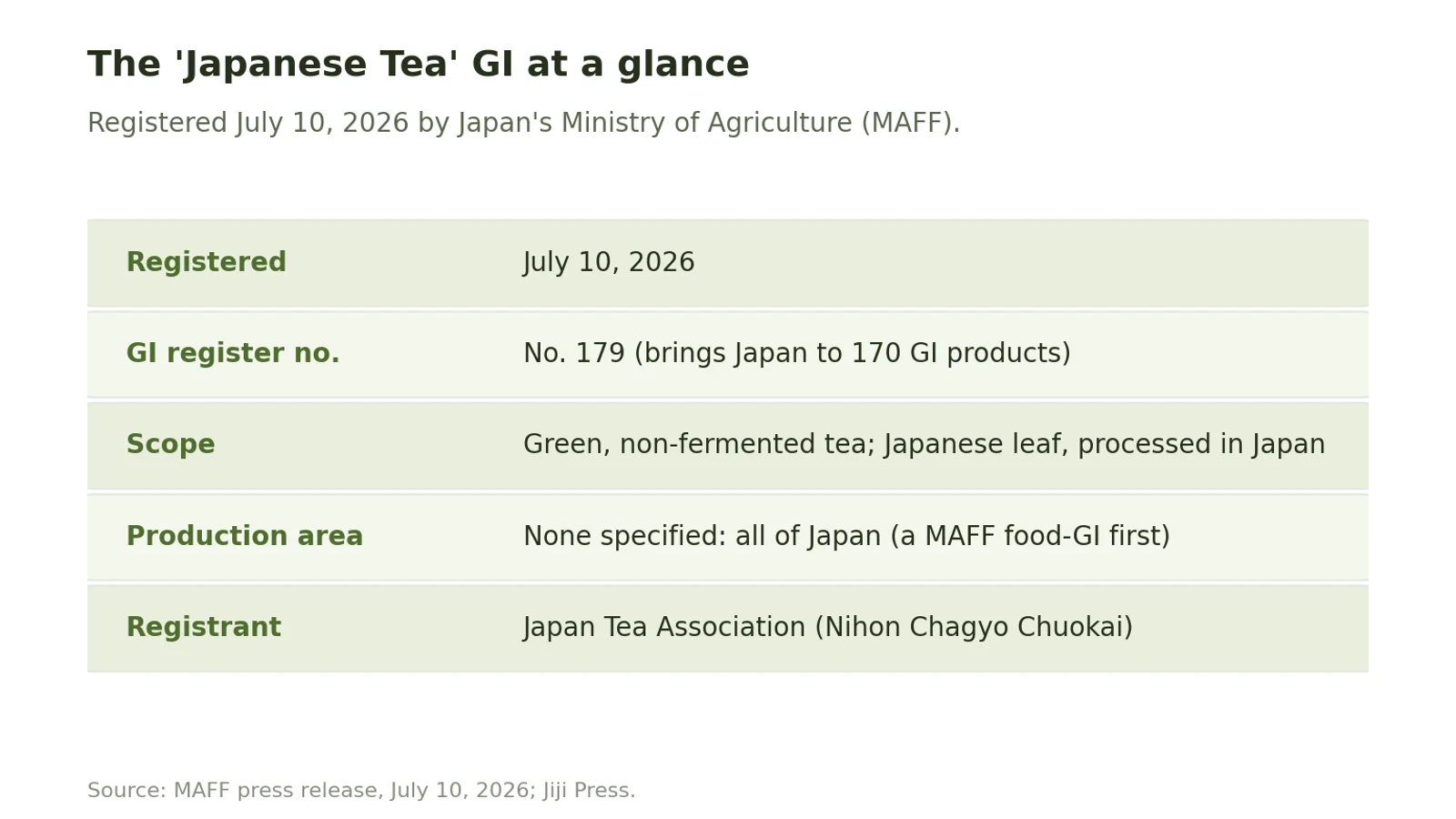

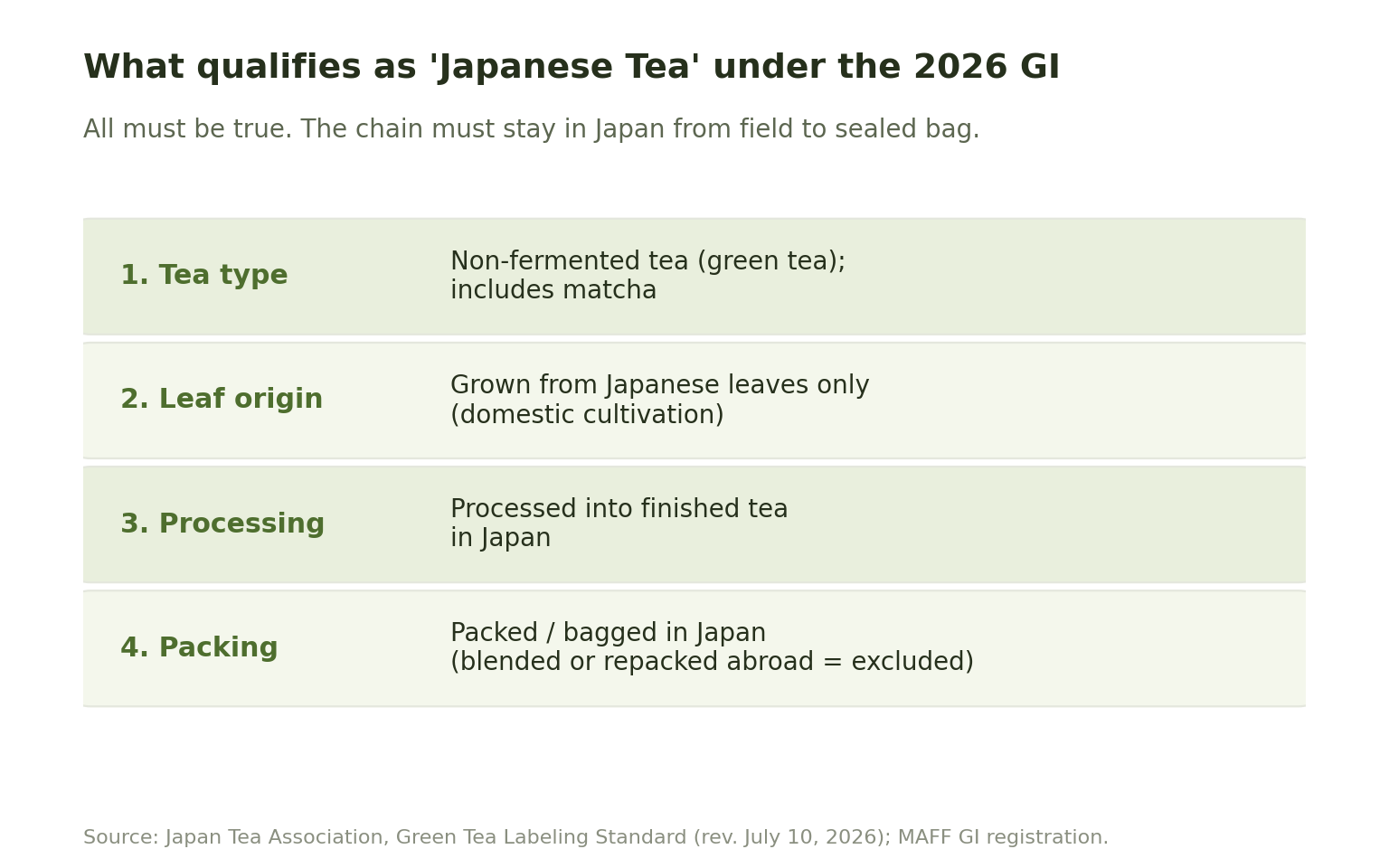
Under the GI, "Japanese Tea" is non-fermented tea (green tea) made only from tea leaves grown in Japan and processed in Japan. The Japan Tea Association, which controls the mark, adds one more condition for anyone who wants to put the GI logo on a package: the tea must be processed and bagged (袋詰め) in Japan. Products that use Japanese-origin leaf or powder but are blended or repacked abroad cannot carry the mark. Being domestic green tea only makes a product eligible. To display the mark, the producer must follow the registered production standard and file to use it through the Association.
These rules sit in the Japan Tea Association's own Green Tea Labeling Standard, whose latest revision is dated the same day, July 10, 2026. Section 3 of its implementing rules defines the GI target as non-fermented tea made from domestic leaves only, with processing through bagging completed in Japan. A related "made with Japanese tea" category covers tea drinks, instant tea, genmaicha and blends made only from Japanese tea. Black tea and oolong made in Japan are not covered at all, because the GI is limited to non-fermented tea.
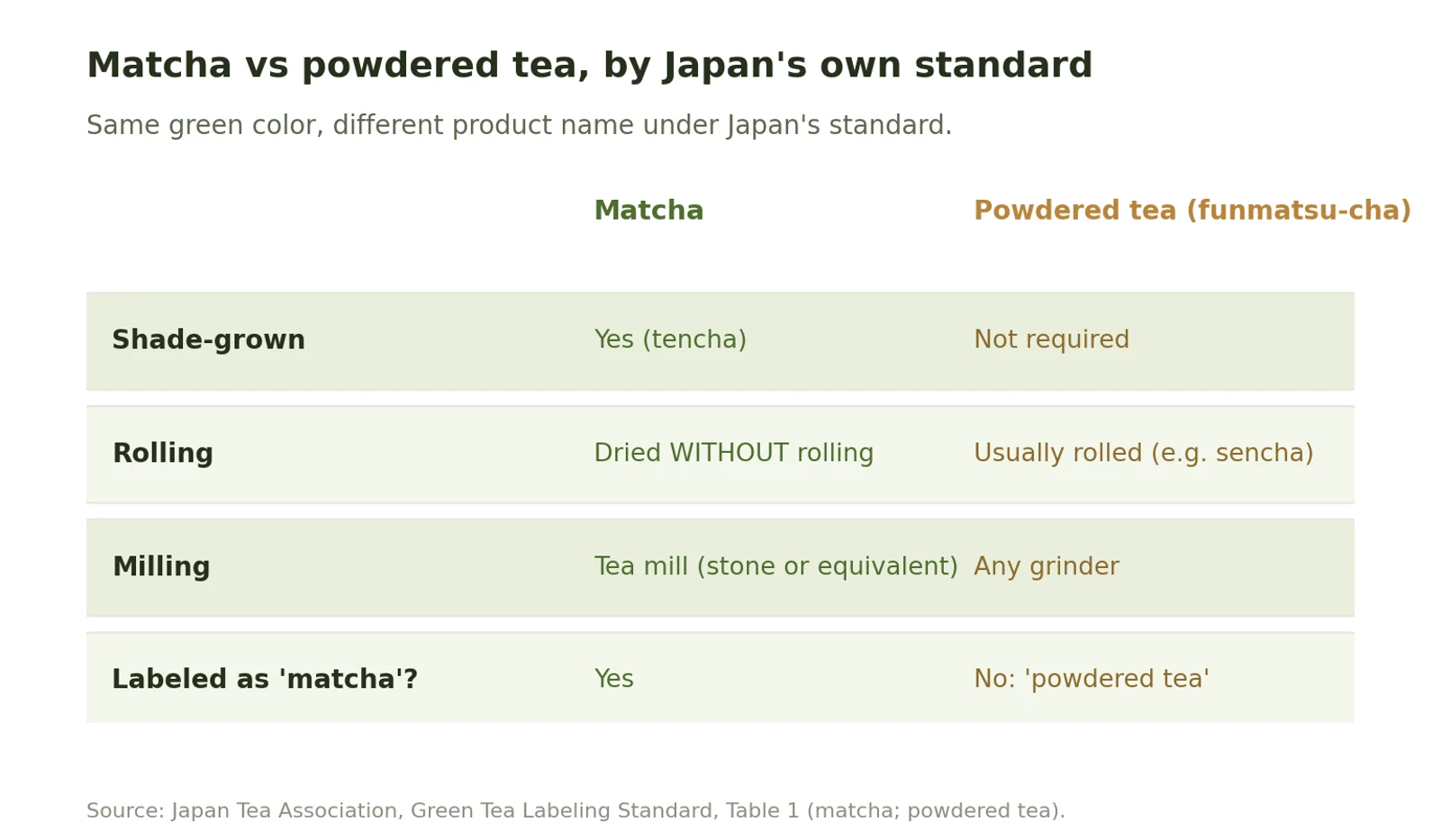
The GI covers Japanese green tea as a whole, not matcha specifically. Matcha's definition lives in the same Green Tea Labeling Standard, in its Table 1. There, matcha is tencha ground into a fine powder with a tea mill (茶臼等). Tencha is leaf from a covered tea field, shaded for roughly two to three weeks, then steamed and dried without rolling. Ordinary "powdered tea" (funmatsu-cha) is any tea reduced to powder with a grinder, and it is a separate name from matcha.
One detail matters for buyers who have been told matcha must be stone-ground. A note to Table 1 says the tea mill category includes equipment with a function equivalent to a stone mill, whatever the grinding method. So the Japanese standard does not require granite stones. What it requires is the leaf: shade-grown, unrolled tencha. A green powder made from rolled sencha fails the definition no matter how it is milled. The international ISO/TR 21380:2022 description takes a similar line and is a technical report, not a binding rule. For how the two documents compare, see what counts as real matcha, and for the terms themselves, the matcha glossary.
A GI is a mark of origin, not a quality grade. It tells you the tea is Japanese; it does not certify that a powder is "ceremonial" or bar-ready. "Ceremonial grade" is a marketing term. Japan's labeling standard goes further and prohibits unsupported superlatives such as "finest" or "special" on tea sold in Japan. Keep judging quality on leaf, process and taste. Our matcha grades explained guide covers what those tiers really mean for price.
No. Japan's GI Act is a domestic law, so registration by itself has no legal effect in the United States, Canada, the Philippines or most other markets. A Japanese GI is protected abroad only where Japan has a mutual GI protection agreement, and today that means two partners: the European Union, under the Japan-EU Economic Partnership Agreement, and the United Kingdom, under the Japan-UK agreement. Japan is not a member of the Lisbon system for appellations of origin, so there is no multilateral route either.
Even in Europe, protection is not automatic. Each Japanese GI has to be added to the partner's list in a separate process after domestic registration. MAFF's list of Japanese GIs protected abroad (last updated March 19, 2026) does not include "Japanese Tea." The Japanese teas on those lists are Yame Traditional Hon-Gyokuro and Fukamushi Kikukawa-cha. Some Japanese trade press describes the new GI as leading to EU and UK protection; that may come, but it had not happened when we checked in September 2026. Japan has no GI agreement with China.
What this means in practice: in a US or Canadian cafe, the GI is a definition and origin signal, not a legal shield. It gives you an official Japanese answer to "what counts as Japanese tea" that you can hold a supplier to in your contract and your spec sheet. It does not stop a US seller from calling a non-Japanese powder "Japanese-style matcha." If a supplier tells you their tea is "GI-protected in the US," that claim is wrong.
No. None of Japan's 170 registered GI products is named Uji, Nishio or matcha. "Uji-cha" and "Uji matcha" are protected in Japan as regional collective trademarks held by the Kyoto Prefecture Tea Cooperative (Uji matcha: trademark No. 6226519, registered 2020). A trademark of this kind has effect in Japan only. A separate application for "Traditional Uji Tencha" as a GI was filed in 2023 and was still pending as of July 2026.
It also helps to know what the name covers. According to the Kyoto Prefecture tea industry body, Uji tea is tea grown in Kyoto, Nara, Shiga and Mie and finished by Kyoto businesses within Kyoto Prefecture, with Kyoto-grown leaf given priority. So "Uji matcha" is a regional brand with a defined meaning, not a promise that every leaf was grown in Uji city. None of this makes Uji matcha less good; much of the best tencha in Japan comes from southern Kyoto. It simply means that if you care about the exact growing area, ask for it by name. The new national GI sits underneath all of these regional names: any of them can also qualify as "Japanese Tea" if the producer registers for the mark.
Japan registered the GI now because the matcha boom has made the name "Japanese tea" valuable enough to copy. Green tea exports reached about ¥72.1 billion (roughly $480 million) in 2025, up from ¥36.4 billion in 2024, according to Ministry of Finance trade statistics. In 2024, powdered tea, which includes matcha, made up about three quarters of export value, and the US took 44%, the largest share of any country. Where demand and prices spike, imitations follow.
The imitation problem is documented. Kyoto Prefecture counted 163 trademarks registered or pending in China in the tea class alone using "Uji" names, as of September 2019, with about 3,000 across all classes. Only 22 of the 163 were filed by Japanese companies. MAFF's July 2026 international standards strategy warns that if Japan does not stay involved in defining matcha, it could lose the free use of the name in international markets. The GI is Japan's domestic answer: a clear national definition of what "Japanese Tea" means, and a mark that only compliant producers can use. Turning that into protection abroad is the slower, country-by-country step described above. For how Japanese and Chinese matcha differ in practice, see Japanese vs Chinese matcha.
From the sourcing floor
The growers we buy from in Kyoto (Uji and Joyo), Kagoshima, Yame and our other regions already work the way the GI describes: Japanese leaf, processed in Japan. For them the GI is not a new hurdle; it is their normal process written into a national standard. The mark itself is a separate step, and none of the growers we work with has registered for it yet, so we ask for the origin on paper rather than for the logo.
For a US cafe, the GI is a sourcing signal, not a certification you need to buy. It gives you a clean, official line for your menu and your customers: tea grown and processed in Japan versus powder that only borrows the name. It also sharpens the questions you ask a supplier, because "made in Japan" and "packed in the USA from imported tea" are now meaningfully different claims under Japan's own rules.
Three things follow. First, provenance is a stronger menu line: "Japanese matcha, grown and processed in Japan" now matches a national definition, not just your word. Second, blends and repacks are easier to question, because a product bagged outside Japan cannot carry the Japanese Tea mark. Third, short supply chains are easier to verify, since the fewer hands between the field and your bar, the easier it is to confirm where each step happened. Our guide on farm-direct versus trading-company sourcing walks through how those chains differ.
What the GI does not do matters just as much. It does not tell you which farm, which harvest, or which grade you are getting. Two tins that both qualify as "Japanese Tea" can differ widely in price and in how they taste in a latte. Use the GI to rule suppliers out, not to pick the winner. For the customs side of bringing Japanese tea into the US, including country-of-origin labeling, see importing matcha into the US.
You can confirm the GI criteria with a few supplier questions and a look at the documents. The test is whether the tea was grown and processed in Japan, where it was bagged, and whether the supplier can show it. Genuine Japanese suppliers answer these quickly; vague or defensive answers are the signal to walk.
Ask for, and check:
For a structured version, our guide on how to find and vet a Japanese matcha wholesale supplier turns these into a repeatable process. Run every new supplier through the same list and keep the answers on file.
Not specifically. The July 2026 GI covers "Japanese Tea," meaning non-fermented (green) tea from Japanese leaves processed in Japan, which includes matcha but is not matcha-only. Matcha's own definition, tencha ground to fine powder in a tea mill, lives in Japan's Green Tea Labeling Standard.
No. A GI certifies origin, not grade. It confirms the tea is Japanese; it does not certify that a powder is "ceremonial" or bar-ready, and it says nothing about the farm or the lot. Keep evaluating matcha on leaf, process and taste.
No. Japan's GI law is domestic. Japanese GIs are protected abroad only in the EU and the UK, through separate agreements, and as of September 2026 "Japanese Tea" had not been added to either list. In the US and Canada, treat it as an official origin definition, not a legal protection.
No. Being Japanese green tea makes a product eligible, not entitled. The producer must follow the registered production standard and file to use the mark through the Japan Tea Association. Eligible is not the same as marked.
No. The Japan Tea Association's rules for the mark require processing through bagging to be completed in Japan. Leaf or powder that is blended or bagged abroad cannot carry the mark, even if it started in Japan.
No. Japan's labeling standard defines matcha as tencha ground to fine powder in a tea mill, and notes that this includes equipment with a function equivalent to a stone mill, whatever the grinding method. The defining requirement is the leaf: shade-grown, unrolled tencha.
No. "Uji matcha" is a regional collective trademark held by the Kyoto Prefecture Tea Cooperative, with effect in Japan only. The name covers tea grown in Kyoto, Nara, Shiga and Mie and finished in Kyoto Prefecture. A GI application for "Traditional Uji Tencha" was still pending as of July 2026.
No. The GI is a sourcing signal, not a purchase requirement. You do not need a certificate to buy or serve Japanese matcha. Prefer suppliers who can show the tea was grown and processed in Japan, and treat that provenance as a menu asset.
Japan now has an official, national definition of what "Japanese Tea" means: green tea from Japanese leaves, processed in Japan, and for the mark, bagged in Japan. It does not grade your matcha, it does not name the farm, and it does not yet have legal force in the markets where most of our readers buy. What it does give a cafe buyer is a precise question set and a provenance standard you can write into a spec sheet. Use it to screen suppliers, then judge the tea itself.
We work directly with growers in Kyoto (Uji and Joyo), Kagoshima, Yame, Sayama and other regions of Japan. Every lot we ship is grown and processed in Japan, and we can tell you the prefecture and harvest for each lot. Tell us your menu and volume and we will send samples and pricing.
Request samples & pricingHiroshi Asami is the founder of Japanomars, which exports Japanese matcha sourced directly from growers to cafes in the US, Canada, and beyond, and has hosted cafe owners on farm visits to partner growers in Japan. This article draws on Japan's primary tea-industry and government documents, read in the original Japanese.
Sources
%E7%99%BD_%E5%A4%A7%E3%81%8D%E3%81%84.png)