%E5%A4%A7%E3%81%8D%E3%81%84.png)
Quality · Glossary · 2026
Nearly every matcha word a US cafe meets falls into one of two piles. Matcha, tencha, aracha, funmatsucha and ichibancha have written definitions in Japan's Green Tea Labeling Standard, last revised on July 10, 2026. Ceremonial grade, culinary grade and stone ground are defined in neither that standard nor the international report on matcha. Knowing which pile a word sits in tells you whether you can hold a supplier to it.
Key takeaways
This page is a working glossary rather than a dictionary. The terms are grouped by where you actually meet them: on a price list, on a spec sheet, in marketing copy, on the shipping paperwork, and behind your own bar. Where a term has a source, the source is named. Where it has none, that is said plainly, because that is the more useful fact.
In this guide
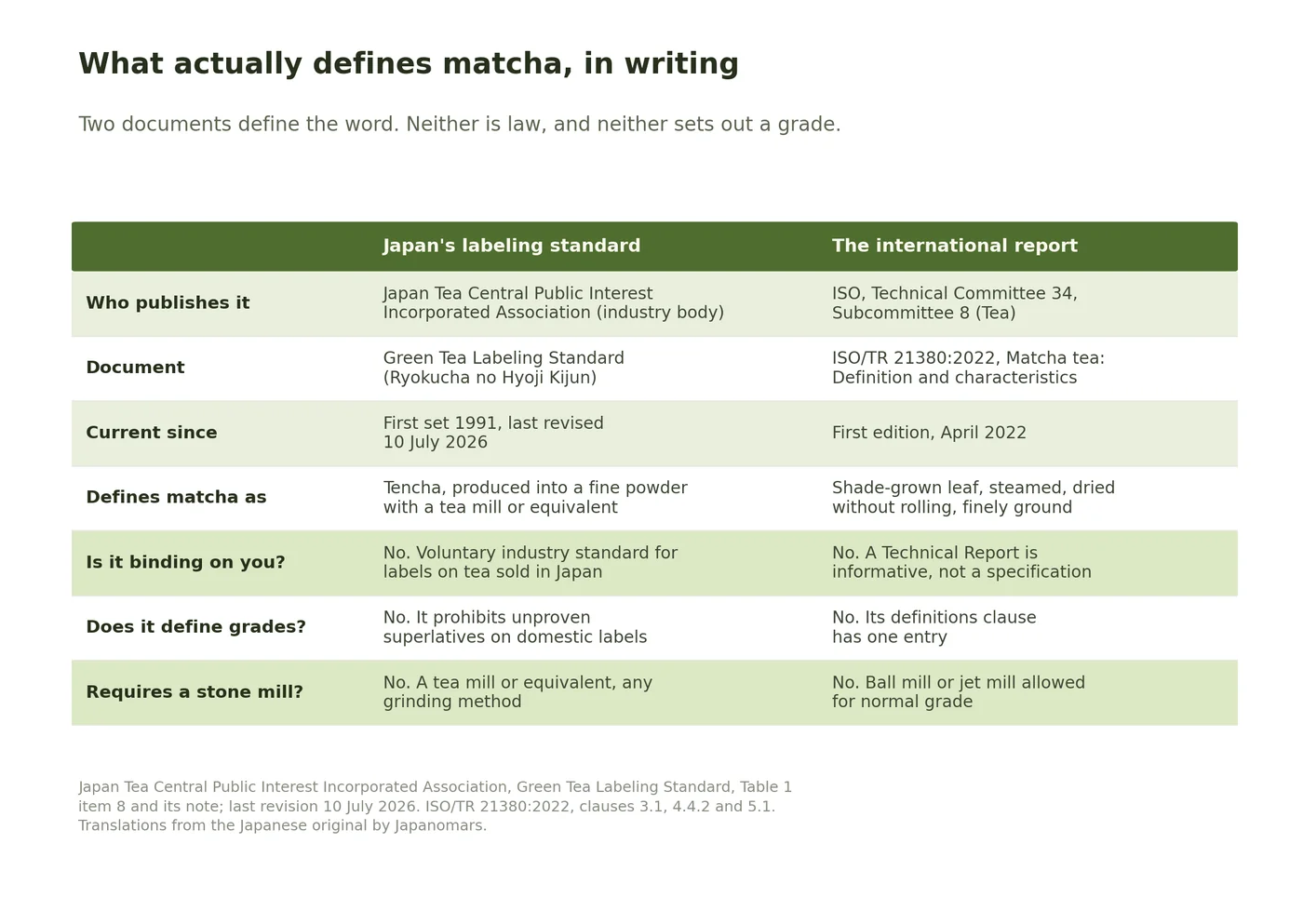
Two documents define matcha in writing. Japan's Green Tea Labeling Standard, published by the Japan Tea Central Public Interest Incorporated Association (Nihon Chagyo Chuokai) and last revised on July 10, 2026, names and defines seventeen kinds of green tea in its main table. ISO/TR 21380:2022 gives an internationally agreed definition. Neither is law, and neither defines a grade.
Japan's standard is a voluntary industry standard governing what may be printed on tea packaging sold in Japan. The ISO document is a Technical Report, which in ISO's own hierarchy is informative: it describes, it does not specify, and nobody can be certified against it. So neither gives an American buyer a compliance hook to pull.
What they do give you is shared vocabulary with a written meaning behind it. When you write tencha or funmatsucha in an email to a Japanese supplier, both of you can point at the same sentence. That is not true of ceremonial grade, and the gap between those two situations is what this page is organised around.
Worth noting for anyone tracking how fast this ground is moving: the International Matcha Association, founded in Tokyo in April 2026, states on its own About page that no internationally recognised standard for what qualifies as matcha currently exists, and lists writing definitions and a grading system as its first objective. Even the body set up to fix this says the standard is not written yet. Our guide to what counts as real matcha covers the authenticity argument in full.
A Japanese price list is organised by harvest and by processing stage, not by grade. Aracha is unfinished tea and shiage-cha is finished. Tencha is the leaf; matcha is what that leaf becomes after milling. Ichibancha is the first harvest of the year. Every one of these terms is defined in the standard.
| Term | Japanese | What it means | Why a buyer cares |
|---|---|---|---|
| Aracha | 荒茶 | Tea made from the leaf, before the finishing stage | An aracha price is not a finished price |
| Shiage-cha | 仕上げ茶 | Finished tea, made from aracha, ready to use | This is what you actually receive |
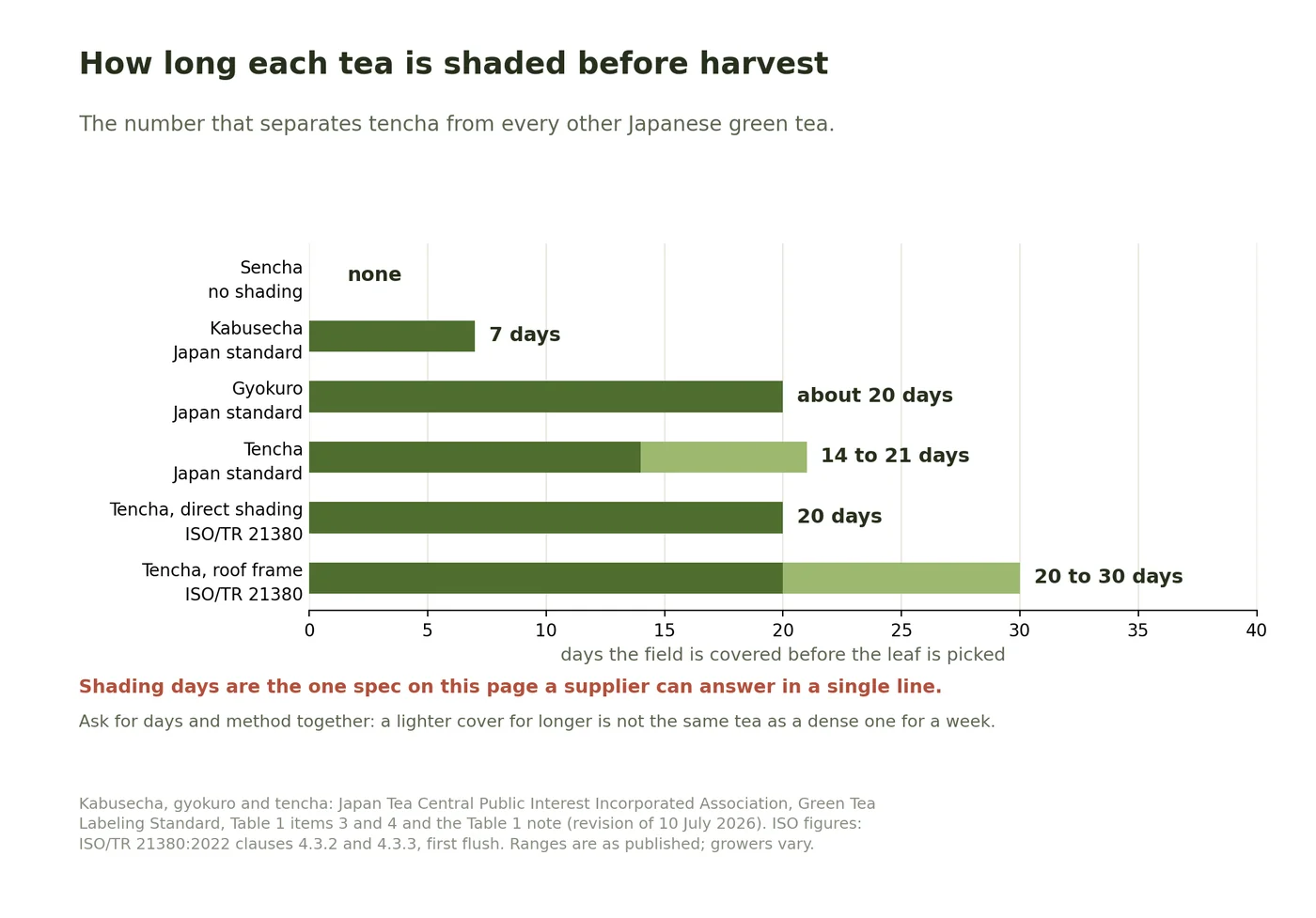
| Tencha | 碾茶 | Leaf shaded 2 to 3 weeks, steamed, dried without rolling | The only input the definition allows |
| Matcha | 抹茶 | Tencha milled to a fine powder with a tea mill or equivalent | The definition itself, in one line |
| Funmatsucha | 粉末茶 | Any tea put through a grinder | A separate named product, not matcha |
| Konacha | 粉茶 | Fine material sifted out while finishing leaf tea | The third powdery thing, and the cheapest |
| Ichibancha | 一番茶 | First harvest, by local custom in each municipality | No national date behind the word |
| Nibancha | 二番茶 | Second harvest of the season | Usually a step down in price and in umami |
| Shincha | 新茶 | Tea first produced in the spring of the current year | Improper labeling in Japan if used out of season |
| Kocha | 古茶 | Tea produced in a year before the current one | Romanizes almost identically to kocha, black tea |
| Mogacha | モガ茶 | Unrolled leaf understood as tencha for food processing | Sold as food-processing material, not ceremony tea |
Definitions translated from Table 1 and Table 2 of the Green Tea Labeling Standard, Japan Tea Central Public Interest Incorporated Association, revision of July 10, 2026. The mogacha entry is from the note attached to Table 1.
Three of those rows are a common source of confusion in this trade, and they sit next to each other in the same official table: matcha, funmatsucha and konacha. All three are green, all three are powdery, and only the first started life as shaded, unrolled tencha. If a quotation says funmatsucha, the supplier has told you exactly what it is. Our matcha versus green tea powder guide covers what that difference does in the cup.
A spec sheet answers how the tea was grown and processed, in numbers. The four that carry real information are shading days, particle size, mill type and harvest. Cultivar is optional under Japanese labeling rules, so a blank cultivar field means undeclared rather than unknown.
| Term | Japanese | What it means | The number or answer to ask for |
|---|---|---|---|
| Shading days and method | 被覆 | How long the field was covered, and with what | Days plus method: roof frame or direct |
| Chausu | 茶臼 | The mill. Defined as a stone mill or equivalent equipment | Stone, ceramic ball, or jet |
| Particle size | 粒度 | Fineness of the finished powder | Mean 10 to 30 microns, median under 20 |
| Tencha furnace | 碾茶炉 | Tunnel dryer with 3 to 5 stacked conveyor belts | Whether a brick furnace or a metal dryer |
| Hiire | 火入れ | The finishing fire applied to tea, at 70 to 130 degrees Celsius | Distinct from roasting, which starts at 140 |
| Cultivar | 品種 | The tea plant variety, such as Yabukita | Optional on Japanese labels, so ask directly |
| Certificate of analysis | 分析証明書 | Lab results for a specific lot | Whether it covers your lot or a typical value |
| JAS organic | 有機JAS | Three years with no synthetic agrochemicals or fertiliser | The certificate number and certifying body |
Shading, chausu, hiire, tencha furnace and JAS terms from the Green Tea Labeling Standard, revision of July 10, 2026, including its process classification annex and organic annex. Particle size and the furnace description from ISO/TR 21380:2022, clauses 4.4.1, 4.4.2 and 5.1.
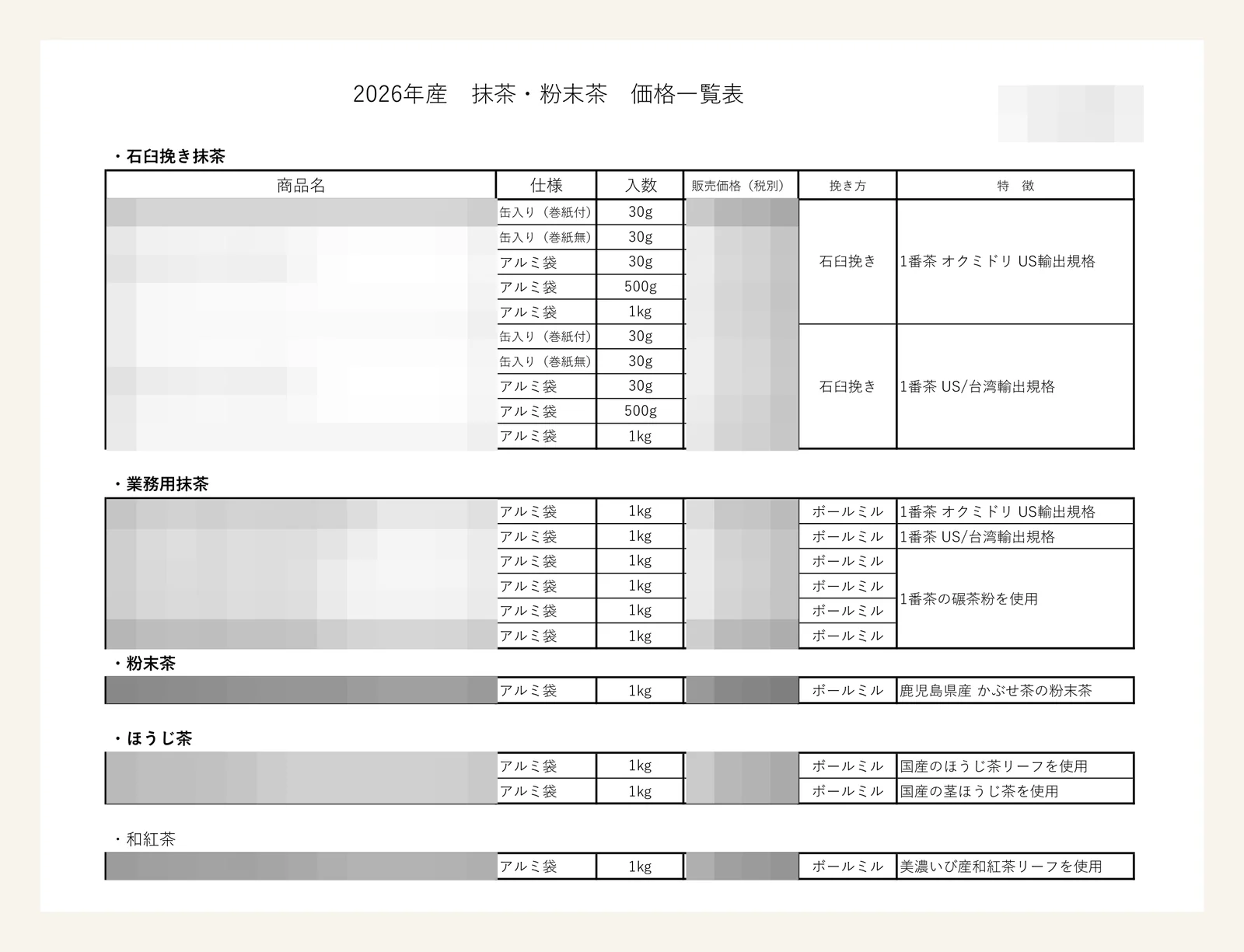
The chausu row is where a widely repeated claim falls apart. Japan's standard defines the tea mill as the stone mill used to powder tencha, and then says in the same note that the term also covers equipment of any grinding method with equivalent function. ISO/TR 21380 is blunter still: normal grade matcha can use a ceramic ball mill or a jet mill. Under both documents, matcha that was not stone ground is still matcha.
Neither defining document sets out grades. The terms and definitions clause of ISO/TR 21380 contains exactly one entry, matcha tea, and the table of tea names in Japan's standard contains no grade names at all. Japan's standard goes further: Article 3 of its implementing rules, headed prohibition of improper labeling, bars unsubstantiated superlatives such as finest, deluxe and special.
That is worth sitting with, because it is the exact register US matcha marketing runs on. The words the Japanese standard singles out translate to complete, highest, extra fine, specially selected, finest, deluxe and special, and it bars them where the claim has no objective basis. A Japanese producer cannot print on a domestic bag what an American reseller prints on the same tea.
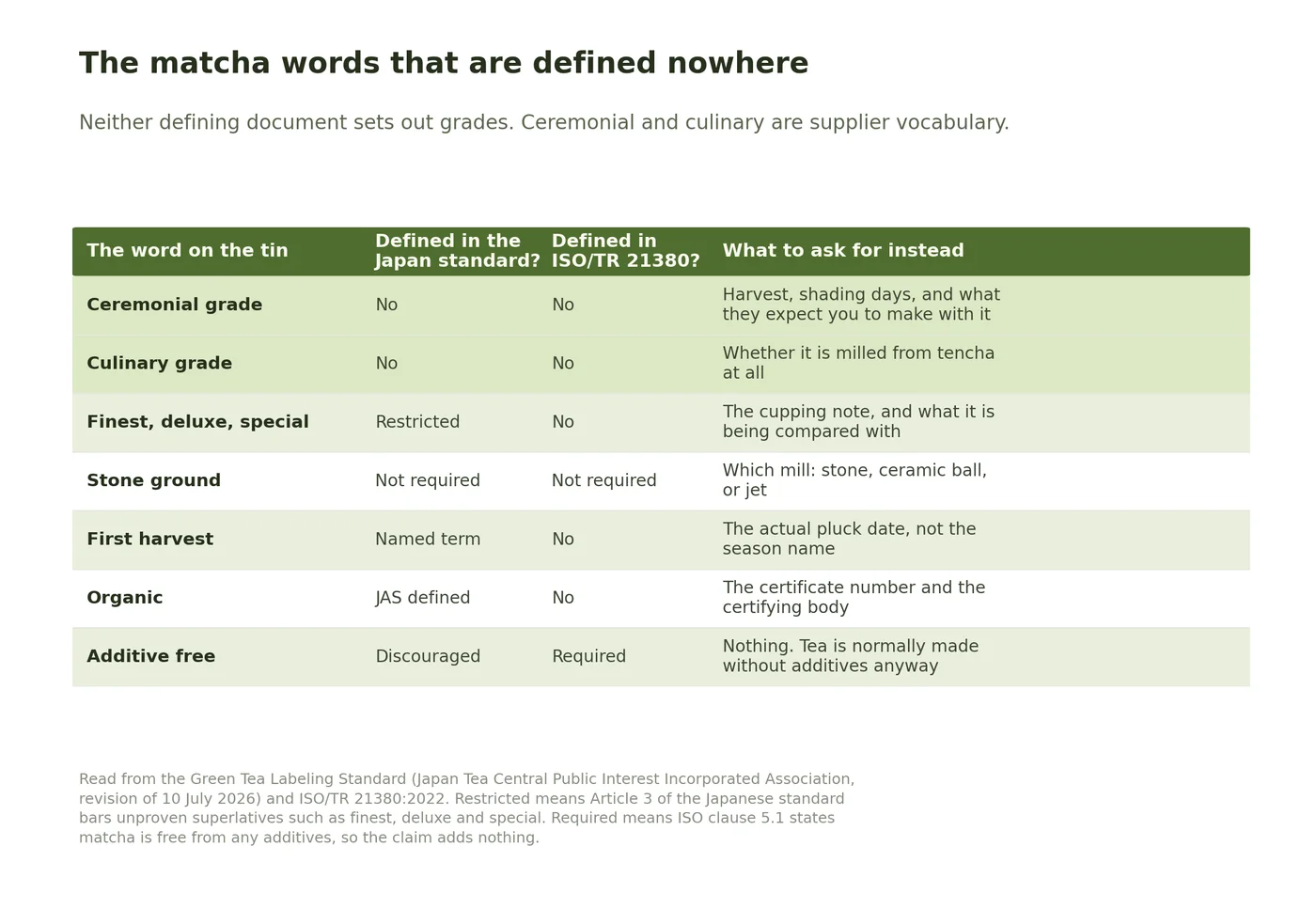
Two more from the same article are worth knowing. The standard treats an out of season shincha claim as improper labeling, naming phrases equivalent to always fresh and cellar-released new tea. And it discourages additive free as a differentiator on tea, on the reasoning that tea is normally made without additives anyway, so the claim implies a superiority that is not there.
None of this makes ceremonial grade a lie. It is a useful shorthand for whisk-grade tea, and we use grade language ourselves because buyers do. The point is narrower and more practical: because no document defines it, two suppliers can apply it to different teas without either being wrong, so it cannot carry a specification. Our guide to matcha grades covers what you are actually paying for as you move up a supplier's ladder.
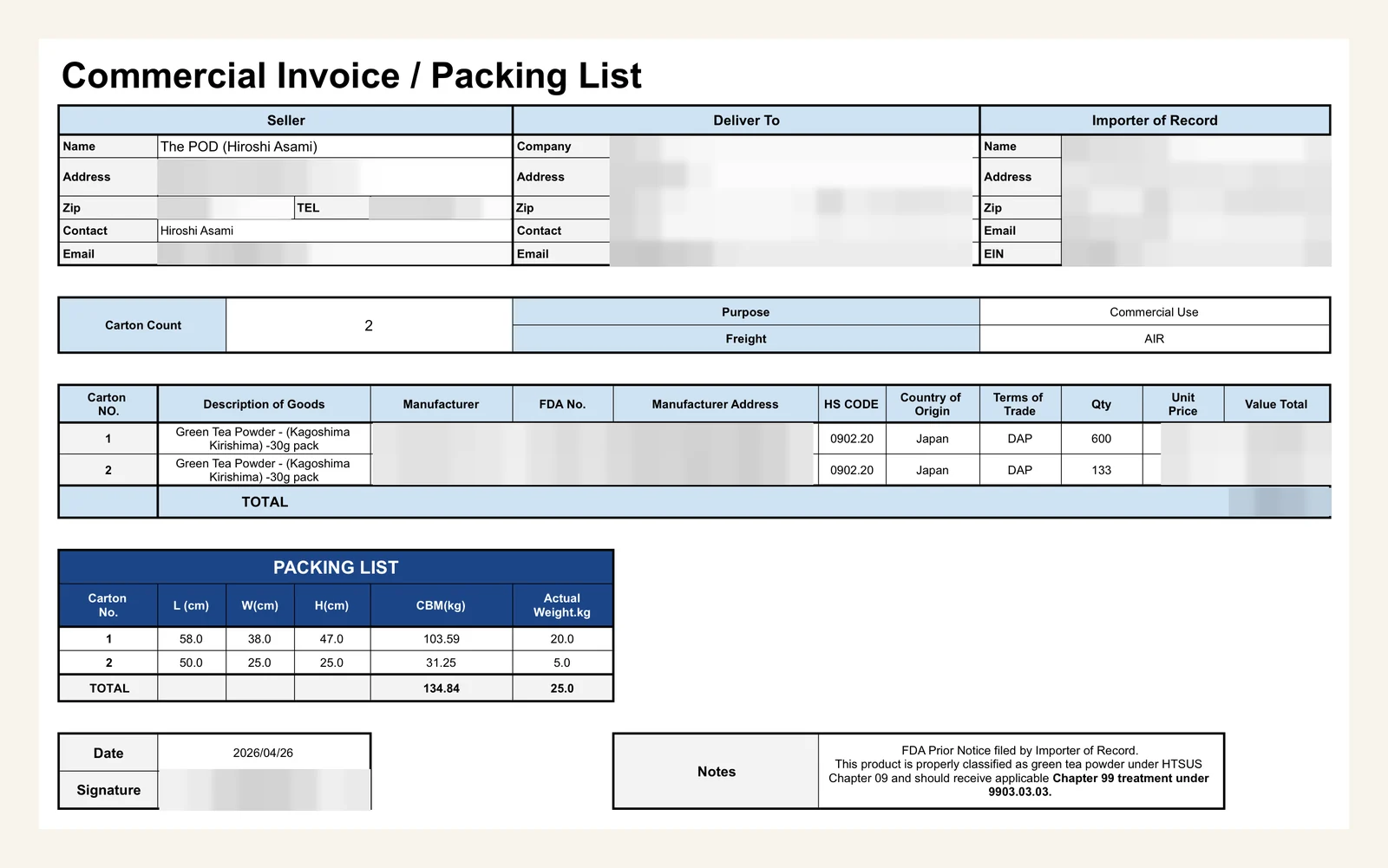
Two vocabularies meet on an import file. One is the Japanese shipping slip, which carries the tea's identity. The other is Incoterms 2020, the current edition published by the International Chamber of Commerce, which decides who pays for what. Confusing the two is how first shipments go wrong.
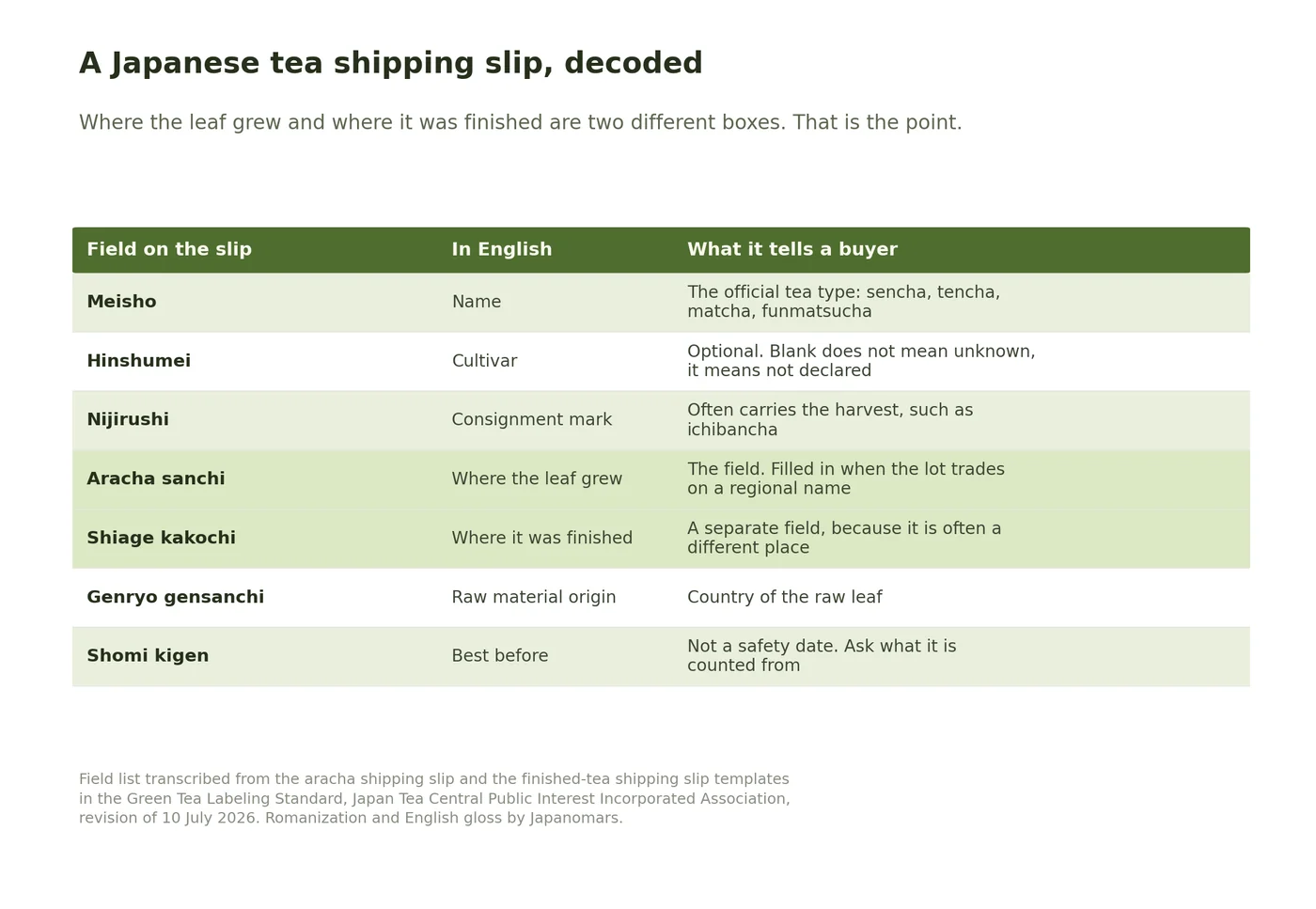
The seven boxes, in the order the template sets them out, are meisho (the official tea type), hinshumei (cultivar), nijirushi (the consignment mark, which usually carries the harvest), aracha sanchi (where the leaf grew), shiage kakochi (where the tea was finished), genryo gensanchi (raw material origin) and shomi kigen (best before). Cultivar is an optional field, so a blank there means undeclared rather than unknown.
Those two highlighted rows are the most useful thing on this page for anyone buying on a regional name. Where the aracha was grown and where it was finished are separate fields in Japan's own template, because they are frequently different places. A regional name on a tin is a claim about one of those boxes, and it is worth knowing which. Our guide to Japanese matcha regions sets out what each name is actually telling you.
| Term | What it means | What it costs you |
|---|---|---|
| FOB | Seller delivers to the ship at the named port of origin | You arrange and pay freight, insurance, duty and delivery |
| CIF | Seller pays freight and insurance to the named destination port | You still pay duty, customs clearance and inland delivery |
| DDP | Seller delivers to your door with everything cleared and paid | Simplest to compare, usually the highest headline number |
| MOQ | Minimum order quantity the supplier will accept | Sets your working capital and your first order size |
FOB, CIF and DDP are Incoterms 2020, the edition in force since January 1, 2020 and the current one; the next decennial revision is not expected before 2030. Always write the edition year and the named place into the contract.
Quotes on different Incoterms are not comparable numbers, and this is a common costing mistake we see from cafes pricing their first direct import. An FOB price and a DDP price for the same tea are not the same number once freight, duty and clearance land, and the gap is not small. Our guide to importing matcha into the US walks through the customs side in detail.
Behind the bar the vocabulary is Japanese but the concepts are simple. Usucha and koicha are preparations, not grades: thin tea and thick tea, distinguished by how much powder goes into how much water. A chasen is the whisk and a chashaku is the bamboo scoop.
| Term | Japanese | What it is |
|---|---|---|
| Usucha | 薄茶 | Thin tea. The whisked preparation nearly every cafe drink is built on |
| Koicha | 濃茶 | Thick tea. Far more powder, far less water, kneaded rather than whisked |
| Chasen | 茶筅 | The bamboo whisk. Prong count varies; it is a tool spec, not a quality signal |
| Chashaku | 茶杓 | The bamboo scoop. A volume measure, which is why a scale beats it on a bar |
Preparation terms in general use. Neither the labeling standard nor ISO/TR 21380 defines usucha or koicha, because both documents describe the tea rather than the drink.
Two things get misused often enough to be worth naming. The first is treating ceremonial as a preparation word, which it is not: usucha and koicha are the preparations, and a ceremonial grade tin can be used for either. The second is the chashaku, which measures volume while your cost and your caffeine both run on weight. Our guide to the mistakes baristas make covers where those two drift on a real bar.
Five terms turn a vague enquiry into a specification a supplier has to answer. Tencha, harvest, shading days, mill type and particle size. Each has a written definition behind it, so a supplier close to the field can answer all five in a few lines, and one who is not will struggle with at least two.
A supplier who answers all five without hedging is telling you they know which lot you are getting, which means they know which field and which week it came from. That is a better signal than any grade name on the tin. Our guide to finding and vetting a supplier sets out the wider version of this conversation, and our main matcha for cafes guide is the place to start if you are building a programme from scratch.
From the sourcing floor
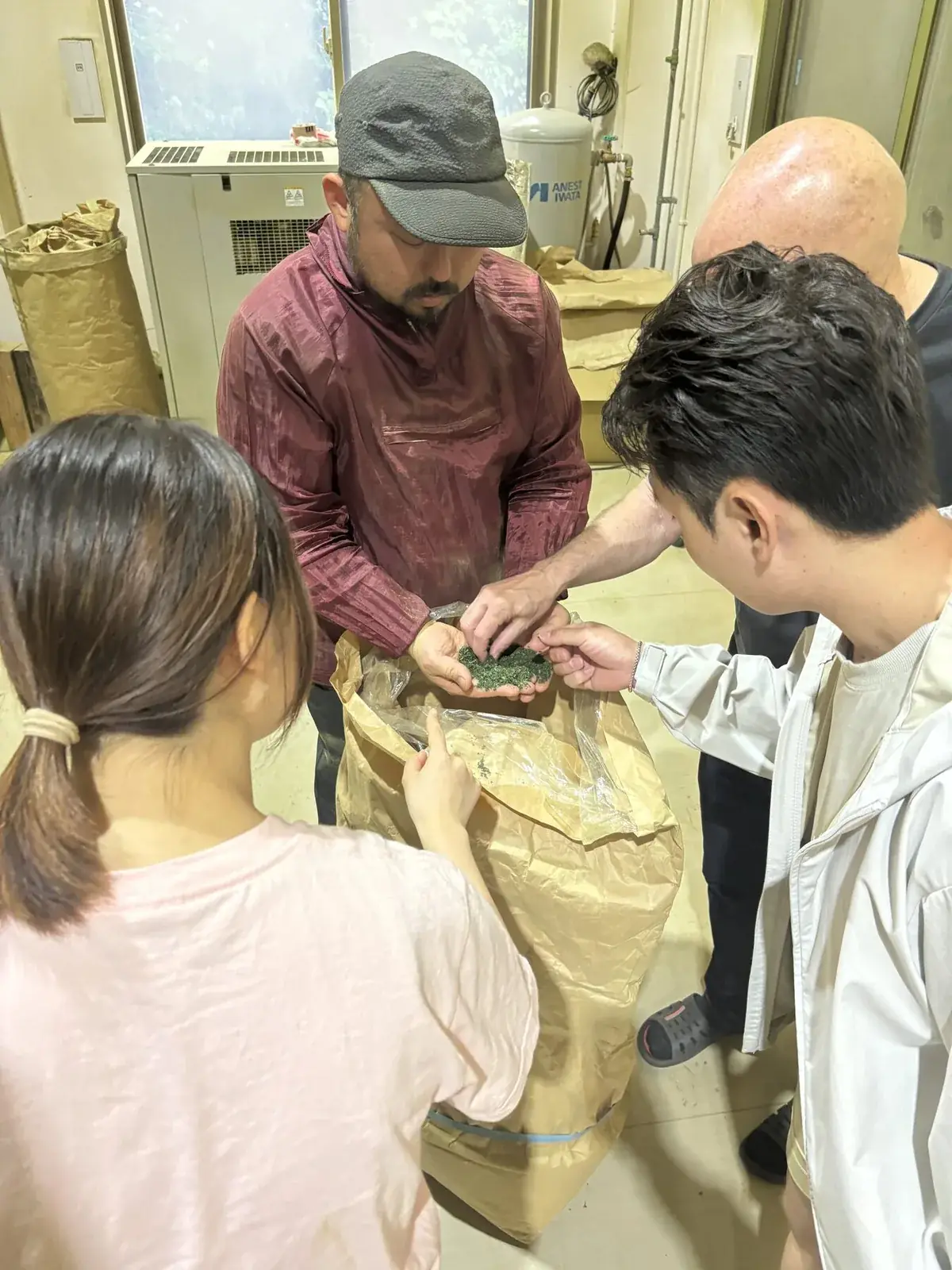
Our suppliers write the region and the cultivar on the paperwork without being asked. The harvest is the current year's crop as a matter of course, and we receive the leaf first and mill it to powder after the order is placed. Growing area and finishing place being two different addresses is normal rather than a red flag: even Uji matcha draws leaf from the districts around Uji as well as Uji itself, and the stone mill is often in yet another region, with the powder shipped on from there. That is true across Japan, not just in Kyoto.
No. Neither Japan's Green Tea Labeling Standard nor ISO/TR 21380:2022, the two documents that define matcha in writing, sets out grades at all. It is supplier vocabulary, which does not make it useless, but it does mean two suppliers can use it for different teas without either being wrong. Ask for harvest and shading days instead.
No, and both defining documents say so. Japan's standard defines the mill as a tea mill or equipment of any grinding method with equivalent function. ISO/TR 21380 states that normal grade matcha can use processes other than the stone mill, including a ceramic ball mill or a jet mill. A stone ground claim is a real claim about equipment, so ask which mill.
They are three separate named entries in the same Japanese table. Matcha is tencha milled to a fine powder. Funmatsucha is any tea put through a grinder. Konacha is the fine material sifted out during finishing of leaf teas. Only the first one started as shaded, unrolled tencha.
The leaf before it becomes matcha. Japan's standard defines it as leaf from a garden covered for two to three weeks, steamed, then dried without rolling in a tencha furnace. A quotation for tencha is a quotation for unmilled material, so confirm whether milling, sifting and packing are inside the price.
Aracha is unfinished tea: made from the leaf but before the finishing stage. Shiage-cha is the finished product. The distinction matters because a Japanese wholesale shipping slip has separate boxes for where the aracha was grown and where it was finished, and those are often two different places.
No. Japan's standard defines ichibancha, nibancha and the rest by the production-period classification customary in the municipality where the tea was produced. There is no single national calendar behind the word. If the date matters to you, ask for the pluck date rather than the season name.
The useful habit this page is trying to build is small. When a matcha word arrives in front of you, ask whether anyone has written down what it means. If someone has, you can hold a supplier to it. If nobody has, translate it into a question that has a number for an answer, and ask that instead. Almost every term on this page falls cleanly on one side or the other.
We supply cafes in the United States, Canada and the Philippines from growers in six regions across five Japanese prefectures, and we mill to order rather than from finished stock. Tell us your monthly volume and we will send samples with current wholesale pricing, the harvest and shading detail for the lot, and which mill it came off.
Request samples & pricing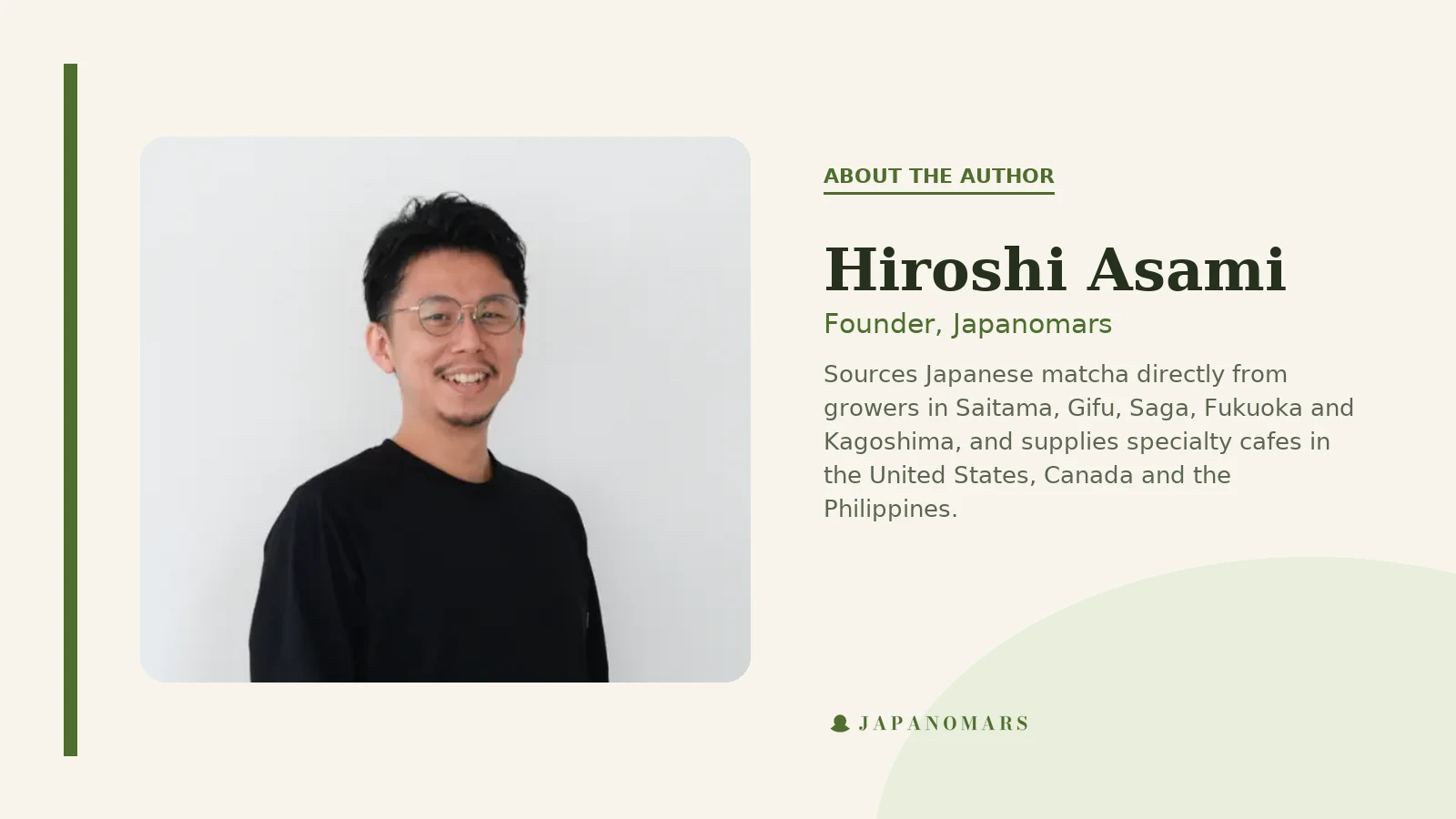
Hiroshi Asami is the founder of Japanomars, which exports Japanese matcha to cafes in the United States, Canada, and the Philippines. He sources through direct relationships with growers and processors in Saitama, Gifu, Saga, Fukuoka, and Kagoshima, and has led four sourcing tours bringing overseas cafe owners to Japanese tea farms. The Japanese definitions on this page were translated from the original standard for this article.
Sources
%E7%99%BD_%E5%A4%A7%E3%81%8D%E3%81%84.png)