%E5%A4%A7%E3%81%8D%E3%81%84.png)
Japan Policy · 2026
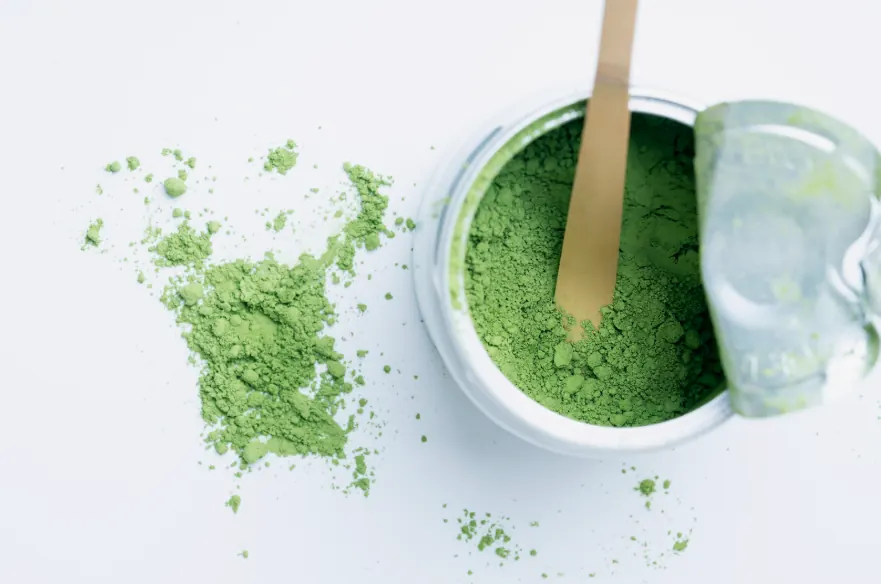
Right now, nobody owns the word matcha. Any producer anywhere can print it on a bag, because the only international document that defines matcha, ISO/TR 21380:2022, is a technical report and not a rule. On July 24, 2026, Japan's Ministry of Agriculture published a national standards strategy warning that this could change, and not necessarily in Japan's favor. Here is what the warning actually says, who is holding the pen, and the one thing it should change about how you buy.
Key takeaways
In this guide
On July 24, 2026, Japan's Ministry of Agriculture, Forestry and Fisheries published its International Standard Strategy for Food, Agriculture, Forestry and Fisheries. In the section explaining why standards matter, the ministry uses matcha as its worked example of what Japan stands to lose by not showing up to the negotiating table.
From the strategy document, translated
"For example, the definition of matcha, which is originally part of Japan's traditional culture, is currently being discussed under Japanese leadership. If Japan does not continue to engage appropriately in that discussion, it risks not only having matcha's original value undermined, but also suffering disadvantages such as the name no longer being freely usable in international markets."
That is the whole of the matcha reference. It is a risk statement in a policy document, not a rule change and not a legal threat. Read it for what it is: the Japanese government saying out loud that the word is not secured.
The surrounding argument is about who writes food rules. The ministry notes that European bodies hold many of the secretariats inside ISO's food committee, TC 34, and that China has pushed its own foods into Codex, getting leaf-wrapped rice, zongzi, adopted as a regional standard. Japan is targeting 5 trillion yen in agricultural and food exports by 2030, and the strategy is blunt that imitation products using Japanese-style packaging and Japanese-language labeling are already circulating overseas and eroding that value.
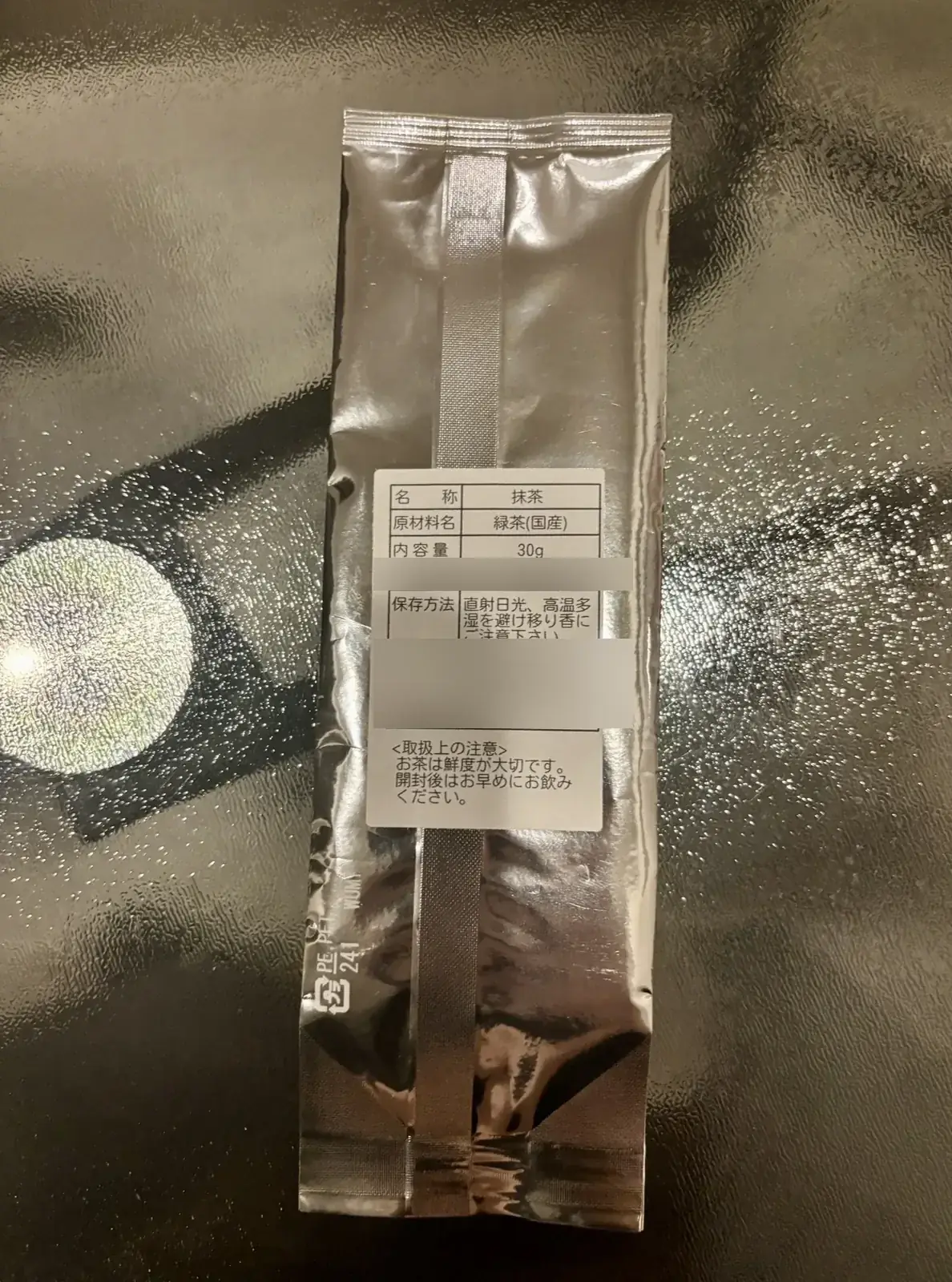
No. Nothing stops a company anywhere from selling green powder as matcha. ISO/TR 21380:2022, published on April 11, 2022, gives an internationally agreed description of matcha: shade-grown leaf, processed on tencha equipment, ground fine. But NARO, the Japanese research body that proposed it, is explicit that a technical report is an information document, not a rule that prescribes anything.
NARO's stated goal is the next step up: a full International Standard that adds provisions on chemical composition tied to quality. It says it is collecting matcha samples in Japan and overseas to build the analytical basis for that. There is no published date for it. Our guide to what officially counts as real matcha covers what the current description does and does not cover.
Two other instruments get confused with name protection, and neither does the job. Japan's "Japanese Tea" geographical indication, registered on July 10, 2026, proves that green, non-fermented tea was grown and processed in Japan. It says nothing about what matcha is, or how good it is. Trademarks protect your brand, not the category word.
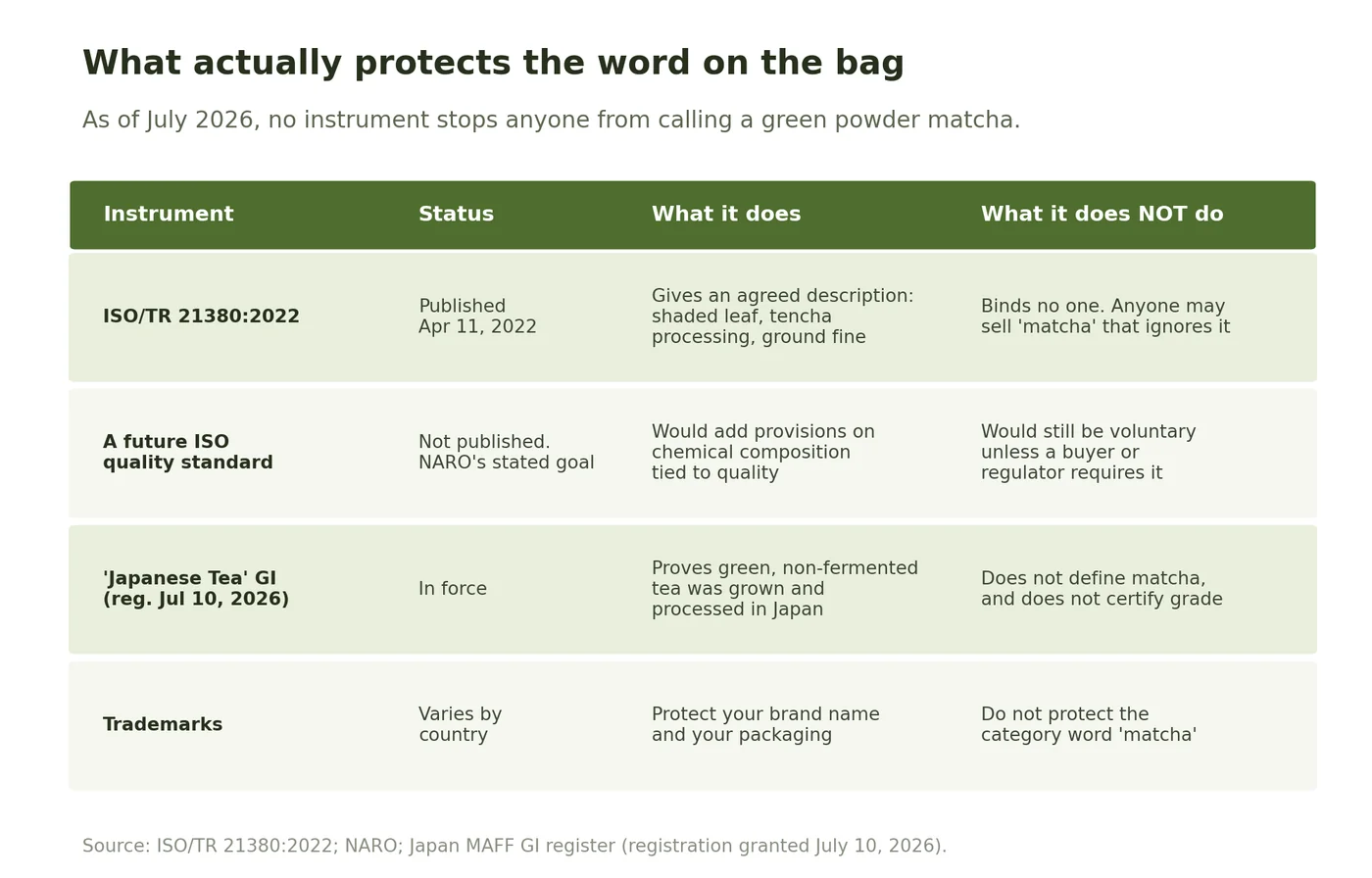
Matcha standards are written inside ISO/TC 34/SC 8, the tea subcommittee, established in 1981. Its secretariat is held by DIN, Germany's national standards body, not by Japan. Japan's influence runs through a single working group, WG 13, Matcha tea. That asymmetry is precisely what the ministry is worried about.
The scale is small enough to matter. As of July 2026 the tea subcommittee lists 18 participating member countries and 28 observing members, with 37 published standards and 2 more under development. In a room that size, whoever turns up with a drafted proposal tends to set the terms.
Japan did turn up. NARO proposed starting matcha standardization work at ISO in 2019, proposed the working group in 2020, and got the technical report published in 2022. The matcha working group's current convenor term runs to the end of 2028. The ministry's own self-criticism is the interesting part: Japanese exporters have adopted HACCP and FSSC 22000 because buyers demand them, but have done almost no standardization work aimed at branding and differentiation.
Nothing on your next invoice. But if a full ISO quality standard for matcha does land, it will do to matcha roughly what specification sheets did to coffee: quality claims stop being adjectives and start being numbers. The suppliers who can already produce those numbers will be the ones ready on day one.
Three things worth doing now, none of which depend on how the standards fight ends:
From the sourcing floor
Because we buy farm-direct, the questions above are a phone call for us, not a research project. When a cafe asks which cultivar, which harvest year, how the leaf was shaded, we ask the grower directly and the answer comes back quickly. If a buyer needs it on file, we put it in writing. That access is the part of this business we would defend hardest.
That is not what the ministry said. It warned that Japan could lose the ability to use the name freely in international markets if it stops engaging in the definition process. In practice, the realistic risk is a standard written to someone else's production method, so that Japanese matcha ends up described as an exception rather than the reference.
No. NARO, which proposed it, describes a technical report as an information document rather than a rule. It gives buyers a common description to point at, which is useful in a contract, but no regulator enforces it and no one can be stopped from ignoring it.
No. The geographical indication registered on July 10, 2026 covers green, non-fermented tea grown and processed in Japan. It is an origin claim. It does not define matcha as a product category and does not certify grade or quality.
No. There is no change to duties, labeling requirements, or import rules. This is a policy strategy describing where Japan intends to push over the coming years.
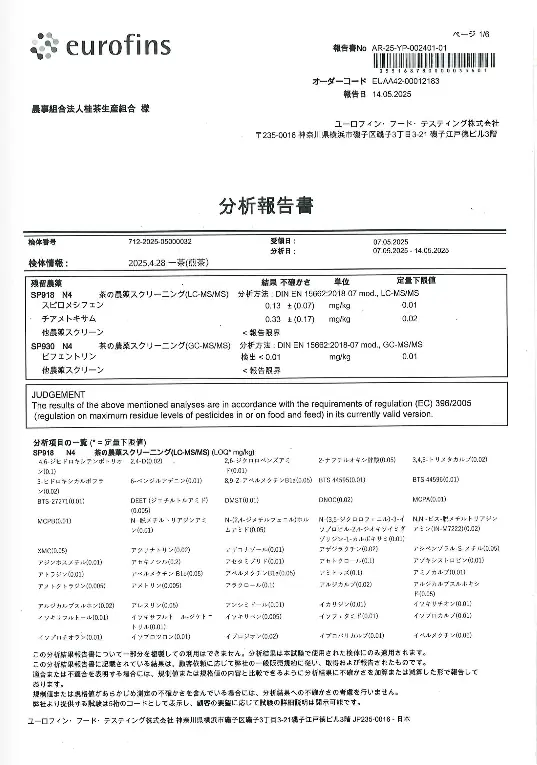
Ask them to put cultivar, region, harvest year, shading, and milling method on the spec sheet, and to send a recent lab report. If a quality standard arrives, that is the data it will be written in. If it never arrives, you still buy better.
The word matcha is not protected, and Japan has now said in a government document that it might not stay freely usable. Nothing about that changes your cost or your paperwork this year. What it should change is the standard of proof you accept from a supplier, because the direction of travel is clearly toward documented, testable claims rather than adjectives on a bag.
We work farm-direct with growers in Kirishima, Yame, Sayama, Ibi, Ureshino, and Chiran, and every lot comes with the region, cultivar, and harvest details on paper. Request samples and current wholesale pricing, and we will send the documentation with them.
Request samples & pricingHiroshi Asami is the founder of Japanomars, which exports Japanese matcha farm-direct to cafes in the US and Canada. He buys from growers and wholesalers in Sayama, Ibi, Ureshino, Yame, Kirishima, and Chiran, and has taken overseas cafe owners to Japanese tea farms four times.
Sources
%E7%99%BD_%E5%A4%A7%E3%81%8D%E3%81%84.png)