%E5%A4%A7%E3%81%8D%E3%81%84.png)
The new US Section 301 "forced-labor" tariff that took effect on July 24, 2026 does not apply to matcha. Green tea, which is matcha's customs category (Harmonized Tariff Schedule heading 0902), is named on US Customs and Border Protection's official exclusion list for this action. So even though Japan is one of the 60 covered economies, your matcha shipments are not hit by this particular duty.
This guide is for US cafe owners and importers who saw the headlines and want a straight answer, plus the primary-source proof behind it.
No. The Section 301 forced-labor tariff that began on July 24, 2026 excludes green tea, and matcha is classified as green tea (HTS heading 0902). US Customs lists the exact 0902 codes on the official exclusion annex (heading 9903.05.86) for this action. Japan is a covered economy, but because the carve-out is by product, matcha is not charged this duty.
The reason this matters is that the tariff was designed to be broad. On paper it reaches "Chapter 1 to 97" of the tariff schedule, which is effectively every category of goods. What keeps ordinary agricultural imports like tea out of it is a long exclusion list, and green tea sits on that list. So the correct read is not "Japan got a pass" (it did not) but that tea, as a product, was carved out.
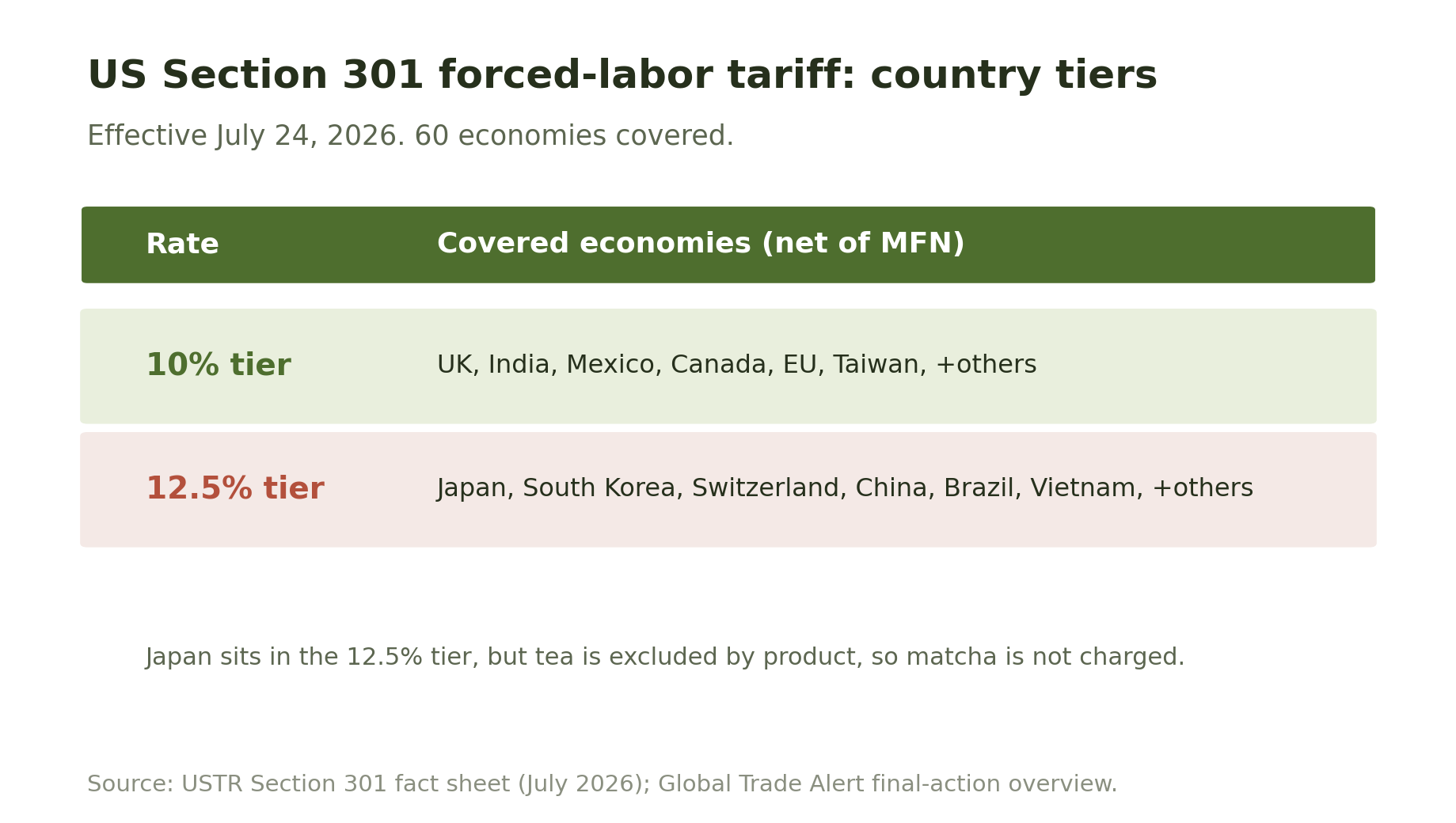
This is a US Trade Representative action under Section 301 of the Trade Act of 1974, imposing extra duties on 60 economies that USTR found had failed to prohibit and enforce against imports made with forced labor. It took effect at 12:01 a.m. eastern time on July 24, 2026. Rates are tiered: 10% for economies with a qualifying forced-labor import ban, 12.5% for the rest. Japan is in the 12.5% tier.
USTR opened the investigations in March 2026, took over 1,600 written comments, and held hearings on July 7 to 9 before finalizing the action. Seventeen economies, including the United Kingdom, India, Mexico and Canada, landed in the 10% tier; the European Union and Taiwan also qualify for 10%. The remaining economies, including Japan, South Korea, Switzerland, China, Brazil and Vietnam, are at 12.5%. For five of them, the European Union, Taiwan, Japan, South Korea and Switzerland, the duty is applied net of the product's most-favored-nation rate.
For a matcha importer the headline number (Japan, 12.5%) looks alarming at first glance, which is exactly why the exclusion list matters so much. The tariff schedule does the carving; the country tier never gets a chance to apply to tea.
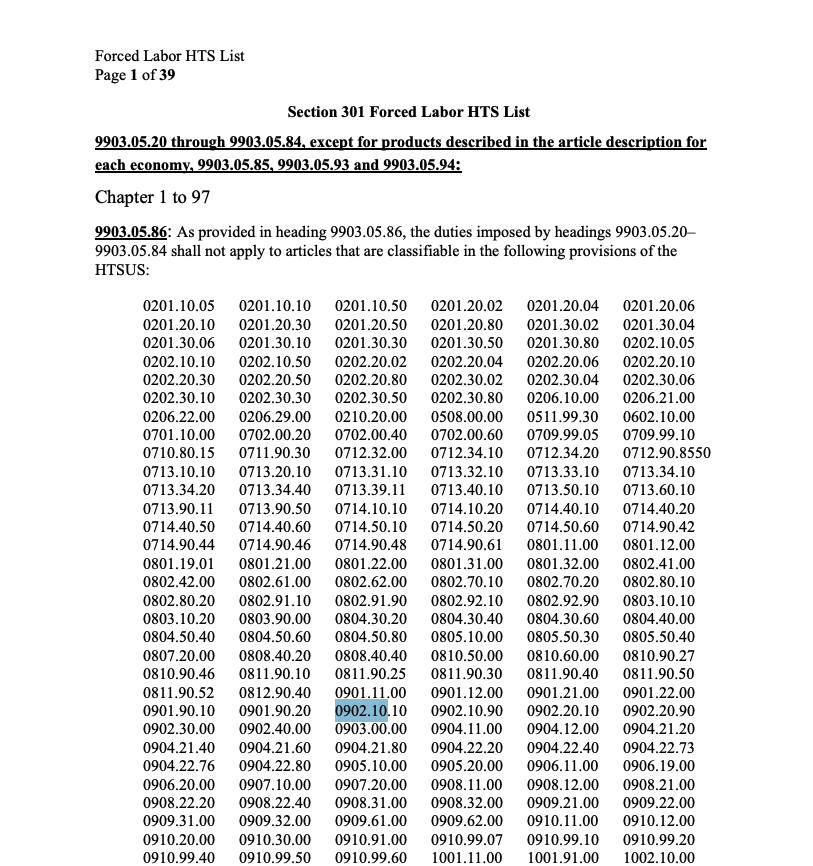
The proof is a public Customs document. On July 23, 2026, CBP published its "Forced Labor HTS List," the official schedule that defines both the covered goods and the exclusions for this action. The duties are imposed by headings 9903.05.20 through 9903.05.84. Heading 9903.05.86 then lists the specific HTS codes to which those duties shall not apply, and the green-tea lines are on it.
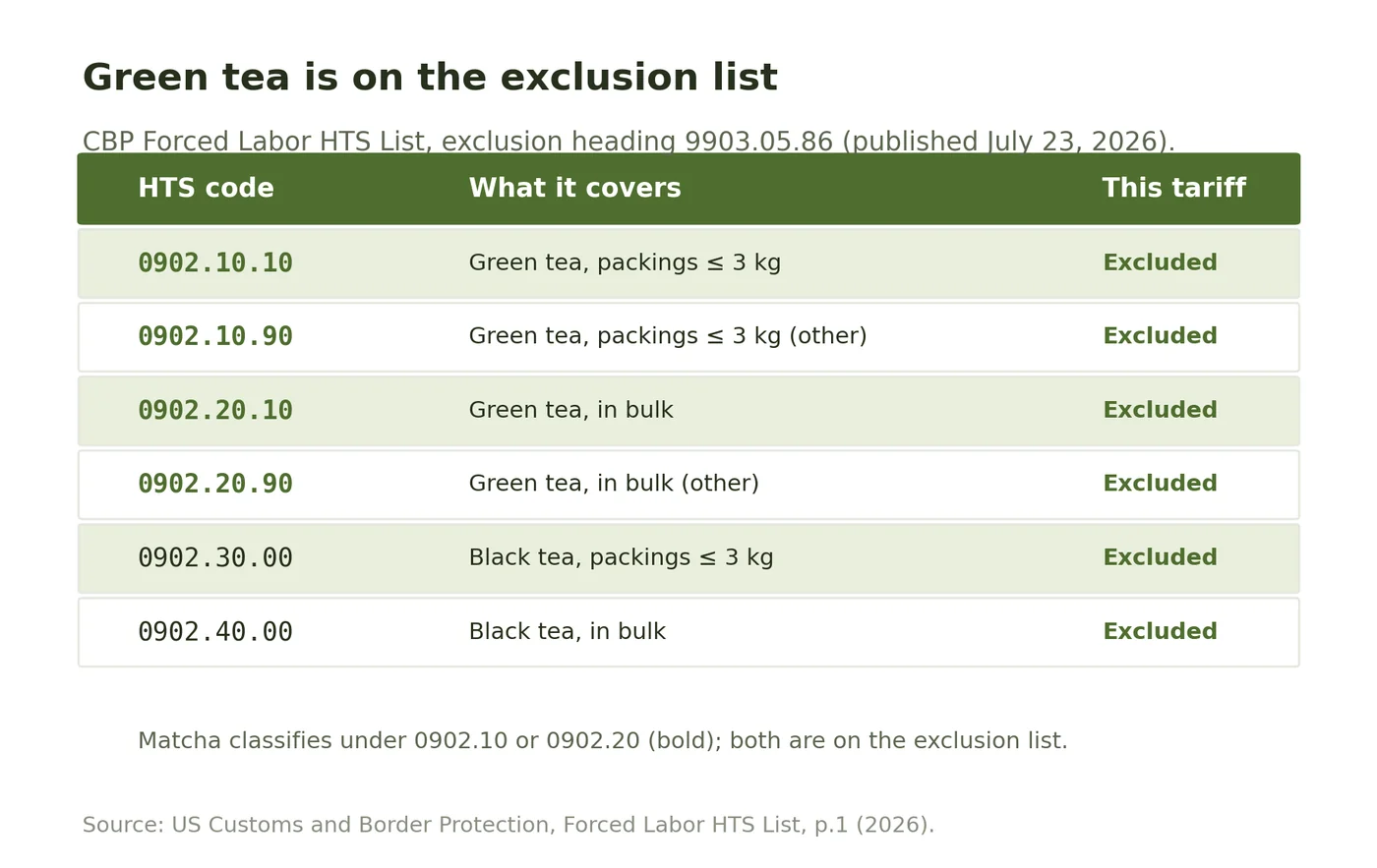
The green-tea codes named on the exclusion list (heading 9903.05.86) are: 0902.10.10, 0902.10.90, 0902.20.10, 0902.20.90, 0902.30.00 and 0902.40.00. Matcha, whether it ships in retail packings of 3 kg or less or in bulk, classifies under 0902.10 or 0902.20, both of which are on that list. In other words, the specific eight-digit lines a matcha shipment enters under are the ones Customs excluded.
This is why your supplier or customs broker can point to a single document. It is not an interpretation or a forecast; it is the operative Customs list for the tariff, and tea is named on the exclusion side of it.
Heading 9903.05.86 is not a short carve-out. Extracting the codes from the list CBP published gives 863 separate HTSUS provisions that the forced-labor duties do not apply to, covering food, agriculture, energy, chemicals, metals and electronics. Tea sits inside that set.
The tea lines named under 9903.05.86 are 0902.10.10, 0902.10.90, 0902.20.10, 0902.20.90, 0902.30.00 and 0902.40.00. Matcha enters under 0902.10 in retail packings of 3 kg or less, or under 0902.20 in bulk, so both of the parent lines that matter to a cafe order are on the exclusion side. Coffee (heading 0901) and the chapter 09 spice lines are on the same list, which matters if you import more than tea.
Two neighboring headings get mistaken for this one. 9903.05.85 covers goods already loaded and in transit before 12:01 a.m. eastern time on July 24, 2026. Headings 9903.06.01 through 9903.06.21 hold country-specific exemptions for economies including the United Kingdom, Switzerland, Taiwan and Indonesia, which is a different mechanism from the product carve-out in 9903.05.86.
The exclusion attaches to the HTSUS provision, not to the product name, so your entry has to actually classify there. Plain unflavored matcha is green tea under 0902. Premixed matcha lattes and flavored blends can classify elsewhere and fall outside the carve-out. Confirm the line with your customs broker before the commercial invoice is issued.
Being excluded from this one tariff does not make matcha duty-free overall. Your total landed duty still depends on the base most-favored-nation rate for your exact HTS line and on any other trade measures in effect at import. Those are separate regimes with their own rules, and they are not settled by the forced-labor exclusion. Confirm your all-in rate with your customs broker before you price a contract. And if you are still deciding where to buy, our comparison of wholesale matcha suppliers for US cafes covers who is taking new accounts in 2026.
For the full customs, FDA, and labeling picture on bringing matcha into the US, see our guide to importing matcha into the US. And if you are budgeting for the year, the pressure that will actually move your matcha cost is the supply-and-demand squeeze on Japanese tea, not this tariff.
9903.05.86 is the Chapter 99 heading that carries the product exclusions for the 2026 Section 301 forced-labor tariff. It names 863 HTSUS provisions that the duties in headings 9903.05.20 through 9903.05.84 do not apply to, across food, agriculture, energy, chemicals, metals and electronics. Green tea is among them: 0902.10.10, 0902.10.90, 0902.20.10, 0902.20.90, 0902.30.00 and 0902.40.00 are all listed, which is why matcha imports are not charged this duty.
No. The Section 301 forced-labor tariff that took effect July 24, 2026 excludes green tea, and matcha is classified as green tea under Harmonized Tariff Schedule heading 0902. US Customs lists the 0902 green-tea codes on the official exclusion annex (heading 9903.05.86) for this action, so matcha imports are not charged this duty.
No. Japan is one of the 60 covered economies and sits in the 12.5% tier. Matcha is spared because the carve-out is by product, not by country. Green tea is on the exclusion list, so tea from any covered country is excluded from this specific tariff.
Matcha is green tea, so it classifies under HTS heading 0902, typically 0902.10 for retail packings of 3 kg or less or 0902.20 for bulk. Both are named on the July 2026 forced-labor exclusion list. Blended or flavored matcha products can classify elsewhere, so confirm the exact code with your broker.
No. The exclusion only means this one forced-labor tariff does not apply. Your total landed duty still depends on the base most-favored-nation rate for your exact HTS line and any other surcharge in effect at import. Those are separate rules. Confirm your all-in rate with a customs broker before pricing a contract.
CBP published the Forced Labor HTS List on July 23, 2026. The duties are imposed by headings 9903.05.20 through 9903.05.84, and heading 9903.05.86 lists the excluded HTS codes, which include the 0902 green-tea lines. Your customs broker can cite this document directly for your entry.
This tariff will not raise your matcha cost, but Japan's tencha shortage will. If you are choosing a supplier, this is a good moment to secure supply.
Request samples & pricingHiroshi Asami is the founder of Japanomars, a Japanese matcha exporter supplying specialty cafes across the US, Canada, and the Philippines, working farm-direct with growers and regional tea factories in six producing regions. This guide reads the US Customs and USTR source documents directly rather than relying on trade-press summaries.
Sources
%E7%99%BD_%E5%A4%A7%E3%81%8D%E3%81%84.png)