%E5%A4%A7%E3%81%8D%E3%81%84.png)
Menu · Costing · 2026

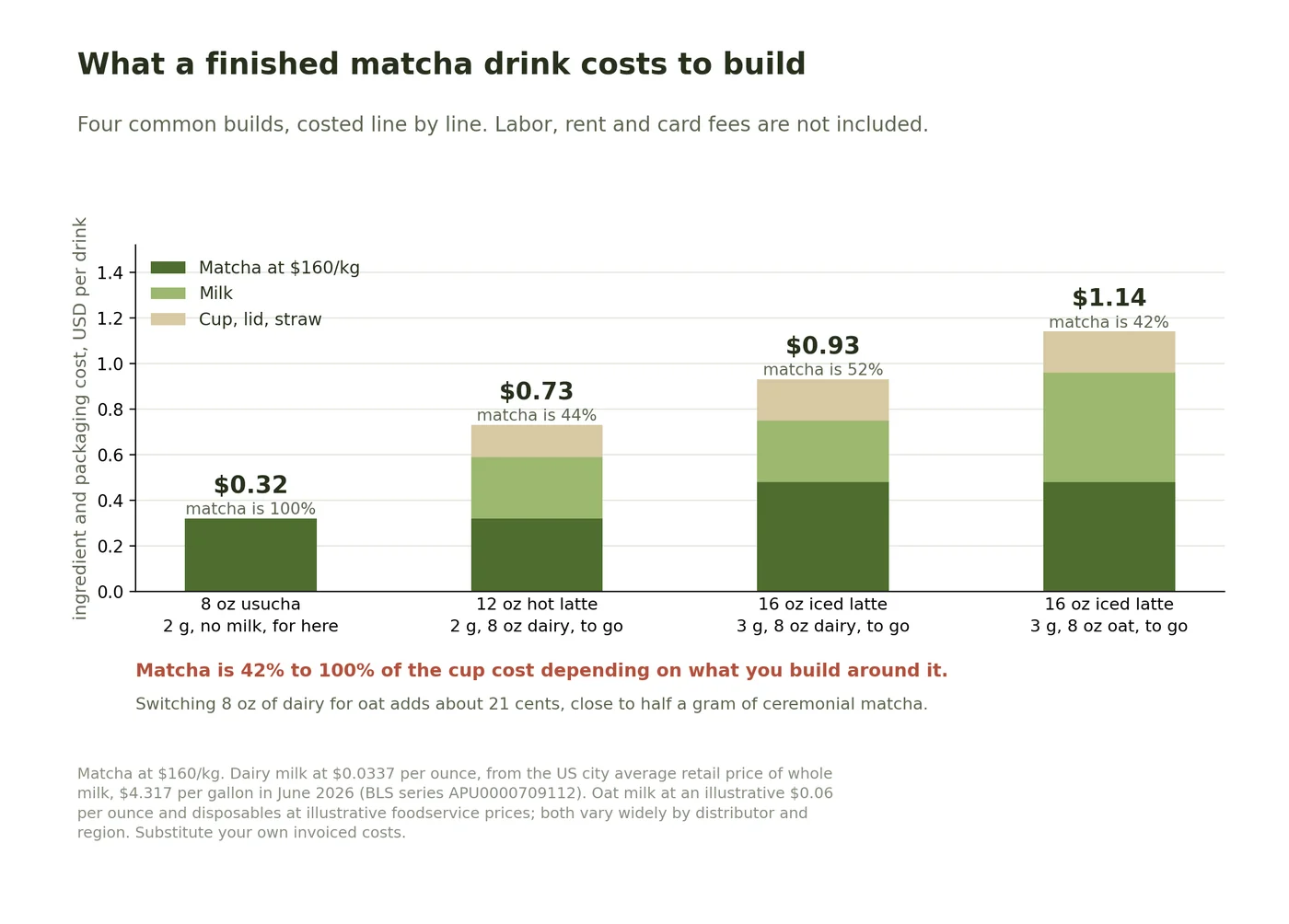
At the prices US cafes are paying in 2026, the matcha in a drink costs between 16 and 96 cents. A 12 ounce hot latte at a mid-market $160 per kilogram works out to about 73 cents all in, and a 16 ounce iced latte with oat milk to about $1.14. The powder is rarely the whole story, and at a 3 gram dose it is only about half of it.
Key takeaways
This guide gives you the arithmetic rather than a number to copy. It covers how to turn your own invoice into a cost per drink, how grade and dose move that number, what milk and packaging add, the costs that never make it onto the spreadsheet, and what a record harvest year like 2026 actually does to a single cup.
In this guide
The matcha itself costs between 16 and 96 cents per drink across the range US cafes buy in. That spans a $80 to $240 per kilogram landed price and a 2 to 4 gram dose. The most common cafe combination, a mid-band price around $160 per kilogram at a 2 gram hot dose, is 32 cents.
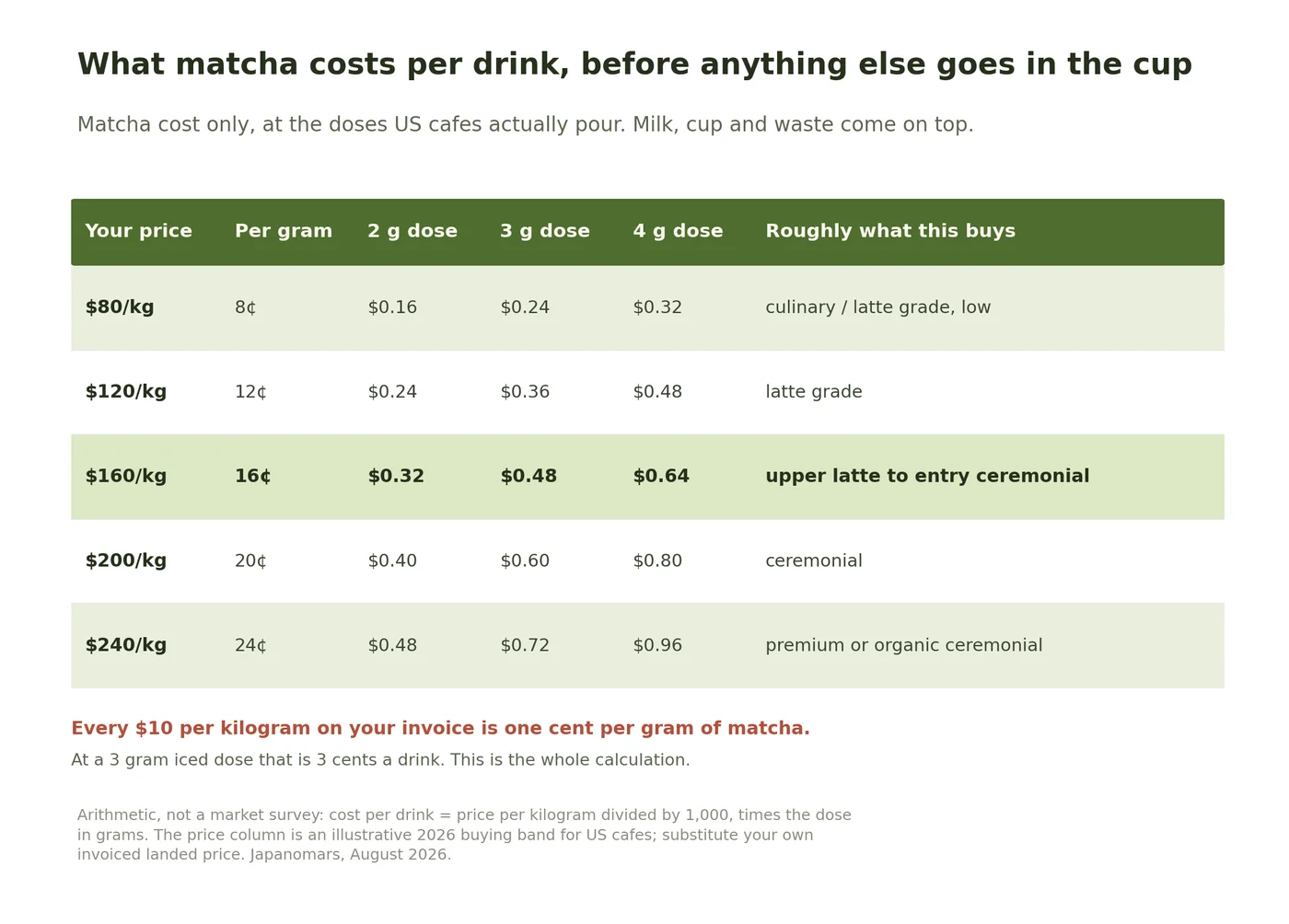
Two things about that range are worth sitting with. The first is how wide it is: at the same dose the top band costs three times the bottom, and across the whole grid the spread is six to one. The second is how small the absolute numbers are. Even the most expensive line in the table, 4 grams of premium organic ceremonial, is under a dollar. Matcha feels expensive when you look at the invoice per kilogram and stops feeling expensive when you divide it by the drinks it makes.
The reason cafe owners get this wrong in both directions is that the unit changes. A supplier quotes you per kilogram, your POS reports per drink, and nobody does the conversion out loud. So a price rise that reads as brutal on a purchase order turns out to be a few cents in the cup, and a cheap bag that looked like a saving turns out to have moved your cost by almost nothing while costing you the drink.
Divide your landed price per kilogram by 1,000 to get a price per gram, then multiply by your dose. That is the entire calculation. A $160 per kilogram matcha is 16 cents a gram, so a 2 gram drink carries 32 cents of tea and a 3 gram drink carries 48 cents.
The rule worth memorising is the one that survives every price change: every $10 per kilogram on your invoice is one cent per gram. At a 2 gram hot dose that is 2 cents a drink, and at a 3 gram iced dose it is 3 cents. You can now price any quote in your head while you are still reading the email.
Use your landed price, not the quoted price. If freight, brokerage or a fuel surcharge appear on a separate line, add them in before you divide, because they are part of what the kilogram cost you. Our matcha wholesale price and availability index publishes the landed-cost build-up we use ourselves, which is a useful floor to check a quote against, and importing matcha into the US covers what customs actually adds. Green tea enters the US under tariff heading 0902 at zero duty in normal treatment, so for most cafes the freight line matters far more than the duty line.
One caution on bag size. A 100 gram tin and a 1 kilogram bag of the same matcha are rarely the same price per gram, and the gap is often large enough to change the grade you can afford. Our guide to wholesale and bulk matcha for cafes covers order sizes and where the breaks usually sit.
Grade moves your cost per drink by cents, not dollars. Stepping from a $120 latte grade to a $200 ceremonial at a 2 gram dose costs 16 cents more per cup. That is real money across a year, but it is smaller than most cafe owners expect, and it is smaller than the swing from changing your dose.
| Grade band | Illustrative landed price | 2 g dose | 3 g dose | Where it usually belongs |
|---|---|---|---|---|
| Culinary | $80/kg | $0.16 | $0.24 | Baking, ice cream, anything cooked or heavily sweetened |
| Latte grade | $120/kg | $0.24 | $0.36 | High-volume milk drinks, iced and blended |
| Upper latte | $160/kg | $0.32 | $0.48 | A house latte you want people to notice |
| Ceremonial | $200/kg | $0.40 | $0.60 | Straight usucha, and lattes at cafes selling on quality |
| Premium or organic ceremonial | $240/kg | $0.48 | $0.72 | A hero drink or a certified organic menu |
Illustrative bands, not a price list. Substitute your own invoiced landed price. Japanomars, August 2026.
The trap here is buying grade you cannot taste. A ceremonial matcha whisked straight into 2 ounces of water shows everything it has. The same powder under 8 ounces of oat milk and a pump of syrup shows a fraction of it. Before you pay the upgrade, pour both in the drink you actually sell and see whether anyone can tell. Our guide to matcha grades explains what the grade words do and do not commit a supplier to, which matters because none of them are legally defined.
Dose moves your cost more than grade does. Going from 2 grams to 4 grams doubles the matcha line, which is a bigger jump than moving up two grade bands. Most US cafes pour 2 grams into a hot latte and 3 to 4 into a 16 ounce iced drink, because ice and volume dilute the tea.
That is a defensible reason to dose iced drinks higher, and it is also the biggest lever most cafes have on their matcha spend. Before you negotiate a supplier down by $10 a kilogram, check what your bar is actually pouring against what the recipe card says. Even half a gram of drift at $160 per kilogram is 8 cents a drink, four times what that negotiation would have won you on a 2 gram dose.
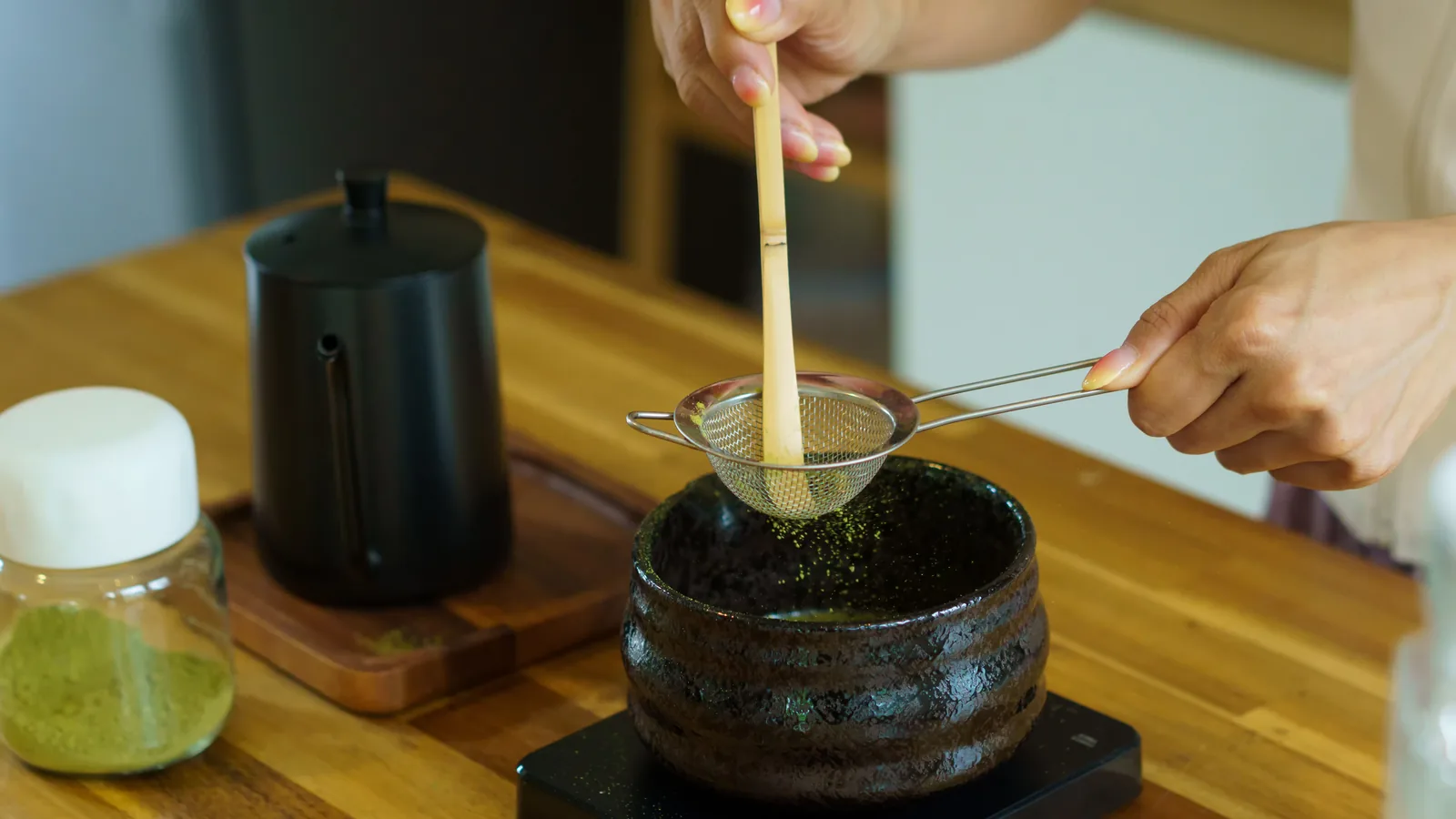
Weigh, do not scoop. A level teaspoon of matcha is roughly 2 grams and a heaped one is closer to 3, so a bar working by eye is running a full gram of variance on its most expensive ingredient and on the taste of the drink at the same time. A cheap bench scale pays for itself in a month at these prices. Our guides to the matcha latte and iced matcha for cafes cover the ratios we recommend for each, and the mistakes baristas make covers the technique problems that quietly turn into waste.
In a milk drink, matcha is usually less than half the ingredient cost. Eight ounces of dairy runs about 27 cents at the June 2026 US average retail price of $4.32 a gallon, and the same volume of oat runs closer to 48 cents. Add a 16 ounce cold cup, lid and straw and the packaging alone can outrun a gram of ceremonial matcha.
Dairy is also moving. That $4.32 a gallon is up about 7% on a year earlier, which is a steeper percentage move than most matcha buyers saw on their own invoices in the same window. It is worth checking, because a cafe that raised its matcha price to cover a matcha increase may have been covering a milk increase without knowing it.
Use your own distributor price rather than the retail average above, which is only a proxy and can be well off your invoice. And note that the alt-milk gap of around 21 cents on 8 ounces is close to the cost of half a gram of ceremonial matcha. If you need somewhere to recover cost, the alt-milk upcharge is a line customers already expect to see, and the matcha upcharge is not.
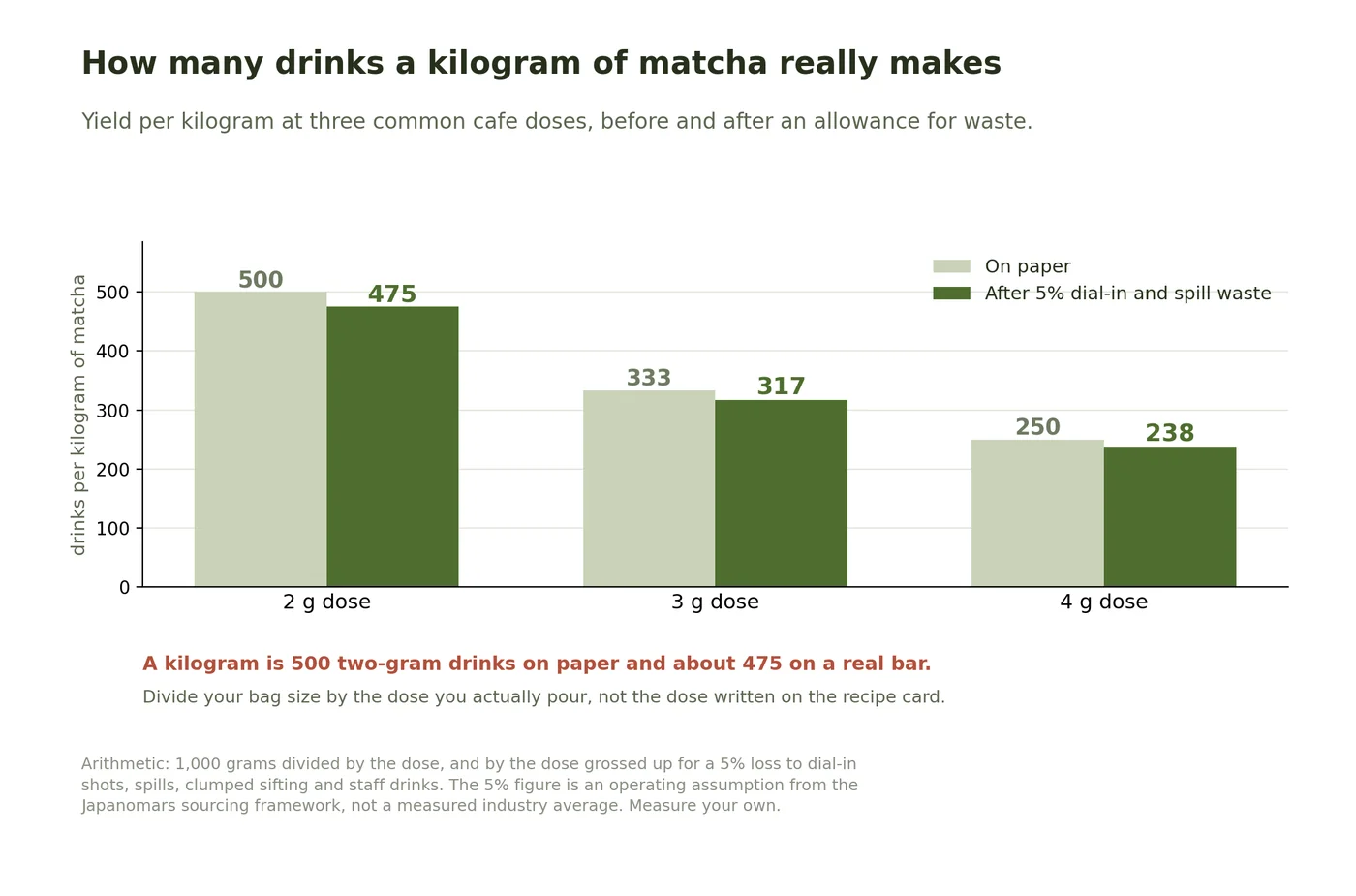
Most cafe matcha costings run 5 to 10% low because they count the dose and nothing else. Dial-in shots, spills, powder left in the sieve, staff drinks and comped remakes all come out of the same bag. Gross your dose up rather than pretending they are free.
| Line | What it typically costs | On a 3 g drink at $160/kg |
|---|---|---|
| Dial-in, spills and sieve loss | 3% to 5% of the bag | About 2 cents |
| Staff and comped drinks | 2% to 4% of drinks poured | 2 to 4 cents equivalent |
| Retained reference sample | One sealed portion per lot | A few dollars per lot, once |
| Sweetener or syrup | Half an ounce to an ounce | 5 to 12 cents |
| Alt-milk upgrade | Oat instead of dairy, 8 oz | About 21 cents |
| Stale stock written off | Whatever you cannot sell | The full bag price |
Illustrative operating allowances from the Japanomars sourcing framework, not measured industry averages. Measure your own over one full bag.
The last line is the one that actually hurts, and it is the one nobody budgets. Matcha loses colour and aroma quickly once it meets air, light and warmth, so a bag you bought at a good price and then poured slowly can cost you more per drink than a smaller bag bought more often at a worse headline price. Order to your real turnover rather than to the price break, and keep opened stock cold, dark and sealed. Our storage and shelf life guide covers the handling in detail.
Japan's record 2026 tencha auctions added roughly 18 cents to a 3 gram drink, not dollars. Kagoshima's first prefectural tencha auction on 14 May 2026 averaged 19,095 yen per kilogram against 10,615 a year earlier. At 157 yen to the dollar and a 0.885 milling yield, that rise is about $61 per kilogram of finished matcha.
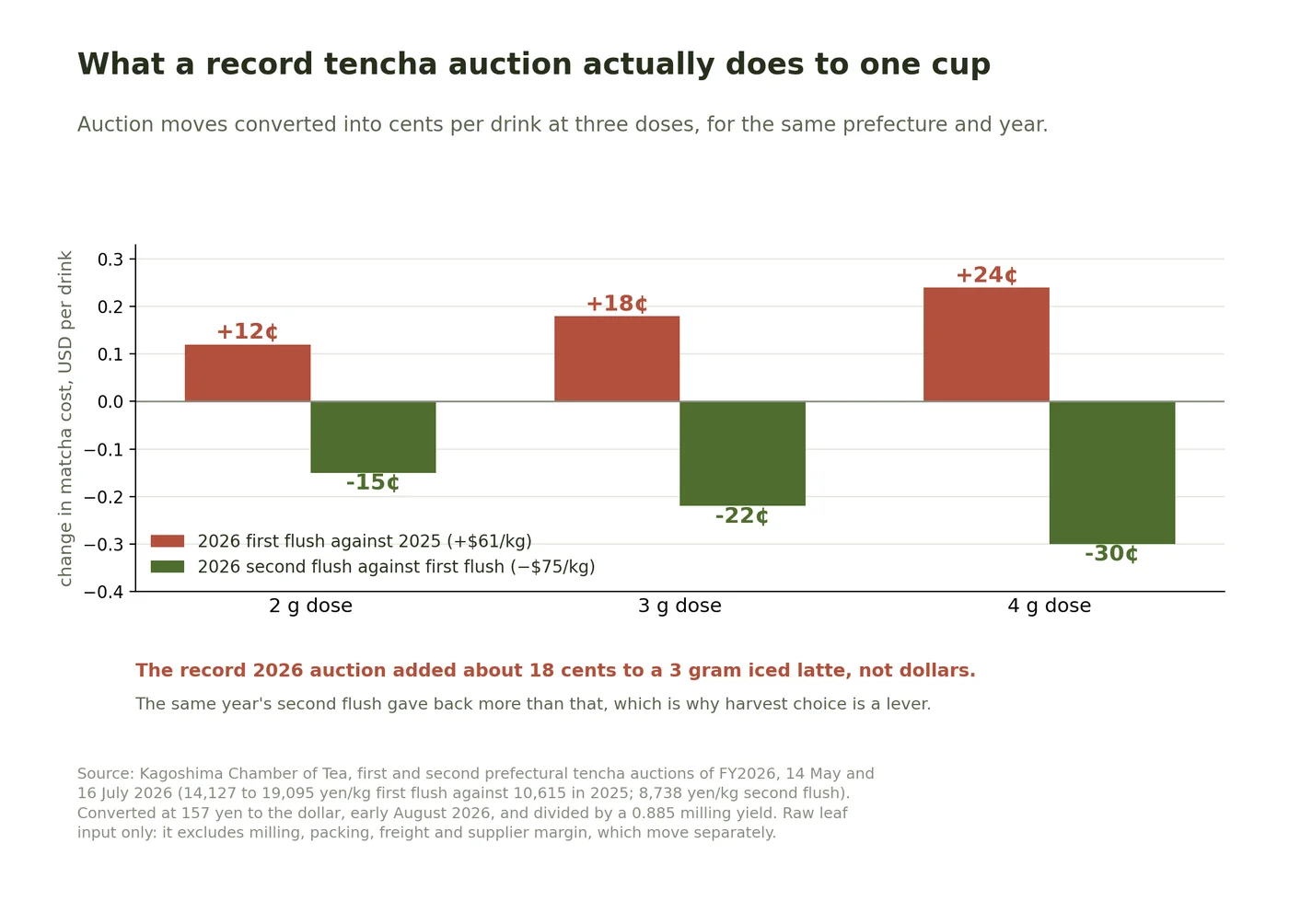
The same year's second flush ran the other way. Kagoshima's 16 July auction averaged 8,738 yen per kilogram, 54% below the May print, which is worth about 22 cents a drink at 3 grams. That is why harvest choice is a real lever on a milk-drink menu: a second-flush latte grade will never carry a straight bowl of usucha, but it does not need to when it is going under 8 ounces of oat milk.
Two honest caveats. Your supplier's price will not move by exactly the auction number, because milling, packing, freight and margin sit on top and move on their own schedules. And the auction is raw leaf: it is the input to your cost, not your cost. What the arithmetic gives you is a sanity check. If a supplier raises a latte grade by $40 a kilogram in a year the auction moved $61, that is a conversation you can have with numbers instead of a feeling.
You can build a defensible number for your own bar in one shift. The point is not precision to the cent, it is knowing which line to pull when costs move.
Keep the sheet and revisit it when a supplier price changes or you switch a milk. Because every line is a unit cost, updating one number updates the whole drink, and you will know in seconds whether to reprice or absorb it.
From the sourcing floor
I do not hear much from cafes about measuring their real dose against the recipe card. The conversation is about the price. What we are quoted has climbed year after year and now sits at roughly three times where it was two or three years ago. My own read is that it will not jump like that again, for a simple reason: any further rise and the cafes cannot carry it, and every grower I talk to knows that.
Between about 16 and 96 cents of matcha, depending on what you pay and how much you pour. At $160 per kilogram, a 2 gram dose is 32 cents and a 3 gram dose is 48 cents. Add milk, packaging and waste and a finished latte lands somewhere between roughly 70 cents and $1.20 in ingredients.
About 500 at a 2 gram dose, 333 at 3 grams and 250 at 4 grams on paper. Allow around 5% for dial-in shots, spills, clumped sifting and staff drinks and those become roughly 475, 317 and 238. Measure your own loss over a full bag rather than trusting the recipe card.
Not usually, because the difference lands in cents. Moving from a $120 latte grade to a $200 ceremonial at a 2 gram dose costs you 16 cents more per drink. Whether that is worth it depends on whether your customers taste it through 8 ounces of milk, which is a tasting question rather than a costing one.
Yes, on two counts. Iced drinks are usually built at 3 to 4 grams rather than 2, because ice and a larger cup dilute the tea, and a 16 ounce cold cup with a lid and straw costs more than a 12 ounce hot cup. On the same matcha and the same milk, a 16 ounce iced latte at 3 grams costs about 20 cents more than a 12 ounce hot one at 2 grams.
Around 21 cents on an 8 ounce pour, on a dairy price near $0.034 an ounce and an oat price near $0.06. That is close to the cost of half a gram of ceremonial matcha, which is why an alt-milk upcharge is usually easier to justify than a matcha upcharge.
Multiply the price move per kilogram by your dose in grams, then divide by 1,000. Japan's record 2026 first-flush tencha auction in Kagoshima raised the raw leaf input by roughly $61 per kilogram, which is about 18 cents on a 3 gram drink. Supplier price changes are usually larger than the auction move alone, because milling, packing and freight sit on top.
Matcha costs less per drink than its invoice suggests and more per drink than most costings admit. The gap between those two facts is where cafes lose money, and it closes with one number: your real landed price per gram, multiplied by the dose your bar actually pours. Once you have that, a supplier quote, a grade upgrade and a harvest year all become the same kind of question, answered in cents.

We ship to cafes in the United States, Canada and the Philippines from growers in six regions across five Japanese prefectures, and we mill to order rather than from finished stock. Tell us the drink you sell, your dose and your monthly volume, and we will come back with current wholesale pricing and the cost per drink it works out to on your own build.
Request samples & pricingHiroshi Asami is the founder of Japanomars, which exports Japanese matcha to cafes in the United States, Canada, and the Philippines. He sources through direct relationships with growers and processors in Saitama, Gifu, Saga, Fukuoka, and Kagoshima, and has led four sourcing tours bringing overseas cafe owners to Japanese tea farms.
Sources
%E7%99%BD_%E5%A4%A7%E3%81%8D%E3%81%84.png)