%E5%A4%A7%E3%81%8D%E3%81%84.png)
Sourcing · Sample evaluation · 2026
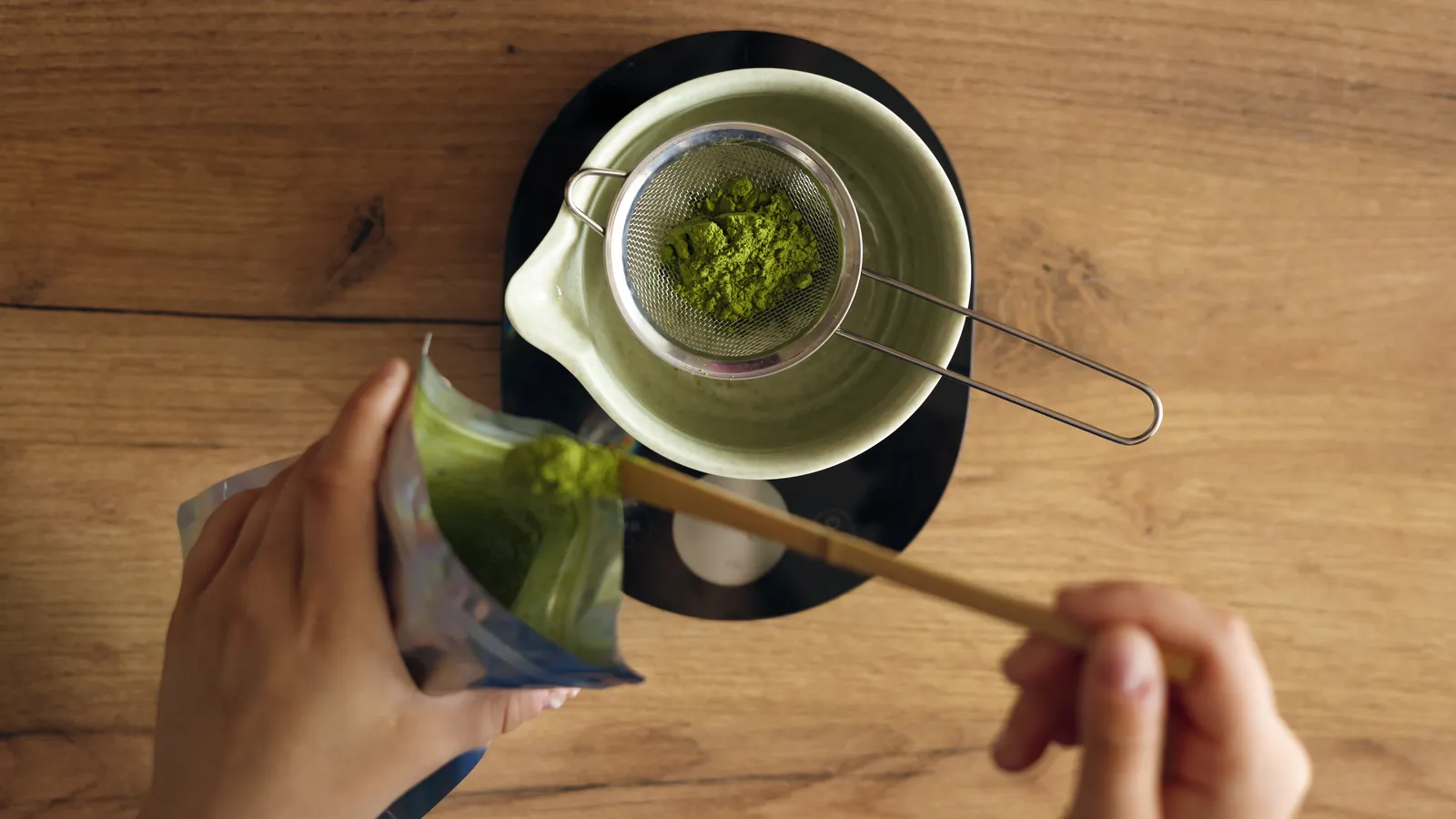
Evaluating a matcha sample well is mostly a procurement job, not a tasting job. Before you taste anything, you need to know which lot the sample came from, whether you can buy that same lot, what harvest year it is, and what happens when it runs out. Get those four answers and the tasting tells you something real. Skip them and you are rating a powder you may never receive again.
This guide is written from the supply side. It covers what to ask for, how to tell whether the sample represents the lot, which documents should arrive with it, how to compare fairly, and the red flags that should end a conversation early.
Key takeaways
In this guide
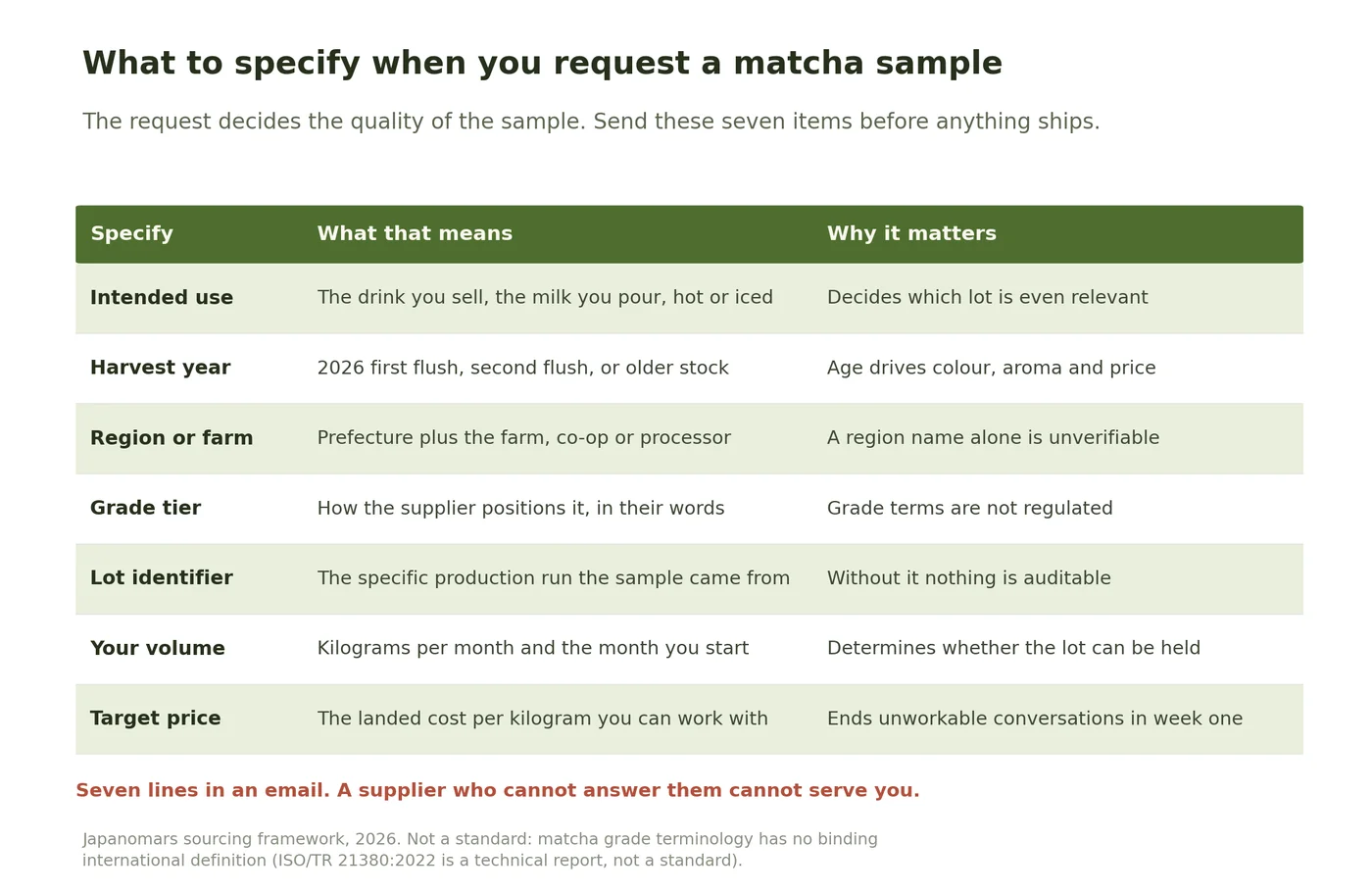
Specify six things in the request: your intended use, the harvest year, the region or farm, the grade tier, the volume you would realistically buy, and your target landed price. A supplier who receives that can send something relevant. A supplier who receives "can I get a sample?" will send whatever is nearest the door, and you will learn nothing useful about whether they can serve you.
Intended use matters more than grade language. A matcha that scores beautifully whisked in water can flatten under 12 ounces of oat milk, and one built to carry milk can read as coarse tasted straight. Tell the supplier what the drink is, what milk you pour, and whether it is served hot or iced. That sentence changes what a competent supplier picks off the shelf.
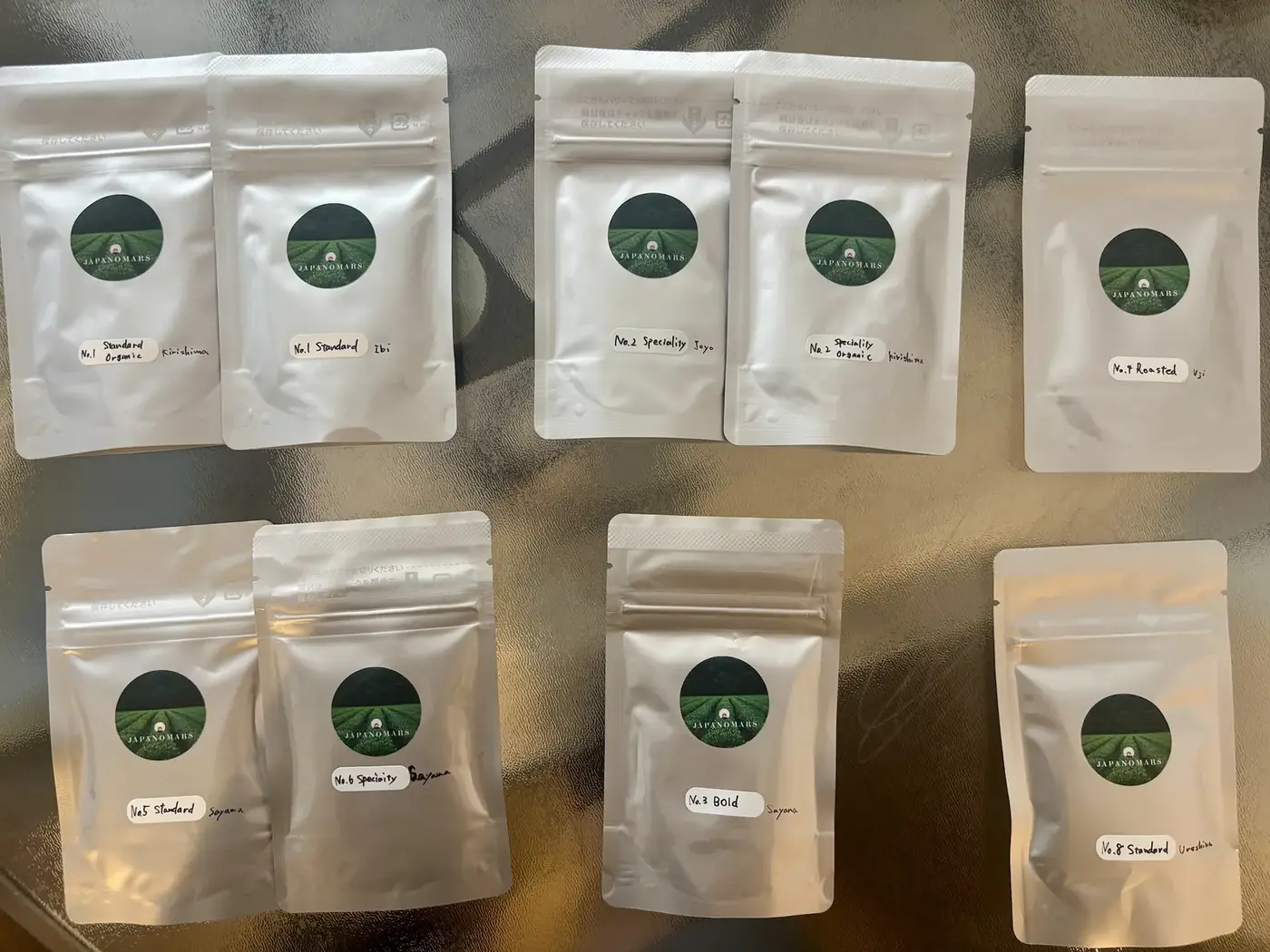
Ask for two or three candidates in one shipment rather than one. Buying decisions get made on comparison, and shipping three pouches together costs a supplier very little more than shipping one. It also tells you something: a supplier who can only offer one option has a narrow book, and a narrow book is a supply risk in a short-crop year. State a decision date while you are at it.
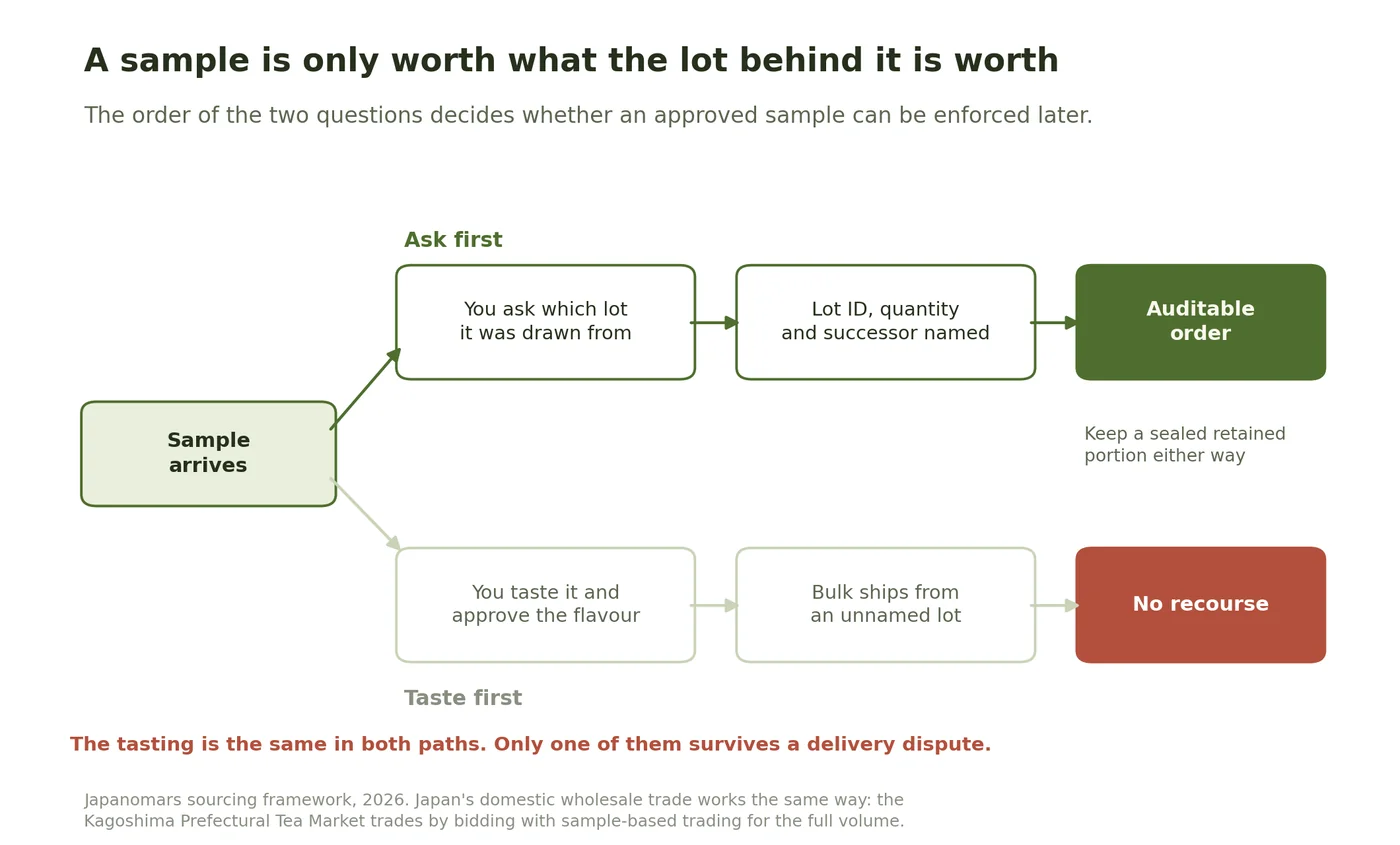
This is the question that separates a useful sample from a marketing exercise. Ask directly: is this drawn from a specific lot, can I buy that lot, roughly how much of it exists, and what will you send me when it is gone? A sample that cannot be tied to a lot is a flavour illustration, not a purchasing document.
Japan's domestic trade is built on exactly this principle. The Kagoshima Prefectural Tea Market, run by the Kagoshima Tea Industry Council, describes its trading method as bidding with sample-based trading for the entire volume, and buyers handle the leaf and judge colour and aroma on the bidding floor before they bid. There, the sample is the contract. When a pouch arrives at your cafe by post, that link is not automatic, so you have to ask for it.
There are two legitimate answers, and you should know which one you are buying.
Single lot. You are buying a defined quantity of one production run. The sample is exactly the product, but it ends, and the next lot will taste at least slightly different.
Blended to a profile. Japanese tea firms hold a flavour profile steady across lots and seasons through blending, known in the trade as gogumi. This is craft, not concealment, and it is why a well-run supplier can give you the same drink in March and October. Ask for the commitment: will the profile be held, who decides, and what happens if the season makes it impossible.
Ask for a retained reference sample either way. Keep your own sealed portion of what you approved, stored cold and dark, so the first bulk delivery has something to be checked against. It costs nothing, and it is the only leverage that survives a consistency dispute six months later. Our guide to matcha storage, freshness, and shelf life covers how to hold it.
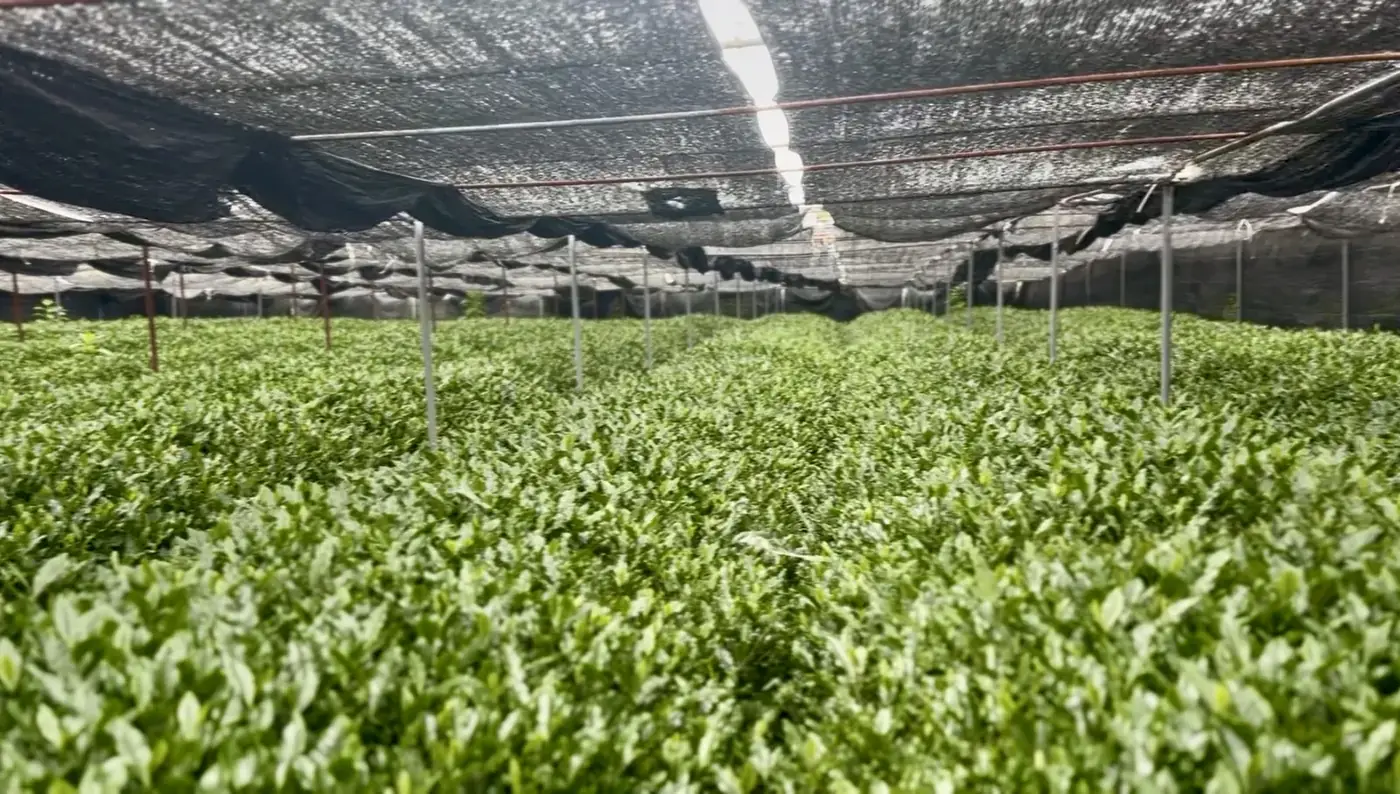
At minimum: harvest year, region, lot identifier, intended use or grade tier, and the milling or packing date. If the supplier makes a certification claim, the certificate should come with it. None of this is exotic. It is what any exporter already holds, and a reluctance to share it is itself information.
Be aware of what does not exist. The closest thing matcha has to an international reference is ISO/TR 21380:2022, published in April 2022 with Japan's National Agriculture and Food Research Organization leading the work. It is a technical report, meaning it describes cultivation, manufacture, and a sensory method rather than setting a binding standard, and no one polices label claims against it. So "ceremonial grade" on a pouch is a marketing term with no legal definition behind it, which is why the paperwork is the real specification. We covered what the grade words do and do not mean in matcha grades explained.
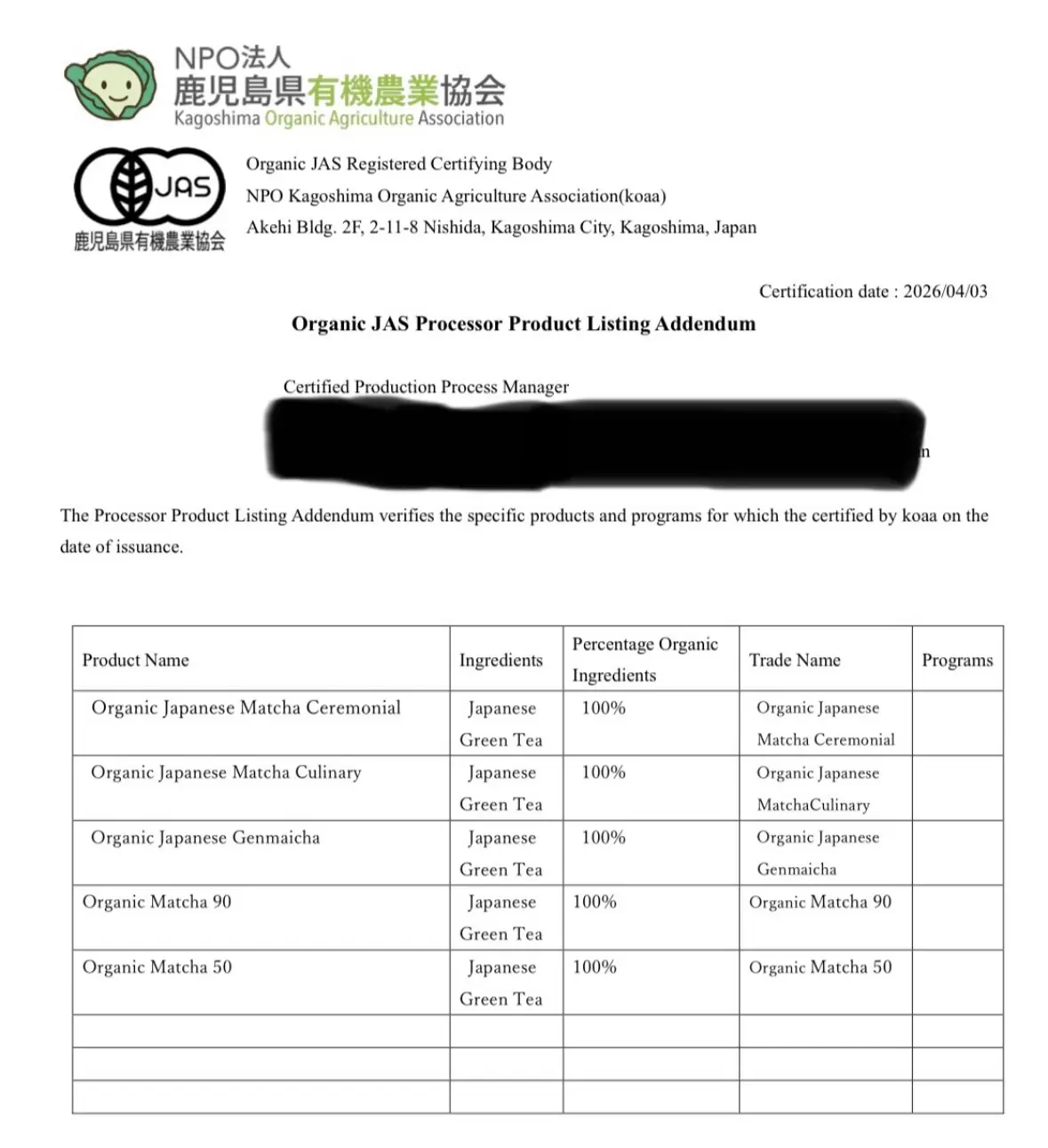
Two documents are worth asking for by name. A recent certificate of analysis, if you need residue or heavy-metal data for your own compliance. And the organic certificate itself, not a claim, if the matcha is sold as organic: Japan's JAS system and the US National Organic Program are separate schemes with an equivalence arrangement, covered in organic, JAS, and pesticide residue.
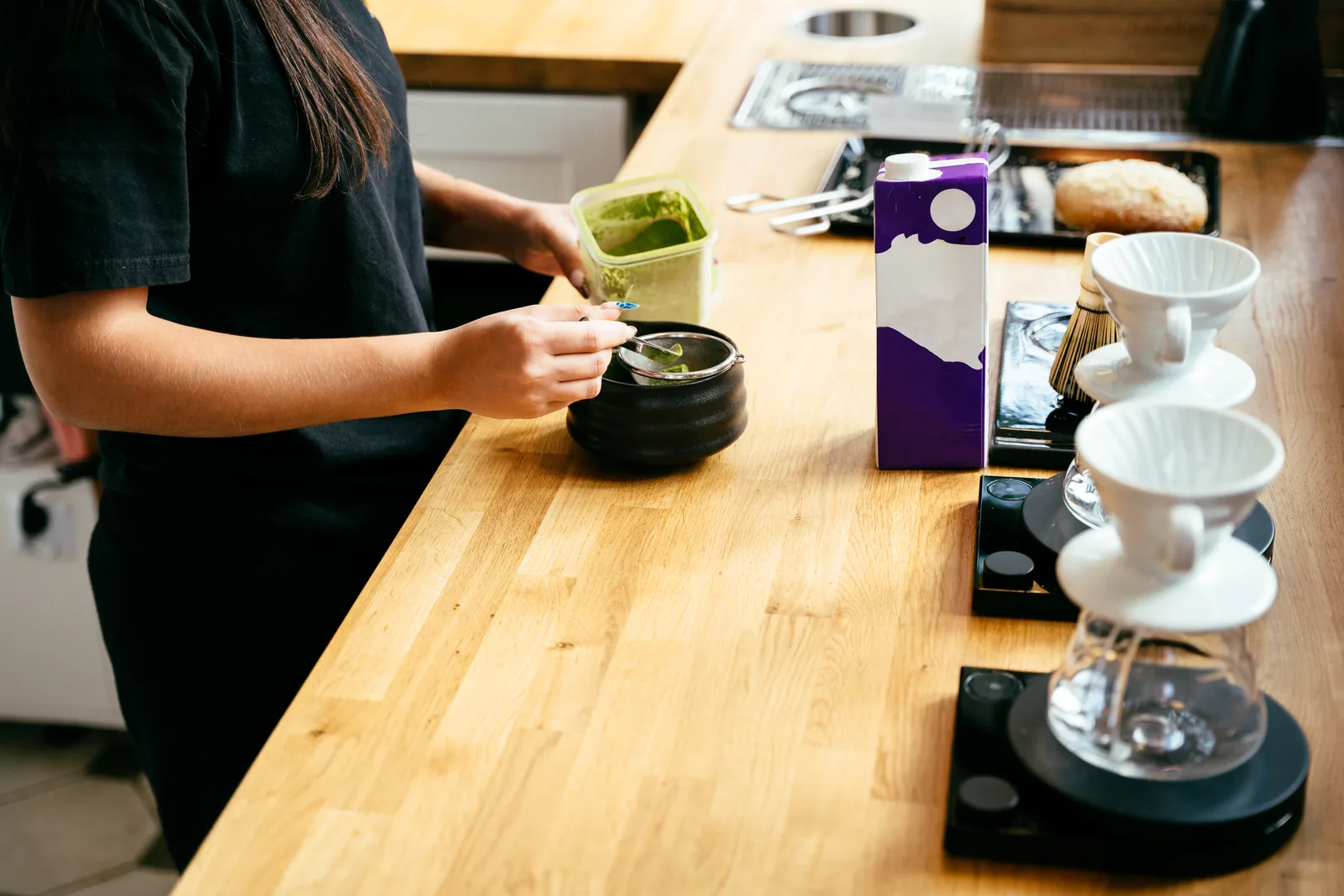
Blind, same day, same water, same dose, same milk, and never more than three at once. Include your current matcha as one of the unlabelled samples. Most buyers who skip the blind step end up confirming what they already believed, which is an expensive way to run a tasting, because the incumbent usually wins on familiarity rather than on quality.
Run each sample twice: once straight, then once as the drink you actually sell, at your normal ratio and milk. Tasting straight tells you about the leaf and the freshness; the drink test tells you about the business. A sample that places second straight and first in a latte is the right choice for a cafe that sells lattes.
Hold the mechanics identical across samples. The sensory method in ISO/TR 21380 uses 2 grams of matcha into 100 millilitres of hot water, whisked, which is a reasonable anchor for a repeatable straight tasting. Whatever you choose, keep it constant, because a large share of the differences people report between samples come from a moving dose or water temperature. For what you are looking for in the cup, see what makes matcha good.
Write the result down immediately, with the lot identifier next to the score.
Yes, in most cases, and a modest sample charge is usually a good sign rather than a bad one. Free samples are cheap to send and cheap to ignore, which is precisely why so many sample conversations end in silence. A small paid sample sets a real, low-risk transaction in motion and signals that you intend to buy something.
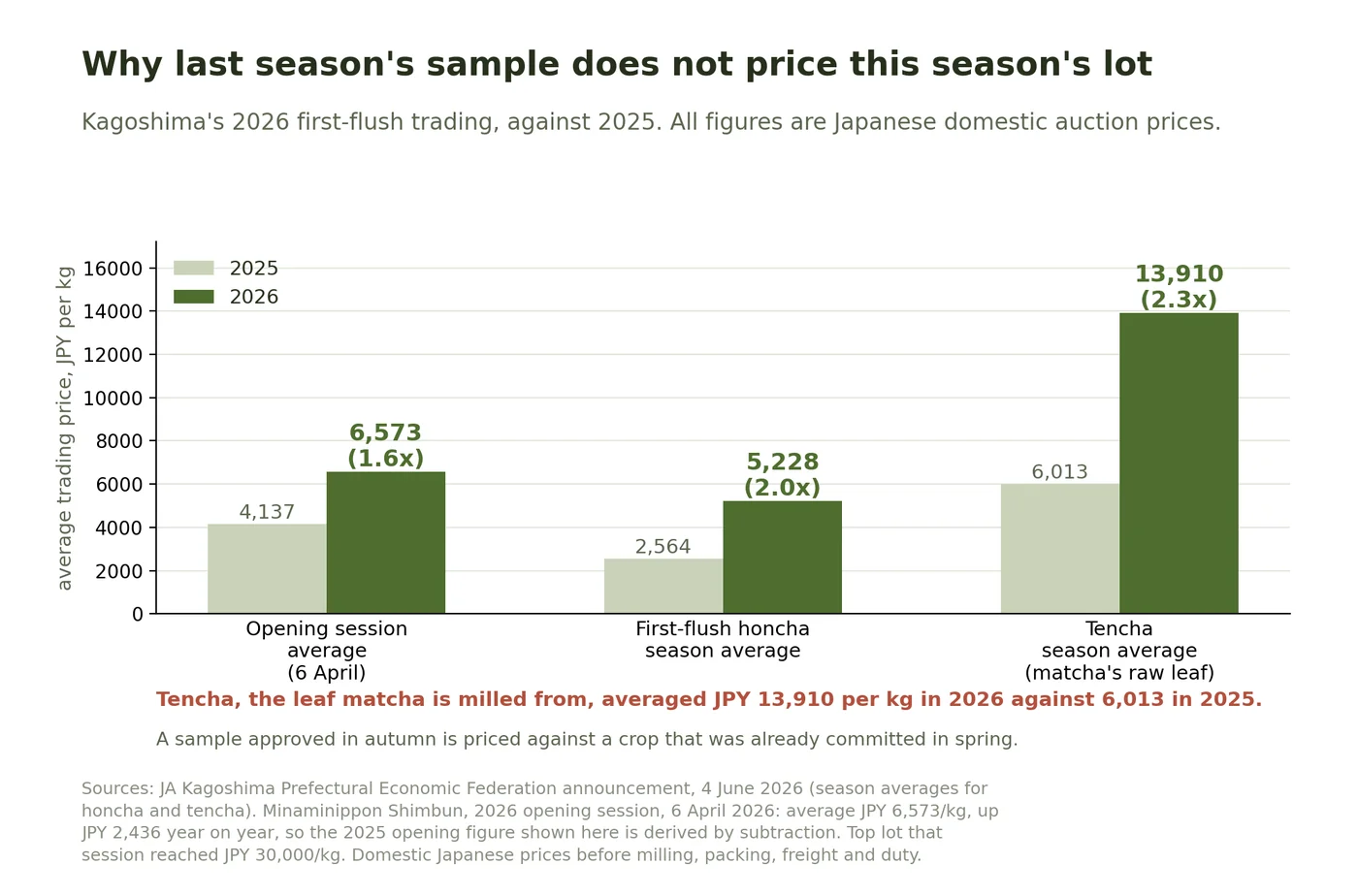
The arithmetic behind the charge is worth understanding. Matcha's raw material is tencha, and in 2026 tencha ran expensive: the JA Kagoshima Prefectural Economic Federation announced on 4 June 2026 that the season's average tencha trading price reached ¥13,910 per kilogram against ¥6,013 the previous year, roughly 2.3 times higher. That is the unmilled input, before milling, packing, freight, duty, and margin.
What should worry you is not a $10 or $20 sample charge. It is a finished wholesale price that looks impossible against those input costs, because something in that offer is not what it says it is. For where real wholesale numbers sit and how MOQs work, see wholesale and bulk matcha for US cafes.
Honestly: most sample conversations stop here, and from the supply side that stall is the most common outcome we see. It is rarely because the matcha was bad. It is because nobody named a volume, a start month, or a decision date, so the sample sat on a shelf until the season moved and the lot was gone.
The season is the part buyers underestimate. Japanese first-flush pricing is set in a compressed window each spring, and 2026 moved hard. Kagoshima's opening trading session on 6 April 2026 averaged ¥6,573 per kilogram, up ¥2,436 on the prior year, with a top lot at ¥30,000 per kilogram, according to Minaminippon Shimbun. By the end of the season JA Kagoshima's average for honcha stood at ¥5,228 per kilogram against ¥2,564 in 2025, the highest since 1975, and Japan Agricultural News reported on 16 June 2026 that even second-flush leaf was trading at roughly double the previous year. A sample you approve in September is being priced against a crop that was spoken for in May.
So send three numbers with your verdict: the volume you want, the month you want to start, and the price you can work with. If the answer is no, you have learned that in a week instead of a quarter. Matcha is also normally milled to order rather than held as finished powder, so a firm start month is what reserves your production slot.
From the sourcing floor
One of our cafe partners in Manila started exactly this way: a small paid sample set of two lots, a side-by-side tasting, and a decision made on the comparison rather than on either sample alone. The first email was in October; the first 50-kilogram bulk order came about five months later. That is a normal timeline, not a slow one.
Some answers should end the conversation before you taste anything. The pattern in all of them is the same: the supplier will not attach the sample to a real, finite, documented quantity of tea, which means nothing you taste can be enforced later.
None of these requires you to be a tea expert. They are procurement questions, and they are the same ones we recommend in how to find and vet a Japanese matcha supplier.
Run this as a one-page record per sample. The point is not the score. It is that in three months you can still reconstruct what you approved and hold a delivery against it.
Before the sample ships, confirm: intended use stated, harvest year, region or farm, lot identifier, whether the lot is buyable and in what quantity, what follows the lot, and the sample charge. On arrival, record: packaging condition, colour, milling or packing date, and the documents enclosed. During the tasting, record: blind rank straight, blind rank in your drink, and any defect notes. After the tasting, record: your target volume, start month, workable price, and decision date.
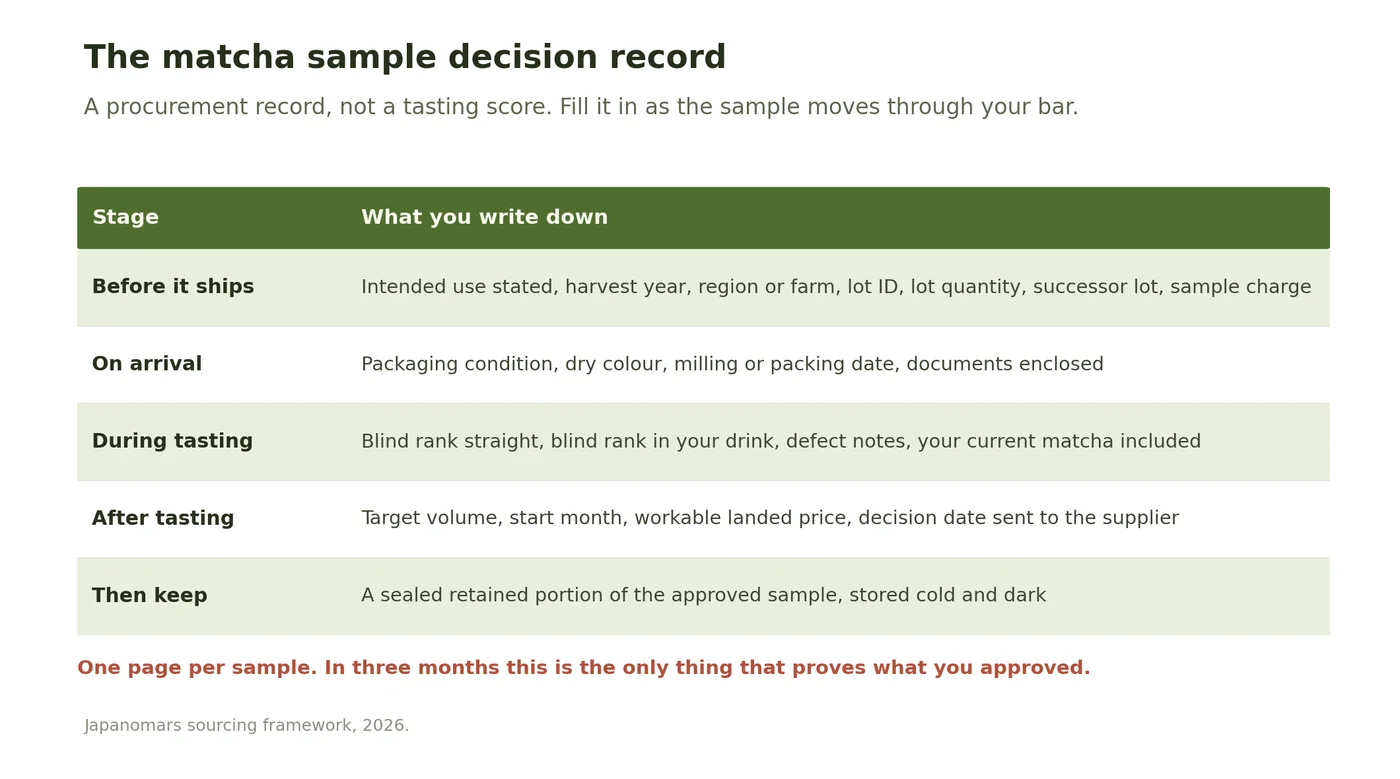
Then seal and keep a portion of what you approved. That retained sample is the reference for every delivery that follows.
Enough to make several drinks the way you actually sell them, which in practice means tens of grams rather than a single-serve sachet. A sample that allows only one whisked bowl cannot tell you how the matcha behaves in a 12 ounce latte, and the latte is what you are buying it for.
Usually yes, and a modest charge is a reasonable sign. Tencha, matcha's raw material, averaged 13,910 yen per kilogram in Kagoshima in 2026, about 2.3 times the 2025 level, so a serious sample carries real cost. Free samples are easy to send and easy to ignore.
Ask for the lot identifier, whether that lot is buyable and how much exists, and what will be sent once it runs out. Keep a sealed retained portion of the approved sample so you can compare it against the first delivery.
No. ISO/TR 21380:2022 is a technical report describing matcha's cultivation, manufacture, and sensory evaluation rather than a binding standard, and grade words on packaging are not policed against it. Treat harvest year, region, lot, and intended use as the real specification.
Two or three, tasted blind on the same day with your current matcha included. Beyond three, palate fatigue makes the later samples unreliable and the comparison stops being fair to whichever one you tasted last.
Treat an opened sample as a short-window reference and re-seal it cold and dark between sessions. Colour and aroma fade first once matcha meets air, light, and warmth, so a comparison run over several weeks from a repeatedly opened pouch is not comparing the same tea.
A matcha sample is only as good as the lot behind it. Ask which lot it came from, whether you can buy it, what harvest year it is, and what replaces it, and the tasting becomes a decision instead of an opinion.
We send comparison sample sets with harvest year, region, and lot details attached, along with current wholesale pricing. We work with cafes on long-term supply rather than one-off orders, so tell us what you pour and we will pick the candidates.
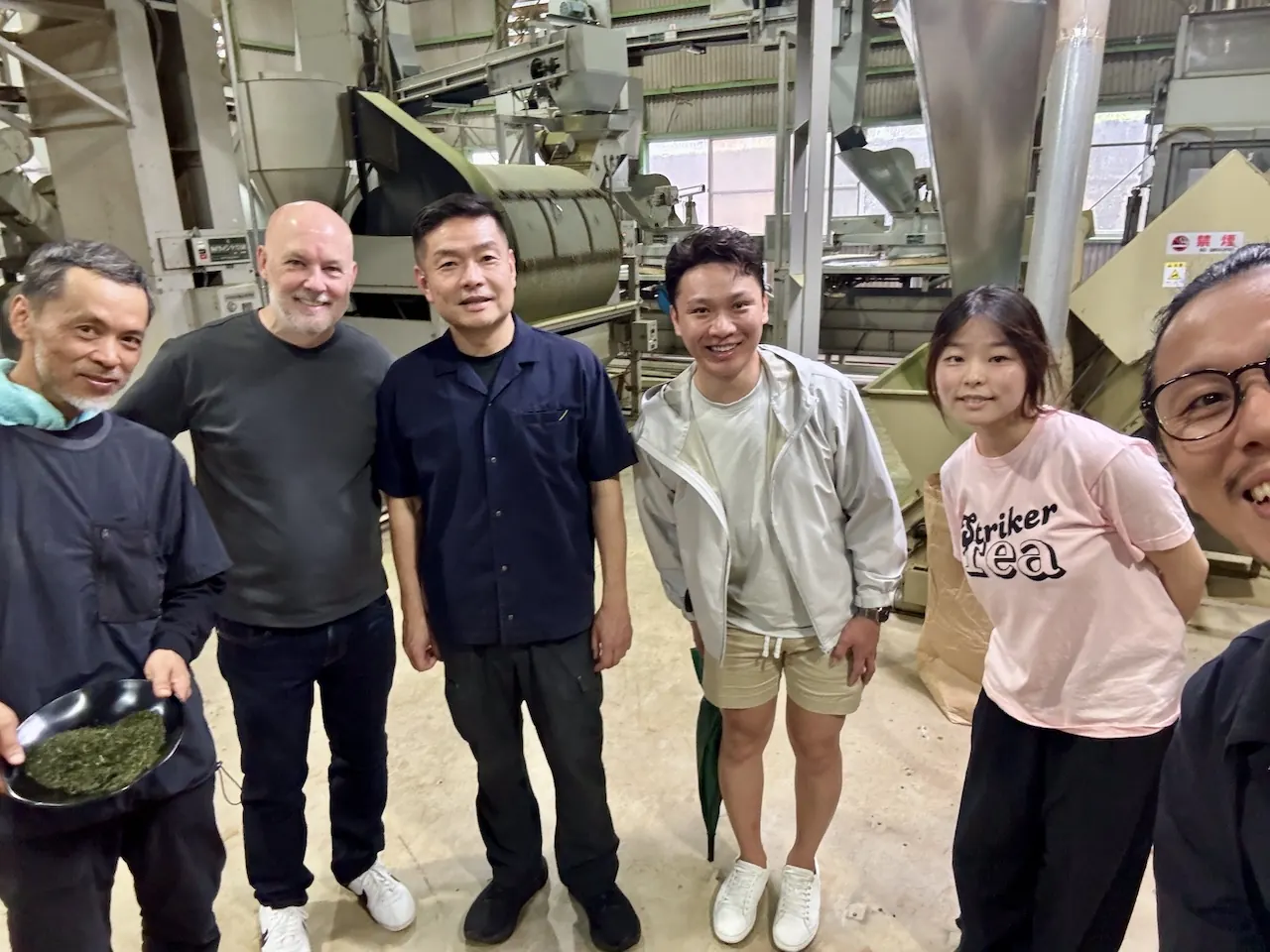
Request samples & pricingHiroshi Asami is the founder of Japanomars, which exports Japanese matcha to cafes in the United States, Canada, and the Philippines. He sources through direct relationships with growers and processors in Saitama, Gifu, Saga, Fukuoka, and Kagoshima, and has led four sourcing tours bringing overseas cafe owners to Japanese tea farms.
Sources
%E7%99%BD_%E5%A4%A7%E3%81%8D%E3%81%84.png)