%E5%A4%A7%E3%81%8D%E3%81%84.png)
Menu · Baking · 2026
Culinary grade is not a defined grade. No standard sets one out, so each Japanese maker draws the line itself, and it draws it on bitterness rather than on quality. For a kitchen that line is still the right one to buy on, because the oven takes a measurable cut of exactly what ceremonial grade charges you for. In one published trial, total catechins fell 19 per cent in fifteen minutes at 180 degrees Celsius.
Key takeaways
This is a guide to the buying decision rather than a recipe collection: which matcha belongs in the kitchen, how much goes in a batch, what that costs per item, and which applications justify reaching for the tin behind the bar.
In this guide
Nothing that is written down anywhere. Neither Japan's Green Tea Labeling Standard nor ISO/TR 21380:2022, the two documents that define matcha, sets out grades of any kind. Culinary grade is a line each maker draws inside its own range, on bitterness and astringency rather than defect.
You can see the line in the makers' own catalogues. Yamamasa Koyamaen in Uji lists its food-processing matcha in five steps of its own devising, Toku-A and Toku-B followed by numbers one through three. That is a real specification inside one house and meaningless outside it, because the next maker's number one is a different tea. A grade name is precise locally and travels badly. Our guide to matcha grades covers what you buy as you climb one supplier's ladder, and what counts as real matcha covers why no document defines the rungs.
The assumption worth dropping is that culinary grade is what is left over. It is a selection, not a sweeping. It leans on later-harvest leaf, thicker and more astringent, and that profile is chosen on purpose: a tea tasted through butter, sugar and flour has to survive them.
Nor is it a side business any more. A research paper published by Japan's House of Councillors in December 2025 warns that overseas demand is increasingly demand for matcha as a raw material in processed foods such as matcha sweets, and that this erodes the value of matcha as a product in its own right. Cafe kitchens are, in Japan's own framing, the demand changing what matcha is for.
Enough to change the buying decision. Researchers at the University of Leeds School of Food Science and Nutrition baked matcha shortbread at 180 degrees Celsius for 15 minutes, measuring the powder as dough and again after baking. Total catechins fell 19 per cent, and the profile did not simply shrink: heat converted one catechin into another, so what came out was chemically not what went in.
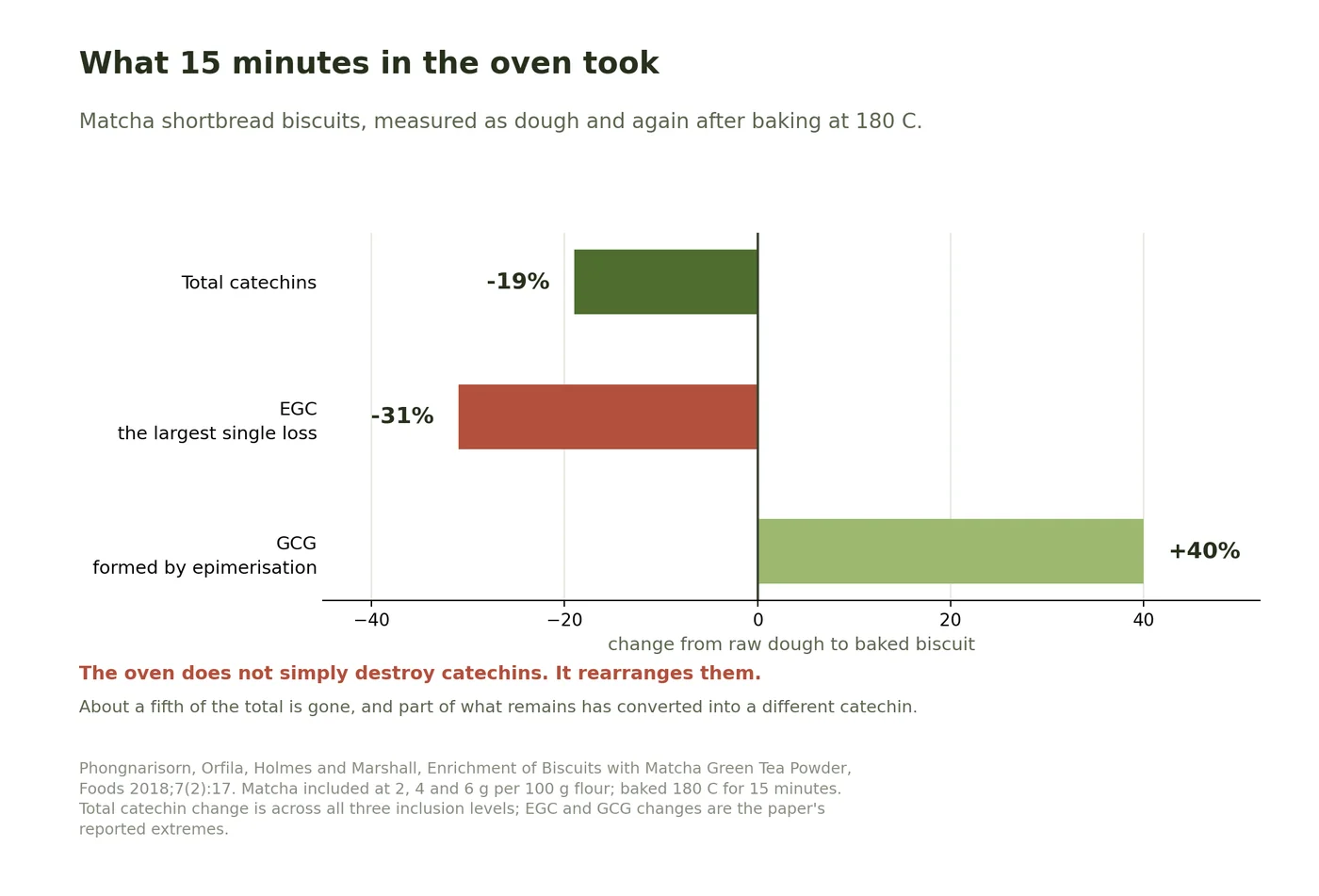
Two conclusions follow. Paying up for a whisk-grade tea and then baking it is largely spending money on the oven, because the aroma and sweetness that justify a ceremonial price are what heat removes first. And a baked matcha item is not a health item: the catechins are down a fifth and rebalanced, so the powder in a cookie is not the delivery you get from the same powder in a cup. Our matcha latte guide is where that argument belongs; a brownie is a brownie.
Because the colour is a magnesium atom, and heat and acid take it out. Chlorophyll converts to pheophytin when the magnesium at the centre of the molecule is replaced, a substitution driven mainly by acid and by heat, and a review of chlorophyll chemistry in food reports that conversion above 60 degrees Celsius. What you get instead is the dull olive brown of a bake that has gone over, and there is no oven that does not cross that line.
The honest framing for a pastry chef is that the reaction cannot be prevented, only slowed or routed around. Four levers follow from the chemistry, and only the last is reliable.
| Lever | What to change | How much it helps |
|---|---|---|
| Take the acid out | Swap buttermilk, sour cream, citrus or cream of tartar for neutral equivalents | Real, because acid drives the substitution directly |
| Shorten the heat | Lower temperature for longer, or a shorter bake at the same temperature | Real but small, and it fights your crumb and colour |
| Hide the shift | Pair with white chocolate, black sesame or a pale crumb that flatters olive | Cosmetic, and honest, which is more than green dye is |
| Add it after the oven | Dust, glaze, ice or fill with matcha once the item is out and cool | The only lever that keeps the colour intact |
The mechanism is the loss of magnesium from chlorophyll under acid and heat, per Ebrahimi and colleagues, Plants 2023, volume 12, article 1533. The four levers are what follows from that mechanism in a kitchen; we have not measured them in a lab and neither should you take them as tested results.
The practical version most cafes land on is a split build: matcha inside the item, dosed for flavour, and matcha on the outside, added cold, chosen for colour. It is the logic of finishing a dish with fresh herbs rather than cooking all of them into it.
Less than most cafes use. The Leeds trial tested three inclusion levels, 2, 4 and 6 grams per 100 grams of flour, in front of a consumer panel. The panel preferred the lowest. What put people off the stronger biscuits was colour and bitterness, and more sugar did not rescue them.
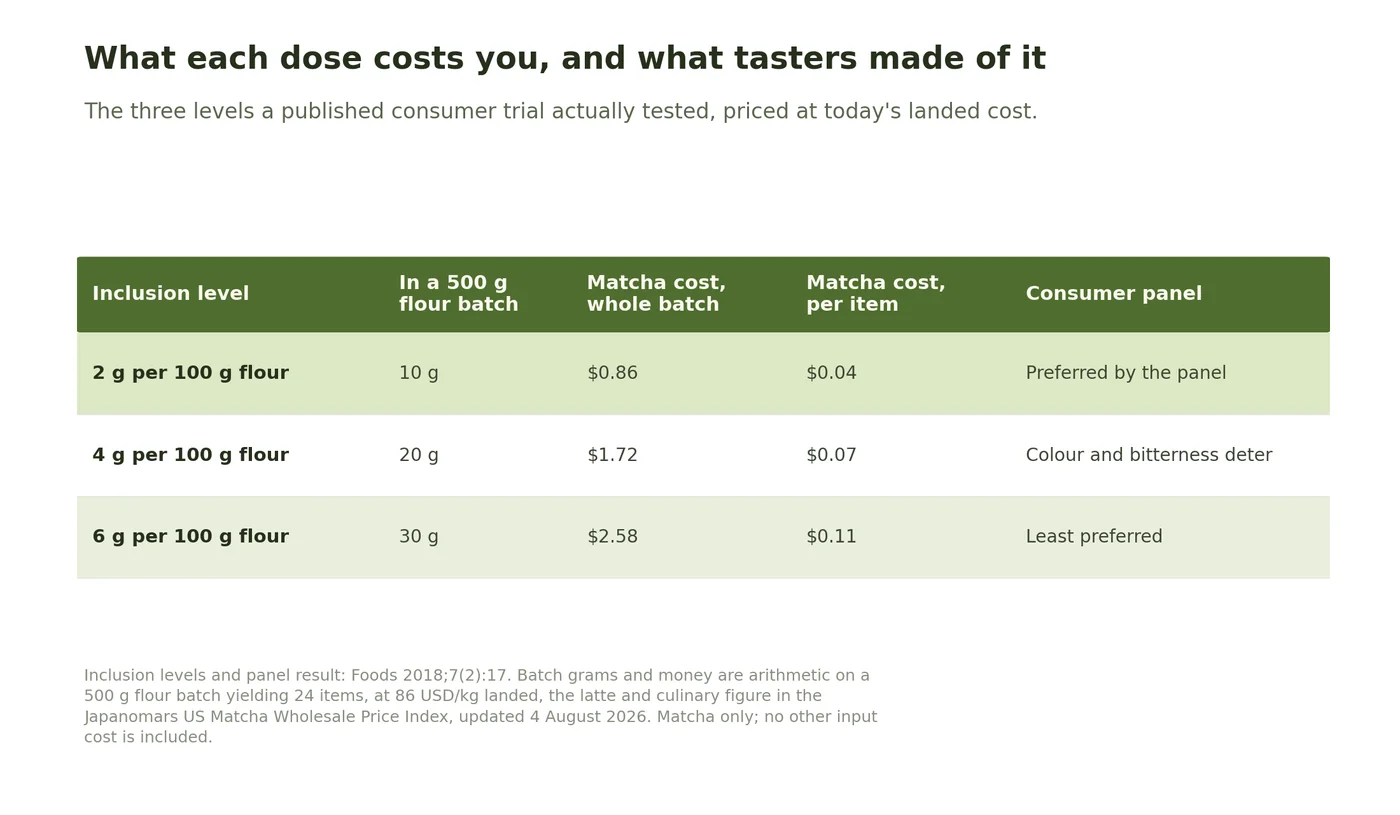
That is a useful correction, because the instinct when a matcha bake tastes flat is to add more powder, and more powder is what the panel liked least. If the flavour is not reading at 2 per cent, the likelier problems are too much sugar, old matcha, or a fat that coats the palate first.
Treat it as a starting line rather than a rule. It comes from a shortbread, which is high in fat, low in moisture and mild, so a wetter or busier base will want a different figure. Bake the range once against your own menu before you set a spec card. Our guide to adding matcha to a cafe menu covers how to run that test without tying up a service.
Under five cents an item at the dose that tasted best. Our own price index put latte and culinary grade at about 86 US dollars a kilogram landed on 4 August 2026, against about 171 for ceremonial. At 2 grams per 100 grams of flour, matcha is roughly 4 cents of a cookie. The more interesting number is what happens when you try to go cheaper.
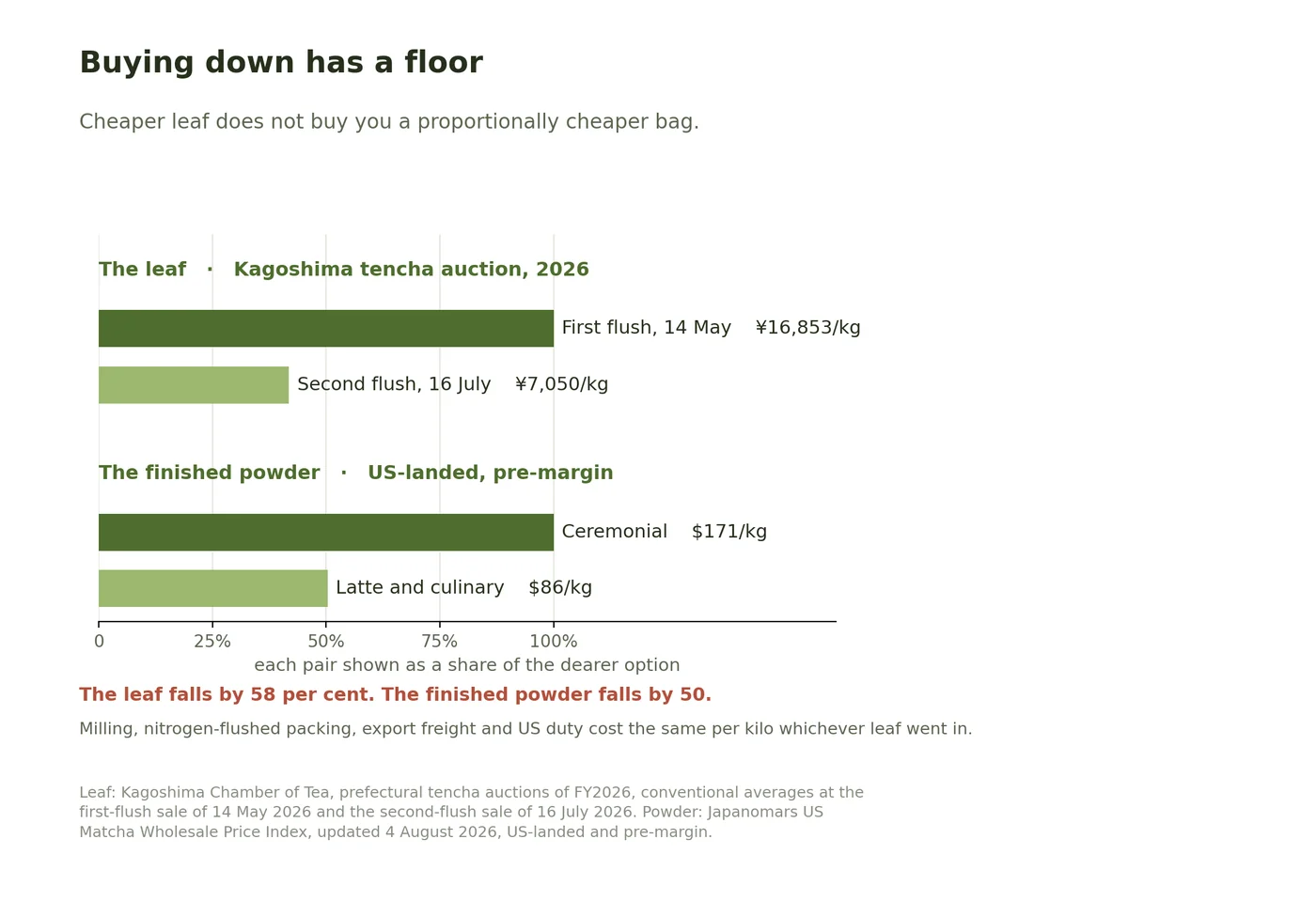
That gap is worth understanding before you negotiate. The leaf feeding culinary grade costs 42 per cent of first-flush leaf, but the finished bag costs 50 per cent of a ceremonial bag, because milling, nitrogen-flushed packing, ocean freight and US duty are charged per kilogram and do not care which leaf went into the mill. Below a point, you are buying the same freight with less tea attached.
So squeezing the kitchen SKU is close to the lowest-value negotiation available to you. Four cents of matcha in a cookie that sells for four dollars is not where the margin is. Our US matcha wholesale price index tracks both bands if you want to check the spread before your next order.
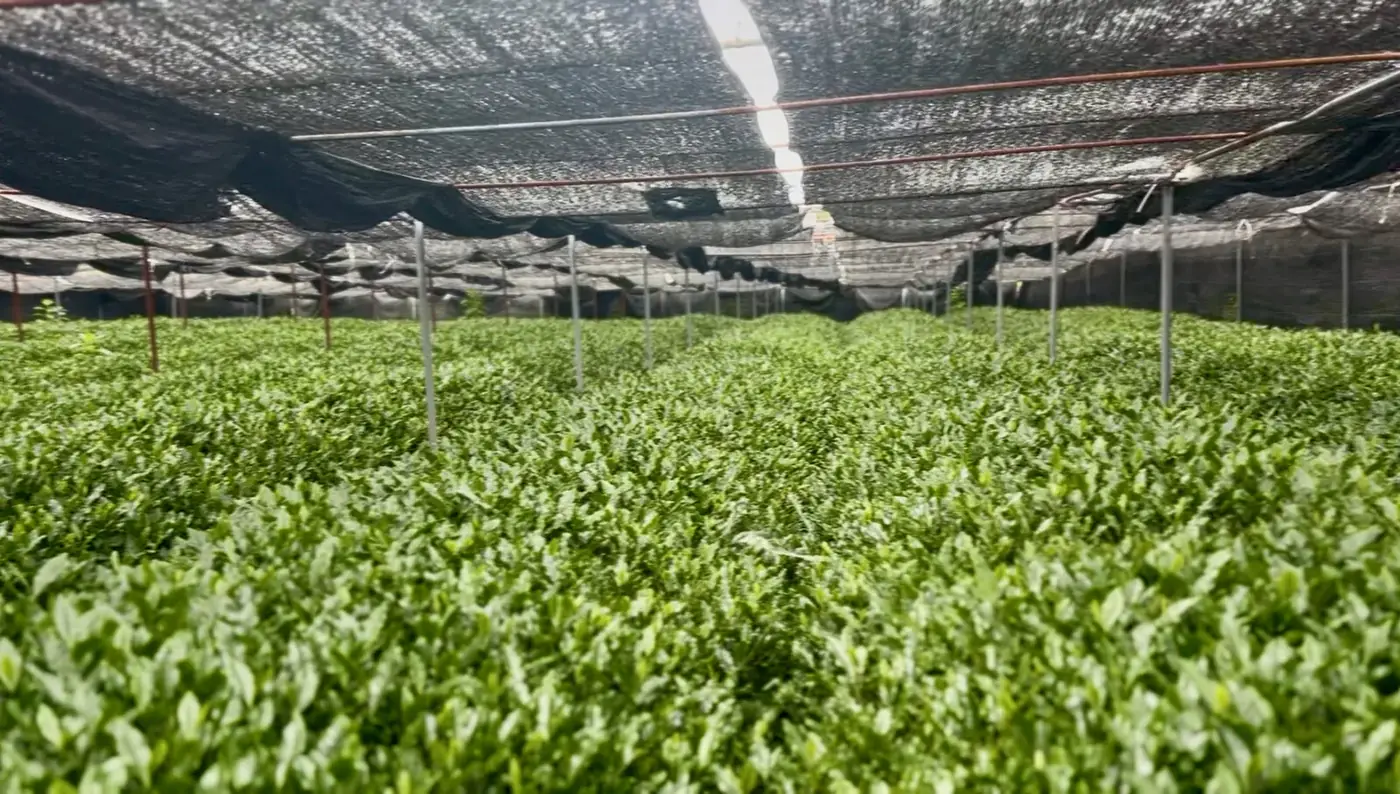
One question decides it, and it is not how special the item is. Ask whether the process degrades the matcha before anyone tastes it. If it does, buy food-processing grade. If it does not, the tea reaches the guest intact and a better one is worth the money. That sorting rule is not ours; it is the guidance Yamamasa Koyamaen publishes for its own customers.
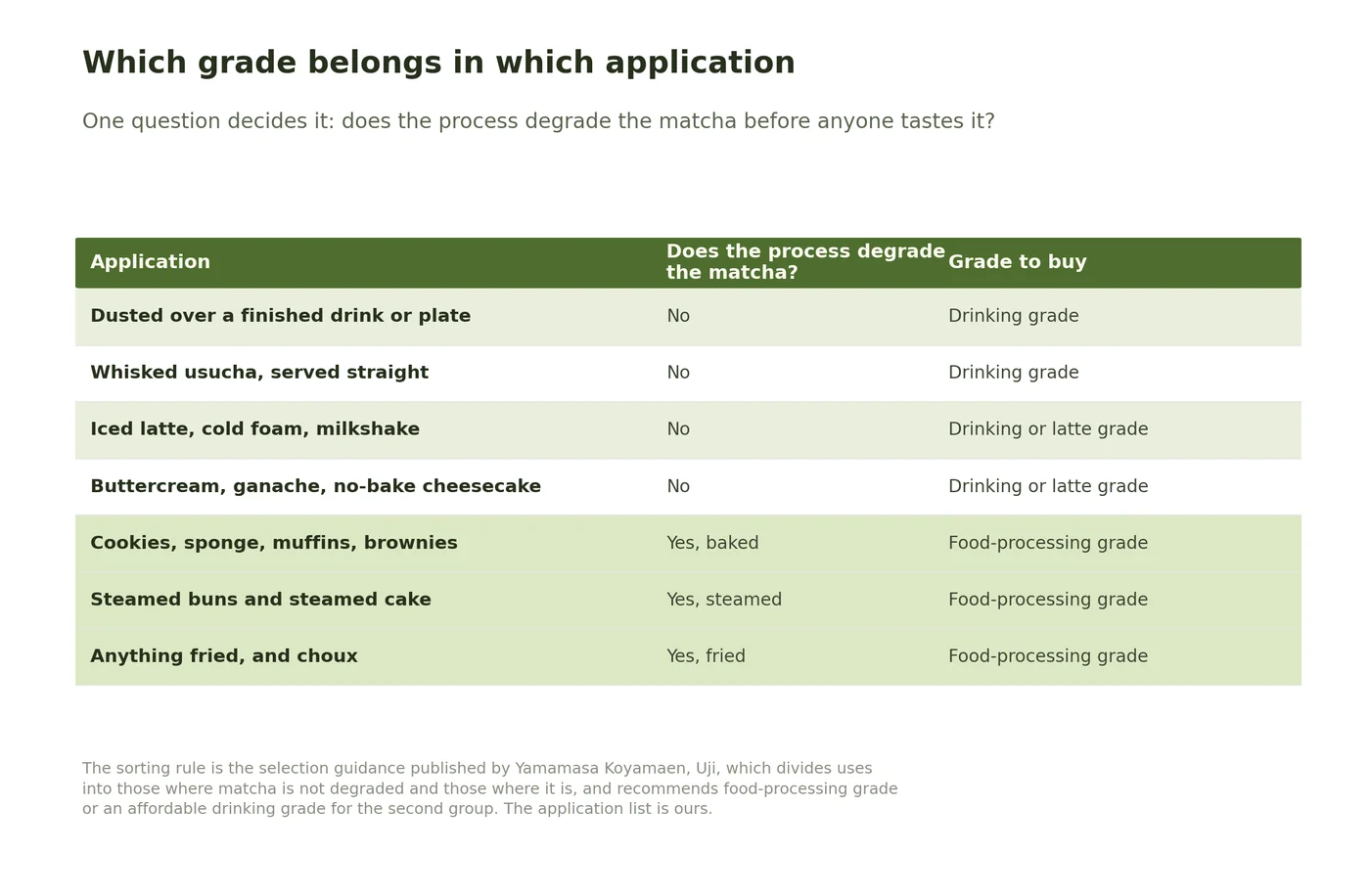
It cuts across the assumption that expensive items deserve expensive matcha. A buttercream on a cheap sponge should get the good tea, because it is never heated and every note survives to the fork. A laminated pastry that took two days should get the kitchen grade, because the oven flattens whatever you put in it. Prestige of the item is the wrong variable. Anything set rather than baked, folded into cold cream, or dusted at the pass is drinking-grade territory.
Buy it as a second SKU, not a bigger bag of the first one. A kitchen goes through matcha in bursts and a bar goes through it steadily, so one purchase pattern does not fit both. The failure mode is specific: a large bag bought on a per-kilo saving, then open for months.
| Decision | The bar tin | The kitchen bag |
|---|---|---|
| What you are optimising | Colour and aroma in the cup | Flavour that survives heat |
| Grade | Drinking grade | Food-processing grade |
| Sensible pack size | Small enough to finish in weeks | Sized to a month of production, not a year |
| After opening | Sealed cold, back in the fridge | Sealed cold, and dated on the bag |
| Who may open it | The bar | The kitchen, and only the kitchen |
The two-SKU pattern we recommend to cafes running both a matcha drink and a matcha bake. The shelf-life mechanics behind it are the same for both tins.
The clock starts when the seal breaks, which is what cafes underweight when a per-kilogram discount is on the table. Buying six months of kitchen matcha to save a few dollars a kilo means serving month-five matcha, and that flat, hay-like flavour is what makes an operator conclude the recipe was wrong. Label the two containers unmistakably and keep them apart. Our guide to matcha storage, freshness and shelf life has the full mechanics, and how matcha is made covers why a ground powder ages faster than a leaf.
We supply cafes in the United States, Canada and the Philippines from six regions in Japan, and we send the drinking grade and the food-processing grade together so you can decide in your own oven rather than ours. Tell us what you are making and we will match the grade to it.
From the sourcing floor
We carry a food-processing grade ourselves, and it is what goes into baked goods. At the supplier level in Japan it runs from about 3,000 yen a kilogram at the low end to 5,000 or 6,000 yen at the top, roughly double where it sat a year ago. It comes from several regions, it is second or third flush as a rule, and the colour is not good. That is the honest description of the grade this article is about, and it is why the colour argument above matters more than the grade name on the bag.
You can, and most of what you paid extra for will not survive. A published trial baked matcha shortbread at 180 degrees Celsius for 15 minutes and lost 19 per cent of total catechins, and the aroma and sweetness that separate a whisk-grade tea are what heat removes first.
Chlorophyll lost its magnesium and became pheophytin, which is dull olive brown. The replacement is driven by acid and by heat, and a review of chlorophyll chemistry in food reports it above 60 degrees Celsius, so every oven is far past that. An acidic batter, from buttermilk, citrus or cream of tartar, speeds it up.
Start at 2 grams of matcha per 100 grams of flour, which is 10 grams in a 500 gram batch. That was the lowest of three levels in a published consumer trial and the level tasters preferred; colour and bitterness put them off the stronger ones.
It is a different selection, not a lesser process. Neither Japan's Green Tea Labeling Standard nor ISO/TR 21380 defines any grade, so each maker sorts its own tea, usually by bitterness. One maker's food-processing grade can beat another's drinking grade.
It reduces them and rearranges them. In the same trial, total catechins fell 19 per cent, EGC dropped by up to 31 per cent and GCG rose by up to 40 per cent as heat converted one catechin into another. Do not make health claims for baked items.
Our own price index put latte and culinary grade at about 86 US dollars a kilogram landed on 4 August 2026, against about 171 for ceremonial. At 2 grams per 100 grams of flour, that is roughly 4 cents of matcha in a cookie.

Hiroshi Asami is the founder of Japanomars, which exports Japanese matcha to cafes in the United States, Canada, and the Philippines. He sources through direct relationships with growers and processors in six regions across five Japanese prefectures, and has led four sourcing tours bringing overseas cafe owners to Japanese tea farms. The Japanese sources on this page were read in the original and translated for this article.
Sources
%E7%99%BD_%E5%A4%A7%E3%81%8D%E3%81%84.png)