%E5%A4%A7%E3%81%8D%E3%81%84.png)
Menu · Hojicha · 2026
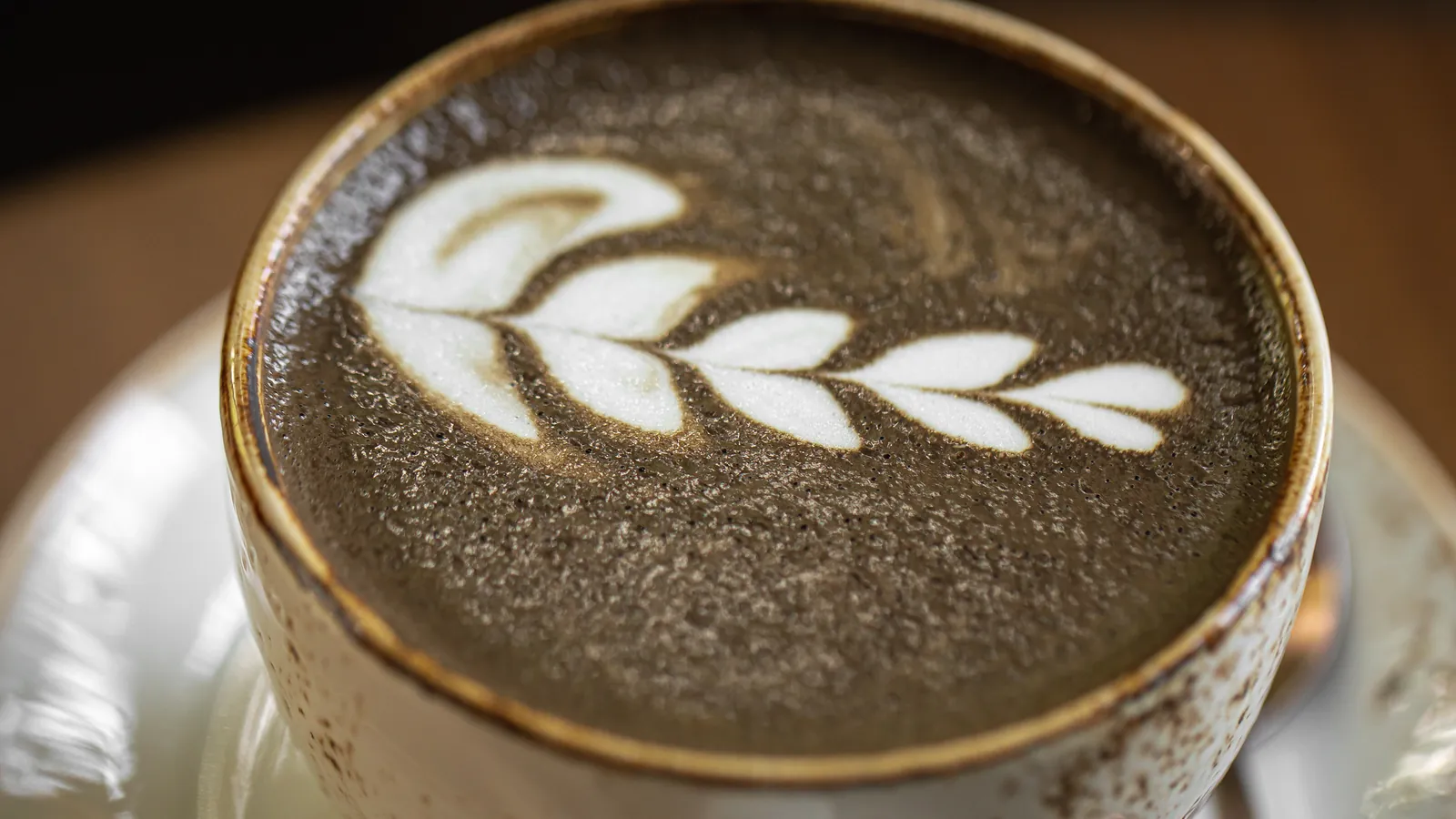
A hojicha latte is roasted Japanese green tea built like a matcha latte, either whisked from powder or poured from a brewed concentrate. Which of those two you choose decides almost everything: the tea in one costs 21 cents brewed from leaf and 54 cents from powder, and only the brewed version has a caffeine figure you can actually stand behind.
Key takeaways
This guide is about the drink itself rather than the category. It covers the two builds and their ratios, what the caffeine claim really is, what a cup costs, and what happened in 2026 to the leaf hojicha is made from, using Kyoto market figures that are not published in English.
In this guide
A hojicha latte is roasted Japanese green tea served with milk. The leaf is fired in a rotating drum at around 200C until it turns reddish brown, which converts the grassy, vegetal character of green tea into something toasty and faintly caramel. That roast is why it works with milk without needing sugar to rescue it, and why it appeals to the customer who tried a matcha latte once and found it too green.
Cafes are adding it now for a practical reason rather than a fashionable one. A matcha programme gives you one tea drink and one flavour direction. Hojicha gives you a second one that shares the same equipment, the same milk, the same cup and, if you buy well, the same supplier. It is the lowest-friction second tea SKU a cafe can add, which is exactly why it keeps appearing next to matcha on 2026 boards rather than replacing it.
If you are still deciding whether hojicha belongs on your menu at all, rather than how to build it, our guide to hojicha and other Japanese teas for your cafe menu compares it against genmaicha and sencha. This article assumes you have made that call and starts at the bar.
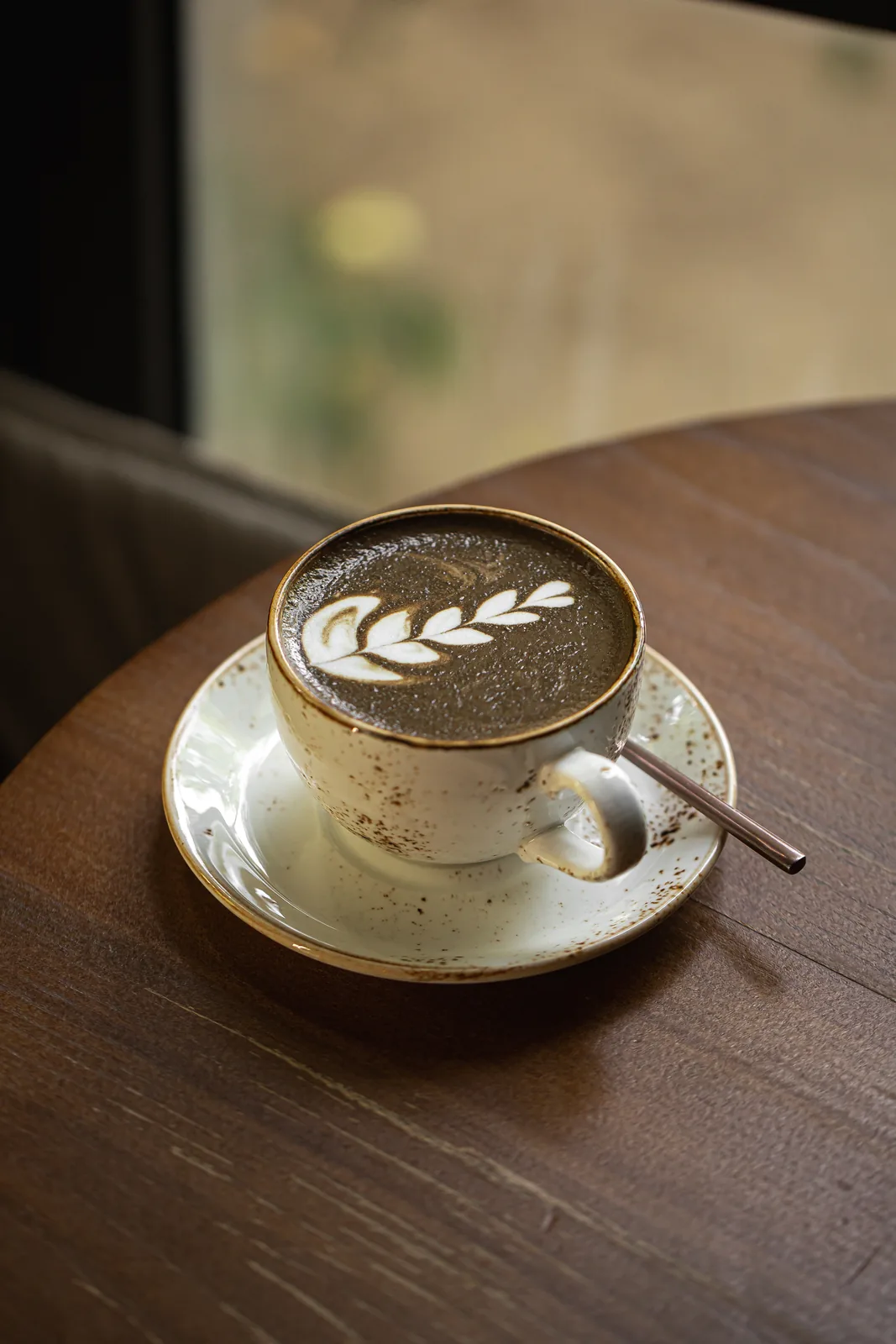
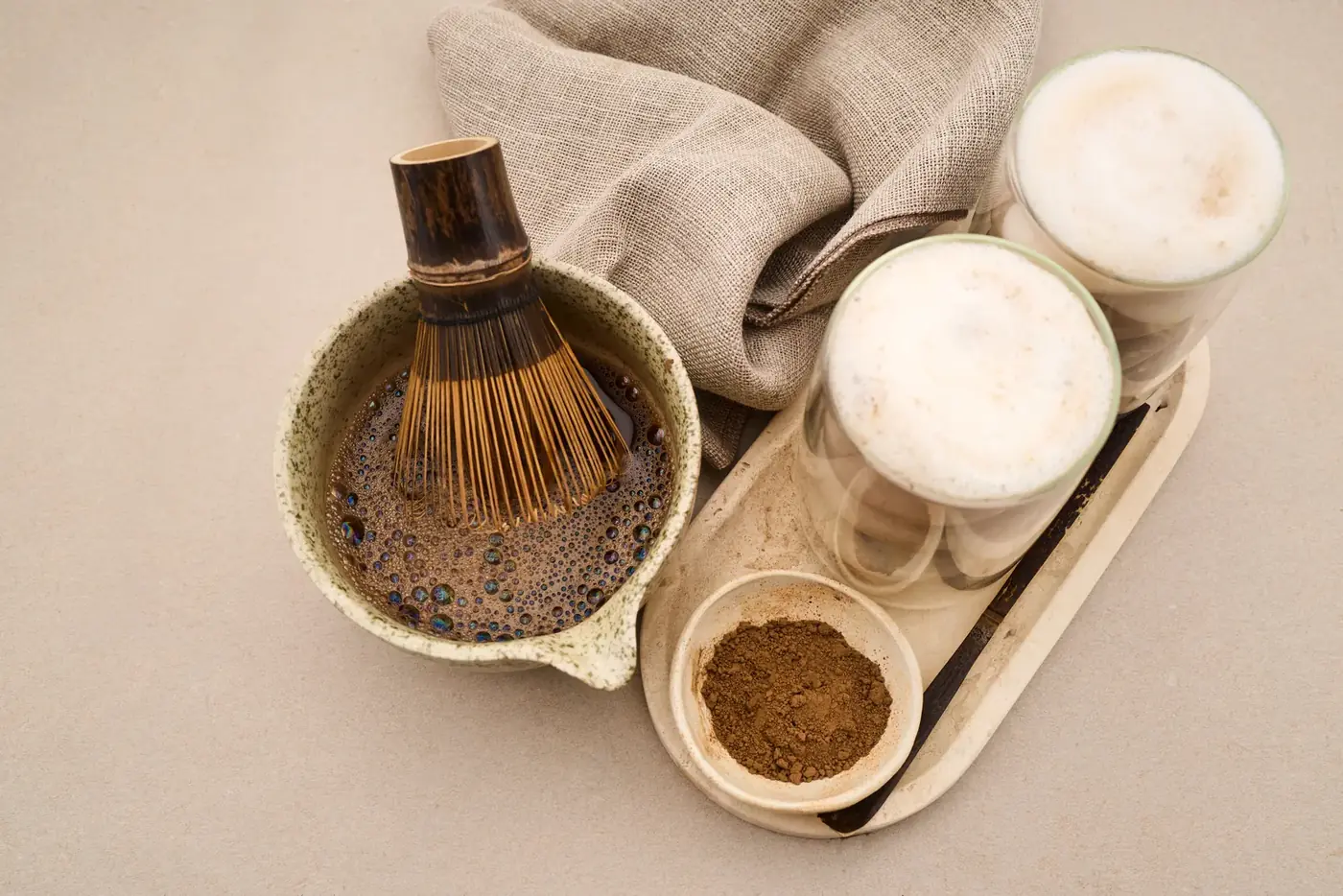
Powder is faster and more consistent, brewed concentrate tastes better and costs less. Powder behaves exactly like matcha, so your bar already knows the motion, and the colour is uniform every time. Concentrate keeps the roast aroma that powder loses in milling and storage, and it cuts the tea cost of the drink by roughly half.
The honest trade-off is aroma against throughput. Hojicha is bought on smell more than taste, and the aroma compounds created in the roast are volatile. Grinding a roasted leaf into powder and then leaving that powder open on a bar for a week loses a great deal of what you paid for. A concentrate brewed each morning does not have that problem, but it does need a batch routine and fridge space, and it is one more thing to run out of at 2pm.
Most cafes we supply end up running both: powder on the hot bar, where speed matters and the milk is carrying the drink anyway, and a batched concentrate for iced, where a bigger cup and ice would thin a powder build out. Our iced matcha guide applies the same split to matcha, and it holds better here, because roast aroma survives cold far better than it survives an open tin.
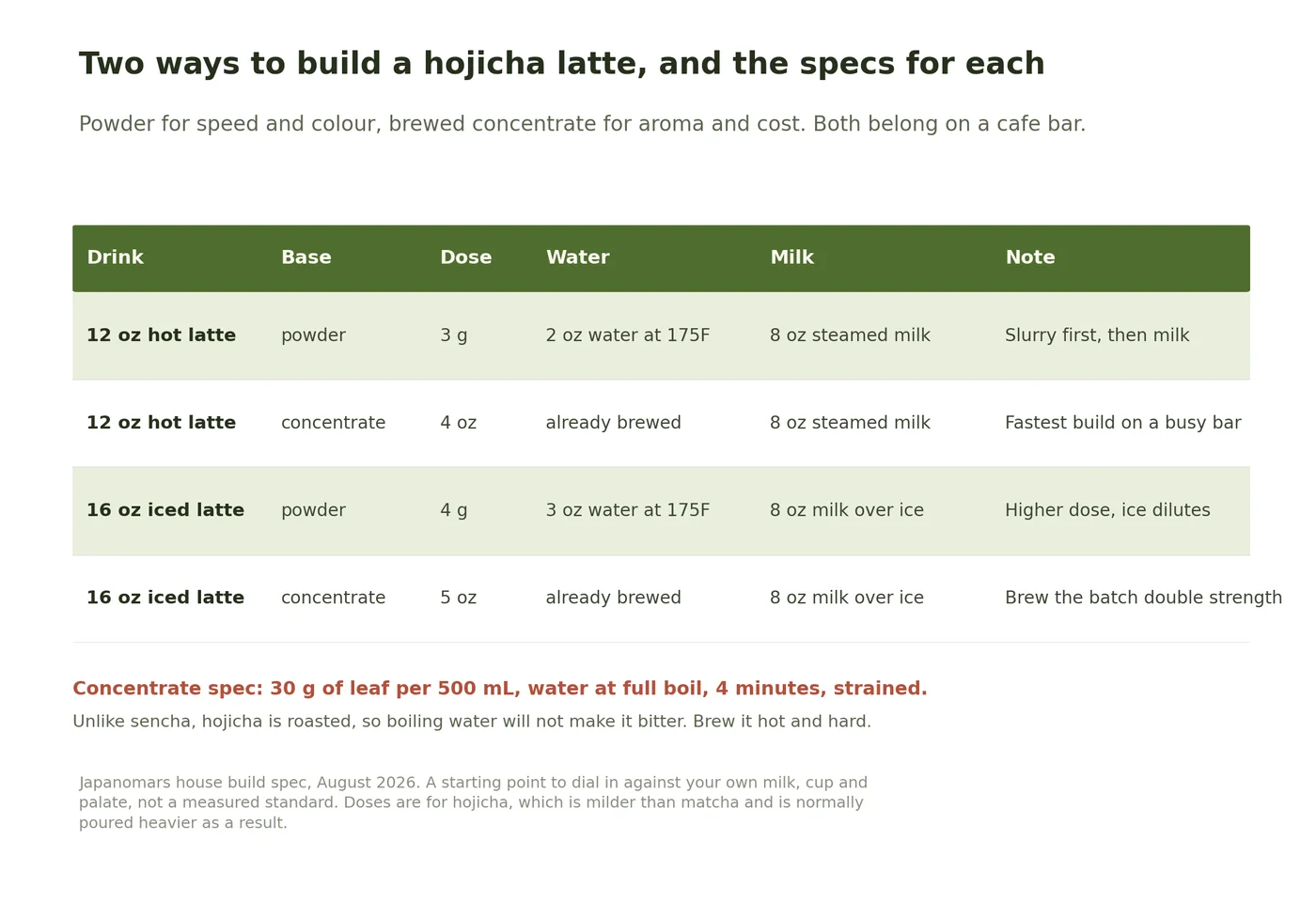
Start at 3 grams of powder for a 12 ounce hot latte and 4 grams for a 16 ounce iced, which is about a gram more than you would use of matcha in the same cup. Hojicha is milder, and a matcha dose poured straight across will disappear under 8 ounces of milk. On concentrate, use 4 ounces hot and 5 ounces iced, brewed at 30 grams of leaf per 500 mL for 4 minutes.
Two technique points matter more than the exact numbers. The first is water temperature, and it runs opposite to everything your baristas have learned about green tea. Sencha needs restraint because heat pulls astringency out of an unroasted leaf. Hojicha has already been through 200C, so there is no astringency left to pull. Brew it at a full boil and brew it hard. Timid water is the single most common reason we see a cafe conclude that hojicha tastes like nothing.
The second is that hojicha and sugar are not the same relationship as matcha and sugar. The roast reads as sweet before any sugar is added, so a build that carries two pumps of syrup as a matcha latte usually wants one, or none, as a hojicha one. Dial the sweetener down before you dial the dose up. Our note on the mistakes baristas make with matcha covers the whisking and clumping problems that carry over to powder builds unchanged.
Brewed hojicha is genuinely low in caffeine. Japan's official food composition tables put a hojicha infusion at 20 milligrams per 100 mL, so a latte built on 4 ounces of it carries about 24 milligrams. That is a little over a third of a 2 gram matcha latte and about a sixth of a 12 ounce drip coffee. Hojicha powder is a different drink and the figure does not transfer.
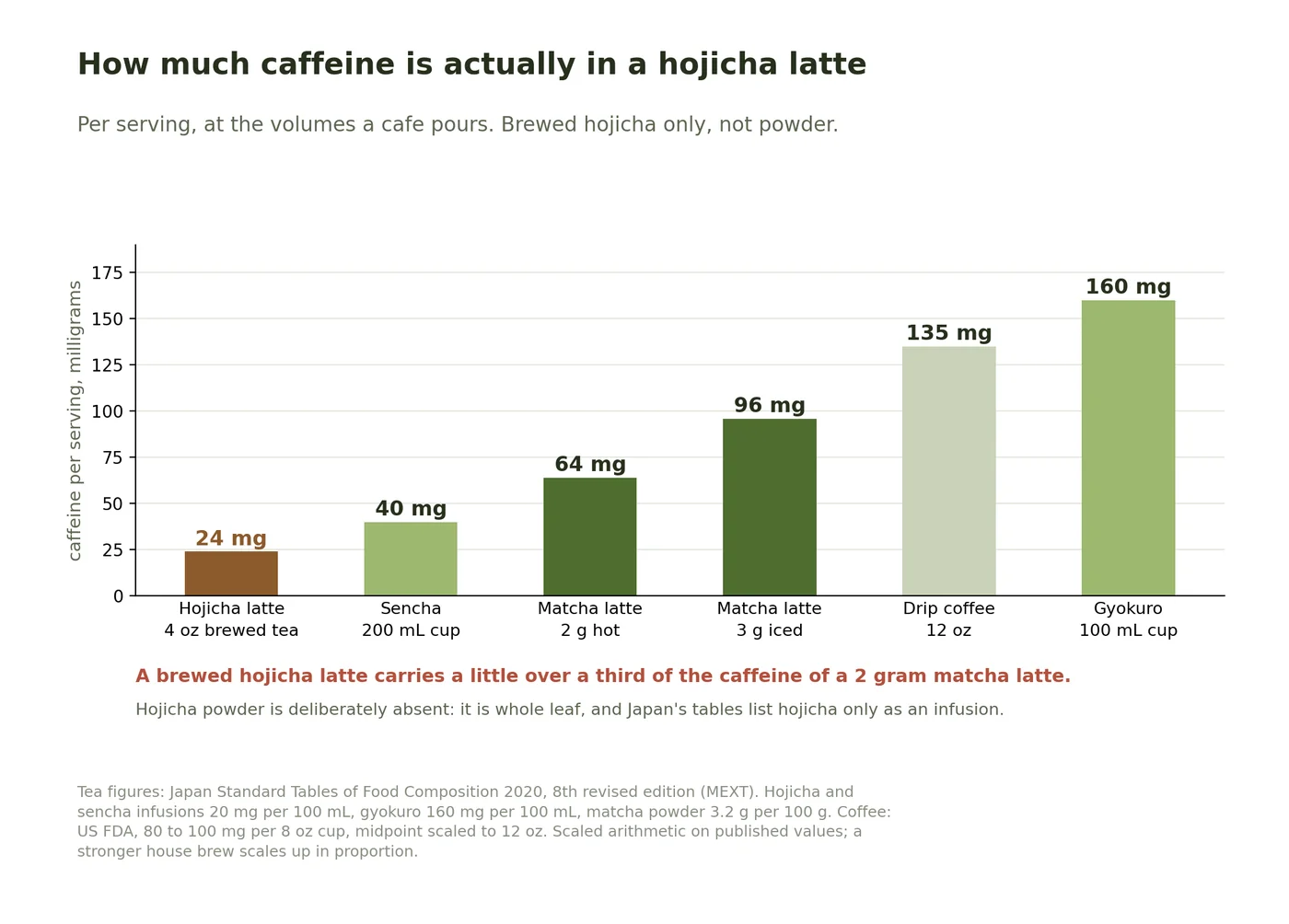
Two things make brewed hojicha low. The base leaf is usually bancha or stem rather than young spring buds, and it starts with less caffeine to begin with. Then the roast runs above caffeine's sublimation point of about 178C, so some of what is left leaves the leaf as vapour. Neither mechanism is exotic, and together they are why the number lands where it does.
The trap is the word brewed. In a brewed cup, most of the caffeine stays behind in the spent leaf and goes in the bin. In a powder drink you swallow the entire leaf, so nothing is left behind. Japan's composition tables publish a value for matcha powder, 3.2 grams per 100 grams, but they list hojicha only as an infusion, with no entry for the powder. So a cafe that builds with powder and prints low caffeine on the board is making a claim that no published source supports. If that claim matters to your customers, ask your supplier for a lab result on the specific lot rather than borrowing the brewed figure.
Between about 21 and 54 cents of tea, and the spread is decided by powder against leaf rather than by quality. Brewed from leaf at an illustrative $30 per kilogram, a 7 gram serving is 21 cents. Built from powder at a published US wholesale price near $135 per kilogram, a 3 gram hot drink is 41 cents and a 4 gram iced one is 54 cents.
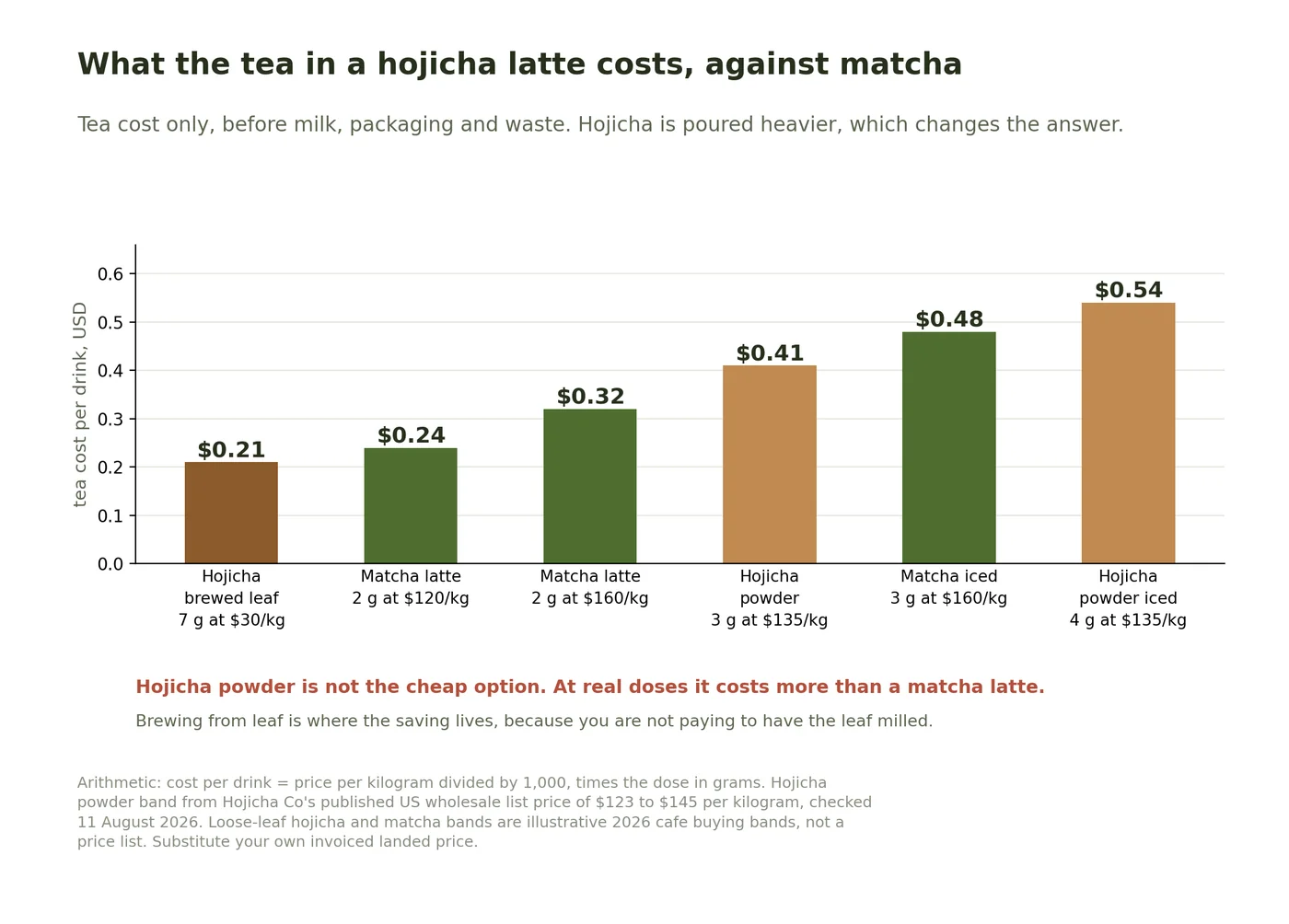
The result surprises most buyers, so it is worth stating plainly: at these prices and doses, hojicha powder is not a cheaper drink than matcha. Published US wholesale hojicha powder sits in the same band as latte-grade matcha, and because hojicha is milder you pour more of it, so the finished drink can cost more. If you added hojicha to the menu expecting margin relief from a matcha price rise, powder will not deliver it.
The reason is that milling, not leaf, is most of what you are paying for. The raw leaf behind hojicha traded at about $18 a kilogram in Kyoto this year. Once it is refined, roasted, milled fine enough to suspend in milk, packed under nitrogen and freighted, that leaf is a small fraction of your invoice. Brewing skips the expensive half of the chain, which is why the concentrate build costs half as much. Our matcha wholesale price and availability index works the same logic through in detail for matcha.
The coarse leaf that becomes hojicha has repriced harder than tencha has, in percentage terms, and the figures behind it are not published in English. At Kyoto's tea market, karinaoshi, the coarse first-flush leaf refined into hojicha and genmaicha, averaged 2,850 yen a kilogram in 2026 against 674 yen in 2024. That is 4.2 times in two years, on 54% less volume traded.
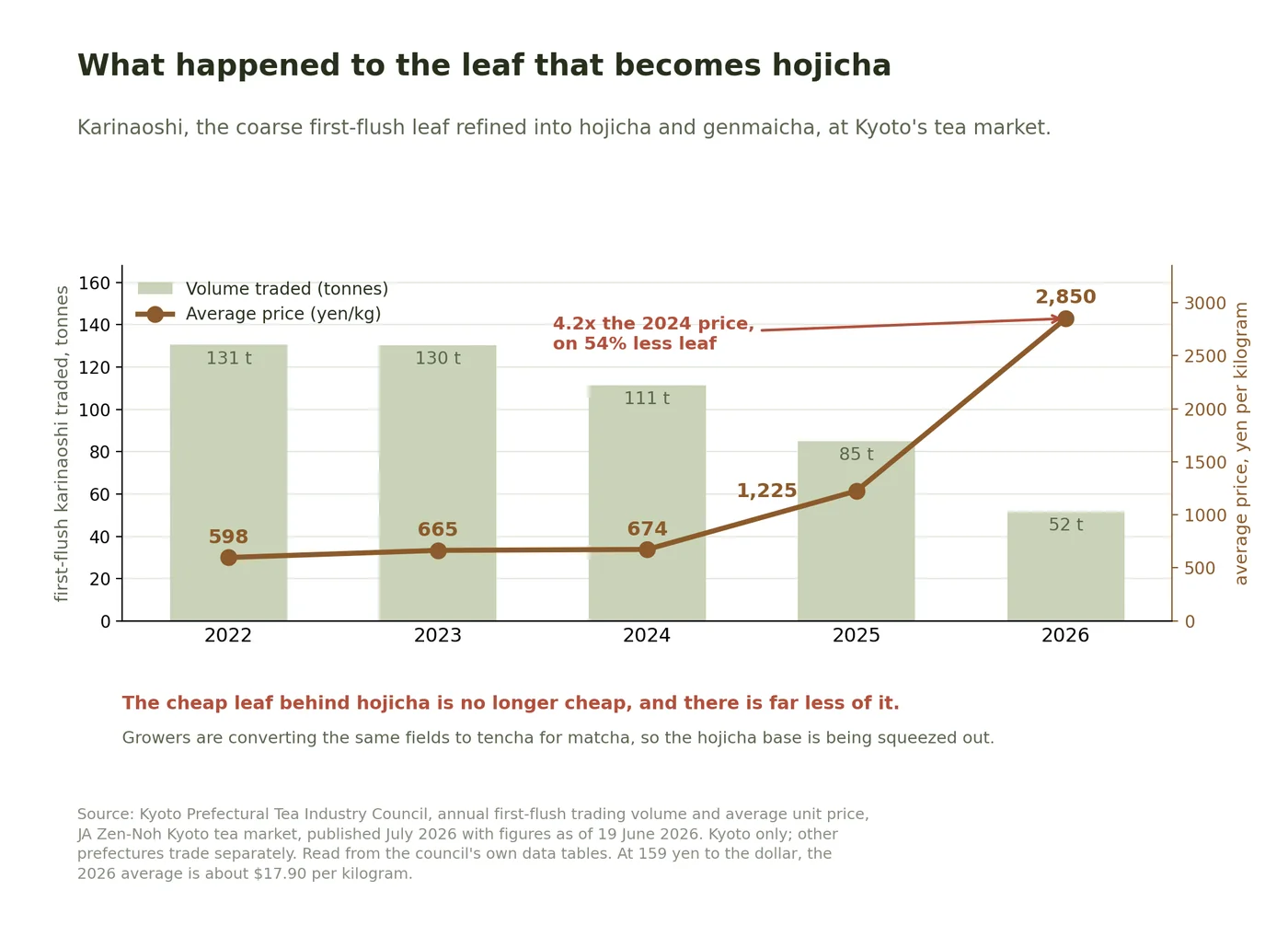
Over the same two years, Uji tencha at the same market went from 20,024 to 52,086 yen a kilogram, which is 2.6 times. Tencha is still far more expensive in absolute terms, but the gap between the two has closed sharply. Tencha cost about 30 times as much as karinaoshi in 2024 and about 18 times as much in 2026.
| First-flush average, Kyoto | 2024 | 2026 | Change |
|---|---|---|---|
| Karinaoshi (hojicha and genmaicha base) | 674 yen/kg | 2,850 yen/kg | 4.2x |
| Uji tencha (matcha base) | 20,024 yen/kg | 52,086 yen/kg | 2.6x |
| Tencha as a multiple of karinaoshi | 29.7x | 18.3x | gap closed |
| Karinaoshi volume traded | 111,335 kg | 51,654 kg | down 54% |
JA Zen-Noh Kyoto tea market, first flush, as of 19 June 2026. Published by the Kyoto Prefectural Tea Industry Council. Kyoto only; other prefectures trade separately.
The mechanism is the matcha boom itself. Karinaoshi was never really a product, it was what came off the field alongside the leaf a grower actually wanted to sell. When those same fields are converted to shade-grown tencha because matcha pays better, the by-product stops appearing, and a tea that was cheap because it was incidental becomes expensive because it is incidental to nothing. Our matcha market supply and demand outlook covers the conversion trend on the tencha side of the same equation.
For a US buyer the practical reading is this. Hojicha is a good second SKU on demand grounds and a poor one as a hedge, because it is exposed to the same shortage from the other end. Anyone selling you hojicha as the cheap, unaffected alternative to matcha is either not watching the leaf market or hoping you are not.
Hojicha is usually sampled in water and then has to survive 8 ounces of milk, and roast aroma that reads as beautiful on its own can vanish under a latte. Test the way you will serve it, and ask six questions before you commit to a lot.
Then run the milk test properly. Build your actual house latte with each sample at your actual dose, leave it four minutes, and taste it at the temperature a customer would. A hojicha that still smells like roasted tea at that point is the one to buy, regardless of how it performed in a tasting cup. The same discipline we apply to matcha samples, and the questions worth asking any Japanese tea supplier, are in our guide to finding and vetting a supplier.
From the sourcing floor
So much leaf is now going into tencha that the raw material for hojicha, and for sencha, is getting scarce and expensive too. The hojicha we are quoted runs from around 3,000 yen a kilogram at the low end to about 10,000 yen at the top. As for concentrate, I have not yet heard of a cafe switching from powder to a brewed build. The powder is still what they ask for, which is exactly why the cost section above is worth reading twice.
A hojicha latte is roasted Japanese green tea served with steamed or cold milk, built either from hojicha powder whisked into a slurry or from a strong brewed concentrate. It tastes toasty, nutty and faintly caramel, with almost none of the grassy astringency of matcha, because the leaf has been roasted at around 200C rather than shaded and dried.
About 24 milligrams in a latte built on 4 ounces of standard-strength brewed hojicha, using the 20 mg per 100 mL figure in Japan's official food composition tables. That is a little over a third of a 2 gram matcha latte and about a sixth of a 12 ounce drip coffee. A stronger house brew scales the number up in proportion.
Only if you brew it from leaf. Hojicha powder sells at a published US wholesale price close to latte-grade matcha, and because hojicha is milder it is normally poured at 3 to 4 grams rather than 2, so a powder-built hojicha latte can cost more per drink than a matcha one. Brewed from leaf, the same drink lands near 21 cents.
Powder if you want speed, a consistent colour and a build your baristas already know from matcha. Brewed concentrate if you want the roast aroma, which is the whole point of the tea, and a materially lower cost per drink. Many cafes run powder on the espresso bar and a batched concentrate for iced.
For a 12 ounce hot latte, 3 grams of powder slurried in 2 ounces of water at 175F, then 8 ounces of steamed milk. For a 16 ounce iced, 4 grams in 3 ounces of water over 8 ounces of milk and ice. On concentrate, use 4 and 5 ounces respectively, brewed at 30 grams of leaf per 500 mL for 4 minutes.
Be careful. The low figure published by Japan's food composition tables is for brewed hojicha, where most of the caffeine stays in the spent leaf. A powder drink is whole leaf, so the caffeine is far higher, and Japan's tables list hojicha only as an infusion, with no entry for the powder. If you build with powder, ask your supplier for a lab result before you make a claim.
A hojicha latte earns its place on a menu because it sells to the customer matcha does not reach, not because it is cheap. Build it from leaf if you want the cost saving and the aroma, from powder if you want the speed, and be precise about the caffeine claim either way. The 2026 leaf market has made the second question, where your hojicha actually comes from, as worth asking as it has been for matcha.
We supply cafes in the United States, Canada and the Philippines from growers in six regions across five Japanese prefectures, and we mill to order rather than from finished stock. Tell us your build, hot or iced, powder or brewed, and your monthly volume, and we will send samples of both formats from the same lot with current wholesale pricing.
Request samples & pricing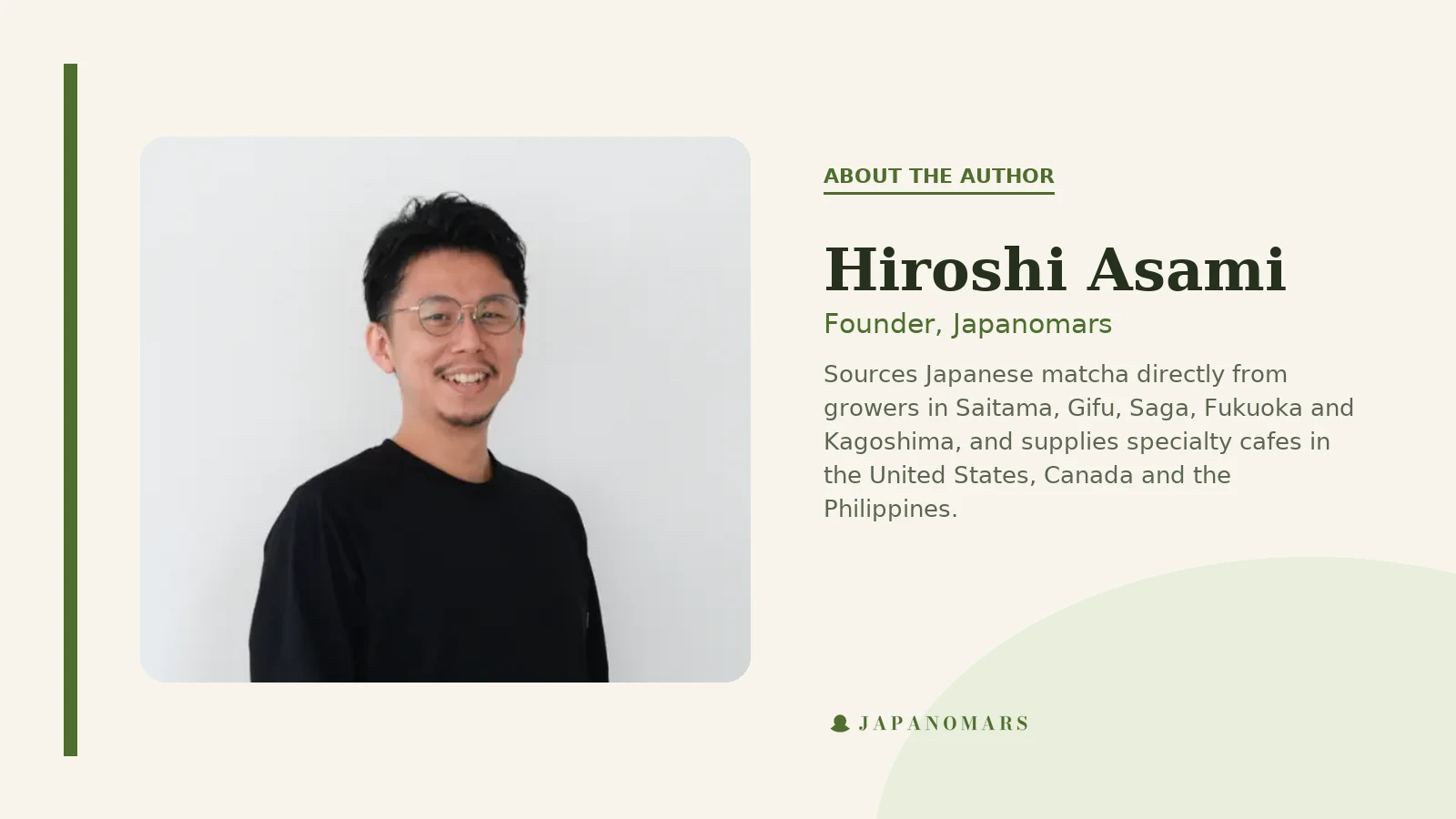
Hiroshi Asami is the founder of Japanomars, which exports Japanese matcha to cafes in the United States, Canada, and the Philippines. He sources through direct relationships with growers and processors in Saitama, Gifu, Saga, Fukuoka, and Kagoshima, and has led four sourcing tours bringing overseas cafe owners to Japanese tea farms.
Sources
%E7%99%BD_%E5%A4%A7%E3%81%8D%E3%81%84.png)