%E5%A4%A7%E3%81%8D%E3%81%84.png)
Cafe Operations · 2026
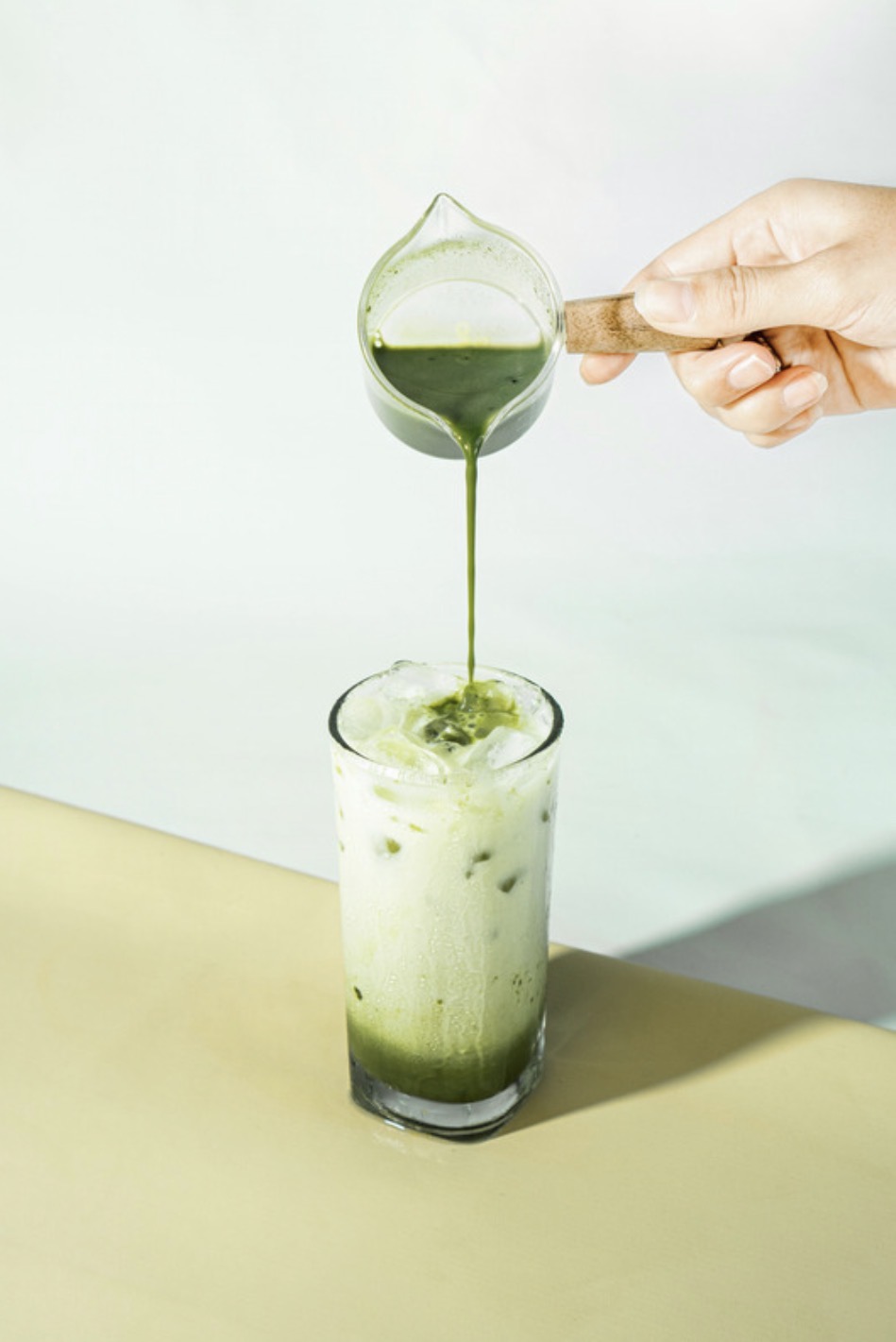
Batching matcha as a concentrate is the right call for most cafes selling more than about 20 matcha drinks a day. Mix matcha and water so the finished concentrate weighs 12 times the matcha, which is 1 part matcha to 11 parts water, hold it at or below 41°F, and pour 24 to 36 grams per drink depending on cup size. The number that trips cafes up is shelf life, because the food safety limit and the quality limit are two completely different numbers, and most of the advice online quotes the wrong one.
This guide is for owners and bar managers who need a batching standard they can hand to a closing shift and defend to a health inspector.
Key takeaways
In this guide
Batch if matcha is a regular menu item and your bar has a rush. Whisking to order takes 40 to 60 seconds of a barista's hands, which is the single biggest reason cafes quietly drop matcha from the menu. Batching moves that work to prep and turns service into a pour. The tradeoff is that a concentrate is a perishable prepared food with a clock on it.
The honest threshold is volume. Under roughly 20 drinks a day, a batch will usually outlive its quality window and you will pour some of it down the drain. Above that, batching pays for itself in labor within the first week.
There is a middle path that many specialty cafes settle on: batch for the predictable rush and whisk to order for the ceremonial pour. That lets you keep a high grade on the menu as a to-order item without slowing the line, which is the same split we cover in how to add matcha to your cafe menu.
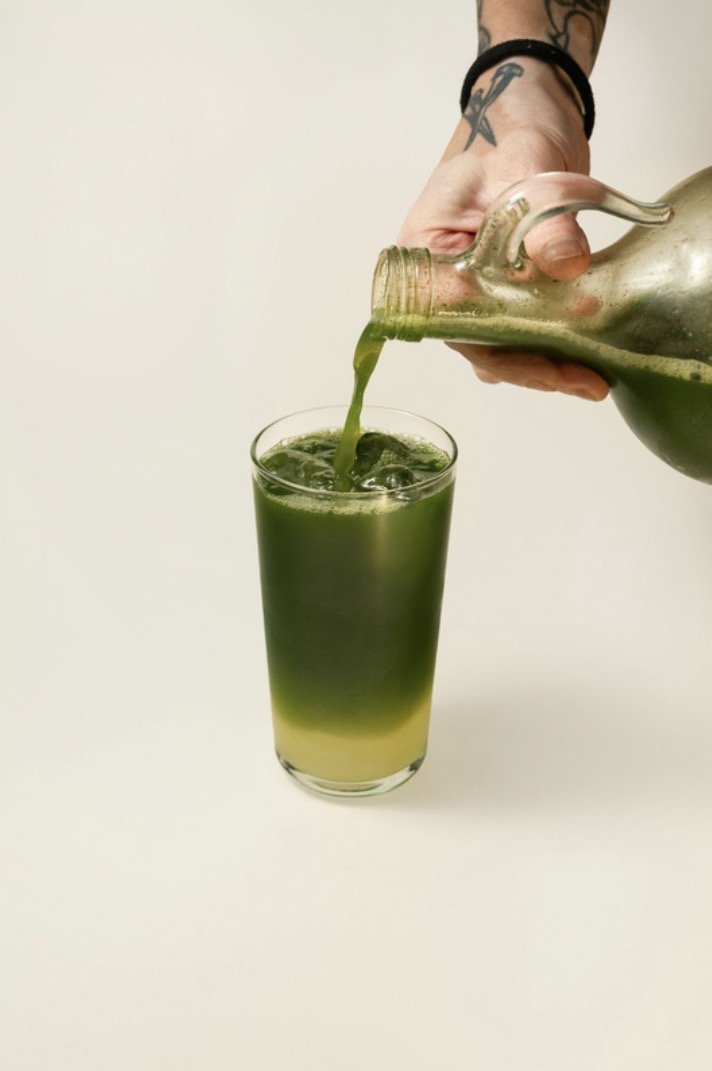
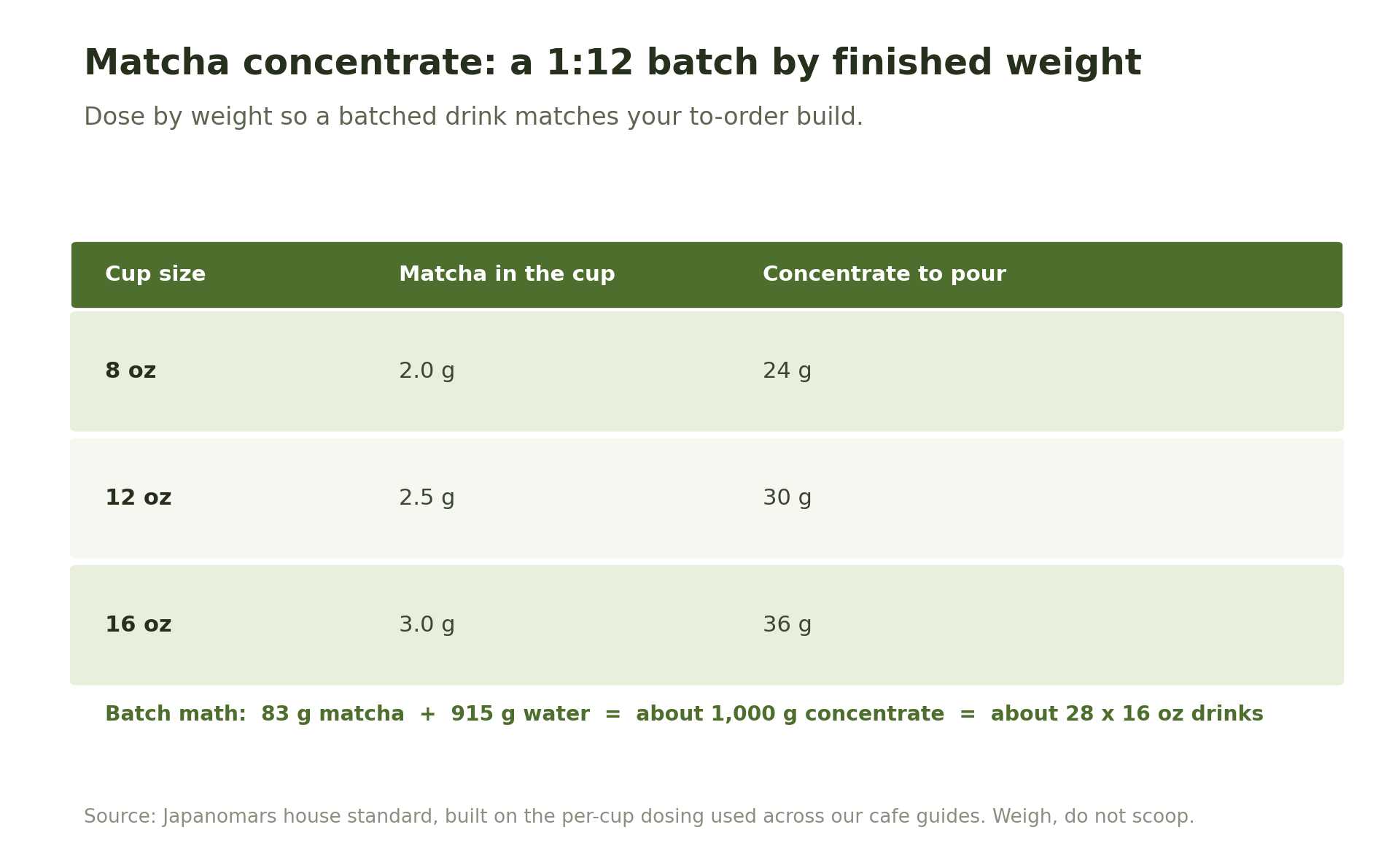
Use a 1:12 concentrate by weight, meaning 1 part matcha to 11 parts water so the finished batch weighs 12 times the matcha. That gives a concentrate you can dose by cup size without recalculating: 24g of concentrate carries 2.0g of matcha, 30g carries 2.5g, and 36g carries 3.0g. Those per drink doses match the standard 8oz, 12oz, and 16oz builds, so your batched drink tastes like your to-order drink.
The math scales cleanly. 83g of matcha and 915g of water yields about 1,000g of concentrate, a full liter, which is roughly 28 sixteen-ounce drinks.
Published cafe recipes cluster between 1:10 and 1:12, so this is a narrow band rather than a contested one. Nuditea uses 1:10, Five Senses Coffee batches 42g to 450g of water, and Zen Green Tea's unsweetened concentrate works out to about 2.5g per 30g. Ours sits inside that band, chosen because a 12 times finished weight maps cleanly onto standard cup sizes.
Two things to hold fixed. First, weigh the matcha rather than scooping it, because scoop density varies a lot between products. Second, keep your dose consistent with your to-order recipe. If you are not sure what that should be, the per-cup dosing table in the matcha latte guide is the same one this ratio is built on.
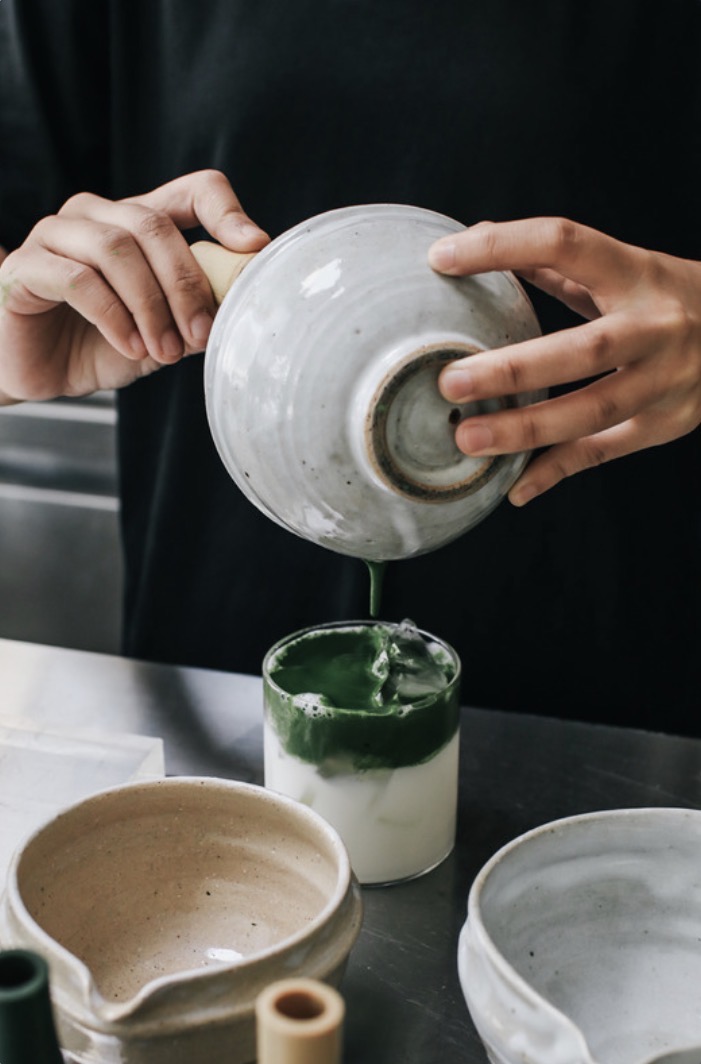
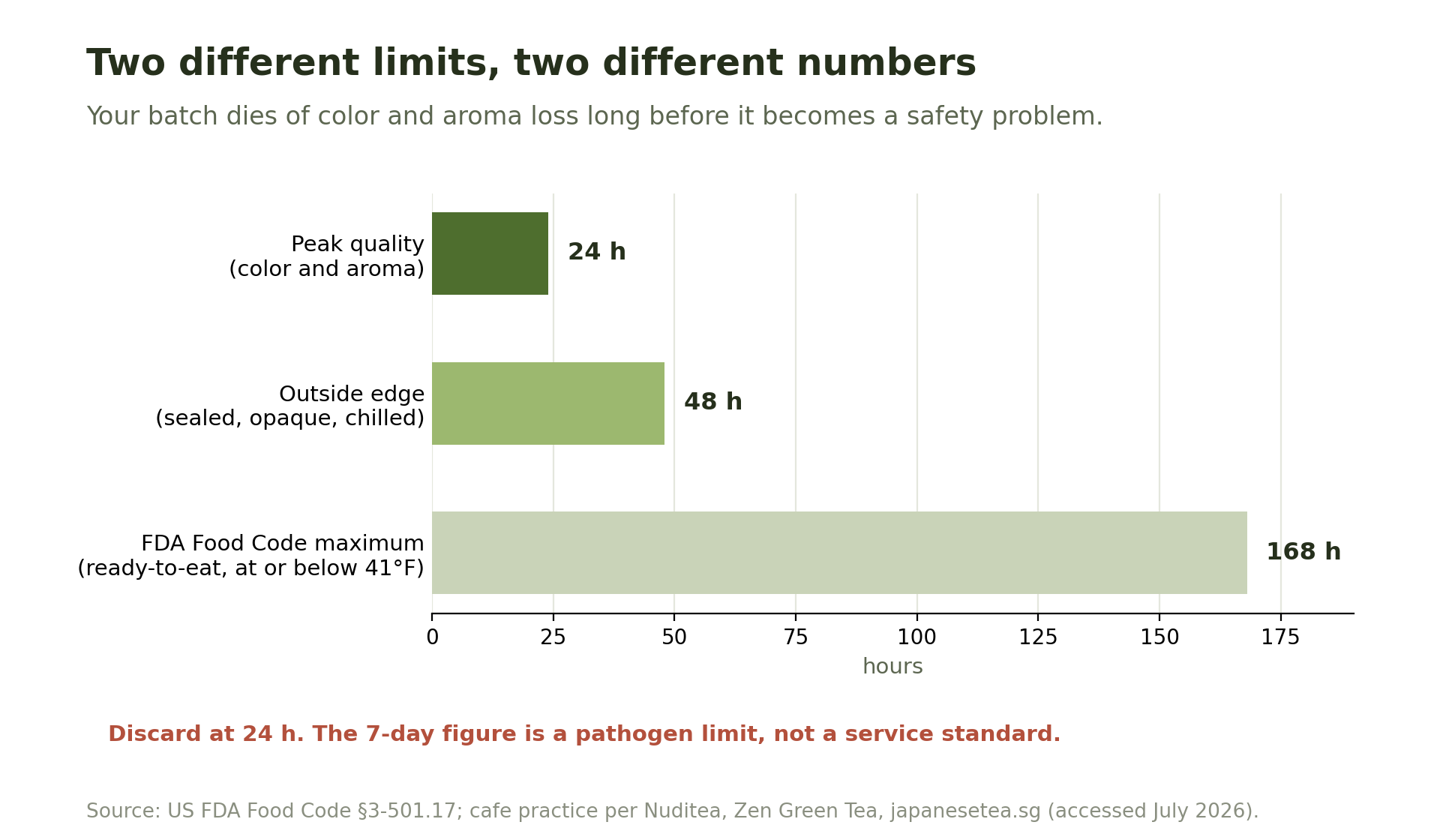
Two separate limits apply, and conflating them is why published advice ranges from 24 hours to 3 days. The safety limit under the US FDA Food Code is up to 7 days at 41°F or below. The quality limit is 24 to 48 hours. Your batch dies of color and aroma loss long before it becomes a food safety problem, so quality is the number that should govern your prep sheet.
On safety, FDA Food Code section 3-501.17 requires ready-to-eat food that needs time and temperature control for safety, and that is held longer than 24 hours, to be date marked, and sets a maximum of 7 days when held at 41°F (5°C) or less. The day of preparation counts as day one. The rule exists to control Listeria monocytogenes, which grows at refrigeration temperatures. Unsweetened matcha concentrate is a low acid, high moisture prepared food, so the safe default is to treat it as a TCS food and date mark it. Local jurisdictions adopt the Food Code with variations, so confirm your specific requirement with your health department rather than assuming.
On quality, the mechanism is chlorophyll. The green in matcha comes from chlorophyll, whose porphyrin ring holds a magnesium ion at its center. That magnesium is displaced by acid, heat, light, and oxidation, converting chlorophyll to pheophytin, which is a dull brown green. Once your concentrate is in water and exposed to air, that conversion runs continuously, which is why a batch that looked vivid at open looks muddy by the next afternoon.
This is not a cosmetic detail. Japan's National Agriculture and Food Research Organization measured 56 matcha samples between 2014 and 2018 and found all of them held a chlorophyll index (A664) of 0.4 or above, while commercial powdered tea samples failed to reach that benchmark. NARO's work fed into the international effort to define matcha, which we cover in what counts as real matcha. Put plainly: chlorophyll is one of the markers that distinguishes matcha from ordinary green tea powder, and a stale batch is measurably shedding it.
Published cafe practice mostly lands on 24 hours, and where you see three days it is worth reading the fine print. Nuditea puts peak flavor and color at 24 hours, still fresh to 48 when sealed and refrigerated. Five Senses Coffee recommends using it the day it is made, calling day three noticeably more bitter and dull. A three day refrigerated experiment by japanesetea.sg concluded 24 hours is the maximum validated window, finding the batch brownish yellow and almost aroma-free by day three. Zen Green Tea is the outlier at three days, and says plainly that the figure comes from general prepared food guidance rather than matcha specific testing. So the three day number in circulation is not a matcha finding at all.
Our recommendation
Batch once daily, date mark it, and discard at 24 hours. If your volume makes daily batching wasteful, 48 hours in an opaque sealed container is defensible, but taste it before service rather than trusting the date.
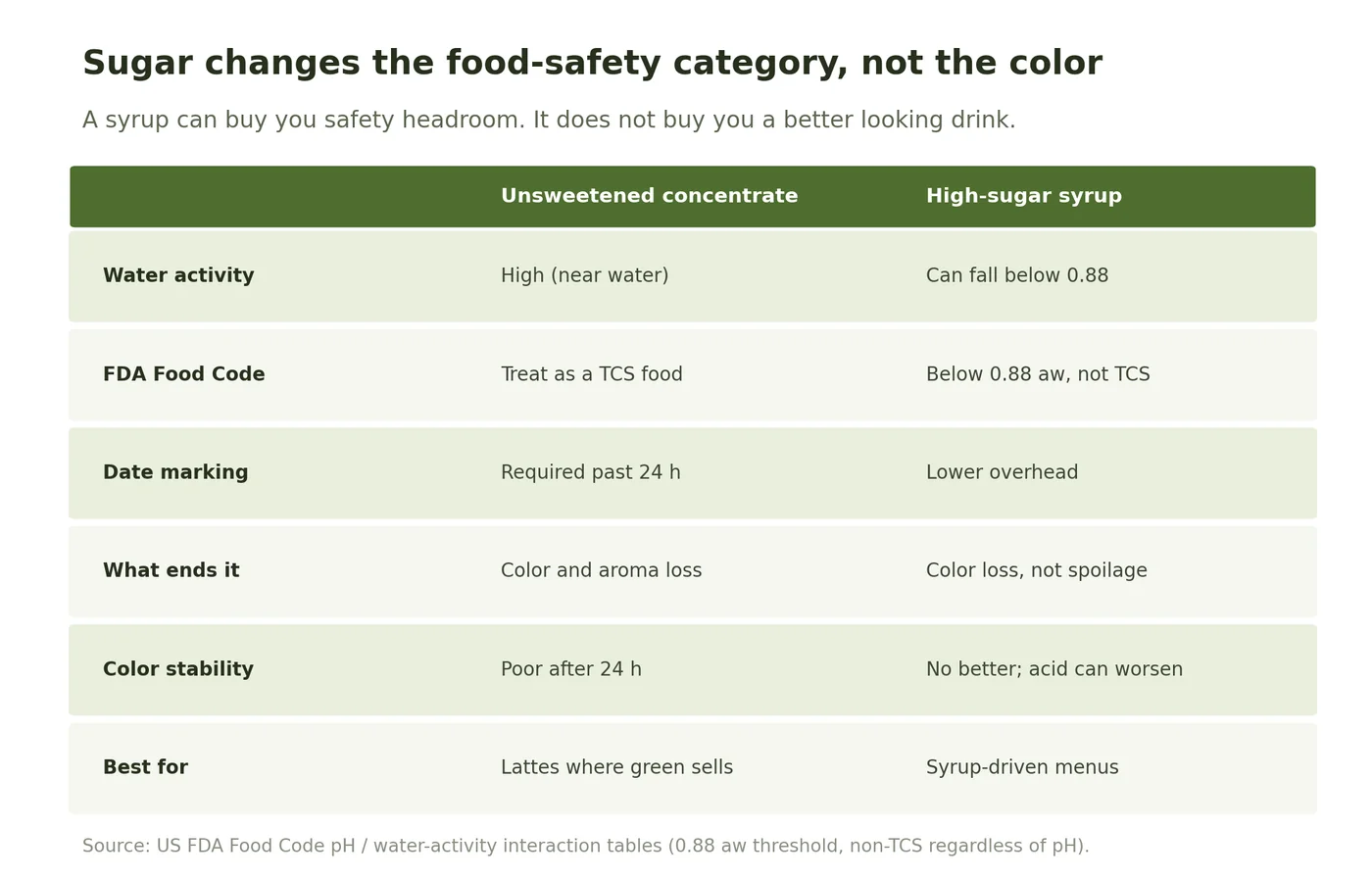
Adding sugar is not just a flavor decision, it changes the food safety category. Water activity below 0.88 puts a food outside the time and temperature control requirement entirely under the FDA Food Code interaction tables, regardless of pH. A high brix matcha syrup can clear that threshold. An unsweetened concentrate never will.
That makes them operationally different. A plain concentrate is a TCS food: refrigerate it, date mark it, discard it on schedule. A high sugar syrup behaves more like the flavoring syrups already on your bar.
The catch is that sugar does nothing to stop chlorophyll loss, and in fact a syrup's lower pH can accelerate the magnesium displacement that browns it. So a syrup buys you food safety headroom, not color stability.
Choose based on your menu. If matcha lattes are the point and the layered green look sells them, run an unsweetened concentrate and sweeten in the cup, which also lets you serve it unsweetened on request. If matcha is a flavor note inside a broader syrup driven menu, a sweetened syrup is the lower maintenance choice.
Sift, dissolve with a small amount of water first, then dilute, then chill fast. The failures that ruin a batch are all front loaded: clumps that never dissolve, water hot enough to strip the aroma, and a warm batch sitting out while it slowly oxidizes. Getting to cold quickly is the step most cafes skip.
Shake before every pour. Matcha is a suspension of ground leaf, not a solution, so it will separate in the fridge no matter how well you blended it. A batch that is not shaken pours weak at the top and gritty at the bottom, which is one of the errors in the matcha mistakes baristas make.
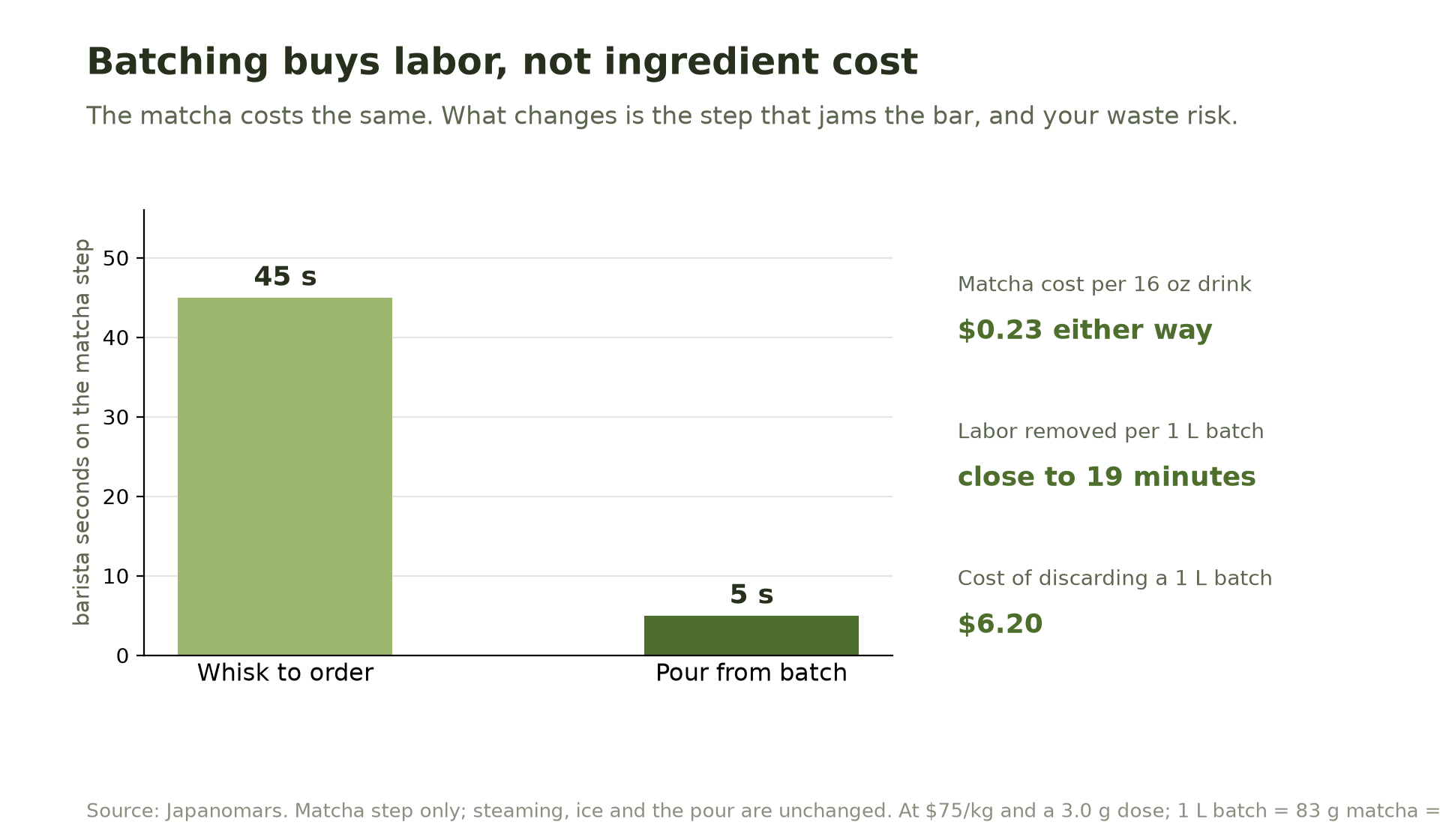
Batching does not change your ingredient cost per drink, it changes your labor cost and your waste risk. At a typical latte grade wholesale price of about $75/kg, a 3.0g dose is roughly $0.23 of matcha whether you whisk it or pour it. Set that against your menu price: Starbucks lists a 16oz matcha latte at $6.26 in 2026, and independent specialty cafes generally sit at or above it. At $0.23, matcha is about 4 percent of the ticket, and milk is almost always the larger line. Moving up a grade costs you cents and changes what the customer tastes considerably more. What batching buys is about 40 seconds per drink on the matcha step alone. Steaming, ice and the pour are unchanged, but that step is the one that jams the bar, and it is close to 19 minutes of labor removed per liter batch of 28 drinks.
The waste side is the real variable. A discarded 1 liter batch is about $6.20 of matcha. Discard one batch a week and you have given back a meaningful share of the labor saving, which is why batch sizing matters more than batch technique. Size the batch to the day rather than to the container: batch about 80 percent of what you sold on the same weekday last week and whisk to order past that. Conservative beats discarded.
Grade matters differently here than it does for a to-order bowl. A batch is a stress test of freshness, because you are asking the matcha to hold color and aroma in water for a full day. Matcha that was already months past milling starts that test with less to lose, and it shows up as a batch that browns by lunchtime. This is where the milling date, not just the grade name, becomes the thing to ask your supplier about. Grade naming itself is inconsistent across suppliers, which we unpack in matcha grades explained.
From the sourcing floor
Most Japanese wholesalers mill tencha to order rather than holding ground matcha in stock, so the milling date and the order date are usually close together. That is invisible on a spec sheet but it is exactly what determines whether your concentrate still looks right at 4pm. When cafes tell us their batch browns fast, the first thing we check is not their method, it is how long the powder sat before it reached them.
Treat 24 hours as your working limit for quality, and 48 hours as the outside edge if sealed and opaque. The US FDA Food Code permits up to 7 days at 41°F or below for ready-to-eat foods needing temperature control, but color and aroma degrade long before that, so the legal maximum is not a useful service standard.
Use a 1:12 concentrate by weight, which is 1 part matcha to 11 parts water. That yields 24g of concentrate per 2.0g dose, 30g per 2.5g, and 36g per 3.0g, matching standard 8oz, 12oz, and 16oz builds. Weigh the matcha rather than scooping, since density varies significantly between products.
Yes, measurably, but not immediately. Within the first several hours a well made, quickly chilled batch is very close to a to-order build. The loss is in aroma and color, driven by chlorophyll converting to pheophytin through oxidation and light exposure, and it becomes obvious somewhere between 24 and 48 hours.
Assume yes. Unsweetened matcha concentrate is a low acid, high moisture prepared food, which is the profile that requires time and temperature control under the FDA Food Code, and food held longer than 24 hours must be date marked. Confirm the specific requirement with your local health department, since jurisdictions adopt the Food Code with variations.
It can be. A food with water activity below 0.88 falls outside the time and temperature control requirement regardless of pH, and a high sugar syrup can meet that. Sugar does not slow color loss though, so a syrup gives you food safety headroom rather than a better looking product.
Chlorophyll holds a magnesium ion that is displaced by acid, heat, light, and oxygen, turning it into pheophytin, which is brown green. Storing the batch in a clear container on a lit bar accelerates this. Use opaque sealed containers, chill quickly after mixing, and check the freshness of the powder itself.
Batch at 1:12 by weight, date mark it, and pull it at 24 hours. Do not let the 7 day food safety maximum set your service standard, because your customers will notice the color and aroma loss days before there is any safety question. And if your batches are browning faster than they should, the variable worth checking first is not your method, it is how fresh the matcha was when it reached you.
That last point is a sourcing question, not a bar question. We can send samples with the milling date on them so you can batch one yourself and see how it holds at 24 hours.
Hiroshi Asami is the founder of Japanomars, which exports matcha from producers in Saitama, Gifu, Saga, Fukuoka, and Kagoshima to cafes in the United States and Canada.
%E7%99%BD_%E5%A4%A7%E3%81%8D%E3%81%84.png)