%E5%A4%A7%E3%81%8D%E3%81%84.png)
Origins & Story · 2026
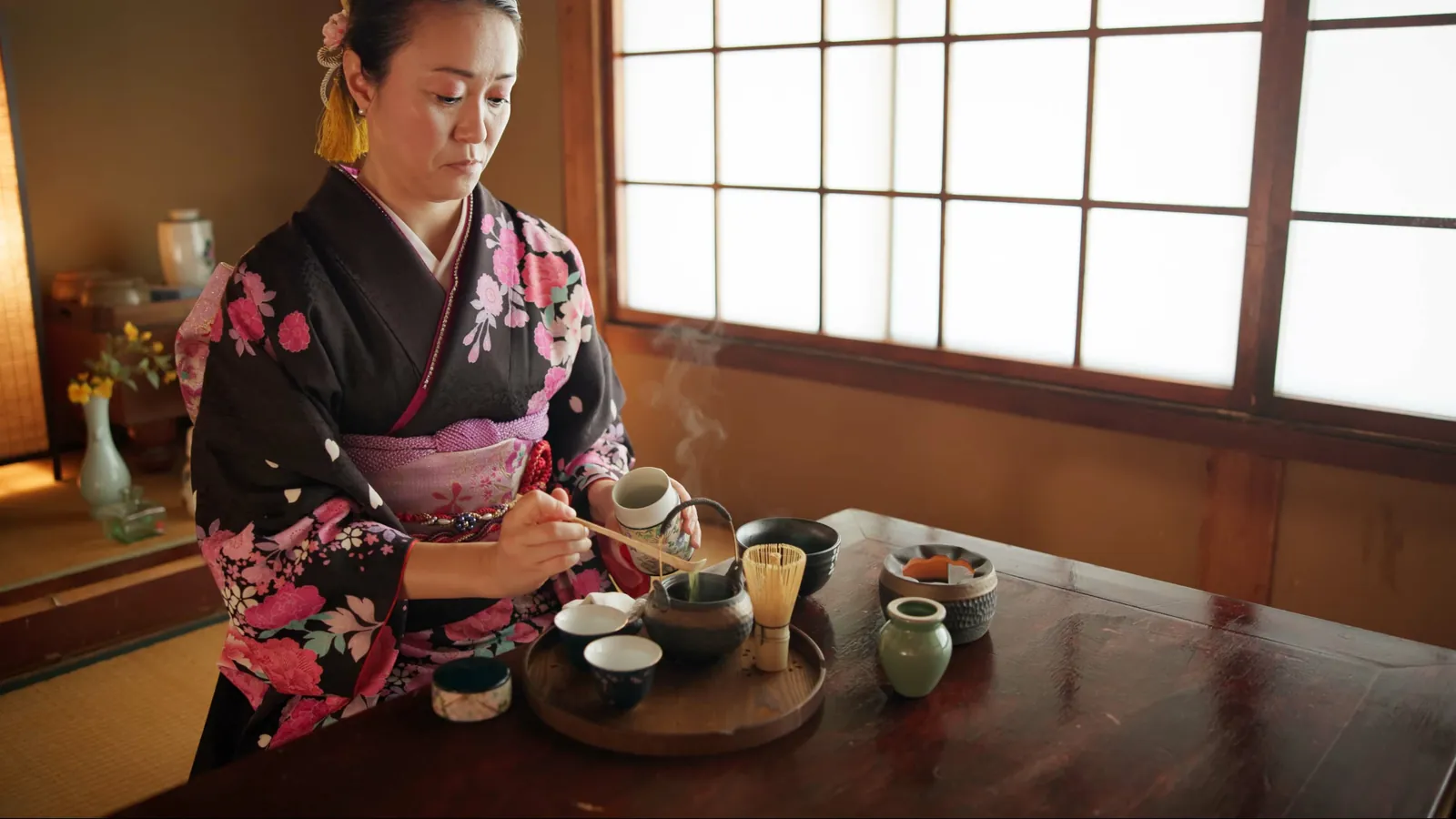
Matcha began in Tang-dynasty China as a way to preserve and drink powdered tea, but the version served today is a distinctly Japanese invention: brought to Japan by the Zen monk Eisai in 1191, refined into the tea ceremony by Sen no Rikyu in the 16th century, and made vividly green by a shading technique developed in Uji around the same era. China largely abandoned powdered tea after a 1391 imperial ban favored simpler loose-leaf tea, which means the tradition survived almost exclusively in Japan for roughly 600 years before its recent global spread. This guide traces that arc from Tang China to your cafe counter, and why the history still matters for what you're actually buying today.
Key takeaways
In this guide
Matcha's roots are Chinese, not Japanese. During the Tang dynasty (618 to 907 CE), tea leaves were steamed and pressed into bricks for storage and transport, then broken off, ground to powder, and whisked with hot water, a practical solution to preserving a perishable leaf. By the Song dynasty (960 to 1279), this had evolved into diancha, a refined method of whisking fine powdered tea into a frothy bowl that is the closest historical parallel to how matcha is prepared today, complete with competitive tea-whisking contests and poetry written about the foam.
What's often missed is that this powdered-tea tradition eventually disappeared almost entirely from China itself, while it survived, and was elevated into an art form, on the other side of the East China Sea. The rest of this history is really the story of how that happened.
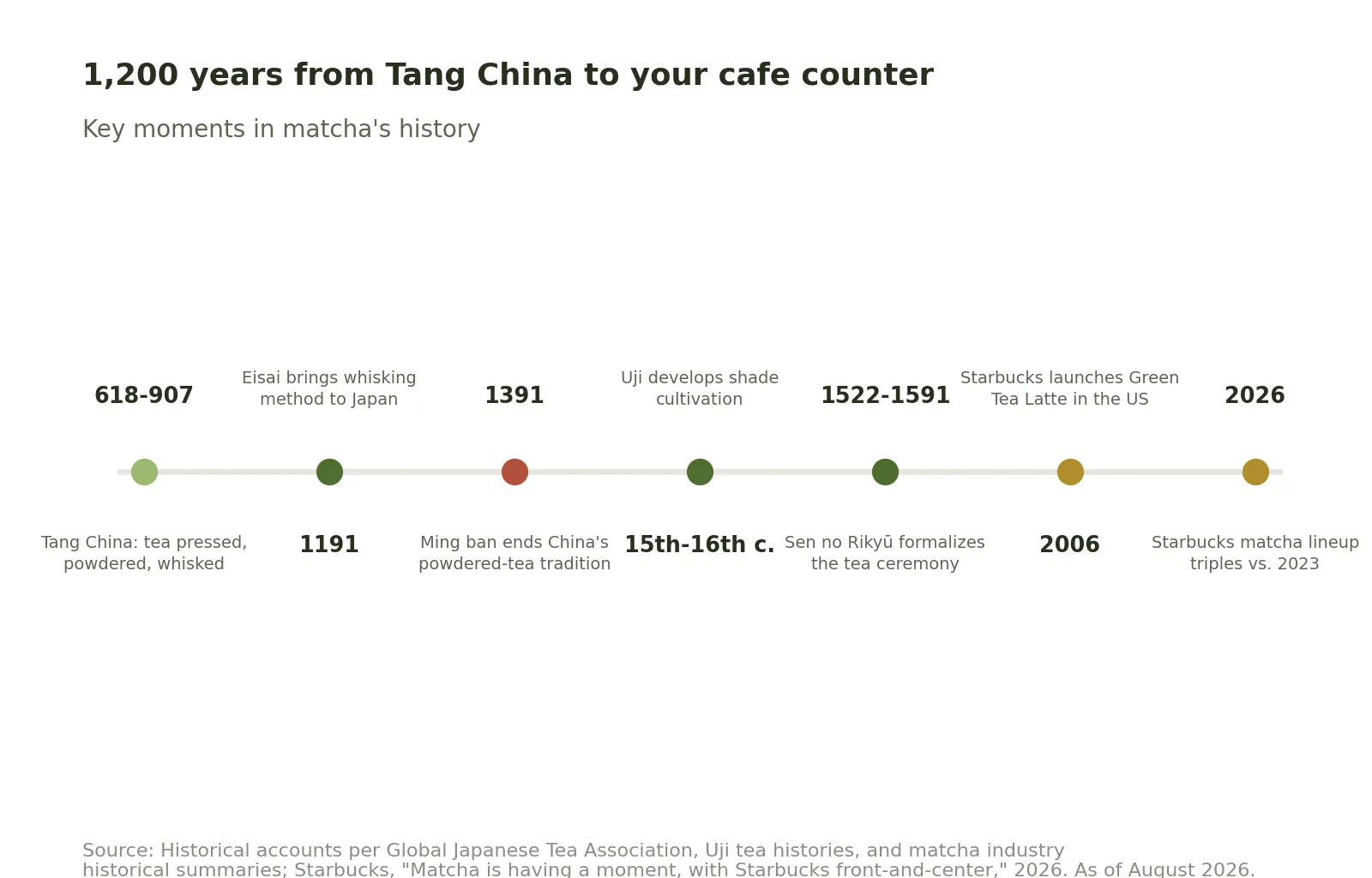
The Zen monk Myōan Eisai (明菴栄西, 1141 to 1215) is traditionally credited with bringing tea seeds and the Song whisking method from China to Japan around 1191, along with his treatise Kissa Yōjōki, "Drinking Tea for Health," one of the earliest texts promoting tea's medicinal value in Japan. Eisai is also said to have given seeds to the monk Myōe, who cultivated tea at Togano-o near Kyoto, from where cultivation spread south into the Uji valley, still the most famous matcha-producing region in Japan today.
Tea took root first in Buddhist monasteries and the samurai class, where the ritual of preparing and drinking whisked tea fit naturally alongside Zen practice and meditation. That religious and martial-class foundation matters for what comes next: by the time China moved away from powdered tea two centuries later, matcha was already embedded in Japanese institutions with the cultural weight to preserve it.
China's powdered-tea tradition ended largely because of a political decision, not a change in taste. In 1391, the Hongwu Emperor banned compressed "dragon cake" tribute tea, intended to reduce the labor burden on tea-growing peasants, which made the elaborate steaming-pressing-grinding process behind powdered tea obsolete almost overnight. Producers shifted to pan-firing loose leaves instead, a simpler, cheaper method that needed no stone grinder, no bamboo whisk, and no specialized bowls, and loose-leaf tea has dominated Chinese tea culture ever since.
Japan was insulated from this shift. Eisai's transmission happened two centuries before the Ming ban, and Japan entered its own long period of relative isolation not long after, which effectively froze the Song-dynasty whisking practice in place while China moved on. What could have been a shared East Asian tradition instead became something Japan alone carried forward and eventually turned into a formal art.
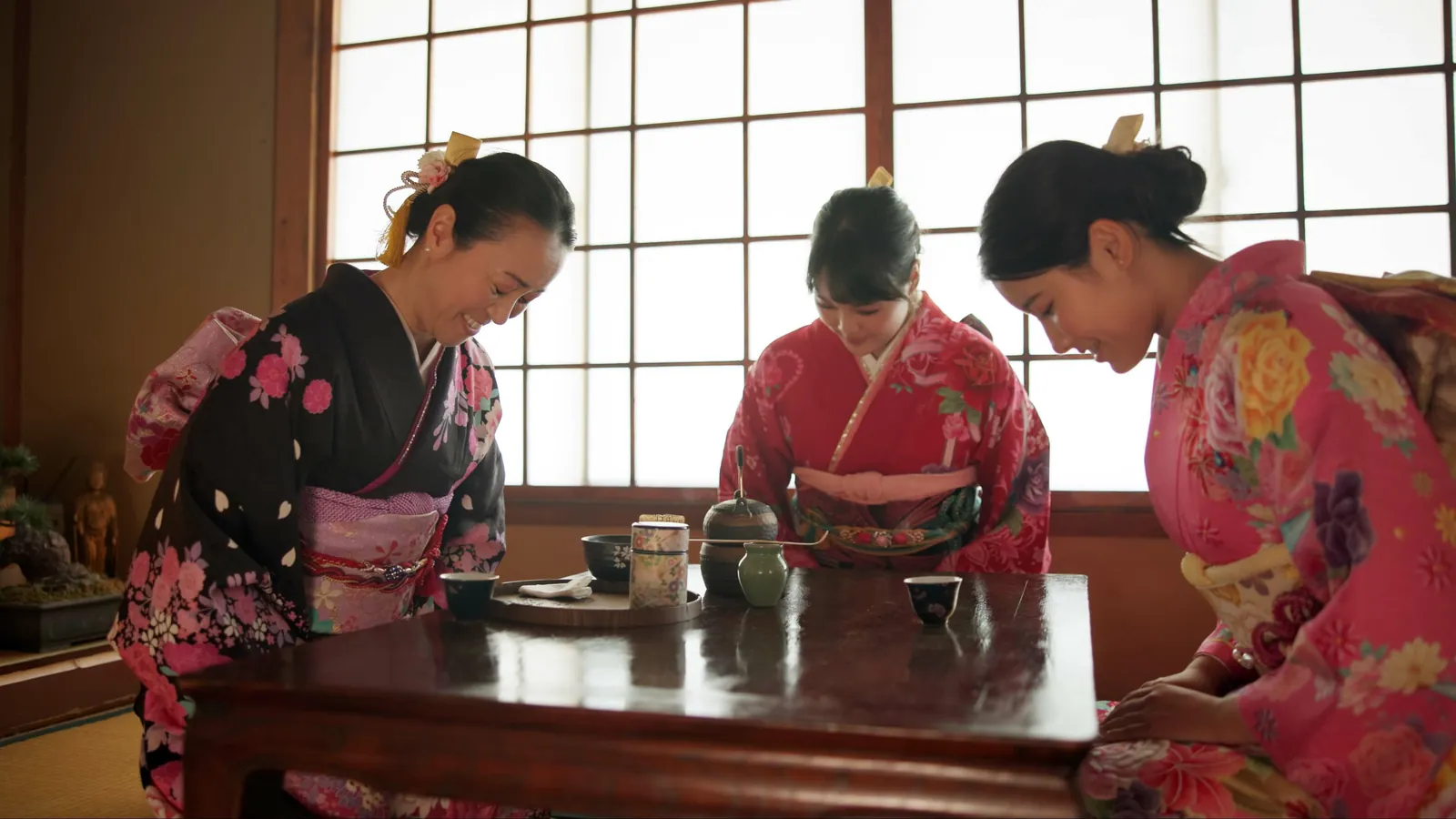
The tea master Sen no Rikyū (1522 to 1591) is the figure most responsible for turning whisked tea into chanoyu, the Japanese tea ceremony as it's still practiced today. Serving as tea master to two of the most powerful warlords in Japanese history, Oda Nobunaga and Toyotomi Hideyoshi, Rikyū stripped away the ostentatious tea gatherings of the era and distilled the practice down to a small, plain tearoom and four guiding principles: wa (harmony), kei (respect), sei (purity), and jaku (tranquility).
Those four principles still shape how matcha is prepared and served in a formal setting today, and they explain something that surprises a lot of Western buyers: matcha was never meant to be a commodity beverage. It was built, deliberately, as a ritual object, which is part of why the quality bar for real ceremonial-grade matcha remains so exacting even now. For how that translates into what you're actually paying for at a wholesale level, see matcha grades explained.
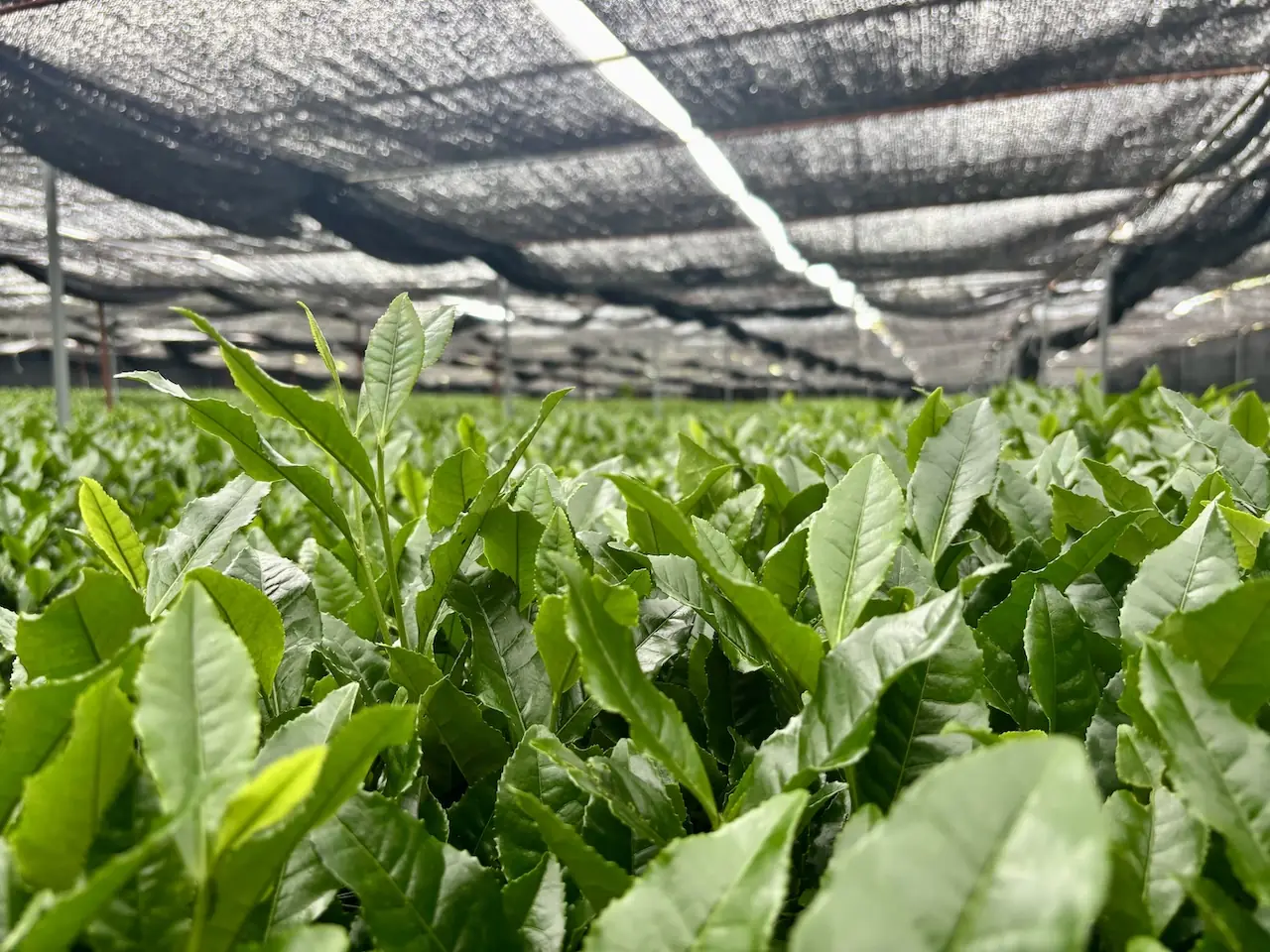
Matcha's vivid green color is a Japanese technical innovation, not an original feature of the Chinese powdered tea it descended from. Sometime in the Muromachi period (14th to 16th century), tea growers in the Uji valley developed ōishita saibai (覆下栽培), "covered cultivation," building canopies of reed screens and rice straw over the tea plants before harvest. The technique had become commonplace in Uji by the mid-to-late 1500s, and some accounts place its beginnings earlier still, in the 1400s.
The original purpose was likely mundane: protecting young buds from frost damage. What growers discovered along the way was transformative. Shading dramatically raises chlorophyll and amino acid levels in the leaf while suppressing bitter catechins, turning what would otherwise be a brownish, astringent tea into the bright green, umami-forward leaf that defines matcha. That same shading process, refined but fundamentally unchanged, is still what separates real matcha from ordinary green tea powder; the mechanics of it are covered in what makes matcha good.
From the sourcing floor
What stays with me from the farms is not the dates but the arithmetic the growers describe. A tea bush gives you nothing for the first several years, so the families who planted these fields had to find a way to eat while they waited, and more than one farmer has told me the planting was as much about making work for a village as about making tea. Those same families talk about the years when Japanese tea poured into America and the money came fast, and lately I have started to hear them describe what is happening now as the second time around.
Matcha stayed almost entirely within Japan for roughly 800 years before its recent, rapid globalization. The first real crossover moment was small: Häagen-Dazs Japan launched a matcha-flavored ice cream in 1996 that became a domestic hit. Starbucks launched its Green Tea Latte in the US in 2006, but matcha was slow to catch on with Western palates for another decade; blogs began framing it as a wellness drink and coffee alternative through the 2010s, and the term "ceremonial matcha" entered common use around that time as cafes outside Japan began building menus around it.
The real inflection point is much more recent than the 2006 launch. The 2020s social-media wave, Instagram and TikTok visibility, wellness-lifestyle branding, pushed matcha into the same "viral superfood" tier as acai and kombucha, and the chains followed the demand rather than creating it. Starbucks' own figures show the shape of it: tea sales up more than 70% since 2021, and a year-round matcha lineup that had tripled against 2023 by February 2026. In other words: a 1,200-year-old tradition became a mainstream Western beverage category in well under two decades.
The history explains the current supply squeeze more directly than most market analyses do. Matcha's production method, shade cultivation, hand-adjacent processing, slow stone milling, was refined over roughly 500 years inside a small, specific region of Japan, not built to scale to sudden global demand, which is exactly why the 2026 matcha shortage is a structural story and not a temporary blip. When a cafe asks what separates "real" matcha from a green tea powder with the same name, the honest answer traces straight back to Eisai's 1191 transmission, the Ming ban that ended China's version of the practice, and Uji's 15th-century shading breakthrough, a specific, six-century lineage that a mass-produced substitute simply doesn't share.
That lineage is also the strongest argument for provenance mattering when you buy. A supplier who can tell you which region, which farm, and which harvest your matcha came from is continuing a specific historical practice; a supplier who can't is selling you a green powder that happens to share a name with it. For what that provenance question looks like in practice, see how to find and vet a Japanese matcha wholesale supplier and farm-direct vs trading company sourcing.
Matcha's roots are in Tang-dynasty China (618 to 907 CE), where tea was pressed into bricks, ground to powder, and whisked with hot water. By the Song dynasty (960 to 1279), this had evolved into diancha, a refined whisked-tea method that closely resembles how matcha is prepared today.
The Zen monk Eisai is credited with bringing tea seeds and the Song whisking method to Japan around 1191, along with a treatise on tea's health benefits. Tea took root first in Buddhist monasteries and the samurai class before spreading more broadly.
China largely abandoned powdered tea after a 1391 imperial ban on labor-intensive "dragon cake" tribute tea, which shifted the country toward simpler loose-leaf tea. Japan received the powdered-tea tradition two centuries earlier and, entering its own period of relative isolation soon after, preserved and elevated the practice instead of moving on from it.
Chanoyu, the Japanese tea ceremony, was formalized by the tea master Sen no Rikyū (1522 to 1591), who served as tea master to warlords Oda Nobunaga and Toyotomi Hideyoshi. Rikyū distilled tea gatherings into a small, plain tearoom and four guiding principles: harmony, respect, purity, and tranquility, principles that still shape how matcha is prepared formally today.
Shade cultivation, developed in Japan's Uji valley starting around the 15th century, is what gives matcha its vivid green color. Covering tea plants before harvest raises chlorophyll and amino acids while suppressing bitter compounds, a technique that didn't exist in the original Chinese powdered tea Japan's version descended from.
Matcha's global spread is very recent relative to its history. Starbucks launched its Green Tea Latte in the US back in 2006, but matcha stayed a niche order for roughly another decade; the real surge came with 2020s social-media visibility and wellness-trend branding. Starbucks' own numbers track it: tea sales up more than 70% since 2021, and its year-round matcha lineup tripled against 2023 by February 2026.
Matcha's story is really two stories: an origin in China that mostly ended six centuries ago, and a Japanese tradition, carried forward through Eisai's 1191 transmission, Uji's shading breakthrough, and Sen no Rikyū's tea ceremony, that turned it into something China itself no longer practices in the same form. That six-century lineage is exactly why provenance matters when you're sourcing matcha today: the tradition survived in a specific place, through specific techniques, and buying real matcha means buying into that history, not just a green powder that shares its name.
Japanomars sources directly from the farms and regions carrying this tradition forward, Kagoshima, Uji, and beyond, with real provenance behind every lot. Request samples and current pricing to taste the difference history makes.
Request samples & pricingHiroshi Asami is the founder of Japanomars, a Japanese matcha exporter supplying specialty cafes across the US, Canada, and the Philippines, working farm-direct with growers and regional tea factories in six producing regions, and has hosted cafe owners on farm visits to historic producing areas including Uji.
Sources
%E7%99%BD_%E5%A4%A7%E3%81%8D%E3%81%84.png)