
Buying · Grades · Cafes
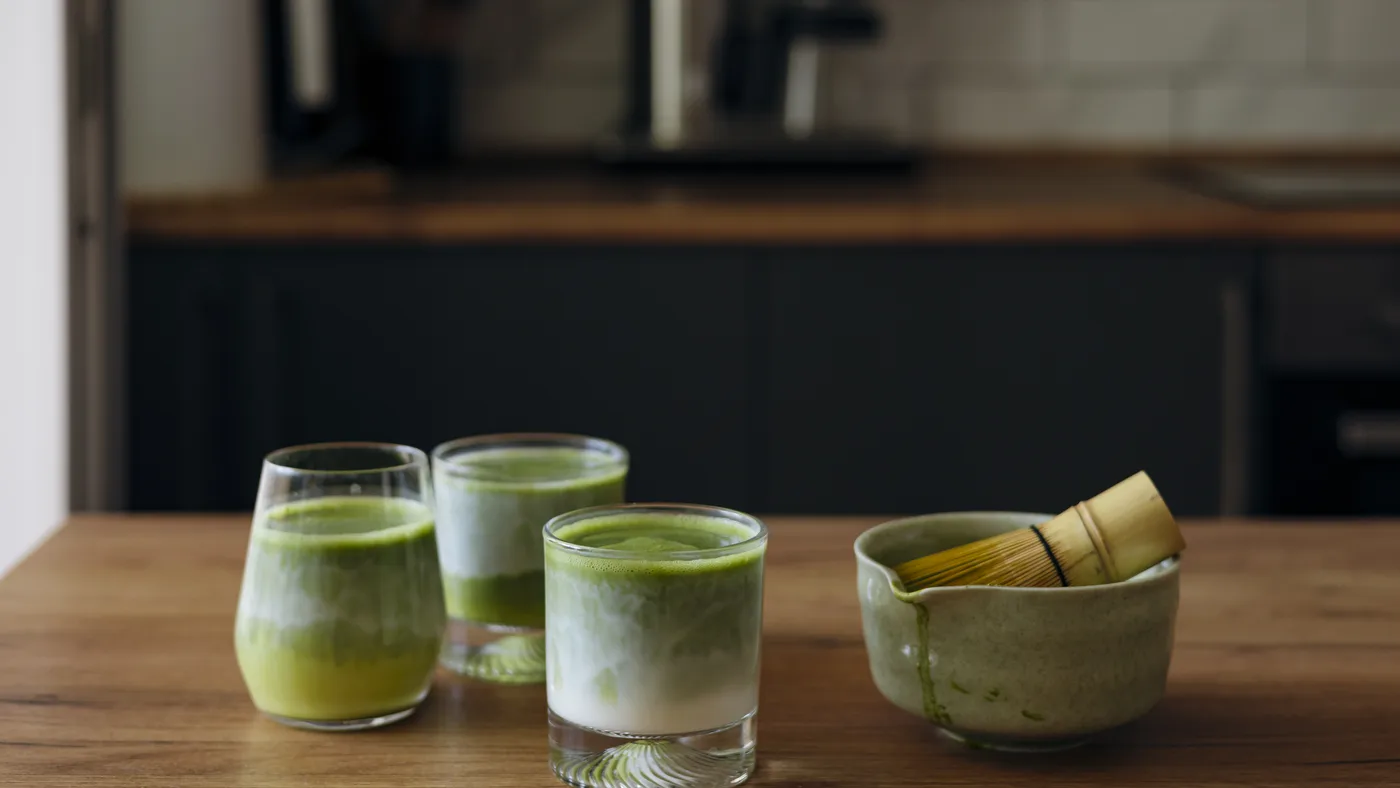
For most cafe lattes, buy latte grade: the upper end of what suppliers call culinary, at about $100 to $160 per kg, which keeps its color and a clear tea taste under milk for 20 to 32 cents of matcha in a 2 g drink. Keep ceremonial, at about $160 to $210 per kg, for straight matcha or a signature latte you price higher, and use low-end culinary for baking. The grade names are sellers' terms, not legally defined grades, so test two grades in your own latte before you commit.
| Ceremonial | Latte grade (upper culinary) | Culinary (baking) | |
|---|---|---|---|
| What it is | Label for matcha whisked with water and drunk straight | Label for matcha built to hold up under milk | Label for matcha for baking and blended drinks |
| Harvest | Usually first flush (spring), finely milled | First flush, or a first and second flush blend | Mostly later harvests |
| Color | Deep, vivid green | Bright green | Duller; the cheapest can look olive or yellowish |
| Taste under milk | Sweet and mellow alone; much of the aroma fades under milk | Enough body and bitterness to come through | Strong and bitter; often flat or harsh as a latte |
| Best use | Straight usucha, a signature latte | House hot and iced lattes | Baking, ice cream, blended drinks |
| Typical cafe dose | 2 g hot, 3 g iced 16 oz | 2 g hot, 3 g iced 16 oz | By recipe in baking |
| Price band per kg | About $160 to $210 | About $100 to $160 | About $30 to $100 |
| Cost per 2 g drink | About $0.32 to $0.42 | About $0.20 to $0.32 | About $0.06 to $0.20 |
Harvest, color and taste are typical tendencies, not definitions. Prices are Japanomars wholesale ranges at 1 kg before shipping and move with exchange rates and the harvest. Cost per drink is the price per kg divided by 1,000, times 2 g.
In this guide
No. Japan's green tea labelling standard (Japan Tea Central Council, last revised July 10, 2026) defines 17 tea names, including matcha, and no grades. Its rules also bar words such as "finest" or "special" on a label without an objective basis. ISO/TR 21380, the international technical report on matcha, defines matcha itself, not grades, and is not binding. The International Matcha Association's June 2026 guideline proposes four criteria for what counts as matcha, which it frames as a starting point for dialogue. None of the four is about grade.
So the same word can sit on very different powders. Matcha made for formal tea ceremony in Kyoto sells far above any cafe price band. Judge the bag by harvest, color, milling date and taste. More in our guide to matcha grades and ceremonial grade for cafes.
Most of what you pay for in ceremonial is subtle: sweetness, low bitterness and a fresh aroma that show best whisked with 2 oz of water. Add 6 to 8 oz of milk and a pump of syrup and much of it is covered.
For lattes we prefer a matcha with a little more bitterness and body. A sweet one disappears under milk, while a firmer one lets the tea through. That is the job of latte grade, which many suppliers sell as culinary.
The top of the culinary range is, and most good cafe lattes use it. The bottom usually is not. Cheap culinary tends to be dull in color and harsh in a drink. It belongs in baking, ice cream and blended drinks, where sugar and fat carry the flavor.
Cents, not dollars. At the middle of our ranges, $130 per kg for latte grade and $185 for ceremonial, ceremonial adds about 11 cents to a 2 g hot latte and about 17 cents to a 3 g iced 16 oz. At 1,000 hot lattes a month, about 2 kg, that is roughly $110 a month.
Dose moves cost more than grade. Going from 2 g to 3 g of latte grade at $130 per kg adds 13 cents, more than the step to ceremonial. Our cost per drink guide adds milk, cups and waste. A kilogram gives about 475 two-gram drinks once waste is counted.
When the matcha is tasted on its own or the drink is sold on the tea: straight usucha, a matcha-forward latte with less milk, or a named signature drink at a higher price. A cafe selling mostly sweetened iced lattes usually gets more from a good latte grade, weighed carefully. You can also run both: latte grade for house drinks, ceremonial for one or two. Our matcha latte guide covers ratios and method.
Whatever you choose, matcha loses color and aroma after milling, so buy to your real turnover. We mill after you order.
How to test two grades in your own latte
Yes, but much of what you pay for fades under milk. At the middle of our price ranges it adds about 11 cents to a 2 g latte over latte grade.
Yes at the upper end, which is often sold as latte grade or premium culinary. The cheapest culinary matcha tends to taste flat or harsh in a drink and is better used for baking.
Ceremonial is usually first flush, finely milled and vivid green, for drinking straight. Culinary usually comes from later harvests and tastes stronger and more bitter. Neither term is legally defined, so judge the matcha, not the label.
A middle tier built to keep its color and tea flavor under milk. At Japanomars it runs about $100 to $160 per kg, or 20 to 32 cents of matcha in a 2 g drink.
About 2 g with 2 oz of water and 6 to 8 oz of milk for a hot latte, and about 3 g for a 16 oz iced latte. Weigh it, because a heaped teaspoon can hold a gram more than a level one.
At a 2 g dose and our wholesale ranges before shipping, about 20 to 32 cents for latte grade, 32 to 42 cents for ceremonial and 6 to 20 cents for culinary.
Tell us your best-selling drink, your dose and your monthly volume, and we will suggest two grades to sample side by side.
Request samplesMinimum order, lead time and duties are on our wholesale terms page.
Hiroshi Asami is the founder of Japanomars, a Japan-based matcha wholesale supplier for independent cafes. Japanomars works with tea farmers in eight regions: Kyoto (Uji), Sayama, Ibi, Yame, Ureshino, Kirishima, Chiran and Miyazaki, and supplies cafes and matcha brands in the United States, Canada, the Philippines and Europe.

Sources