
Industry Report · IMC2026
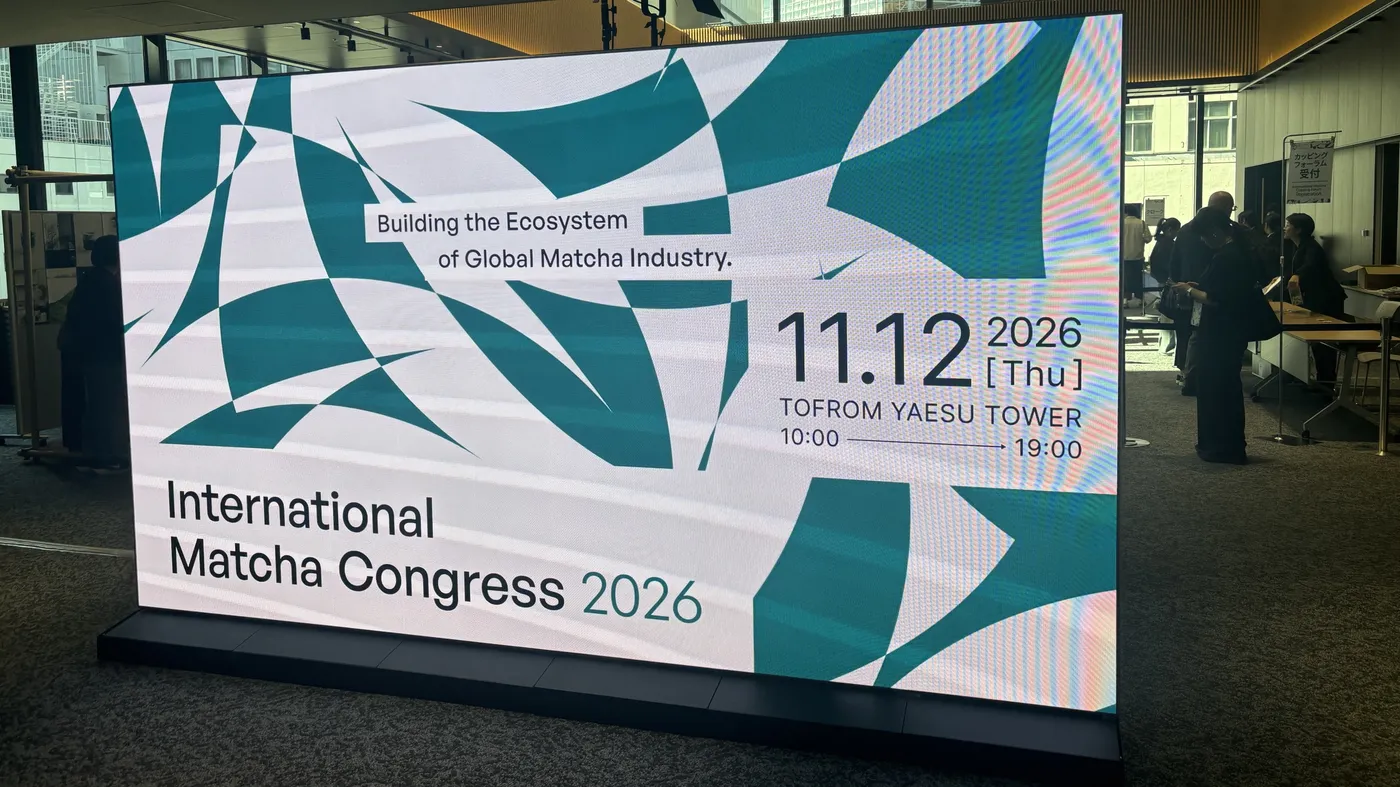
Short answer: the first International Matcha Congress (IMC2026), held in Tokyo on November 12, 2026 by the International Matcha Association (IMA), kept coming back to four points that matter to anyone buying matcha. Demand is settling into a staple rather than a passing trend. Supply, not demand, is the bottleneck. There is still no shared definition or grading standard for matcha. And cafe customers have started to ask where their matcha comes from and who made it.
Key takeaways
In this report
IMC2026 was the first international conference held by the International Matcha Association, a non-profit association founded in Tokyo in April 2026. It ran for one day in Yaesu, Tokyo. According to the MC and speakers, more than 1,000 people from 27 countries took part: growers, processors, tea wholesalers, overseas cafe chains, researchers and government officials. IMA said it plans to hold the congress again in the coming years.
| Session | Who spoke |
|---|---|
| Opening dialogue | Ryo Iwamoto (IMA Representative Director) and Norikazu Suzuki (former Minister of Agriculture, Forestry and Fisheries) |
| Matcha today and the industry's challenges | Japanese tea companies including ITO EN and Kyoei Seicha |
| The future of matcha, seen from the cafe market | Blank Street (US, UK), Onyx Coffee Lab (US), Super Matcha (Korea), Gail's (UK) and others |
| The many values of matcha | UC Davis Global Tea Institute and others |
| Ecosystem dialogue | Future Food Institute (Italy) and others |
I attended as a general participant, as a supplier who ships Japanese matcha to cafes abroad. This report is written from what I heard in the room and from partial recordings. Remarks are paraphrased, not exact quotes.
The tea industry panel was clear that matcha is moving from a boom to a staple, and that it is unlikely to disappear from menus. Several speakers placed it as a third choice after coffee and black tea. The moderator and an industry speaker dated the jump in worldwide consumption to the last two or three years.
The cafe panel showed what that looks like on the floor:
The picture is demand growing in two layers: steady quality and volume for lattes, and a smaller top tier that shows the character of a region.
Every company in the industry session named the same problem: tea acreage is shrinking and growers are leaving the business. One speaker said acreage is falling even in Nishio, one of Japan's main matcha areas. The first goal, they said, is simply to stop the decline.
The ideas on the table were practical:
Nobody on stage gave price figures. The season data does: Kyoto's first-flush tencha traded above its opening auction through July, with scissor-picked tencha averaging 17,250 yen per kg for the season (up 22% on 2025) and hand-picked Uji tencha 52,275 yen. Kagoshima's first-flush tencha averaged 13,910 yen per kg, 2.3 times the 2025 level. For 2027, Kyoto's Chamber of Tea said in October that this year avoided the shortages of previous years and it expects stable supply, and Kagoshima reports more factories making tencha, with about one in five tea businesses planning to expand it. Our tencha price index tracks these numbers.
What this means for a buyer: supply is improving at the margin, but labor and acreage are long-term problems, so committed volume matters more than chasing a lower price.
No. There is no shared standard for what matcha is or how it is graded. Ryo Iwamoto argued that without one, good matcha and cheap matcha sit side by side at the same price, and the market rewards whoever produces the most. ITO EN added that as new origins grow, including China, Vietnam and, in future, Africa, consumers cannot tell what to base their choice on.
The panel's conclusion was to set the rules first and then educate. IMA said it will not decide alone: the industry will discuss and agree, and what a definition should rest on is still open. No date was given.
For reference, IMA's labeling guideline of June 2026 proposes four criteria (the tea plant, Camellia sinensis; shade-grown leaf; leaf steamed and dried without rolling, which is tencha; and milling into a fine powder), and IMA itself frames it as a starting point for dialogue, not a standard. A slide at the congress also listed what the guideline does not specify, including how long the leaf is shaded and whether it is milled by stone or air-jet. Our guide to who decides what matcha is covers the labeling rules that already exist.
Speakers from the cafe side asked for the same thing from the other direction. A coffee consultant said evaluation, scoring, standards, a definition and food safety need to be built together. The moderator from Gail's said cafes can only pass on the value of matcha if there is traceability and an international standard they can rely on.
Until that exists, grade names on a tin do not travel. Ceremonial means what each supplier says it means.
In coffee, transparency reports that show the producer, the processing and even the price paid are common. Matcha is just starting, and the opening dialogue noted that buyers will also expect to see whether value reaches growers.
From our side of the supply chain, five things follow from what was said in Tokyo:
If you buy for cafes outside Japan, our pages on matcha wholesale for US cafes and how to vet a Japanese matcha supplier go into the details.
A 4-page PDF with what each cafe chain said, the 2026 tencha season numbers, where the quality standard discussion stands, and a 2027 buying checklist.

On November 12, 2026, in Yaesu, Tokyo. It was a one-day conference, the first held by the International Matcha Association.
The International Matcha Association (IMA), a non-profit association founded in Tokyo in April 2026. Its representative director is Ryo Iwamoto.
No. Speakers agreed a shared definition and grading are needed, and IMA said the industry will discuss and agree on them, but no standard or date was announced. IMA's June 2026 guideline proposes four criteria and is framed as a starting point for dialogue.
No price forecast was given at the congress. Kyoto's Chamber of Tea expects stable supply after avoiding shortages in 2026, and Kagoshima reports more tencha production capacity, but 2026 prices stayed far above 2025.
The tea companies and cafe chains on stage described it as becoming a staple. Blank Street said it serves about one million matcha drinks a month.
We work with growers in eight regions, Kyoto (Uji), Sayama, Ibi, Yame, Ureshino, Kirishima, Chiran and Miyazaki, and mill after you order. Tell us your drinks per day and we will pick lots to sample.
Request samples & pricingHiroshi Asami is the founder of Japanomars, a Japan-based matcha supplier for cafes abroad. He attended IMC2026 as a general participant. This report is compiled from what he heard at the venue and partial recordings; remarks are paraphrased summaries, not exact quotes, and company figures are as stated on stage.
Sources: International Matcha Association (matcha-association.org) and International Matcha Congress (matcha-congress.com); International Matcha Association, labeling and classification guideline release, June 8, 2026; Kyoto Prefecture Chamber of Tea and JA Zen-Noh Kyoto tea market division, report on Kyoto first-flush tea, August 2026, and Kyoto Prefecture Chamber of Tea notice, October 1, 2026; Minaminippon Shimbun, Kagoshima first-flush tea market, June 4, 2026; Kagoshima Prefecture, tea industry survey, March 2026.